“The purpose of learning isn’t to affirm our beliefs; it’s to evolve our beliefs.” (p. 26)
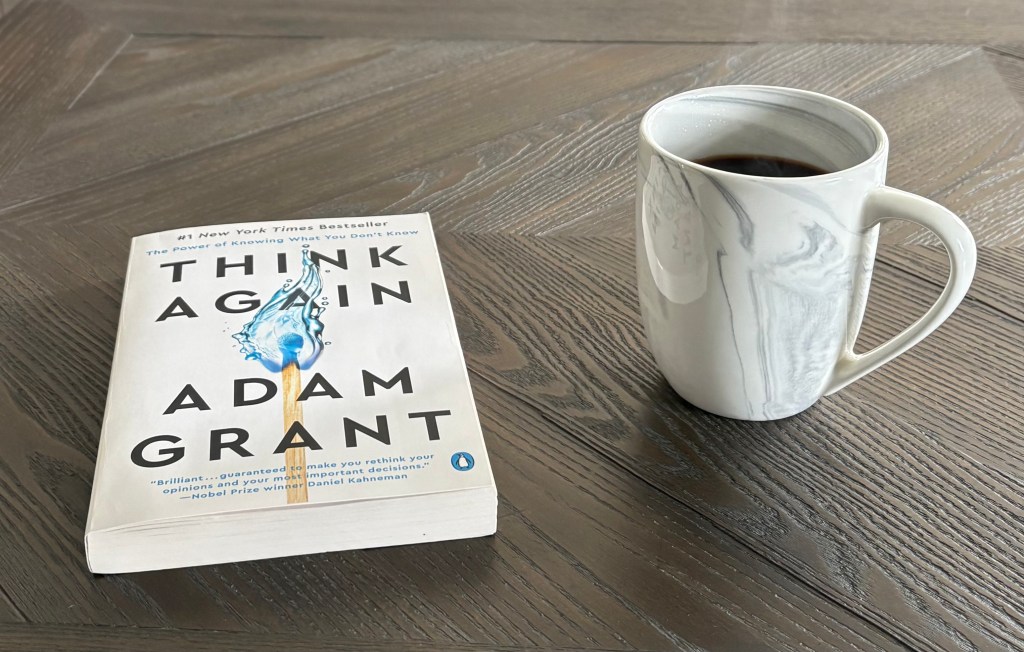
Think Again by Adam Grant was an interesting read, but I’m a bit on the fence, so to speak, about this book. It offered a lot of good insights about reframing the way we make decisions, but I think, at least for me, it came a little too late. The book was published in 2021, two years before my retirement, and most of the things the author discusses are areas I’m already knowledgeable about. Still, I learned a few things and managed to take a couple of pages of notes.
I really liked how he started the book. In the prologue, he said the following:
“Intelligence is traditionally viewed as the ability to think and learn. Yet… there’s another set of cognitive skills that might matter more: the ability to rethink and unlearn.” (p. 2)
The ability to rethink and unlearn is extremely important. We see it all the time, especially in our current political environment: people who are unwilling to rethink and unlearn the past and embark on a new and better direction for the benefit of all. Then, a couple of pages later, he said the following:
“Part of the problem is cognitive laziness… we often prefer the ease of hanging on to old views over the difficulty of grappling with new ones… Questioning ourselves makes the world more unpredictable. It requires us to admit that the facts may have changed, that what was once right may now be wrong. Reconsidering something we believe deeply can threaten our identity.” (p. 4)
Reading this immediately triggered thoughts about what is going on right now: forcing our will on others through bullying and even wars, trying to reverse women’s rights just because some men find it difficult to adapt to a new reality, cutting budgets and reducing manpower to save money while spending much more on armed conflicts and special interests. The list goes on, and much of this we have seen before. Those things didn’t work in the past, are not working now, and will not work in the future. Cognitive laziness is indeed part of the problem.
On pages 22–26, Grant introduces four types of mental modes, or ways people tend to think about situations. These are Preachers, Prosecutors, Politicians, and Scientists.
In preacher mode, “changing our minds is a mark of moral weakness.” This is probably debatable, but I’m okay with it as a general observation. In prosecutor mode, “allowing ourselves to be persuaded is admitting defeat.” In politician mode, “we flip-flop in response to carrots and sticks.”
Grant recommends that we think like scientists: “actively open-minded… searching for reasons why we might be wrong… and revising our views based on what we learn.” I tend to operate in this mode, and it seems that the older I get, the more I challenge what I know.
I liked what he said about lifelong learners: “A mark of lifelong learners is recognizing that they can learn something from everyone they meet.” (p. 54) It’s one of the reasons I love blogging. Every day I learn something new from reading other people’s blog posts.
In the chapter about the “Joy of Being Wrong,” Grant discusses an area of extreme importance in today’s world. He talks about the “dictator policing your thoughts” and goes on to say a few things, but I’m going to highlight two of them:
“The totalitarian ego, and its job is to keep out threatening information… the totalitarian ego steps in like a bodyguard for our minds, protecting our self-image by feeding us comforting lies.” (p. 59)
“The inner dictator manages to prevail by activating an overconfidence cycle. First, our wrong opinions are shielded in filter bubbles, where we feel pride when we see only information that supports our convictions. Then our beliefs are sealed in echo chambers, where we hear only from people who intensify and validate them.” (p. 61)
On page 74, Grant said something that I’m still thinking about, and I’m not sure I agree with 100%.
“When we find out we might be wrong, a standard defense is ‘I’m entitled to my opinion.’ I’d like to modify that: yes, we’re entitled to hold opinions inside our own heads. If we choose to express them out loud, though, I think it’s our responsibility to ground them in logic and facts, share our reasoning with others, and change our minds when better evidence emerges.” (p. 74)
I’m a firm believer that ordinary people are entitled to their opinions, and I think the listener is the one with the responsibility to assess those opinions based on current knowledge. Or perhaps the listener needs to do some homework to learn more about a particular subject. I think if every opinion needs to go through Grant’s standard, then only those with the skills to overpower others with their words will be able to express themselves.
Introverts like me operate differently. We like to listen, even if in our heads we are saying, “What in the world are you saying? That doesn’t make sense whatsoever,” while nodding so the speaker doesn’t feel bad. I say “ordinary people” because there are people who are expert debaters and present logic, facts, and reasoning for a living. Not every person has that capacity, and if we feel in our gut that something is morally wrong—even if a hundred people say it is not, and even if there is a possibility that we might be wrong—then we should still be able to express our opinion, even if we cannot completely articulate the reasons behind it.
Now, here is something that is spot on:
“Every time you encounter new information, you have a choice. You can attach your opinions to your identity and stand your ground… or you can operate more like a scientist… committed to the pursuit of truth—even if it means proving yourself wrong. The faster you are to recognize when you’re wrong, the faster you can move toward getting it right.” (p. 76)
While narrating an experience in a high school classroom where students were taught how to examine evidence, he provided some very good fact-checking guidelines:
“(1) interrogate information instead of simply consuming it, (2) reject rank and popularity as a proxy for reliability, and (3) understand that the sender of information is often not its source.” (p. 190)
Toward the end of the book, he said the following:
“It’s a mistake to follow traditions because the status quo is familiar. We’re better off questioning whether past routines are serving us well in the present and guiding us toward a better future.” (p. 222)
There is so much truth in that statement.
He concludes the book with 30 practical takeaways that can help us improve our rethinking skills. It’s a nice way to summarize the content of the book.
Something he said stayed with me. It’s really a question that, as he said, “we need to ask more often, both of ourselves and of others.” (p. 211)
“How do you know?”
Think Again was an excellent read that I think will benefit those starting a new leadership role or perhaps those struggling to understand the current political environment. It will help readers rethink choices and make better decisions in the future.
About the Author:
Adam Grant is an organizational psychologist and bestselling author who explores the science of character, connection, culture, and change. Adam received his B.A. from Harvard and his Ph.D. from the University of Michigan.
 Thoughts about leadership, history, and more
Kitap üzerine çok kapsamlı ve düşünceli bir değerlendirme olmuş. Özellikle “cognitive laziness” kavramını günümüz siyasi ve toplumsal ortamıyla ilişkilendirmeniz çok etkileyici. Grant’in “bilim insanı gibi düşünmek” önerisini kendi yaşam deneyiminizle bağdaştırmanız yazıyı daha da değerli kılmış. Katılmadığınız noktalara da yer vermeniz, eleştiriyi dengeli ve samimi hale getirmiş. Teşekkürler.
LikeLiked by 2 people
You’re welcome, and thank you (Teşekkürler) for reading and commenting. 🙏🏼
LikeLike
Love this review and this sounds like a great read! Your applications to how we see this defensiveness of our traditions and beliefs coming into play in the current politics of the U.S. is spot on and exactly why this skill of “thinking like a scientist” is so important. I’ll admit I’m just as likely to get defensive as the next person when coming face-to-face with something that goes against what I know to be right. But I try my best to be open, especially if the facts are there to prove me wrong!
I also really liked your point about the listener needing to be the one more accountable for researching and fact-checking. I do think that for people in positions of power or influence, we should ideally hold them to a higher standard for having some backing to what they say. But definitely for an everyday person just chatting with friends or family, it would be an immense pressure to have to research every opinion we have before expressing it.
I’ll be keeping some of these ideas in mind going forward for sure, thank you for sharing!
LikeLiked by 2 people
Thank you for your comment, Kimberly. I totally agree that people in positions of power or influence should be held to a higher standard. I also believe that we need to challenge everything they say if we believe the person is wrong. The problem is that most of the time they are not willing to listen and usually surround themselves with people aligned with their views so that they operate in a kind of echo chamber. That’s pretty much how politicians from both parties are operating and all we can do is listen, research, and vote accordingly. When I was in the Army, I always heard opposing views and there were deep discussions that in some cases changed my view and the particular course of action that I had previously approved. I didn’t get many opportunities when I did the same with people senior to me. As for family and friends, yes, listening is my default approach unless they ask me for advice.
LikeLiked by 1 person
Absolutely, despite that higher standard we hold them too it is still up to us to do our own research and not blindly believe what is said. I wish this was a skill more emphasized in education earlier on!! That’s really cool to hear about your experience in the Army! Hope more people can experience a space like that that exposes them to the value of an open, deep discussion.
LikeLiked by 1 person
I agree. That is the kind of skill that should be taught in school. Thank you for adding that piece, Kimberly.
LikeLiked by 1 person
Great review, I’ve read “Originals” and “Give and Take’, i need to read Think Again”, thanks for the review.
LikeLiked by 2 people
Thank you. Since you have previous experience with the author, you’ll definitely like this one.
LikeLike
I’ve not yet read this book of Grant’s, but enjoyed his The Power of Knowing What You Don’t Know. Thinking like a scientist. Looking for evidence that we are wrong, not right. Striving to keep our minds open and receptive. What a wonderful world it would be.
LikeLiked by 2 people
You’re right. It would be a wonderful world.
LikeLike
I haven’t seen a reference to Epistomology in any recent blog posts by anybody. It is the study of “the study of knowledge: what it is, how it is acquired, and what its limitations are.” (The quote comes from the Internet). Clearly, Mr. Grant finds this of great interest and importance.
I get the sense that the book’s author thinks that people who fold fast to information and beliefs that they should unlearn are not trying very hard for reasons he discounts.
Perhaps.
But my experience with clients in my clinical psychology practice suggests they are vulnerable if they dispense with incorrect, damaging beliefs. The investment in time, thought, trust, comfort, avoidance of whatever makes them feel insecure, who to vote for, who you should believe, and who your friends are can be enormous, especially in U.S. life today.
I will grant you that this social and intellectual and perhaps even religious area can be a sunk cost, but we are reminded by economics professors that many people tend to stick with bad investments longer than they should.
If I have misunderstood the writer, please correct me Edward. I am more than willing to unlearn what I have just written!
LikeLiked by 1 person
Thank you for your comment, Dr. Stein. You’re correct in your assessment, of course, based on your vast experience with your clients. I don’t think you can just unlearn something unless you are willing to look at the lessons learned and adjust your life accordingly. Most people don’t, for various reasons. The book is valuable for those who are willing to work on changing their behavior. It would be wonderful if more people did that, but that’s just not reality.
LikeLiked by 1 person
Test comment verification.
LikeLiked by 1 person
Wonderful post! I always enjoy discovering new reading perspectives. When I need a break between chapters, Slope Game at https://onlineslope.net/ is my go-to for quick entertainment. Keep sharing these great recommendations!
LikeLiked by 1 person
Thank you.
LikeLike
A very interesting book review. Thanks for sharing.
LikeLiked by 1 person
You’re very welcome, and thank you for reading.
LikeLiked by 1 person
Great review.
LikeLiked by 2 people
Thank you, Sumita. 🙏🏼
LikeLiked by 1 person
As someone who has not followed tradition in many parts of my life, it’s funny how negatively I reacted to the Adam Grant quotes about tradition. I agree that we must examine our lives and I do continually. I think that debating is overrated when culturally certain individuals have a larger degree of power and access to air time, people who look like Adam Grant. I’ve had people try to convince me to change the wrist I place my watch from the right to the left because tradition and not listen to a word I say about my preference (maybe this is an argument against tradition for tradition’s sake ; ) I agree that convention is not always preferable. But sometimes I tire of explaining why my spouse and I have different last names…
LikeLiked by 2 people
Thank you, Rebecca. Two quick comments. First, your comment about where you wear your watch reminded me of something I read years ago about how it is good to change wrists because it helps challenge the brain and keep it healthy. The same goes for switching the positions of your personal items, like where you place your toothpaste, toothbrush, etc. The brain gets used to the easy routine.
Second, the last names—oh my goodness, why people have problems with that is beyond me. I think last names should not change once you get married. It doesn’t make sense to me, but people can do whatever they want.
About what you said regarding debating, I agree with you, and that’s why I tend to listen more than I debate. Sometimes it is not worth the effort. I listen and come to my own conclusions. Now, I like to have conversations and express my opinion, but I don’t force my beliefs on anybody. We have free will, and we should live accordingly.
LikeLiked by 1 person
Thanks for your thought provoking response, Edward. I think travel is good for the brain because our routines get reorganized in new spaces. In the wristwatch conversation, I objected to the man’s attitude of a conversion, almost a religious one trying to get me to conform to common practice. In retrospect, I would have offered to switch wrists for my watch for one week as an experiment, as long as he did the same. ; ) As for last names, for at least 50 years in the US if women marry they have chosen either to keep their original surnames or take their spouse’s. But I get reactions as if I am the first person someone has met in their life whose last name differs from their spouse’s. For example, administrators, utility bill personnel, and dentists seem to think that a same last name is the only indicator of marriage. It may be easier for them if that is the case, but their database needs to be flexible enough to include family members with different last names without homogenization.
LikeLiked by 1 person
You’re welcome, my friend. Yeah, some people are just rude. I agree with you on the last name issue. With all the problems caused by the mandate, if approved, forcing divorced people to get new IDs just to match their birth certificates—I think more people are going to choose not to change their names when getting married.
LikeLiked by 1 person
Yes, good point. Ironic that I will be rewarded in that case and those who follow tradition may be punished with a lot of paperwork.
LikeLiked by 1 person
Crazy, right? I guess following tradition is not always good after all. By the way, I saw your email and the answer is yes. I’ll reply back later this afternoon.
LikeLiked by 1 person
So very ironic! That could alienate several generations of women. Cool, I look forward to your email.
LikeLiked by 1 person
Indeed.
LikeLiked by 1 person
I disagree with the part about scientists. Many scientists and other intellectuals are not open to new ideas because they feel threatened, don’t want to adapt to change, or don’t want to give up their own status. My personal beliefs come from what I’ve experienced in life. No politician or pseudointellectual is going to change my mind unless their ideas align with what I’ve experienced or personally witnessed. Ideas do not necessarily reflect reality. A lot of people live in a wishful thinking state of mind that is totally unrealistic.
LikeLiked by 1 person
Thank you, Dawn. That’s true for some scientists and intellectuals, but not all. Actually, the same applies to a lot of humans; after all, we are not perfect. There are always exceptions, and I have met some outstanding scientists and engineers who are doing some great work challenging current scientific thought and innovating.
LikeLike
Great review, Edward with practical advice of how to engage with our mind that likes to make decisions and stick to our opinions no matter what the cost. Anytime we can think again with the mind set of of a scientist or beginners mind we can challenge our own beliefs and see if they still fit. It’s not always easy but so important that we don’t get stuck in dogma for dogma sake-:) ❤️
LikeLiked by 2 people
Thank you, Cindy. That is so true. Getting stuck in dogma for dogma’s sake is not a smart way to live. We need to continue assessing and validating our beliefs to ensure we are on track. Happy Sunday, my friend!
LikeLiked by 1 person
Sounds a very timely book for many people. I often hear that since I left teaching thete is less critical thinking and of course how do we get to know more about how we know! Quaker advice – Think you might be mistaken’ ! Sounds a bit better than ‘you might be wrong’ or barking up the wrong tree’. Thanks for the detailed response of your review.
LikeLiked by 2 people
You’re welcome, and thank you for reading. We definitely have a problem with critical thinking that is getting worse as people get more addicted to their smart devices and social media. Somehow, we need to find a balance and find other forms of entertainment, such as reading, to improve our critical thinking skills.
LikeLiked by 1 person
Wow, if this isn’t relevant, I don’t know what is. I know something I succumbed to in my younger years, and that I see often, is the tendency to associate beliefs or opinions of *insert topic here* with their self-identity. If continuing to examine and evaluate a constant stream of information is a threat to how you define yourself, life is going to seem pretty threatening and scary. The good news, of course, is that it doesn’t have to be that way. Striving to best understand the truth, and to be accurate in ones thoughts is a great thing.
Interesting food for thought, Edward!
LikeLiked by 2 people
Thank you, Scott. You just touched on an important issue. Associating beliefs or opinions with self-identity might not be too bad if a person is still open to new ideas. But if those opinions become so ingrained, as is the case with so many people I know, it becomes extremely dangerous because they begin to act irrationally. I think part of the problem in this country is due to exactly that. Even in religion, a person needs to be careful not to fall into the trap of attaching their identity to only a few select teachings while ignoring other essentials, simply because those truths don’t align with their current worldview.
LikeLiked by 2 people
Very well put!
LikeLiked by 1 person
Oh my gosh – this is EXACTLY where my head is at in this moment – I am posting a similar but completely different revelation to this on Wednesday (I’ll include a link back here because Mr Grant is more articulate about my ideas than I am!) There is always a potential for a disconnect between what is said and what is heard – the speaker has some responsibility to be polite (but not necessarily less passionate), but the listener also has some responsibility to bring to the table open ears / eyes / heart… think, and think again, is a perfect way to put it – I’ve placed a request for this title at the local library – THANK YOU for the tip!! xx
LikeLiked by 2 people
You’re so welcome, Linda. I like what you said about “open ears, eyes, and heart,” it’s so true. We need to use all our senses when thinking and making decisions. It’s so good. I made a mental note to read your Wednesday post.
LikeLiked by 1 person
Great! I’m looking forward to reading the book myself – so much to read and so little time, but this one’s moving to the top of my pile! 🤩
LikeLiked by 1 person
Awesome!
LikeLiked by 1 person
Edward, thanks very much for this excellent review of Adam Grant’s book. I agree that “The ability to rethink and unlearn is extremely important.” I’m also a lifelong learner: It makes life more interesting.
Grant makes a crucial point when he notes: “It’s a mistake to follow traditions because the status quo is familiar. We’re better off questioning whether past routines are serving us well in the present and guiding us toward a better future.” This change in thinking is ever so critical for humanity to get off of fossil fuels and commit to using more sustainable forms of energy.
LikeLiked by 1 person
Thank you, Rosaliene. What a great point about fossil fuels and sustainable energy; it absolutely applies in that case. It’s interesting to see how Americans debate buying electric cars when fuel prices are up, yet switch to big SUVs and trucks when fuel is cheap. Some people refuse to change their way of thinking, even to their own detriment.
LikeLiked by 1 person
Often, we have to hit rock bottom before we change our ways.
LikeLiked by 1 person
That’s true.
LikeLiked by 1 person
Edward….love this! I read Grant’s book some time ago and saw a couple of interviews (I think he was a guest on Brene Brown’s podcast) and at the time, his thoughts about cognitive laziness stood out, but as you said so well, even more so just a few years later. I loved what you said here:
“The ability to rethink and unlearn is extremely important. We see it all the time, especially in our current political environment: people who are unwilling to rethink and unlearn the past and embark on a new and better direction for the benefit of all.”
I think that’s what’s missing for me these days. The inability of so many to see the damage being done, the inability to see what’s morally right. There’s a narrowmindedness that comes with aging and it’s scary to think about the future…and the disconnect between generations in power (and clinging to it) vs. doing the work, remaining open. And humble. Thanks for another gem of a review. Appreciate you! 💝
LikeLiked by 1 person
Thank you, Vicki. I share those exact same concerns. It seems like narrow mindedness is only getting worse. Just looking at the fights over gerrymandering these past few months is mind-boggling. Instead of having open, frank discussions about what needs to happen to improve the quality of life in their states, politicians are becoming cognitively lazy, and altering maps is simply the easier way out for them.
LikeLiked by 1 person
Totally with you and everything feels so sneaky and convoluted. Really chipping away at my trust levels and that’s one of my favorite virtues about myself, LOL — my tendency to be trusting. We could do a whole series on perceptions of “truth” and “honesty”! So much massaging of facts going on…just when I think it can’t get worse! Appreciate commiserating with you, Edward! 💝
LikeLiked by 1 person
“Massaging of facts,” totally! I always enjoy chatting with you, my friend, and I’ll see you soon, hopefully with book in hand. Have a wonderful weekend! 🫶🏼
LikeLike
Thank you, Edward! Feel the same! And yes….I hope a book is well on its way to you by now! 💝💝💝
LikeLiked by 1 person
You’re very welcome, and yes! 🙌🏼
LikeLiked by 1 person
💝😊💝
LikeLiked by 1 person
Hi Edward, this is an interesting sounding book. The comments you be posed are certainly food for thought. I think you snd he are thinking about the same type of person differently. You are both considering the loud and forceful personalities; you are saying they should listen to others with an open mind (they never do) and he’s saying they should be more socially responsible before they speak (they won’t because they believe they are right).
LikeLiked by 1 person
Thank you, Robbie. It was a great read. I believe everyone has an opinion and should be allowed to express it, even if they don’t have all the facts. As a listener, my job is to hear them out and assess the validity through my own investigation. In the U.S., we are often too quick to shut down others’ opinions, which causes a lot of problems. In a perfect world, people would stick strictly to facts, but in today’s environment, that is highly unlikely.
LikeLike
You are right, Edward. I have also seen this trend with shutting people down. I must remember to be patient with my dad and listen when he goes on 🤗💓
LikeLiked by 1 person
Oh yes, our parents, we definitely need to be patient with them. Hopefully, our kids do the same with us. 😀
LikeLike
🙏🌈
LikeLiked by 1 person
Another interesting review, Edward. And again, you do a great job of explaining the introvert’s position. Good stuff!
LikeLiked by 1 person
Thank you so much, Lori. 🙏🏼
LikeLiked by 1 person
Well, Mr. Grant seems true to his book title in that he has made several people “think again.” Thanks for this mindful review, Edward. I enjoyed your insights compared to the author’s.
Interesting. Long ago at a book store I met a woman who instantly drew my respect. In a brief conversation about a popular self-help book – and I don’t remember the preceding sentence, I exclaimed a rhetorical question, “Why would anybody believe something so absurd?” Her reply is something that I have realized and believed ever since – “Disagreeing with it would make them have to think. And people hate to think.”
The late Bob Proctor used to say similar things. He remarked that most of us are never taught to think. That it isn’t taught in school. I was astonished to realize that was true. He said true thinking is a deliberate, conscious process—not mere mental activity. (Maybe somewhere there are schools where people are taught to think, but I never encountered one.)
I like what Grant said about thinking like scientists. I’ve told junior writers at work about fact checking themselves, “Don’t try to prove yourself right. You can always find something online that agrees with you. Instead, try to prove yourself wrong.” Grant seems to think similarly in that regard.
And I very much like what you, Edward, said about people with skills to overpower others. I hope you’ve had a thriving Thursday. Hugs to you and yours.
LikeLiked by 1 person
Thank you so much, Teagan. What that woman said to you is so true. A lot of people hate to think, and they will accept anything at face value. I guess that’s why there are so many cults in this country and around the world. Following someone blindly is so dangerous.
I like to “argue” with books and news articles. It’s good to find points of disagreement with authors. You’re right, there are not a lot of classes that teach us to think. I guess philosophy students might be the exception. The Army has a lot of good training that makes you think under pressure, and I’m glad I attended a few of those.
I hope you have a wonderful weekend, my friend.
LikeLiked by 1 person
A thoughtful and engaging start to a review—clearly setting up a reflective take on learning, belief, and intellectual growth. 📚✨
LikeLiked by 1 person
Thank you very much. 🙏🏼
LikeLike
Really thoughtful review Edward
LikeLiked by 1 person
Thank you, Willie.
LikeLiked by 1 person
Hi Edward…
I had a really good time reading. Think again. I even got the audio version to listen to chapters again after reading. Many of the things you highlight in thia piece, were scribbled next to, in my hardcopy.
I lent it to my brother, and he and I have often discussed some of the things we agreed with or disagreed with. It did help me consider my approach to most topics. Critical thinking is such an important skill to develop.
It was an interesting read, very engaging. It was nice to see a blogger mention it.
LikeLiked by 1 person
Thank you, Nigel. I agree with you that critical thinking is important and must be cultivated. It’s so great that you are able to discuss the book with your brother; books are always good conversation starters.
LikeLiked by 1 person
They sure are. Every road trip we may listen to one. The Last we listened to and discussed was Mindset by Carol Dweck. Very interesting. We had to pause several times to discuss.
LikeLiked by 1 person
That’s very cool.
LikeLiked by 1 person
Isn’t it bizarre when you read a book and realize you already know all the things?? It’s like, “Heck, maybe I AM smart” I think, with my four college degrees and low self-esteem. I didn’t realize so many of us were inflexible until COVID 19 and the concept of being good to each other, protecting each other, turned into identity politics and conspiracy theories. I used to be a college English/Lit/Creative Writing professor, and one of my FAVORITE assignments was just to have students write a report. That’s it. No opinions. The textbook even had a chapter called “Just the Facts, Ma’am.” They struggled so hard! Every semester, I warned them, DO NOT PICK A TOPIC YOU LOVE! YOU WILL STRUGGLE. Invariably, they picked a topic they loved and struggled, lol. If someone wanted to argue that the drinking age should be lowered to 18 because at 18 you can smoke and fight in a war, but they inevitably arrived at a bunch of scientific articles about the pre-frontal cortex and brain damage, something they’d never considered. Thus, I would argue it’s less important for us to share our opinions than it is to talk about our findings and to remain curious and open. You don’t have to read about the science of alcohol and make a decision. You can simply be aware and use that info later.
LikeLiked by 1 person
I have been through so much leadership and management training during my time in the Army that I’m already familiar with most of his concepts. That isn’t a bad thing, though; it validates what I’ve learned.
Selfishness is a real thing, and many people are very protective of their personal space. I think COVID simply illuminated that aspect of humanity.
I completely agree with you that, during conversations, the most important thing is to share findings and observations openly so people can reach their own conclusions.
LikeLike
My learning is in the classroom, for the most part. I got an bachelor’s degree in English and didn’t know what to do with it. I was told I needed an MA, so I did that. Then I was told that in creative writing, which was my focus, I had to have an MFA because that was the terminal degree for the field. Haha, now there are PhDs in creative writing and an MFA means nothing. I pieced together professor work for eleven years before quitting, hitting the on/off button to reset myself, and doing another bachelor’s degree, this time in sign language interpreting, which has been amazing. So yeah, I know a lot of sh!t at this point.
LikeLiked by 1 person
My bachelor’s is in chemistry, and I know leadership is not taught at any level, so most chemists pursue an MBA to get the leadership training they will need to run pharmaceutical companies or other businesses.
LikeLiked by 1 person
Whaaat. Okay, where are all the science book reviews!? Chemistry is HARD.
LikeLiked by 1 person
Well, I have one on the history of chemistry on my reading list, so it’s coming.
LikeLiked by 1 person
“A mark of lifelong learners is recognizing that they can learn something from everyone they meet.” – so true. It is always interesting to listen to random people. Like you as an introvert, I listen and nod even if they are talking crazy.
LikeLiked by 1 person
Absolutely! There is often valuable information to be found amid the craziness. 😀
LikeLiked by 1 person
I can’t tell you the number of bad decisions I avoided making by listening carefully to an opposing view and saying, “Uh oh, I need to do a rethink on this.”
LikeLiked by 2 people
It’s amazing how helpful it is to take the time to listen to other people’s perspectives. Thank you, Liz.
LikeLiked by 1 person
You’re welcome, Edward.
LikeLiked by 1 person
Compelling
LikeLiked by 1 person
Thank you.
LikeLiked by 1 person
We like the notion ‘cognitive laziness’. We see that we quite often cognitive lazy and as more so as older we get.
The Fab Four of Cley
🙂 🙂 🙂 🙂
LikeLiked by 1 person
… that we are quite often … Sorry for the mistake.
LikeLiked by 1 person
Thank you, and you’re so right. As I get older, I’m fighting against cognitive laziness myself, trying to read about different subjects to break through some of my biases.
LikeLiked by 1 person
rethinking and relearning are very powerful moves, not everyone chooses to go there, and i wish that more would
LikeLiked by 1 person
I’m with you there. We’d be much better off if more people did that.
LikeLiked by 1 person
I like the idea of the first passage you mentioned—learning to evolve—and I am a keen advocate of perspective. Perspective changes everything. And often takes us into more meaningful directions that don’t necessarily comply with tradition. But that’s the key to evolution. A very interesting book and post, Edward! The focus on choice is so timely and relevant! Much enjoyed, my friend! Taking some of your notes with me for reflection. Infinite blessings and light your way, always! ✨🙏🍀🌞
LikeLiked by 1 person
You’re so right that perspective changes everything. Processing new information and reevaluating what we know helps us readjust to a more accurate one. Thank you, my friend, and I’m glad the information resonated with you. 🙏🏼
LikeLiked by 1 person
An insightful review that highlights the value of intellectual humility and the courage to rethink our assumptions. Your reflections beautifully capture how growth often begins when we remain open to learning, unlearning, and seeing things from new perspectives. In a world full of certainty and quick opinions, this message feels especially timely and important.👌
LikeLiked by 2 people
Thank you very much, John. 🙏🏼
LikeLiked by 1 person
You sure offered a great review here, Edward! There’s so much to learn about how we perceive the world, how we have been programmed by media, radio, TV, and movies, teachers, parents, etc. and the role of our own ego (mostly to protect ourselves). It’s a wonder that we can check our own biases at all!
I love to learn, and put myself in the role of scientist often. But I catch myself falling back into my conditioning too, and therefore, change my mind and edit my words—sometimes mid sentence! Ha!
I think this book offers a lot of food for thought! Thanks for the review!
p.s. speaking of politicians, most are lawyers. And that’s probably why we get so much double-speak from them. I love the Braver Angels group because they teach us how to respectfully debate issues with those across the political aisle. Of course our current legislators, and administration could learn a lot from them too!
LikeLiked by 1 person
Thank you, Sheila. It’s really hard to break away from the programming that we have been conditioned to follow for so long. It’s up to the individual to realize that, and rethink and unlearn—using the author’s words—our way of thinking. I agree with you that current legislators are not doing very well in that department. I have seen videos of that group and they are pretty good. We definitely need more civilized discussions.
LikeLike
This sounds like a book I would very much enjoy …. Edward! The more you write these fab reviews, the longer my “want to read” list grows. I’m pretty sure I won’t live long enough to read what I already have downloaded to my e-reader far less adding a new one every week or two, lol.
I also always enjoy that you share your own philosophical outlook related to these reads.
My favourite quote that you shared from the book:
“ … The faster you are to recognize when you’re wrong, the faster you can move toward getting it right.”
LikeLiked by 2 people
Thank you, Terry. I’m not going to post a book review next week, so there is a little break for you. 😀 The book is filled with memorable quotes, which I love. That particular quote is so good.
LikeLiked by 1 person
Thanks for your book review. I especially liked your comment, “Introverts like me operate differently. We like to listen, even if in our heads we are saying, “What in the world are you saying? That doesn’t make sense whatsoever,” while nodding so the speaker doesn’t feel bad.”
I’m an introvert too. I’m on a weekly zoom call, invited by a client of my husband’s, where we talk about global current events, politics and religion. I’m learning from people with different views, religions and locations around the nation. I’m the youngest in a group who are mostly men who had high powered careers and are retired. We’re all called on by our group leader to give opinions out loud.
As an introvert it’s been tough but I’m getting used to it. Also, I get good book recommendations each week and I’m learning about history and world events. It’s a smart group of people. The one I’m reading this week you might want to look at if you haven’t read it already: “Strength to Strength: Finding success, happiness and deep purpose in the second half of life” by Arthur C. Brooks. It’s nine chapters and I read one chapter a day.
LikeLiked by 2 people
You’re welcome, and what a great group learning opportunity! Those Zoom calls are difficult for us at the beginning, but they get better over time. I have heard of Arthur C. Brooks, but I haven’t read any of his books yet. I’m going to check him out; thank you for the recommendation.
LikeLiked by 2 people
Thanks. I read one chapter each PT or doctor’s appointment I’m driving my husband to post surgery. It works out well. I have two more days left of the book. The people in the group include neurosurgeons, lawyers, one had a seat on the CBE, and another ran a bond desk on Wall Street. At first I was really intimidated, but realized it’s opened up my world knowledge and they respect my opinion, too. I look at it as a chance to learn more about things I’m unfamiliar with. Plus, how many times do we get to discuss politics and religion these days and learn from others?
LikeLiked by 1 person
That’s pretty cool. Yes, any time we have the opportunity to discuss politics and religion in a civilized manner, it is well spent time.
LikeLiked by 2 people
I haven’t read this book so I love hearing your take on it. The four models are interesting — and the scientist reminds me of Neil deGrasse Tyson. His way of questioning everything is so good and when I heard him on a podcast a year or so ago, I remember thinking that our world would be so much better off if we all questioned things like he did.
Rethinking and unlearning – you have me considering where I need to do that. Thanks for the great quotes and ending question. Great review, my friend!
LikeLiked by 2 people
Thank you so much, my friend. I like Neil deGrasse Tyson; he is a quick thinker and explains science beautifully. I think we all have to rethink and unlearn a few things.
LikeLiked by 2 people
I think that as new information comes to light, we have to be able to examine the data without bias and make an informative decision. I know a lot of people who are stuck in their ways and have particular prescribing habits but if there’s something newer and better with less side effects, I’m more willing to try that out versus staying with the old status quo and accepting the minimum.
LikeLiked by 1 person
Absolutely! You just can’t grow if you’re stuck in that mindset.
LikeLiked by 1 person
I read this book a couple of years ago and thought it was a worthwhile read. A couple of things that stood out to me were:
– The discussion of confident humility…that you can be confident in your knowledge while being humble enough to recognize you can learn from others.
– His information on how to how have productive conversations with skeptics.
LikeLiked by 2 people
Thank you, Michelle, for the additions. Great discussion about that and how to find areas of agreement during arguments.
LikeLiked by 2 people
Thanks for sharing some of these quotes. In particular, I like the rethinking of intelligence as unlearning and relearning.
And opinions! Interesting conflict there between speaker and listener. Thanks for interpreting it and responding. I think we all have opinions, but they should be supported by evidence of some sort. You’re right that some folks struggle to manage that in a timely manner. People should respect that and allow for processing.
Appreciate the book rec!
LikeLiked by 2 people
You’re very welcome. I agree with you. In an ideal world, it would be wonderful for a person to have the space to give their opinion followed by their reasoning based on facts. But in today’s world, where politicians are experts at giving their opinions based on “alternative facts,” It’s up to the listener to receive someone’s opinion and assess its validity after some rigorous investigation. Thank you very much, Nick.
LikeLiked by 1 person
Amazing
LikeLiked by 1 person
Thank you.
LikeLiked by 1 person
You’re the most welcome dear Sir 💗
LikeLiked by 1 person
Sounds interesting Edward…I like the part about learning something new each day, it’s a great idea, even if it’s something small right?!
Yes our damn egos get in the way, get in our own way.
LikeLiked by 1 person
Absolutely! Lifelong learning is a beautiful thing, even in small doses.
LikeLiked by 1 person
You write a great review, Edward. You offer the information we are seeking as potential readers, and you’re honest about your perception and value of the book. This does sound like a good book. especially today, when no one listens to the other side.
LikeLiked by 4 people
Thank you, Mary. You’re spot on about the current climate. We really do need to listen to each other more. This book would be a great resource for anyone interested in personal growth.
LikeLiked by 3 people
The book seems full of practical advice about how we can stay open minded, explore new ideas, and keep learning. Thanks for the summary and reminders Edward.
LikeLiked by 2 people
You’re welcome, Brad. It’s full of great ideas; he’s a gifted storyteller who uses his narratives to explain these concepts really well.
LikeLiked by 2 people
“Part of the problem is cognitive laziness” Is our issue in the U.S. government cognitive laziness or simply cognitive issues? The average age of a U.S. Senator in the 119th Congress is 61. Senator Chuck Grassley is 91 years old, The President turns 80 in June.
LikeLiked by 3 people
Maybe both. You are so right about that. You can add Nancy Pelosi to the list. She is 86, though I think she is retiring. Also, Bernie Sanders, who is 83.
LikeLiked by 2 people
Sounds like a great pitch: Run for Congress- it’s the last job you’ll ever have.
LikeLiked by 5 people
Sad but true. I’m sure you heard about the congressman from Georgia who died last month. He was 80 and entered politics in the ’70s.
LikeLiked by 2 people
Interesting read,
LikeLiked by 1 person
Thank you very much. 🙏🏼
LikeLiked by 2 people