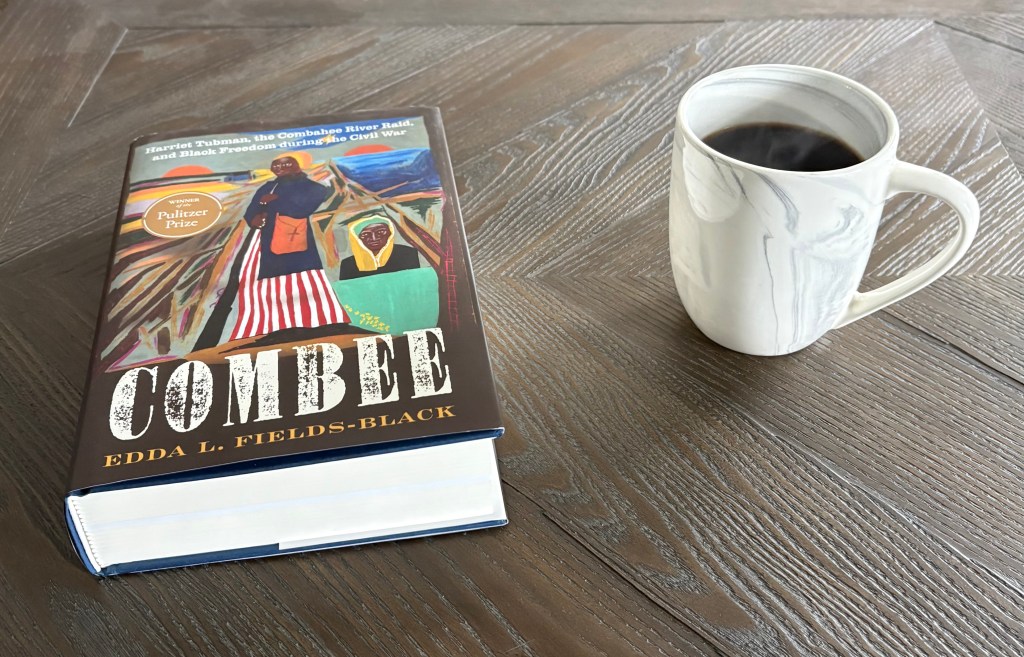
Last year, I attended the Printers Row Lit Fest, an annual book fair and literary festival held in Chicago. While there, I listened to Edda L. Fields-Black speak about her book Combee and her ancestors. It was a very powerful talk that led me to purchase the book.
Combee: Harriet Tubman, the Combahee River Raid, and Black Freedom during the Civil War was published in 2024 and won the 2025 Pulitzer Prize in History. The book, of course, is excellent. It recounts in detail the Combahee River Raid, a military operation conducted in June 1863 in South Carolina, during which Harriet Tubman and 300 African American soldiers rescued more than 750 enslaved people.1
“Combee” in the title reflects how the Combahee refugees identified themselves.
The book is divided into four parts, describing extensively how the transatlantic slave trade began, tracking slave ships, matching names of arrivals to slave owners, documenting enslaved family compositions, detailing how Harriet Tubman obtained her freedom, outlining the preparations for the Combahee River Raid, and examining other Civil War battles in South Carolina, as well as the aftermath.
The author did a magnificent job gathering information, and the level of detail is extraordinary. After all, the book is over 700 pages long, including an extensive notes section. To tell this story, the author reviewed evidence from prewar planters’ documents, military records, and postwar pension files, presenting a clear picture of the lives of enslaved people, particularly in the Lowcountry of South Carolina.
I think many people are aware of Harriet Tubman and her work with the Underground Railroad. There is even a 2019 film, Harriet, that tells her story. This book covers that part of her life, but it goes much deeper into the lives of enslaved people.
The book begins by narrating how the Ashanti Empire, one of West Africa’s most powerful kingdoms, sold people captured in interstate warfare to European traders at one of eighteen ports along the Gold Coast, in what is known today as Ghana (p. 8). A total of 2,000 captives were brought to Maryland in this way. Many more were transported to the colonies before, during, and after the American Revolution—even after it became illegal to transport captives from Africa (p. 9).
Regarding Araminta Ross, who is known today as Harriet Tubman, the author highlights her rebellious nature from an early age. “Minty,” as she was called by her family, resisted slavery from the start. The author writes:
“From an early age, Minty did not want to be forced to live and work in close proximity to white folks. Refusing to learn how to weave may have been Harriet Tubman’s first act of rebellion.” (p. 59)
In a sequence of events that set her on the path to becoming part of the Underground Railroad, the author narrates:
“Minty was hired by a young married woman known as Miss Susan to take care of her baby… Minty was so small that she had to sit on the floor to hold the baby… Young Minty was sometimes forced to sit up all night rocking Miss Susan’s fussy, hungry, and sometimes sick baby after cleaning the house all day. If the baby’s cries disturbed Miss Susan’s sleep, she whipped Minty… after Minty proved unwilling to learn a trade and unsuited for domestic work… Minty worked with male field hands breaking flax. One day she encountered an angry overseer… in pursuit of another field hand… Minty got caught in the middle and tried to block the overseer, who grabbed a two-pound iron weight from a scale and hurled it at her, striking her in the forehead and fracturing her skull… after a year or two, Minty did recover, well enough to work in the fields or in the house… however, Minty’s status as a ‘refuse slave’ provided an opportunity.” (pp. 60–61)
That opportunity was her ability to work and live independently. She offered to find her own work, pay her owner an annual fee from her earnings, and cover her own living expenses. Her owner accepted the offer, and by 1840, Harriet Tubman was earning wages similar to her male counterparts. She paid $60 per year for the privilege of working independently (p. 61).
Her refusal to accept slavery and its terrible conditions from an early age set her on a path to freedom. This part fascinated me because it shows how strong she was—she did not wait for freedom to be given to her; she fought for it.
The book describes her movement north, where she finally gained freedom, how she helped others continue their journey to Canada, and how she purchased land in Auburn, New York, where she built a house and retired after the war.
There are many details about the military actions during the Combahee River Raid and other Civil War battles, but I won’t highlight those here, even though the author brings unique perspectives on events in South Carolina and Georgia that are often overlooked in most Civil War history books. Instead, I will highlight a few other aspects I found particularly interesting.
The author emphasizes that even after gaining her freedom, Harriet Tubman was determined to help her family and others escape, despite the risk of being captured and returned to slavery. She and others were “willing to put it all on the line, risking their freedom and maybe even their very lives for the freedom of others” (p. 519). The author contrasts her actions with those of Frederick Douglass, who, while a powerful abolitionist, did not return to the Lowcountry to rescue others.
Harriet Tubman served as a spy and scout, providing timely intelligence to U.S. forces. After the conflict, she served as a nurse in the U.S. Army, working at a hospital in Fort Monroe, Virginia (p. 472).
At the end of her service, she received a pension of $20 per month—$12 for her service as a nurse and $8 as part of a widow’s pension. She was never compensated for her work as a spy and scout (pp. 506–507). However, she was inducted into the Military Intelligence Corps Hall of Fame in 2020, a great honor that highlights her contributions during the Combahee River Raid (p. 518).
One thing I learned from this book—and had not known before—was how the Combahee River Raid helped open the way for Lowcountry Creoles to become what are now known as the Gullah Geechee (p. 495).
“The Gullah Geechee people are descendants of Africans who were enslaved on the rice, indigo, and Sea Island cotton plantations of the lower Atlantic coast. Many came from the rice-growing region of West Africa. The nature of their enslavement on isolated island and coastal plantations created a unique culture with deep African retentions that are clearly visible in their distinctive arts, crafts, foodways, music, and language. Gullah Geechee is a unique creole language spoken in the coastal areas of North Carolina, South Carolina, Georgia, and Florida.”2
As I said at the beginning, this book is extensive and rich in detail. I got the sense that if this country ever decides to pay reparations, this book will be essential, as it codifies a significant amount of data needed to trace family lineage. This is a must-have book for anyone studying the American Civil War.
About the Author:
Dr. Edda L. Fields-Black is Professor in the Department of History and Director of the Dietrich College Humanities Center at Carnegie Mellon University. Her research specialty is the trans- national history of West African rice farmers, peasant farmers in pre-colonial Upper Guinea Coast and enslaved laborers on rice plantations in the antebellum South Carolina and Georgia Lowcountry. Throughout her career, Fields-Black has used interdisciplinary sources and methods to uncover the voices of historical actors in pre-colonial West Africa and the African Diaspora who did not author written sources.3
 Thoughts about leadership, history, and more
A personal and cultural reflection—recalling attendance at the Printers Row Lit Fest in Chicago and highlighting engagement with authors and literary conversations. 📚✨
LikeLiked by 2 people
Thank you.
LikeLike
Thanks for sharing! Looks like an interesting read.
LikeLiked by 1 person
You’re welcome, Dawn. It was a long read, but a great one.
LikeLike
This sounds quite the book for all the historical detail. I watched the film so think there would be so much of interest in this book bit yes, a lot of pages.
LikeLiked by 1 person
The movie is excellent, and yes, this book is long. I think it’s a great source for anyone who likes to dig into the details of the American Civil War, though it might be a bit dry for everyone else.
LikeLiked by 1 person
It’s shameful how, throughout history, we humans have enslaved people and treated them as less than human. This topic is important to contemplate, Edward.
LikeLiked by 2 people
You’re so right, Mary. Sadly, it seems like humans continue this shameful habit and can’t let go.
LikeLiked by 1 person
There is so much to say about your marvelous review, Edward, and many readers more eloquent than I have already commented. I just want to add that your inquisitive and caring mind benefits all of us in the way you choose a topic and delve into it and then graciously share it with your readers. Such an important topic! Thank you!
LikeLiked by 1 person
You’re so welcome, Lori. I really appreciate your kind words. It’s a pleasure to pass along what I’m learning. 🙏🏼
LikeLike
A wonderfully detailed review for such a poignant sounding book. An incredible story. I plan on watching on Netflix. I commend you on reading such a tome. 😁
LikeLiked by 2 people
Thank you so much! I hope you enjoy the movie. It was a long read, but I learned a great deal about that specific Civil War battle and other historical events in South Carolina.
LikeLiked by 1 person
No doubts, fascinating history. 🙂
LikeLiked by 1 person
I have just saved the movie Harriet for husband and I to watch on Amazon Prime for free. I am really looking forward to it and thank you for bringing this story to our attention.
LikeLiked by 1 person
You’re very welcome, Lana. I hope you enjoy the movie.
LikeLiked by 1 person
We really enjoyed it last night. Definitely worth a watch. The hand of God was surely upon her! Amazing faith.
LikeLiked by 1 person
Excellent! You’re absolutely right. God was with her. Thank you for the feedback, Lana. 🙏🏼
LikeLiked by 1 person
Great review, Edward. There aren’t many things I find more admirable than putting it all on the line for a cause one believes in. Taking that personal risk is an inspiring thing, and Tubman was nothing if not willing to hold up her end. Sounds like one I need to track down.
LikeLiked by 1 person
Thank you, Scott. This book is definitely in your lane, and I’m sure you are going to enjoy it.
LikeLiked by 1 person
Thanks for sharing! This sounds like an incredibly detailed book. Those are top-tier every time! I’ve been reading Civil War collections of letters and diaries. Those primary sources are wonderfully rich. I hadn’t heard of this military endeavor before, so thank you! Cheers!
LikeLiked by 1 person
You’re very welcome, Nick. This is also my first time reading the details on this particular battle, so I learned a lot from this book.
LikeLiked by 1 person
I truly admire your dedication to reading such historical books, Edward.
Many people may think about reading them, but very few have the patience and commitment to take on 700 pages. That kind of dedication is really impressive.🙏🏻
I’m also very impressed by all your posts. Every time I read one, I always come away learning something new.🙏🏻💛
LikeLiked by 2 people
Thank you very much. I really appreciate your kind words, and I’m glad that you find my posts informative.
LikeLiked by 1 person
🙏🏻💛
LikeLiked by 1 person
Wow – what a fantastic review of an important story. I love your note about Harriet Tubman, “This part fascinated me because it shows how strong she was—she did not wait for freedom to be given to her; she fought for it.” Her fortitude is amazing and it sounds like this book does a great job of highlighting that and detailing the greater situation and struggle. How fun that you found it at the LitFest!
Thanks for sharing this book and story, Edward!
LikeLiked by 3 people
Thank you so much, Wynne. The book is full of similar stories and how people used to keep personal records, such as marriage certificates, at their local convenience stores (a one stop shop for everything in those days) to avoid losing them. LitFest was awesome and I’m planning to go again this year.
LikeLiked by 2 people
Thank you, Edward, for your stellar review, and to Joe for his lengthy, but necessary and informative addition. I would add only that Faulkner still rings true, “The past is never dead. it isn’t even past. “
LikeLiked by 2 people
You’re very welcome, Dr. Stein. That quote absolutely still holds true. Our ability to learn lessons and adapt to change isn’t exactly our strongest suit, and the human trafficking statistics in this country are truly horrendous.
LikeLiked by 2 people
A most interesting book Edward, slavery , such a dark period in our history. Hard to imagine it still going on , heartbreaking. Thx you for introducing us to this book. Tubman was and is an unforgettable figure in our history and the present.
LikeLiked by 2 people
You’re very welcome. It’s incredible that this is still happening, even in the U.S., where sex trafficking remains such a major issue. She was a strong and extraordinary woman, for sure. Thank you for reading and commenting.
LikeLiked by 2 people
Major issue in UK too and is growing.
LikeLiked by 1 person
Terrible!
LikeLiked by 1 person
It’s a disturbing fact, what to do about. it!
LikeLiked by 1 person
I think we must continue to raise awareness and support the organizations directly helping victims.
LikeLiked by 1 person
Indeed, thank you for reminding us of this very urgent issue!
LikeLiked by 1 person
You’re so welcome.
LikeLiked by 1 person
Hi Edward, I do know some of Harriet Tubman’s story and I know about the selling of people as slaves by the African leaders. That is not a well known fact in Africa. I learned a great deal more from this post and the book sounds very informative.
LikeLiked by 1 person
Thank you very much, Robbie. I’m glad you found the post informative. Slavery remains a global issue, with reports of forced mining and women exploitation appearing in the headlines constantly. It’s a devastating reality of human nature, but I hope that we’ll see an end to it one day.
LikeLiked by 1 person
I agree that slavery has been with mankind for centuries. I’ve recently read about slaves taken by the Vikings. I’ve also read about Roman slavery.
LikeLiked by 1 person
Interesting! I knew about the Romans, but the Vikings, that’s new to me. I might need to learn more about that aspect.
LikeLiked by 1 person
It was new to me too. I thought the Vikings killed everyone but they didn’t. They also took slaves, especially women and children.
LikeLiked by 1 person
I love movies about Vikings. Now I need to rewatch a few of them and pay attention to that detail.
LikeLiked by 1 person
👍🏻
LikeLiked by 1 person
Slavery is such a big shadow of humanity’s history and a hard-to-digest topic, personally speaking. It’s like this issue doesn’t run on my system, no matter how hard I try to frame it—totally incomprehensible. So, this would be a heavy read for me, and I thank you, Edward, for your great review. I became slightly acquainted with the book without having to dive into the depths of suffering and injustice. I found it interesting that Minty’s accident ended up being a door of opportunity to change. Sometimes what seems a disgrace may just be the driver to sunnier places. Life has its mysterious ways and is not unaware of our stories. An important post, as ever, my friend. Light and blessings your way 🙏✨🍀🌞
LikeLiked by 3 people
I completely agree with you. It’s incomprehensible, and sadly, we continue to witness it; child and forced labor are common in the mining industry, and women are exploited against their will. A real tragedy. Minty’s tragedy is a reminder that we need to keep up our awareness because we don’t know when an opportunity for a better life will come. Thank you for your insightful comment, my friend. 🙏🏼
LikeLiked by 1 person
This is a wonderful review, Edward. Since many of your comments mention the ‘need’ for a college course, I thought I’d offer up a resource I recently discovered myself. I am not Southern, but am currently living in South Carolina, (about 1.5-2 hours away from Columbia), so the following link is even more relevant to your book review. I encourage you to peruse this site: https://www.scpronet.com/modjeskaschool/ . As an outsider, I am humbled by the valiant efforts of individuals, such as Modjeska Simkins, who kept this history alive – even if underground by necessity – and who actively initiated change within & without the system. The Modjeska Simkins school was launched a mere 11 years ago…but then SC just took down their Confederate Flag at the Capitol a mere 11 years ago, too.
LikeLiked by 2 people
Thank you very much. I checked the website and they have an excellent program. I’m going to look into it further to see what other offerings they have. I appreciate you sharing the link.
LikeLiked by 1 person
You’re more than welcome. I’m thrilled to have introduced you to this. Don’t overlook the info under the resources tab…it’s quite meaty.
LikeLiked by 1 person
Absolutely! I started reading the booklets. A lot of great information.
LikeLiked by 1 person
So interesting! I learned a lot about her from your piece. Thanks!
LikeLiked by 2 people
You’re so welcome, Donna. I’m glad you enjoyed the review.
LikeLiked by 1 person
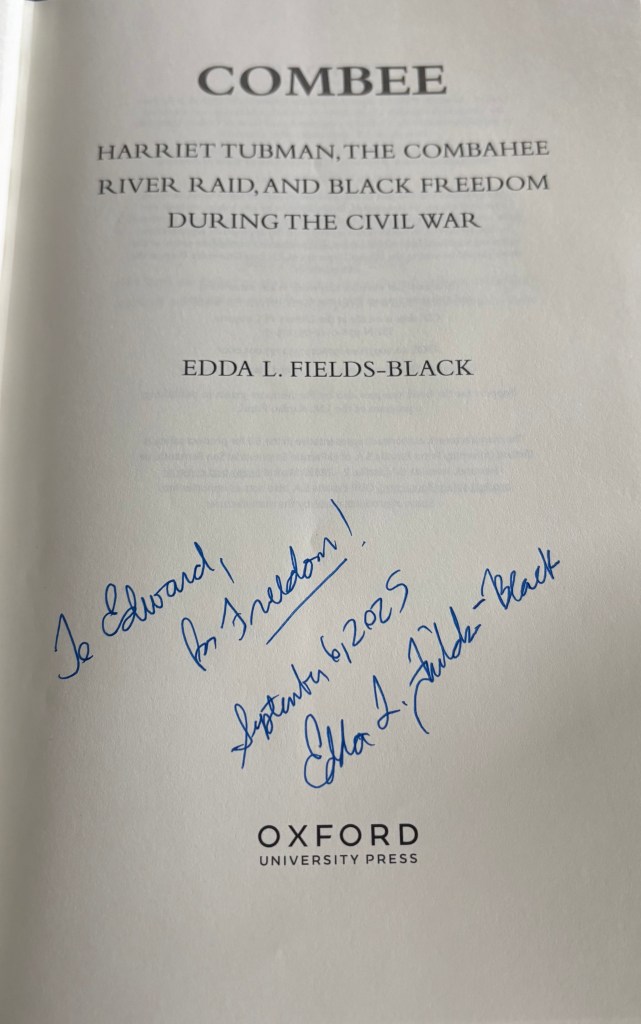
You wrote a wonderful review of this book, Edward. Harriet Tubman is a real inspiration in her strength and her ability to bring so many people to freedom. I like that you suggest this book be read by anyone studying the American Civil War. The author, Dr. Edda L. Fields-Black, is a professor… I wonder if there’s a way to get her well-researched book into college history classes in bite-size chunks. Or maybe dedicate a course to her research and this book. It seems like such an excellent book and it should be shared properly. I love the way she signed her book to you, “In Freedom”.
LikeLiked by 1 person
I know, I love how she signed it also. It’s meaningful since she talks about her descendants in the book. I can definitely see a college class using this book as a textbook. According to what she explained during the talk and included in her bio, her specialty is the history of West African rice farmers, the pre-colonial Upper Guinea Coast, and enslaved laborers on rice plantations in South Carolina and Georgia. I’m sure she has students in her graduate program studying and researching this topic. She discusses the rice plantations in detail, which was all new to me since the focus is usually on cotton. Thank you, Rose.
LikeLiked by 1 person
Oh my goodness. On my reading list. Thank you, Edward. My writers group enjoyed a visit from Scott Ellsworth recently – his new book “Midnight on the Potomac” is soooo good and it’s sent my interest in the Civil War soaring again. I’ve been wondering what I’ll read next…and here you are — answering the question! Thank you, thank you, thank you! ❤️😊❤️
LikeLiked by 1 person
You’re very welcome, my friend. Midnight on the Potomac looks interesting, so I’m adding it to my list. I’m always looking for new material about the Civil War. Bruce Catton wrote a trilogy (Mr. Lincoln’s Army, Glory Road, and A Stillness at Appomattox) that is really good.
LikeLiked by 1 person
Ohhh…thank you! Let me know what you think about “Midnight…”….puts a whole new spin on John Wilkes Booth! But that’s all I’m gonna say! 😜
LikeLiked by 1 person
Awesome! I would probably read it first thing next year because I have a pile that I still need to work through and, of course, I’m waiting for the arrival of Slivers to read it right away. 😉
LikeLiked by 1 person
I’m smiling….I’m not sure you should sideline important books in your TBR pile for Slivers…but know that I’m super-duper grateful! 😊😊😊
LikeLiked by 1 person
My friend, your book is important and has been holding a place on my list since you mentioned it last year. By the way, Surviving Sue is two books to the left of Susan Cain’s Quiet. 🫶🏼
LikeLiked by 1 person
Ohhhh….you know I LOVE the sound of that. I think it was one of our first conversations about books we love — “Quiet” for sure! So good. Thanks for all the kindnesses, Edward! ❤️😉❤️
LikeLiked by 1 person
You’re probably right. It’s my favorite, and it helped me so much. You’re so welcome, my friend.
LikeLiked by 1 person
❤️😉❤️
LikeLiked by 1 person
Ohhhh! Just heard! Slivers pre-orders ship on Monday! Yay! 😉❤️😉
LikeLiked by 1 person
Yes!!!🕺🏻🙌🏼
LikeLiked by 1 person
I wonder how long it took her to write the book. Let alone do all the research!
LikeLiked by 1 person
Great question, JT. I know she mentioned it in the book, so I went back and looked it up. She did a lot of research for her doctoral degree (2001), and according to the acknowledgments section, she was diagnosed with breast cancer at the end of December 2016. She decided to start writing the book at that time, so it took quite a while and she wrote through some difficult times. She has been cancer free since 2022.
LikeLike
I love books that have great detail, including notes that provide context for what was common at the time, or convert money, etc. However, I cannot STAND endnotes. Please give me footnotes, or better yet, the rare sidenote. In regards to more information about how the slave trade continued after it was illegal, anything about Cudjo Lewis is excellent. Zora Neale Hurston, known for her fiction, profiled him as part of her anthropology work. Sylviane A. Diouf also wrote about him. He was the last slave brought in to the U.S. from the transatlantic slave trade. Now, the nickname Minty sounds perfect for Tubman because it sounds so innocuous but packs a punch! The words “unwilling” and “unsuited” in the quote made me laugh because I could just see such a stubborn child, and that makes my heart happy. Children weren’t born to be controlled. I mean, understand I don’t want children to be stubborn about safety or good health or being kind, but a kid who is determined always makes me feel a little proud of their tenacity.
LikeLiked by 2 people
This one has an extensive notes section and appendices showing logs describing owners and the names of the enslaved people under their purview. There is a lot of incredible data here. I don’t mind the occasional footnote, but I’m with you, extensive footnotes are annoying. I had the same reaction when I read that part about her childhood. She’s the perfect example of a strong-willed child.
LikeLiked by 1 person
Kudos on this review and the intriguing book selection, Edward. I get so much more out of history when it’s told as a story, and that appears to be the way of this book. I really like that you included the photo of the signed page. 🤗 Hugs.
LikeLiked by 2 people
Thank you so much, Teagan. The author did an amazing job of showing readers the human side of the enslaved people. Through her research, she was able to identify many of those brought into the United States by name and place of origin. That aspect of her work was fascinating.
LikeLike
wow, this sounds amazing, i’d love to read it –
LikeLiked by 1 person
It was long, but I enjoyed it and learned a lot.
LikeLiked by 1 person
The movie Harriet was well done and inspiring. Thanks to your great review, Edward, I might take a look at this 700 page book if I ever finish Texas by James Michener. My Kindle edition of Texas is 1430 pages, so it’ll be a while.
LikeLiked by 2 people
1430 pages? Wow, that’s a lot. But if you enjoy American Civil War history and stories about the freedom fighters, then you’ll definitely like this book. Thank you, Terry.
LikeLiked by 1 person
An insightful and well-articulated review. Your discussion effectively underscores the historical significance of the Combahee River Raid and Harriet Tubman’s broader role in the struggle for Black freedom during the Civil War. I particularly appreciated the emphasis on recovering overlooked histories and restoring visibility to the lives and experiences of those often absent from mainstream narratives. A thoughtful analysis that highlights both the scholarly depth and contemporary relevance of the work.👌
LikeLiked by 2 people
Thank you, John. I always appreciate your comments. 🙏🏼
LikeLike
fabulous post! hooray for people like this: “she did not wait for freedom to be given to her; she fought for it.” Thank you for reading all those pages for us! (Reading the comments, others have highlighted some of the overlaps with ’12 years a slave’ – such a harrowing time in history).
LikeLiked by 2 people
Thank you, Linda. It was horrible, but the worst part is that slavery is still happening today. I’ve read some truly awful stories about people being forced to work in mines, including children, and about women being exploited in the sex trade. The human capacity to inflict such atrocities is incredibly sad.
LikeLiked by 1 person
It’s the cruelty of a few who affect so many…
LikeLiked by 1 person
So true, my friend.
LikeLiked by 1 person
Slavery is probably one of the oldest crimes against humanity. The ‘free’ citizens of Athens (30 or 40,000 if I recall?) ‘managed’ because they had more than 100,000 slaves…
LikeLiked by 3 people
Absolutely! Civilizations were built on their backs. A really sad commentary on humanity, and worst of all, some of those atrocities were blessed by the Church from the very beginning.
LikeLiked by 1 person
Very good point Edward. Civilisations were built on the backs of slaves. And indeed, the Church(es) turned a blind eye.
(Nada que ver, algunos te llaman ‘Lalo’) (Un amigo de muchos años se llama Eduardo, pero todo el mundo le dice Lalo.)
Saludos.
LikeLiked by 1 person
“Lalo”, interesante. Fíjate, mi mamá me llamaba “Pocho” cuando yo era pequeño, pero todo el mundo me conoce como Edward o Ed.
LikeLiked by 1 person
Lalo es muy Mexicano. Pocho suena muy lindo.
Ed or Edward it will be then.
Cuídate.
LikeLiked by 1 person
Gracias, y cuídate también.
LikeLiked by 1 person
🤗
LikeLiked by 1 person
I love the dedication ~ “In freedom!”
LikeLiked by 2 people
I know, she nailed it. Thank you, Ana.
LikeLiked by 1 person
The Myth Breaks, the Signal Remains
By Joe Cozart
A very special thanks to Ed Ortiz for creating and writing this inspiring book review! Sadly and valiantly I wept while writing this …
There is a temptation to read a work like Combee: Harriet Tubman, the Combahee River Raid, and Black Freedom during the Civil War as a historical correction—a filling in of gaps, an overdue expansion of the record. That reading is too small. What the book actually does is destabilize a convenient national myth while simultaneously offering something far more structurally durable in its place.
The destabilization is straightforward. The American story, as it is commonly told, leans heavily on inevitability—progress as a kind of moral gravity pulling the nation toward freedom. In that framing, figures like Harriet Tubman become symbols rather than operators. Their lives are softened into inspiration, their actions abstracted into legend. What this work does—through its density, its documentation, its refusal to compress—is strip away that abstraction. It shows that freedom, in this context, was not inevitable, not broadly granted, and not systemically supported. It was engineered, often at the edge of annihilation, by individuals operating without institutional protection.
That is where the sense of something being “crushed” emerges. The myth of passive progress cannot survive contact with this level of detail. The idea that the system naturally corrected itself collapses when confronted with the reality that individuals like Tubman had to function as scout, spy, logistician, and liberator inside an active war zone simply to force outcomes the system resisted. The fact that she was never compensated for her intelligence work is not a footnote—it is structural evidence. It reveals a system capable of using extraordinary human capability without recognizing or rewarding it. That realization erodes confidence in the moral coherence of the historical system.
And yet, paradoxically, this is where the revitalization of hope begins.
Because once the illusion of systemic benevolence is removed, what remains is something more credible: agency. Not abstract, not symbolic, but operational. The Combahee River Raid is not merely a story of liberation; it is a demonstration of coordinated intelligence, timing, risk tolerance, and execution. It shows that even within constrained and hostile systems, decisive actors can alter outcomes materially and immediately. Over 750 people were not “eventually freed” by the arc of history—they were extracted because someone designed and executed a plan under pressure.
That distinction matters. It replaces passive hope with active possibility.
The deeper layer, which the review touches on but does not fully extend, is that this work reframes leadership itself. Leadership here is not positional. It is not validated by rank, title, or compensation. It is defined by the ability to perceive what must be done, assemble the necessary conditions, and act despite systemic indifference or resistance. Tubman’s contrast with Frederick Douglass is particularly instructive—not as a moral judgment, but as a structural distinction between influence and execution. One shapes narrative; the other alters reality on the ground.
Both matter. But only one produces immediate liberation.
There is also a quieter but equally important implication embedded in the discussion of the Gullah Geechee. The preservation and evolution of that culture is not simply an anthropological outcome; it is a downstream effect of specific operational decisions—movements of people, disruptions of control systems, openings created by military action. Culture, in this sense, is not static heritage. It is the residue of strategic events.
That recognition expands the significance of the raid beyond its immediate humanitarian impact. It becomes a generative moment—one that reshapes identity, language, and continuity across generations.
So the emotional duality you’re pointing to—collapse and renewal—is not accidental. It is structural. The collapse occurs at the level of narrative comfort; the renewal occurs at the level of operational truth. When the myth falls away, what remains is not emptiness but clarity: systems do not correct themselves without pressure, and individuals—properly aligned, properly positioned—can exert that pressure in ways that scale beyond their apparent power.
If there is a single conclusion worth carrying forward, it is this: the book does not argue that the American spirit is broken. It argues that it has been misidentified. It does not reside in the system’s self-conception. It resides in the individuals who, when confronted with the system’s limits, choose to act anyway—and in doing so, redefine what the system must eventually become.
——— GMJoe™ ——— Clarity. Strategy. Sovereignty.
Books by Joe Cozart, published by GMJoe Consulting, are available on Amazon at: amazon.com/author/joecozart (http://amazon.com/author/joecozart)
——— GMJoe™ ——— https://www.amazon.com/author/joecozart
Joe Cozart GMJoe™ Consulting Clarity. Strategy. Sovereignty. Author, Consultant, Writer Mobile: (701) 885-2684 Email: joe@gmjoe.org
Website: https//:GMJoe.org
>
LikeLiked by 3 people
Thank you, Joe, for this profound comment. There’s really not much to add, and I’m in complete agreement with your conclusion: “The American spirit… resides in the individuals who, when confronted with the system’s limits, choose to act anyway—and, in doing so, redefine what the system must eventually become.”
LikeLiked by 1 person
Thank you for the brilliant narration. I always enjoy reading your book reviews.
LikeLiked by 1 person
You’re very welcome.
LikeLiked by 1 person
Thank you for the review, Edward. This sounds like a fascinating (and important!) book.
LikeLiked by 2 people
You’re welcome, Liz. It definitely is. I briefly highlighted the pension that Harriet Tubman received, but the author also described the process other families went through to obtain theirs for their service during the Civil War, and it was painful. The aspect of pensions was new to me.
LikeLiked by 1 person
What a wonderful book, Edward with such amazing history giving credence to such an important time. What an amazing story of one woman’s resilience and perseverance in the face such horrific times and what a well deserved honor that she was inducted into the Military Intelligence Corps Hall of Fame in 2020, a great honor that highlights her contributions during the Combahee River Raid! Thanks for condensing this humungous book for us. Fun to get a signed copy too❣️
LikeLiked by 2 people
Thank you, Cindy. I love history and I really enjoyed reading this book, but it’s definitely humongous, so it was my pleasure to highlight a handful of things for the community. It was nice to get a signed copy from this Pulitzer Prize winner.
LikeLiked by 1 person
You’re os very welcome. It’s so awesome you enjoyed it so much and you took one for the team😘 Yes, that was very cool for sure❣️
LikeLiked by 1 person
I learned a little about Harriet Tubman in school, but this sounds like a rich and detailed account of a dark part of our country’s history. 700 pages is more than I want to tackle. Kudos to your dedication Edward.
LikeLiked by 3 people
Thank you, Brad. It’s a big book, and I still have two more big ones to go this year. The level of detail was impressive, especially given that the main focus was on events that occurred in South Carolina. Some of the accounts were pretty tough to read, but sometimes it is good to read them and bring to light some of the things that happened during that dark part of our history.
LikeLiked by 1 person
Sounds interesting but 700 pages is daunting!
LikeLiked by 2 people
Agree. History is an awesome subject, but most books are lengthyyy!
LikeLiked by 2 people
One of my all time faves is Twelve Years a Slave so I might like this one too! Although it’s obviously quite different.
LikeLiked by 2 people
I saw the movie, and it was really good. This book is a little dry, like most history books are. I think Twelve Years a Slave is a memoir, which is much better to read. I definitely prefer to read memoirs and biographies over history books.
LikeLiked by 1 person
Oh okay yes, makes sense.
LikeLiked by 1 person