“The purpose of learning isn’t to affirm our beliefs; it’s to evolve our beliefs.” (p. 26)
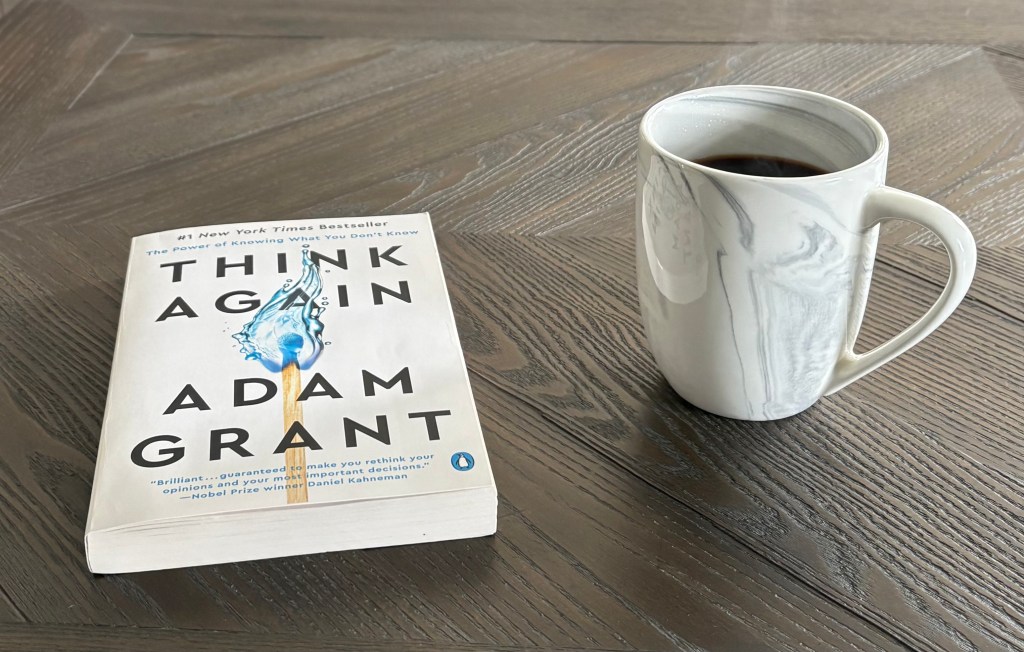
Think Again by Adam Grant was an interesting read, but I’m a bit on the fence, so to speak, about this book. It offered a lot of good insights about reframing the way we make decisions, but I think, at least for me, it came a little too late. The book was published in 2021, two years before my retirement, and most of the things the author discusses are areas I’m already knowledgeable about. Still, I learned a few things and managed to take a couple of pages of notes.
I really liked how he started the book. In the prologue, he said the following:
“Intelligence is traditionally viewed as the ability to think and learn. Yet… there’s another set of cognitive skills that might matter more: the ability to rethink and unlearn.” (p. 2)
The ability to rethink and unlearn is extremely important. We see it all the time, especially in our current political environment: people who are unwilling to rethink and unlearn the past and embark on a new and better direction for the benefit of all. Then, a couple of pages later, he said the following:
“Part of the problem is cognitive laziness… we often prefer the ease of hanging on to old views over the difficulty of grappling with new ones… Questioning ourselves makes the world more unpredictable. It requires us to admit that the facts may have changed, that what was once right may now be wrong. Reconsidering something we believe deeply can threaten our identity.” (p. 4)
Reading this immediately triggered thoughts about what is going on right now: forcing our will on others through bullying and even wars, trying to reverse women’s rights just because some men find it difficult to adapt to a new reality, cutting budgets and reducing manpower to save money while spending much more on armed conflicts and special interests. The list goes on, and much of this we have seen before. Those things didn’t work in the past, are not working now, and will not work in the future. Cognitive laziness is indeed part of the problem.
On pages 22–26, Grant introduces four types of mental modes, or ways people tend to think about situations. These are Preachers, Prosecutors, Politicians, and Scientists.
In preacher mode, “changing our minds is a mark of moral weakness.” This is probably debatable, but I’m okay with it as a general observation. In prosecutor mode, “allowing ourselves to be persuaded is admitting defeat.” In politician mode, “we flip-flop in response to carrots and sticks.”
Grant recommends that we think like scientists: “actively open-minded… searching for reasons why we might be wrong… and revising our views based on what we learn.” I tend to operate in this mode, and it seems that the older I get, the more I challenge what I know.
I liked what he said about lifelong learners: “A mark of lifelong learners is recognizing that they can learn something from everyone they meet.” (p. 54) It’s one of the reasons I love blogging. Every day I learn something new from reading other people’s blog posts.
In the chapter about the “Joy of Being Wrong,” Grant discusses an area of extreme importance in today’s world. He talks about the “dictator policing your thoughts” and goes on to say a few things, but I’m going to highlight two of them:
“The totalitarian ego, and its job is to keep out threatening information… the totalitarian ego steps in like a bodyguard for our minds, protecting our self-image by feeding us comforting lies.” (p. 59)
“The inner dictator manages to prevail by activating an overconfidence cycle. First, our wrong opinions are shielded in filter bubbles, where we feel pride when we see only information that supports our convictions. Then our beliefs are sealed in echo chambers, where we hear only from people who intensify and validate them.” (p. 61)
On page 74, Grant said something that I’m still thinking about, and I’m not sure I agree with 100%.
“When we find out we might be wrong, a standard defense is ‘I’m entitled to my opinion.’ I’d like to modify that: yes, we’re entitled to hold opinions inside our own heads. If we choose to express them out loud, though, I think it’s our responsibility to ground them in logic and facts, share our reasoning with others, and change our minds when better evidence emerges.” (p. 74)
I’m a firm believer that ordinary people are entitled to their opinions, and I think the listener is the one with the responsibility to assess those opinions based on current knowledge. Or perhaps the listener needs to do some homework to learn more about a particular subject. I think if every opinion needs to go through Grant’s standard, then only those with the skills to overpower others with their words will be able to express themselves.
Introverts like me operate differently. We like to listen, even if in our heads we are saying, “What in the world are you saying? That doesn’t make sense whatsoever,” while nodding so the speaker doesn’t feel bad. I say “ordinary people” because there are people who are expert debaters and present logic, facts, and reasoning for a living. Not every person has that capacity, and if we feel in our gut that something is morally wrong—even if a hundred people say it is not, and even if there is a possibility that we might be wrong—then we should still be able to express our opinion, even if we cannot completely articulate the reasons behind it.
Now, here is something that is spot on:
“Every time you encounter new information, you have a choice. You can attach your opinions to your identity and stand your ground… or you can operate more like a scientist… committed to the pursuit of truth—even if it means proving yourself wrong. The faster you are to recognize when you’re wrong, the faster you can move toward getting it right.” (p. 76)
While narrating an experience in a high school classroom where students were taught how to examine evidence, he provided some very good fact-checking guidelines:
“(1) interrogate information instead of simply consuming it, (2) reject rank and popularity as a proxy for reliability, and (3) understand that the sender of information is often not its source.” (p. 190)
Toward the end of the book, he said the following:
“It’s a mistake to follow traditions because the status quo is familiar. We’re better off questioning whether past routines are serving us well in the present and guiding us toward a better future.” (p. 222)
There is so much truth in that statement.
He concludes the book with 30 practical takeaways that can help us improve our rethinking skills. It’s a nice way to summarize the content of the book.
Something he said stayed with me. It’s really a question that, as he said, “we need to ask more often, both of ourselves and of others.” (p. 211)
“How do you know?”
Think Again was an excellent read that I think will benefit those starting a new leadership role or perhaps those struggling to understand the current political environment. It will help readers rethink choices and make better decisions in the future.
About the Author:
Adam Grant is an organizational psychologist and bestselling author who explores the science of character, connection, culture, and change. Adam received his B.A. from Harvard and his Ph.D. from the University of Michigan.
 Thoughts about leadership, history, and more
Thanks for sharing some of these quotes. In particular, I like the rethinking of intelligence as unlearning and relearning.
And opinions! Interesting conflict there between speaker and listener. Thanks for interpreting it and responding. I think we all have opinions, but they should be supported by evidence of some sort. You’re right that some folks struggle to manage that in a timely manner. People should respect that and allow for processing.
Appreciate the book rec!
LikeLiked by 1 person
You’re very welcome. I agree with you. In an ideal world, it would be wonderful for a person to have the space to give their opinion followed by their reasoning based on facts. But in today’s world, where politicians are experts at giving their opinions based on “alternative facts,” It’s up to the listener to receive someone’s opinion and assess its validity after some rigorous investigation. Thank you very much, Nick.
LikeLiked by 1 person
Amazing
LikeLiked by 1 person
Thank you.
LikeLiked by 1 person
You’re the most welcome dear Sir 💗
LikeLiked by 1 person
Sounds interesting Edward…I like the part about learning something new each day, it’s a great idea, even if it’s something small right?!
Yes our damn egos get in the way, get in our own way.
LikeLiked by 1 person
Absolutely! Lifelong learning is a beautiful thing, even in small doses.
LikeLiked by 1 person
You write a great review, Edward. You offer the information we are seeking as potential readers, and you’re honest about your perception and value of the book. This does sound like a good book. especially today, when no one listens to the other side.
LikeLiked by 2 people
Thank you, Mary. You’re spot on about the current climate. We really do need to listen to each other more. This book would be a great resource for anyone interested in personal growth.
LikeLiked by 1 person
The book seems full of practical advice about how we can stay open minded, explore new ideas, and keep learning. Thanks for the summary and reminders Edward.
LikeLiked by 2 people
You’re welcome, Brad. It’s full of great ideas; he’s a gifted storyteller who uses his narratives to explain these concepts really well.
LikeLiked by 2 people
“Part of the problem is cognitive laziness” Is our issue in the U.S. government cognitive laziness or simply cognitive issues? The average age of a U.S. Senator in the 119th Congress is 61. Senator Chuck Grassley is 91 years old, The President turns 80 in June.
LikeLiked by 2 people
Maybe both. You are so right about that. You can add Nancy Pelosi to the list. She is 86, though I think she is retiring. Also, Bernie Sanders, who is 83.
LikeLiked by 1 person
Sounds like a great pitch: Run for Congress- it’s the last job you’ll ever have.
LikeLiked by 3 people
Sad but true. I’m sure you heard about the congressman from Georgia who died last month. He was 80 and entered politics in the ’70s.
LikeLiked by 1 person
Interesting read,
LikeLiked by 1 person
Thank you very much. 🙏🏼
LikeLiked by 1 person