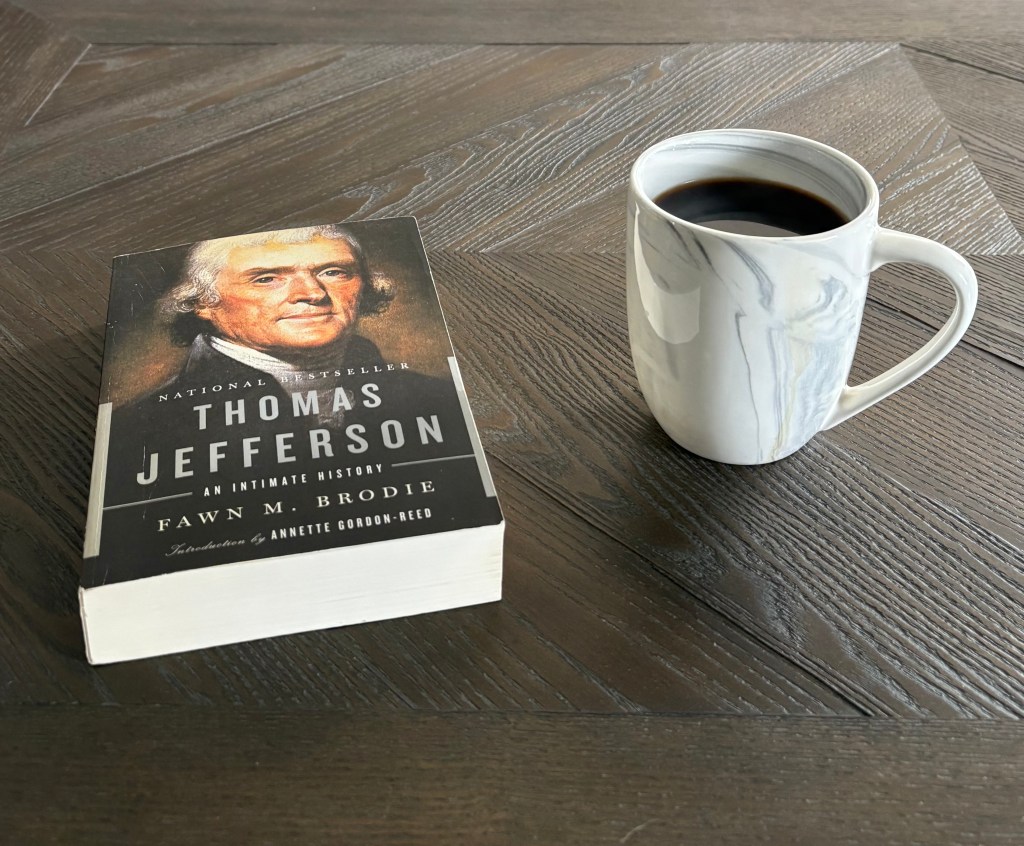
My journey reading the biographies of the principal founding fathers of the United States has been very illuminating up to this point. My goal is to read biographies of the seven principal founders: George Washington, Thomas Jefferson, John Adams, Benjamin Franklin, Alexander Hamilton, James Madison, and John Jay.
While reading about John Adams, I discovered the wonderful Abigail Adams, the second first lady of this country, which led me to read her biography and consider her one of the founding mothers.
This time I read Thomas Jefferson: An Intimate History, written by Fawn M. Brodie, and it was fantastic. The biography goes deep into all facets of our third president’s personal and professional life, and includes reminiscences from Madison Hemings, Thomas Jefferson’s son, and Israel Jefferson, one of his slaves who provided a great deal of historical information after he gained his freedom and moved north.
Thomas Jefferson was the second vice president under John Adams and the third president of the United States. He drafted the Declaration of Independence (pp. 121–123), including the preamble that is known to most of us:
“We hold these truths to be self-evident, that all men are created equal, that they are endowed by their Creator with certain unalienable Rights, that among these are Life, Liberty and the pursuit of Happiness.” (p. 122)
He was also a philosopher, lawyer, and skilled mathematician. He owned hundreds of slaves and had children with one of them, Sally Hemings, a mulatto who, by the way, was the half-sister of Thomas Jefferson’s wife, Martha Jefferson. (p. 29)
The fact that he wrote in the preamble of the Declaration of Independence, “…that all men are created equal, that they are endowed by their Creator with certain unalienable Rights, that among these are Life, Liberty and the pursuit of Happiness,” while at the same time owning hundreds of slaves, is extremely problematic and speaks to his lack of morals. Abigail Adams told him about his lack of morals directly, and it caused a break in their friendship to the point that when Jefferson and John Adams renewed their correspondence, Jefferson said, “that I never name her.” (p. 384)
He was also not a Christian but a deist, whose trinity consisted of Francis Bacon, Isaac Newton, and John Locke (p. 267). Jefferson created his own version of the New Testament by removing all miracles, the virgin birth, the resurrection of Jesus, and other elements, calling it “Morals of Jesus.” (pp. 372–473)
He was also a strong supporter of the separation of church and state and did not include any religious instruction in the curriculum of the newly formed University of Virginia, which he helped establish. (p. 447)
Oh, and one more thing: Thomas Jefferson had an affair with Maria Cosway, who was married, while he was stationed in France. (p. 199) Interestingly, many people refuse to accept that the affair happened because they believe it was out of character for Jefferson. But I’m thinking that if he had six children with Sally Hemings, then morally speaking, he probably would not have held back from having an affair.
Here are a few highlights that caught my attention:
“The care of human life and happiness, and not their destruction, is the first and only legitimate object of good government.” (p. 22)
“The destruction of the power of the Anglican Church became one of Jefferson’s chief goals during the revolution, and one of his first acts as governor of Virginia and a member of the Board of Visitors of William and Mary College in 1780 was to rout out the divines and turn the school over to professors of science, mathematics, and modern languages.” (p. 55)
“Jefferson’s proposed legislation to separate church and state forever in Virginia…” He then said the following:
“Millions of innocent men, women and children, since the introduction of Christianity, have been burnt, tortured, fined, imprisoned; yet we have not advanced one inch towards uniformity. What has been the effect of coercion? To make one half the world fools, and the other half hypocrites.” (p. 157)
While Jefferson’s wife was gravely ill, he retired from politics. But politicians needed him, and John Tyler, Speaker of the House of Delegates, wrote the following:
“I supposed your reasons are weighty, yet I would suggest that good and able Men had better govern than be govern’d… if the able and good withdraw themselves from society, the venal and ignorant will succeed…” (p. 166)
“Jefferson’s daughter later wrote that in the last four months of her mother’s life her father ‘was never out of calling: when not at her bedside, he was writing in a small room which opened immediately at the head of her bed.’” (p. 166)
“He improved his Spanish by reading Don Quixote in the original.” (p. 186)
“When he received a letter from Edward Bancroft asking his opinion on the value of the Quaker experiment in Virginia, where owners freed and then hired their own slaves, Jefferson replied… ‘As far as I can judge from the experiments which have been made to give liberty to, or rather, to abandon persons whose habits have been formed in slavery, it is like abandoning children.’” (p. 235)
“Jefferson preferred the company of scientists and republicans, despising merchants and bankers for their greed, and considering them secret monarchists and potential subverters of the republic.” (p. 264)
During his inaugural presidential speech, he said the following regarding minority rights in the United States. This was on the heels of the passing and enforcement of the Alien and Sedition Acts under the previous president, John Adams:
“If there be any among us who would wish to dissolve this Union or to change its republican form, let them stand undisturbed as monuments of the safety with which error of opinion may be tolerated where reason is left free to combat it.” (p. 336)
Jefferson wrote thousands of letters from 1809 to 1826 (p. 443), and in the chapter “Writer of Letters,” I read the following:
“Most important of all, Jefferson could not dwell on the past for very long except to search for models with which to improve the future.” (p. 445)
A very interesting and complicated life from one of our founding fathers. It is fascinating to read the letters and biographies of the men who were key figures in the creation of this country and compare what they did and said with what current politicians say about the founding fathers. There is clearly a disconnect, and only those who spend time reading the history of our beginnings will be able to sort through fact and fiction.
About the Author:
Fawn McKay Brodie was an American biographer and one of the first female professors of history at the University of California, Los Angeles (UCLA).1


This is all very thought provoking! I just might order one of these books!
LikeLiked by 1 person
Thank you. All three were great reads, but the one about Abigail Adams was the best in my opinion.
LikeLiked by 1 person
A fabulous quote from Jefferson (p. 445). Mindset, too, separate from his immoral choices. Your closing comment is solid. Of course, the credibility of that history is of upmost importance and not always apparent, with all that it is available to us. Your text selections appear well chosen and researched. Thank you for summarizing and sharing with us.
LikeLiked by 1 person
Thank you very much, Michele. Great point about the credibility. It’s kind of sad that we need to verify the “history” that some leaders are pushing on us.
LikeLiked by 1 person
I’ve read this book and the other two you mentioned, Edward, and I agree, Thomas Jefferson was a complicated man. I don’t remember if this title was the one that wrote about Jefferson’s willingness to take the smallpox vaccine way back then. My greatest disappointment in Jefferson was that he never freed Sally or their children, even in his will.
LikeLiked by 1 person
Yes, this is the one that mentioned his willingness to take the smallpox vaccine. He was all about science. Yeah, that was very disappointing, and his daughter freed her at the end. It seems to me that he was too attached to Sally.
LikeLiked by 1 person
Great Job, very informative and thought provoking
LikeLiked by 1 person
Thank you very much.
LikeLike
“The care of human life and happiness, and not their destruction, is the first and only legitimate object of good government.” – sounds like a book some politicians could read!
LikeLiked by 1 person
I agree completely. Today’s politicians, and future ones, need to get into philosophy the way they did in the old days.
LikeLiked by 1 person
it feels like it’s part of an anti-intellect vibe which is spreading… sigh.
LikeLiked by 1 person
Definitely!
LikeLike
So good to point out that Jefferson was a staunch believer in the separation of church and state. That fact seems to be conveniently forgotten of late. What irony that Jefferson wrote of liberty and enslaved 100 people. Yet in addition he had a long term relationship with Sally Hemings… Such a complex man.
LikeLiked by 1 person
Absolutely, and it’s one of the reasons I’m reading about the founding fathers. There is so much misinformation out there. He was definitely a complicated man. It seemed like the societal norms of the time didn’t let him be himself.
LikeLiked by 1 person
A reflective historical reading update—sharing insights from studying biographies of the U.S. founding fathers and describing the journey as enlightening and intellectually engaging. 📚🇺🇸✨
LikeLiked by 1 person
Thank you.
LikeLike
I learnt a lot about him when I was studying American history and found him fascinating. He was both extremely moral and quite immoral which I believe is the case for almost all historical figures when we look into them more deeply. An interesting thing I learnt was that when he was trying to impress Maria Cosway while in France he accidentally tripped and ended up with a fractured wrist and was quite embarrassed.
LikeLiked by 2 people
That incident in France was interesting, and he even wrote a romantic letter to her with his other hand. You’re right that some of those historical figures have both tendencies. That’s why biographies are so good; they continue to research the subjects’ lives and show us the truth about these important figures. Thank you, Pooja.
LikeLiked by 1 person
well… i never knew any of that about him. my mind is blown.
LikeLiked by 1 person
Yeah, there are a few interesting things that I didn’t know, like that Sally was the half-sister of his wife.
LikeLiked by 1 person
Hi, Edward. I enjoyed this mindful review. It was quite a little “Peyton Place,” huh? The overall picture is a great example of how people have always (and now more than ever) self-defined fidelity and morality, “pretzelizing” it (pardon my Teaganese) to fit their own warped concepts. Somehow, I had missed the fact of “Sally Hemings, a mulatto who, by the way, was the half-sister of Thomas Jefferson’s wife, Martha Jefferson.” Yep, definitely Peyton Place populated by Harper Valley hypocrites. 😀 Hugs.
LikeLiked by 2 people
Thank you for adding the link. OMG, that song was awesome. Yes, hypocrisy at its finest.
LikeLiked by 2 people
Third is incredibly interesting. I didn’t know much about Jefferson at all. People did have strange moral codes when it came to slavery. Slavery has been so widespread throughout the history of humanity.
LikeLiked by 2 people
That’s true. From the very beginning and still to this day, the human capacity to subjugate others is incredible. It is truly sad that there are people still engaging in it.
LikeLiked by 2 people
Many, many people engage in it 😢
LikeLiked by 1 person
Indeed. 😔
LikeLiked by 1 person
When I read the part where Abigail Adams told Jefferson he lacked morals, so they were no longer friends, I immediately pictured all the memes that say GOOD FOR YOU, HONEY and so forth.
I appreciate that he was adamant about separation of church and state, which some religious folks forget is to their benefit as well, but everything else about him sounds like we should just gently place him in the dumpster.
One question: as you read these biographies, do you find that things are not so unusual now? I read The Hardest Job in the World by John Dickerson and came away feeling that what we’re seeing today is not much different from the past with the exception of how fast everything travels on the internet.
LikeLiked by 2 people
Thank you, and that’s a great question. What I’m seeing is that politics was pretty nasty from the beginning. They even passed the Alien and Sedition Acts during John Adams’s presidency. The only differences I see are the quality of presidential candidates at the beginning—who were very intellectual and patriotic—and the Senate. Back then, there were a lot of discussions among themselves and their constituents. We are currently lacking in those two areas.
LikeLiked by 2 people
So good, Edward. You do such an amazing job at picking out quotes and sections that provide such insight into both the book and the subject. I’m still laughing about your comment about the affair in France. Good point that he might not be morally opposed.
It’s so interesting to see this view of his life in the whole – the inconsistencies, tendencies, and merits. Your last point about how current politicians bend the narrative to their own liking is so good. Thanks for giving us some food for thought and inspiration! Great post, my friend!
LikeLiked by 2 people
Thank you so much, Wynne. The whole discussion about other biographers and historians doubting that Jefferson was involved with a married woman in France is laughable because there is plenty of evidence. I’m glad that part made you laugh, too.
LikeLike
I find it fascinating that an obviously intelligent person struggled to see the wrong in slavery. I understand it was a way of life… and some people never question ‘the way things have always been done’. But it seems Jefferson should have been more aware, given his educated lifestyle, and Abigail Adams calling him out on it.
I did not know Sally and Martha were half-sisters. That seems like a story that deserves much more explanation.
Thanks, Edward, for sharing your interesting book reviews. I really enjoy reading all the comments you get. Bloggers have a wonderful way of opening up different viewpoints. It’s fun to learn this way, like having a conversation with friends…
LikeLiked by 1 person
I agree with you. People have known that slavery was wrong for centuries before the birth of this nation, especially Christians, but people pursued it anyway because of the power and riches it provided. It’s hard to imagine what those people were thinking, but I think we can use the example of Jeffrey Epstein. A lot of men and women knew that he was a fraud and an abuser, but they played ignorant just to get inside his circle and enjoy the money and power. They supported his lifestyle, and a lot of innocent, underage, and young women paid the consequences of that toxic and evil environment.
I love the comments and interactions. Like you said, it’s like having conversations with friends.
LikeLiked by 1 person
I love a well done biography and have several on my “to read” list. Great thoughtful review, Edward!
LikeLiked by 2 people
Thank you so much, Terry.
LikeLiked by 1 person
I am glad that you are weeding through myths to help others see truth..
Regarding freedom and truth… the horrible awful fact is that Jefferson probably felt he was virtuous rather than hypocritical … because of the colonial greed based belief that people who were other colored.. were not actually human… and because arrogance and entitlement had worked its way into their idea of Christianity. The same thing happened to Natives who were thought to be primitive savage … less than human. ( It still blows my mind that clergy often used the phrase , “ Kill the Indian to save the man) believing that they as Europeans had the right to forcefully indoctrinate Natives into their colonial dream in the name of God…
Have you read Chief Seattle’s letter to the colonial leaders at that time…as he calls them account to act like Christians towards the Native people? Absolutely heartbreaking.
LikeLiked by 1 person
Thank you, Kimberly. Humanity has been behaving like this for thousands of years. I was discussing the other day that human civilization really started in Africa, but for some reason people tend to forget that and Europe somehow becomes the center of the universe. Sadly, I think Christianity (well, those who call themselves Christians but are not) has done a lot of damage. They added human traditions, especially the need for power, and went on to change the world and force others to submit to their beliefs. So many injustices committed in the name of God. I read the letter and it is indeed heartbreaking. Incredibly, we continue to do the same things now. We see injustices every day in this country in the name of God.
LikeLiked by 1 person
Yes…
LikeLiked by 1 person
This sounds like a very interesting and thought-provoking book! History must be judged within the context of its time, not by the standards of the current era. Thomas Jefferson was heavily influenced by the theories and experiments of the Enlightenment (the Age of Reason), which emphasized science, mathematics, and empirical evidence. He was a realist and a rationalist. He was also human and not a follower of any organized religion. He was a “Deist” in the sense that he believed that God is present in the natural world and does not intervene in our lives. He was a proponent of natural law, which endows humans with unalienable rights, as written into the Declaration of Independence, the U.S. Constitution, and the foundations of America. It’s not enough to look at an important figure’s life. You have to put his life within the framework of what was happening in the world at the time. Since I haven’t read the book, I don’t know whether the author did that or not. It’s also important to remember that the Founding Fathers lived through the tyranny of the British monarchy and the monarch-controlled Anglican church. For some reason, people always forget this. Their goal was to make sure tyranny could never control America again. It doesn’t, and it hasn’t, because of their foresight. Americans love freedom, and as long as they own weapons and defend themselves, tyranny will not rule. And it’s pointless to keep criticizing people of that time over slavery. It was horrible, immoral, and wrong, but it was so entrenched in American society by then that the American Revolution was not enough to free them. It took Abraham Lincoln and the Civil War to do that. Change comes slowly. Wonderful post, Edward! I’m sorry if it seems like I’m always arguing with you. That’s not my intention. I appreciate your thought-provoking posts.
LikeLiked by 2 people
You’re spot on, Dawn. The author explained his philosophy and his beliefs in a way that is very close to what you said. Now that I’m starting to read philosophy, I’m starting to see the god that Adams, Jefferson, and other philosophers believed in. I think the author kept it focused on the time and circumstances that Jefferson was in. I’m with you about treating history as it happened.
Dawn, thank you for your comment, and know that I don’t get mad at your comments. I actually like to read what people really feel about a particular subject, and I always appreciate your directness. I’ve experienced rejection from other bloggers because they didn’t like my comments, but I’m not like them. I enjoy open and frank discussions, and I never disapprove or delete comments unless they are extremely offensive, which has happened in the past.
LikeLike
What a complicated and fascinating man. It’s good to see the whole person revealed, I believe. Thank you for your illuminating review, Edward.
LikeLiked by 1 person
You’re very welcome, Lori. Yes, he was, and this author did a great job presenting his human side.
LikeLiked by 1 person
I really like this, Edward. About 10 years ago I decided to read a book on each of the US Presidents. I have them listed somewhere stored away. After reading this I think it would be fun to find it and compare authors. I only made it to the 11th President and I included Benjamin Franklin too as he was so integral to that time. I debated reading one about Benjamin Rush whose name kept popping up … a well-respected and influential Doctor at that time. I didn’t read any books on Alexander Hamilton and John Jay which is such a great idea although your mission is a little different than mine was.
Anyway, I read Mccullough’s Adams and came away with such a love for Abigail too. I thought when I’m finished with the Presidents I’ll read about the President’s wives. But yeah, Abigail was so smart and such and anchor and influence on John. I read two books by Ellis – I think it might have been about George Washington and I can’t remember the other. Anyway, I’m not positive whose book I read on Jefferson but it wasn’t this one. I remember being disappointed with Jefferson, the man. He was poetic, good with words, and important to the foundation of our country but akin to some of what you said about his hypocrisies I was surprised about other things … his many slaves and his own involvement with them including fathering many children with Sally. My memory is that he freed many of them in his will but not Sally. And I remember reading a lot about his overspending because he liked to have the nicest things including his home and foods and wines, and he died in quite a bit of debt.
I also enjoyed reading about his relationship with Adams and how when they were older they corresponded through letters and both died on the same day of the same year and it was July 4th!
Anyway, you’ve inspired me. I have to find my list and maybe it’s time to start where I left off … was that Zachary Taylor? … I’ve already forgotten …
I love your book reviews, Edward!
LikeLiked by 1 person
Thank you so much, Donna. Reading about all the presidents is a huge project. There is another blogger who is reading a book of biographical essays on the presidents, so I’m going to wait for his feedback; I’ll probably read a book like that to get to know them better. I’m going to focus on the Founding Fathers because they were so important, and then read about the others as the interest arises. I have read biographies of Adams, Jefferson, Grant, Eisenhower, G.W. Bush, and Obama.
Jefferson gave freedom to some of the men, but not to her. Jefferson’s daughter arranged to let her go without bringing too much scrutiny, because of what you said about his huge debt. The author mentioned some of this, including the amount of wine he bought because he liked to give bottles to everyone who visited.
LikeLiked by 1 person
Sounds like a good plan. I’d love to hear about the book of biographical essays on the Presidents. Yeah, when I was reading on each of them in chronological order, it was sometimes difficult to find a good book on some of the less well-known Presidents. Near my office in Seattle, there was an “Old World Bookstore” and the owner was an older man who appreciated my project and if I ever needed a suggestion, he’d discuss with some of his friends and the next day he’d have a book suggestion for that particular President. Fun.
LikeLiked by 1 person
I have been using AI for those deep dives, looking for the best books on a particular subject with great results so far. I’ll definitely write about it if and when I find the right book of biographical essays on the presidents. Thank you, Donna.
LikeLiked by 1 person
Very good to know that Abigail called him out on his morality. I’ve never had much interest in visiting Monticello but I recently heard the historians Heather Cox Richardson and Joanne Freeman talking about what a fascinating tour it is—with the slave quarters and kitchen being part of it.
LikeLiked by 1 person
Oh, she did, big time—and he didn’t like it one bit. She is my hero. The more I learn about her, the more I like her. He designed every aspect of it, and I would like to visit one day because I read it’s beautiful.
LikeLiked by 1 person
The deep arrogance of a man attempting to re-write God’s word to suit himself! God said to treat all employees fairly and with respect, plus never to fornicate.
LikeLiked by 2 people
His god was a philosophical one, very different from the One you and I believe in, and he was very arrogant in that respect. I would never dream of modifying sacred scripture from any religion, but there are some who think they have the ultimate answers and expect everyone else to conform.
LikeLiked by 1 person
Remarkable in so many ways, though for a moment a detail of his story (speaking of equality and freedom for all while owning slaves himself) brought to my mind an old Portuguese saying, “Do what I say, not what I do.” But I like his pro-futuristic vision. From the past, we take lessons to improve the future. The path is forward and depends on how we walk it. Thank you, Edward, for enriching my knowledge of US history and of human ways. A precious read! With appreciation and gratitude, sending you light and blessings and wishing you a peaceful day. ✨🙏🍀🌞
LikeLiked by 2 people
You’re very welcome, Susana. It seems to me that he was wrestling internally with equality and freedom for all versus his status as a slave owner. At times, it seems that he had slaves simply because he grew up in that environment and everyone had them, even though his true desire was emancipation.
Yes, I like that part also. We shouldn’t dwell too much on the past, just enough to learn and improve the future.
LikeLiked by 1 person
Yes, societal context is important in framing one’s behavior. And in his case, as a man of high social standards, it was probably limiting his actions. In a way, he was creating the foundations for the emancipation that eventually followed. Thank you, my friend, for clarifying it. Light and blessings, always! ✨🙏🍀🌞
LikeLiked by 1 person
Absolutely! Societal context is definitely important. Luckily, there wasn’t social media in those days. Thank you, Susana.
LikeLiked by 1 person
a very imperfect man who left our country with some wonderful gifts, in spite of the negatives in how he conducted his life.
LikeLiked by 1 person
You’re absolutely right, Beth. Being part of that small group of leaders who helped form this country is something to celebrate. Jefferson did a lot of good for our nation. At the end of the day, we are all imperfect human beings.
LikeLiked by 1 person
yes, it’s what makes us human
LikeLiked by 1 person
Indeed.
LikeLike
Fascinating read, Edward. You did a great job with your review honoring the gifts he brought and writing The Declaration of Independence, his loyalty to his wife and yet the discrepancies in his moral standards. It sounds like the making of a good movie with the drama the lack of moral code and yet strong values! Thanks so sharing it with us❣️
LikeLiked by 2 people
You’re very welcome, Cindy. There are a lot of juicy details that I left out that will make for an awesome movie. The fact that Jefferson had children with half sisters—one white and one mulatto—makes for an interesting story, maybe even a good reality show.
LikeLiked by 1 person
Oh wow, that really does make for a good soap opera, that’s for sure. It seems the men in leadership have a lot in common for the most part, sparing a few of the ones that have high morals. 💕
LikeLiked by 1 person
Yes, there are still a few good men out there. Kind of hard to find them in politics, though.
LikeLiked by 1 person
Gosh, I’ll say! That’s one of the things I love about Obama! ❤️
LikeLiked by 1 person
Agree, but I think Michelle is keeping him in check. 😀
LikeLiked by 1 person
Really? I think they truly have a mutual respect and he wouldn’t have it any other way. xx
LikeLiked by 1 person
I totally agree with you on that point. You can see it in the way each of them talks about the other.
LikeLike
I’m not sure it’s something i would ever read Edward, but you do make it sound interesting 🤔
LikeLiked by 2 people
I understand, my friend. The author did a good job including a lot of juicy details, but at the end of the day, there is a lot of dry history.
LikeLiked by 2 people
Thank you for this thoughtful review. What stands out most is the balanced way you approach Thomas Jefferson — neither blindly admiring him nor completely dismissing him. You highlight both his extraordinary contributions to liberty and democracy and the deep contradictions in his personal life. That honesty makes the review engaging and intellectually meaningful.
Your reflection reminds readers that history is rarely simple. Great leaders can shape nations while still carrying serious moral flaws. Understanding those tensions helps us think more critically about freedom, justice, and the unfinished work of human equality even today. A very insightful and thought-provoking post.
LikeLiked by 4 people
Absolutely! Thank you very much, John. 🙏🏼
LikeLiked by 2 people
I have a copy of the Jefferson Bible, just as you describe it. Complicating Jefferson’s morality was his enormous number of debts and that he broke up black families when selling them to be able to cover his debts.
At the same time, his devotion to his wife as she was dying and after was notable. Though there were no mental health professionals around to help him, it seems certain that he was profoundly depressed. Reading about the interactions between Jefferson and his dying wife is heartbreaking.
Jefferson’s library enabled us to have a national library, the Library of Congress. He also designed the University of Virginia.
Jefferson was a complicated man, but, to me a great one despite of his imperfections. Thanks, Edward.
LikeLiked by 2 people
The book mentioned his debts, but I don’t think she highlighted them in detail. The author definitely mentioned how he broke up families, which was terrible.
The book highlighted that he suffered from severe headaches throughout his political life, and they suddenly stopped once he left the presidency. Stress and, I think, depression were definitely present.
His love for his wife was undeniable. I completely agree with you that despite all his imperfections, he did an extraordinary service for this country. Drafting the Declaration of Independence pretty much by himself is something incredible. Thank you, Dr. Stein.
LikeLiked by 1 person
The last paragraph is my take-away from your review.
LikeLiked by 1 person
Thank you, Liz.
LikeLiked by 1 person
You’re welcome, Edward.
LikeLiked by 1 person
Fascinating, Edward! I remember reading that Benjamin Franklin was a deist, but I didn’t realize this was true for Jefferson, too. So interesting, this focus on reason and logic from founding fathers. You’re inspiring me to learn more…makes me wonder about their motivations for rejecting traditional beliefs and their fervor in the early history of our country. So much I don’t know! 💝
LikeLiked by 1 person
Absolutely! Even John Adams was closer to being a deist, which, I think, he was towards the end of his life. Yes, I’m seeing their focus on reason and logic also, and I think it comes from their deep love for philosophy. They saw everything through philosophical eyes, even their concept of God was through those lenses.
LikeLiked by 1 person
Super interesting, Edward! Love what you’re bringing to use with these insights. Thank you! 💝😊💝
LikeLiked by 1 person
Thank you so much, Vicki. 🙏🏼
LikeLiked by 1 person
❤️😉❤️
LikeLiked by 1 person
🫶🏼
LikeLike
Thanks for the review, Edward. Our founding father is probably horrified at how far we have strayed from the principle of separating Church from State.
LikeLiked by 1 person
You’re very welcome, Rosaliene. Absolutely! That’s one of the things I’m looking for when I read about them, their thoughts about religion and its role, if any, in government. It is just fascinating to get a reminder about what they thought about this subject.
LikeLiked by 1 person
I admire your dedication to reading and learning about our founding fathers. Many were flawed humans, but helped create a unique country and system of government. Jefferson’s morals seem twisted, but we’re typical of the time. And I agree with the separation of church and state which has been greatly reduced by the current administration and Republicans.
LikeLiked by 3 people
Thank you, Brad, and absolutely! They were flawed humans, like the rest of us, and their work was amazing. I’m really interested in learning about these men who led the start of this country. I think some people want to elevate them to some kind of perfection that wasn’t there.
LikeLiked by 1 person
My father, a passionate architect, took us to tour Jefferson’s home when I was a teenager, pointing out to us all the clever devices he had invented for domestic comfort.
LikeLiked by 1 person
Yes, I read about some of his inventions in the book. It’s pretty amazing how he did all that while also doing architectural designs, including designing the University of Virginia. Very talented person, indeed. Thank you, Ana. 🙏🏼
LikeLiked by 1 person