“Abigail was as learned as any man of her time, and she could write like an angel. And Adams kept a diary. When I read Abigail’s letters, I wonder how she ever had time to write them. She was raising a family with four children, running the farm without her husband there; it was nip and tuck whether she could make a go of it financially; she had sickness to contend with, plagues, waves of smallpox, and epidemic dysentery that swept through Braintree.” – David McCullough, History Matters
I first encountered Abigail Adams while reading the biography of her husband, John Adams, one of the Founding Fathers, the first Vice President, and the second President of the United States. My focus was on John Adams when I read his two-volume biography written by Page Smith last year. But as I said in my review, reading the biography of John Adams “brought to light the remarkable life of Mrs. Adams.”
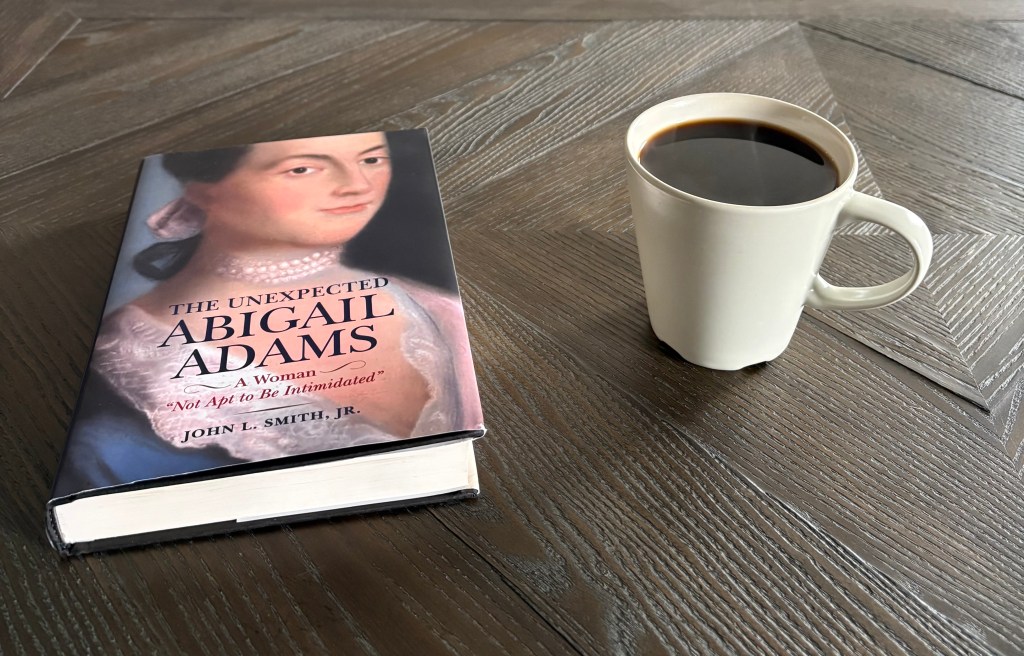
When I finished that biography, I knew I needed to read more about Mrs. Adams. I searched for the best biographies about her and found that one of the most highly regarded was The Unexpected Abigail Adams: A Woman “Not Apt to Be Intimidated” by John L. Smith Jr..
Written in 2024, the biographer had the opportunity to tap into the vast repository of letters written by Mrs. Adams throughout her lifetime—approximately 2,300 in total. Most of those letters can be found in the National Archives Founders Online database.
The book is divided into five parts: “A Young Woman of Massachusetts,” “Revolution,” “Europe,” “First Lady,” and “Legacy.”
The author sets the tone early in the prologue when he quotes her as saying:
“No man ever prospered in the world without the consent and cooperation of his wife.” (p. xi)
That was written in 1809, after she had experienced the American Revolution, traveled through Europe, and lived as Second Lady and First Lady of the United States. By the time she made that comment, Abigail clearly understood how essential wives were to the success of prominent men.
The biographer does an excellent job presenting her strengths by highlighting her character and political views, including women’s rights and education. He describes the balance Abigail maintained between being a strong, intelligent woman and being a devoted wife and mother. (p. xv)
Abigail received her education at home, initially from her mother and later from her father, a Harvard-educated and ordained minister. (pp. 3–4) She married John Adams on October 25, 1764, about 28 days before her twentieth birthday; he was 29 years old. (p. 15)
The book describes her entire life in detail, but I chose to highlight key aspects of her thoughts on slavery, education, how men viewed her, and her independence.
Note: I updated the spelling in some of the quotes because, as the author explains in the prologue, many people at that time spelled phonetically.
On Slavery
She began voicing her opinion about slavery to her husband in 1774, stating:
“There is but little said, and what steps they will take in consequence of it I know not. I wish most sincerely there was not a slave in the province. It always appeared a most iniquitous scheme to me—to fight ourselves for what we are daily robbing and plundering from those who have as good a right to freedom as we have. You know my mind upon this subject.” (p. 45)
In a letter to her sister Mary, after visiting Martha Washington at Mount Vernon, she wrote:
“Decay…if any person wishes to see the baneful effects of slavery, as it creates a torpor and an indolence and a spirit of domination—let them come and take a view of the cultivation of this part of the United States.” (p. 268)
On Education
Abigail had much to say about education for women.
During an interaction with John Thaxter Jr., who was tutoring her son John Quincy Adams, she said:
“It is really mortifying, sir, when a woman possessed of a common share of understanding considers the difference of education between the male and female sex…why should children of the same parents be thus distinguished? Pardon me, sir, if I cannot help sometimes suspecting that this neglect arises in some measure from an ungenerous jealousy of rivals near the throne.” (p. 50)
Later, in a discussion with her husband about improving education in New England, John wrote:
“These imperfections must be remedied, for New England must produce the heroes, the statesmen, the philosophers, or America will make no great figure for some time.” (p. 97)
Abigail seized the opportunity to advocate for female education, reasoning that women were children’s first teachers:
“If we mean to have heroes, statesmen and philosophers, we should have learned women…if much depends, as is allowed, upon the early education of youth and the first principles which are instilled take the deepest root, great benefit must arise from literary accomplishments in women.” (p. 98)
In a letter written in 1787 to her niece Lucy, Abigail described attending five lectures in London:
“The five lectures which I attended were experiments in electricity, magnetism, hydrostatics, optics, pneumatics…it was like going into a beautiful country, which I never saw before, a country which our American females are not permitted to visit or inspect.” (p. 200)
What Men Thought About Her
In a letter from Thomas Jefferson to James Madison, Jefferson wrote:
“When he [John Adams] established himself [in European diplomacy], his pecuniary [financial] affairs were under the direction of Mrs. Adams, one of the most estimable characters on earth, and the most attentive & honorable economist.” (p. 206)
“Groups of Bostonian men had agreed that if John Adams was elected president but was to die suddenly in office, they should rather see Mrs. Adams in the Presidential chair than any other character now existing in America.” (p. 239)
When John Adams was elected president, he realized Abigail’s political savvy after she reviewed his draft resignation letter from his vice-presidential duties as president of the Senate:
“He sent his rough draft to Abigail for comments; she in turn made many edits and remarks…as John read Abigail’s notes, he realized he was receiving excellent, cabinet-level advice from his wife. Abigail had become not only a shrewd partner but a top-notch political consultant.” (p. 242)
On Independence
Abigail’s nieces warned her about traveling without a male escort:
“I was too independent to want a gentleman always at my apron string… I have been accustomed to get through many a trying scene, and combat many difficulties alone. I was therefore not very timid.” (p. 269)
She was proud of her granddaughter Caroline’s intelligence and self-reliant personality and advised her:
“The more we are qualified to help ourselves, the less dependent we are upon others.” (p. 285)
The book’s subtitle includes the phrase “Not Apt to Be Intimidated.” We know Abigail raised four children and ran a farm while her husband was away serving in Congress and fulfilling his political duties. She managed the finances and dealt with sickness and plagues. But the phrase “not apt to be intimidated” was demonstrated in many additional ways.
One example stands out because it defied the culture of the day, when women lacked voting and property rights.
Over the years, Abigail invested in government bonds and became one of the earliest American female investors in U.S. history1, significantly increasing the family fortune. Despite the legal limitations of the time, she accumulated considerable assets and chose to write her own will, leaving the majority of her estate to the women in her life. She appointed her son Thomas as executor. John Adams knew her actions were technically illegal under the law, but he respected and loved her deeply and honored her wishes. She gave her sons John Quincy and Thomas deeds to nearby farms she had purchased over the years and distributed other property, money, and assets to daughters-in-law, granddaughters, nieces, and friends. (pp. 301–311)
She concluded her instructions with this note:
“I hope that no unkind or hard thoughts will be entertained that I have given to Louisa (the daughter of Abigail’s brother William) more than the rest. Her case is peculiar, having no relative upon her mother’s side but a sister. I commend her to the kindness of my children.” (p. 311)
The book ends with Abigail’s words on optimism:
“It is true, we have not always power over our own lot, to carve it out as we please, but the mind has power over itself; and happiness has its seat in the mind.” (p. 312)
I believe there has been an effort, at times, to minimize or overlook the many accomplishments of women throughout history. Religion has also been guilty of this—particularly Christianity, where stories of influential women in the Bible are not highlighted enough.
It is unfortunate that I did not learn about this key figure in American history until I stumbled upon her while reading the biography of her husband.
It is encouraging to see male historians bringing her life to new audiences. This book tells the powerful story of a remarkable woman who deserves to be mentioned alongside the Founding Fathers. As you read about her, you realize that many of them benefited from her intellect.
Do I recommend this book? Absolutely. In my view, it is a must-read if you want to understand the level of influence women had during the early years of this country. It is my hope that we begin speaking about the Founding Mothers with the same frequency as the Founding Fathers. Abigail Adams belongs at the center of that narrative.
About the author2
John L. Smith, Jr. earned a BS degree from the University of South Florida and an MBA from the University of Tampa. He holds a current state-certified social sciences teaching certificate. He is a Vietnam-era veteran and has honorable discharges from both the US Air Force Reserve and the US Army Reserve.
Following retirement after a 40-year career in energy corporations in California and Florida, he began an acting career in films and TV. He earned a SAG-AFTRA card playing in such TV shows as Magic City and Hindsight. His film work includes such movies as Ironman 3, Killing Reagan, X-Men: First Class, and The Conspirator, directed by Robert Redford. Shortly afterwards John was asked by Redford to be his stand-in and body double in A Walk in the Woods. That filming lasted for 3 months.
John’s interest in the American Revolution has produced over 30 peer-reviewed articles in The Journal of the American Revolution. His work has also been featured by Smithsonian Magazine, CNN, Knowledge Quest, the Wall Street Journal, and The National Review. From 2016–2022, he wrote and posted a daily blog called “American Revolution History Bits.” He is an occasional guest on the SiriusXM radio podcast “Revolution Road with the Journal of the American Revolution.” John is a member of the Abigail Adams Historical Society, and he has just completed his first full-length book – a new biography on Abigail Adams called The Unexpected Abigail Adams, a Woman “Not Apt to be Intimidated.” It received an excellent, full-page review by the Wall Street Journal as one of the WSJ Spring Books to read. It is being published by Westholme Publications and is now available in major BOOK STORES as Barnes & Noble, Amazon, Westholme Publications, Fort Plain bookstore, and various websites in 2024. John will be speaking on the book in June at the American Revolution 250 Conference in the Mohawk Valley, New York.


This is such an amazing share! Thank you!
LikeLiked by 3 people
You’re so welcome.
LikeLiked by 1 person
A fine dispatch for a Sunday afternoon. The kind of writing that makes a fellow lean back, sip something slow, and think, “Well now… that’s a thought worth carrying around for the rest of the day.” Groovy stuff. 🌞
LikeLiked by 1 person
Thank you very much. That was an awesome comment and it made my Sunday. 😎
LikeLike
Hi Edward, I don’t know much about this president or his wife but it sounds like an excellent read.
LikeLiked by 2 people
Thank you, Robbie. It really was. Learning about historical events through letters written by the people who witnessed them is amazing.
LikeLiked by 1 person
Yes, I also like reading diaries
LikeLiked by 1 person
Another banger, Edward.
The Adams’ personal correspondence has always been interesting to me, and the #1 thing that sticks in my mind what an amazing person Abigail Adams must have been. John’s writings (at various times) could be tinged with any number of ‘negative’ emotions (anger and frustration, ego, presumptuousness, etc.). Abigail, though, could match wit and intellect, disarm and tease with humor, was graceful, supportive, and kind; she had to have been an absolute superstar of a person that doesn’t get talked about as often as she should.
Thanks for this! Have a great weekend!
LikeLiked by 1 person
Thank you very much, Scott. Their letters were amazing and offer so much value from a historical perspective. You’re right, John Adams had a temper, and Abigail had a great way of putting him in check with her words. There were a few letters where he begged her to join him when they were separated because he was lost without her. It was a really amazing exchange between the two.
LikeLiked by 1 person
A remarkable woman, Edward. Thanks for bringing her life to our attention. I like your suggestion of considering the Founding Mothers of our nation.
LikeLiked by 1 person
You’re welcome, Rosaliene. We really should remember our Founding Mothers and celebrate all the amazing things they did for our country.
LikeLiked by 2 people
I couldn’t agree more, Edward.
LikeLiked by 1 person
I’m so delighted to see you read this book as you mentioned you might after reading about John Adams. She was a pillar of strength with amazing letters as well! I’m so delighted to see her featured here and her dedication to her writing practice! So special! Thank you truly for sharing it with us! 💕
LikeLiked by 2 people
You’re so welcome, Cindy. It was a joy reading her biography. She was a pretty amazing woman.
LikeLike
” I believe there has been an effort, at times, to minimize or overlook the many accomplishments of women throughout history. ” – I so agree Edward! When you look in the past at our first ladies, so many of them ran the country with their husbands, everyone certainly said it about Nancy Reagan and others.
LikeLiked by 2 people
Great point about Nancy Reagan. That’s definitely true, and it’s probably true of Jill Biden as well. Thank you, Melissa.
LikeLike
Many thanks for posting your review, Edward. It feels much more, deeper and more personable than just a book review. The letter quotes you chose are wonderful to bring out her thinking.
I’ve wondered about letter-writing and the time it took back then too. Particularly considering that she would have used the kind of pen that had to be dipped in ink (not even an old fountain pen). Then her page would have had to have been blotted somehow… To me, letters in that time weren’t only communications, they were an art form or a fine craft. No wonder their words sound so carefully chosen. Hugs.
LikeLiked by 2 people
You’re welcome, Teagan. I always try to highlight what caught my attention so people can get a taste of the book and maybe decide to read it because they connected with it. When I read book reviews, I look for reviewers who include quotes so I can figure out whether the book is for me or not.
She was an early riser and spent most of her time writing letters before the children and her husband were up. You mentioned the ink, and it reminded me of a letter she wrote to her husband in which she apologized for the difficulty of some of her writing because it was winter and the ink had frozen. She also mentioned drafting many letters before sending the final one, which speaks to your point about carefully writing them.
LikeLiked by 1 person
Edward: as always an in-depth, thoughtful review of something of consequence! 🙂
I relished this post, filled with juicy quotes from a woman of privilege – an unwitting social activist of her time. As to your “I wonder how she ever had time to write them” pondering. Right off the bat, one slice of the answer to that is clear to me: It was a priority meant to be carved into her daily chores/events/responsibilities. It was part of how she processed, dealt with and engaged with the times. Thus carving out **time for herself**.
LikeLiked by 1 person
She definitely prioritized writing, waking up extremely early to do so. The book also mentioned that she fought bouts of depression through writing, which is a powerful tool many people use to get things out of their system. Thank you very much for your comment.
LikeLiked by 2 people
You’re welcome!
LikeLiked by 1 person
Great review, Mr. Ortiz, it really whet the appetite for a well-written biography. Adding this one to the list.
LikeLiked by 2 people
Thank you very much. I think you’ll enjoy it.
LikeLike
The way you describe Abagail I would have loved to have met her and talked about life and politics. Thanks for your window into her fascinating life and achievements.
LikeLiked by 2 people
You’re very welcome, my friend. The biography describes how she engaged in deep discussions with some of the Founding Fathers, and people from the Continental Congress sought her advice. It would have been amazing to talk to her after they finished their terms in office, so much experience and knowledge.
LikeLiked by 1 person
It is heartening to know that she came from a family that valued education for women. I was lucky my family did too.
LikeLiked by 1 person
That’s something to be grateful for. In many parts of the world, women still don’t receive formal education, which is a shame because those countries are operating at only half their potential.
LikeLiked by 1 person
Yes, Edward, and I would say less than half their potential, because women’s education is directly linked to improved health of their families.
LikeLiked by 1 person
That’s true, but I was thinking that when a country does not allow women to be full members of society, it misses out on their intellectual capacity and strength, and as a result, the country will never reach its full potential.
LikeLiked by 1 person
Yes, women need education, and it benefits their households too.
LikeLiked by 1 person
Absolutely!
LikeLiked by 1 person
“a woman not to be intimidated” – what a great byline!! Fabulous review, thanks as always for the insight you bring to your subject! Linda x
LikeLiked by 2 people
Thank you, Linda. I think the author did a wonderful job with the title, the parts of her letters he highlighted, and the final quote used to close the book. He clearly thought through every detail in presenting this remarkable woman.
LikeLiked by 1 person
It’s always exciting to read a book that has been well crafted from big picture to small detail – it makes it feel well worth investing your energy in their project. Keep reading and reporting back! (it saves me time!)
LikeLiked by 1 person
Absolutely!
LikeLiked by 1 person
What a wonderful review. I love how you pull out quotes and give us such a great sense of not only Abigail Adams but also the writing and content.
Love Abigail’s optimism. “It is true, we have not always power over our own lot, to carve it out as we please, but the mind has power over itself; and happiness has its seat in the mind.” Love that she shows us how to live to our highest potential even if it doesn’t match with the expectations of the times.
Great review – thanks, Edward!
LikeLiked by 2 people
Thank you so much, my friend. That quote was so awesome, and the author ending the book with it was genius. I was in awe of the decisions she made, from investing in bonds while the majority of men, including her husband, were focused on buying land, to inoculating her children without consulting her husband due to the spread of smallpox, to writing her own will when it was illegal for a woman to do so back then. A real trailblazer.
LikeLiked by 1 person
A trailblazer for sure! Thanks, my friend!
LikeLiked by 1 person
You’re very welcome.
LikeLike
Thank you for this review, Edward! I knew from school that Abigail Adams was a revered figure in New England, but your review brings her to life with the specific quotes. A woman after my own heart!
LikeLiked by 2 people
You’re welcome, Liz. She was extraordinary, and I’ve told a few people that she is my favorite First Lady now.
LikeLiked by 1 person
You’re welcome, Edward.
LikeLiked by 1 person
I saw the mini-series on Adams and she was figured very prominently. Definitely deserves more attention in the history of America.
LikeLiked by 2 people
I agree. The series did a great job highlighting her, and history books should definitely highlight her contributions and those of other women from that time, which I’m sure are many.
LikeLike
Very interesting – especially her feeling about the five lectures she attended.
LikeLiked by 2 people
Yes, it’s incredible how excited she was about education. It was also interesting to read about how open London was regarding education.
LikeLiked by 1 person
A truly compelling review, though I admit I was surprised when you wrote, “It is encouraging to see male historians bringing her life to new audiences.” Why male historians in particular? I would like to see more female historians published, as the publishing industry is male-dominated in all ways, from who is published to who gets professional reviews published.
LikeLiked by 2 people
Thank you. I’m with you about seeing more female historians published, and my point was really about men accepting the reality that women have had an important place in history and their willingness to bring those realities to light. There are many men who are trying to erase the importance of women in society or minimize it to the roles of the past—taking care of a home and having children. It’s important for men to speak out and treat women as equals.
LikeLiked by 1 person
Ah, I see what you mean! I shared my first thought with you because it’s actually the reason that I started my book review blog. At the time, which was 2013, most books were published by men, and most books were reviewed by men. Since then, a lot has changed, for which I am glad.
LikeLiked by 1 person
Definitely, a lot has changed, and for the good. Doris Kearns Goodwin is a great historian. I’ve read some of her articles and am still deciding which book I want to read, probably the one about Abraham Lincoln. I have in my stack These Truths: A History of the United States by Jill Lepore. I’m looking forward to reading her perspective.
LikeLiked by 1 person
I have the new Norah O’Donnell book on my list.
LikeLiked by 1 person
Cool! I hope she mentions Mrs. Adams.
LikeLiked by 1 person
Love her. We know all about her greatness here in Massachusetts. Thanks for the book review!
LikeLiked by 2 people
You’re welcome, Mary. I’m definitely adding a visit to their historical sites the next time I’m in the Boston area.
LikeLiked by 1 person
Great! You might like historic Concord (MA) too—Thoreau, Emerson, Alcott homes, plus all the Revolutionary War sites.
LikeLiked by 1 person
Cool! Thank you for sharing that. I Googled it, and there are a lot of interesting places there.
LikeLiked by 1 person
I’m currently watching a history series on Prime Video that features a few of the USA presidents and, so far, all of them have included extensive information about the wives of these men. Thanks for the recap on this book, Edward.
LikeLiked by 2 people
Cool! I might need to check that out. I’m always looking for good documentaries to watch. Thank you, Terry.
LikeLiked by 1 person
i would have voted for her if she was running for president
LikeLiked by 2 people
Me too. She was impressive.
LikeLiked by 1 person
What loveliness you share. I feel so privileged to read your thoughts and her quotes. What a n amazing human. Thanks for sharing.
LikeLiked by 2 people
You’re very welcome, Selma, and thank you for such a wonderful comment.
LikeLike
🙇🏻♀️
LikeLiked by 1 person
Abigail was clearly a wild card, living much ahead of her time. Her clarity and fairness about relevant aspects of society, including human rights (slavery, women, etc.), are truly remarkable. I loved the advice she gave to her granddaughter: “The more we are qualified to help ourselves, the less dependent we are upon others. ” Isn’t this also a key to freedom? What a great woman and what a great book review, Edward! Thank you for bringing it to us so brilliantly! Much enjoyed! Much light and many blessings to you, my friend, today and always! 🙏✨🍀
LikeLiked by 2 people
Thank you very much, Susana. Her advice is certainly key to freedom of all kinds—from toxic relationships to dependence on governments to the stresses of life. The list is endless. I hope you have a wonderful rest of the week. Blessings, my friend. 🙏🏼
LikeLiked by 1 person
This is so cool! Thanks for sharing Edward!
LikeLiked by 2 people
You’re so welcome, my friend.
LikeLike
this is absolutely fascinating and new information to me. I wish that this was more widely known. I’d love it if someone made an accurate documentary about her and other strong women in our history.
LikeLiked by 3 people
That would be an amazing documentary, looking solely from the women’s perspective to show that behind every historical event there were women not only in supporting roles, but leading in some cases. Thank you, Beth.
LikeLiked by 1 person
Well done, as always, happiness has it seat in the mind, one of many incredible quotes of hers.
LikeLiked by 2 people
Thank you very much. She definitely has many thoughts that are quote worthy.
LikeLike
The founding mothers! I don’t think I ever heard that before, Edward! We are indeed lacking in appreciation and knowledge about so many influential women, past and present. Thank you for this important post!
LikeLiked by 2 people
You’re very welcome, Lori. What’s amazing, when I think about her and the other women who stayed in New England during the British bombardment, is their courage and determination to take care of the homes, farms and businesses while their husbands were in Philadelphia working on the Declaration of Independence, the Constitution, and other founding documents. So if we are calling those men fathers, we should also recognize that there were mothers who played a vital role in the birth of this country.
LikeLike
It sounds like a great book Edward. She stands out as the kind of person/wife/leader I wish we had more of.
LikeLiked by 2 people
Thank you, Brad. Absolutely, especially with the kind of leaders we have in government now. I’m sure she would put a few of them in their place.
LikeLiked by 1 person
A perfect book to begin Women’s History Month, Edward. Thank you for sharing this, it’s going on my list. I’ve read stories about Abigail, but this sounds like a more thorough account of her life. The phrase, “not apt to be intimidated” certainly stands out. So glad we have examples like her to encourage women to be strong, intelligent, and independent – despite what the norms and laws were at the time.
LikeLiked by 3 people
You’re very welcome, Rose. When you read the book, you’ll find a few more stories that highlight that “not apt to be intimidated” quality. There’s another story where a group of women put a store owner in his place for hoarding and price gouging during the American Revolution. It was epic.
LikeLiked by 1 person
A superb review, Edward. Much appreciated. I knew little about Mrs. Adams. You have enlightened me. I have no more words.
LikeLiked by 5 people
Thank you very much, Dr. Stein. As I told Vicki, she is my favorite First Lady now.
LikeLiked by 2 people
Sounds like a book well worth reading, Edward. Thanks for sharing your thoughts on it.
LikeLiked by 3 people
You’re very welcome, Jean.
LikeLiked by 1 person
I’ve read about Abigail Adams but not this book. It looks like a fascinating and important read. It’s amazing how little we hear or read about women who made substantial contributions to our humanity. Thank you for being so equally read on both men and women, Edward.
LikeLiked by 5 people
You’re very welcome, Mary. I know, it’s incredible. The book I’m reading now about Phillis Wheatley is a case in point. I was watching The American Revolution documentary on PBS, and they kept mentioning Phillis Wheatley and her poetry. I was like, “Who is Phillis Wheatley?” just to find out that she is considered the first African-American author of a published book of poetry. Incredible story, and some of her poems are simply amazing.
LikeLiked by 2 people
I’m excited to look up Phyllis Wheatley. Thank you, Edward!
LikeLiked by 2 people
You’re very welcome, my friend.
LikeLiked by 2 people
Fabulous, Edward! I LOVE the quote…Abigail’s advice to her granddaughter Caroline. So good! Thank you for highlighting an amazing woman in our country’s history…feels so very important right now. Thank you! ❤️
LikeLiked by 4 people
Thank you, Vicki. She’s my favorite First Lady now.
LikeLiked by 3 people
With you! Grateful for your research and shining a light on her. ❤️😉❤️
LikeLiked by 2 people
I truly appreciate that, my friend. 🫶🏼
LikeLiked by 2 people