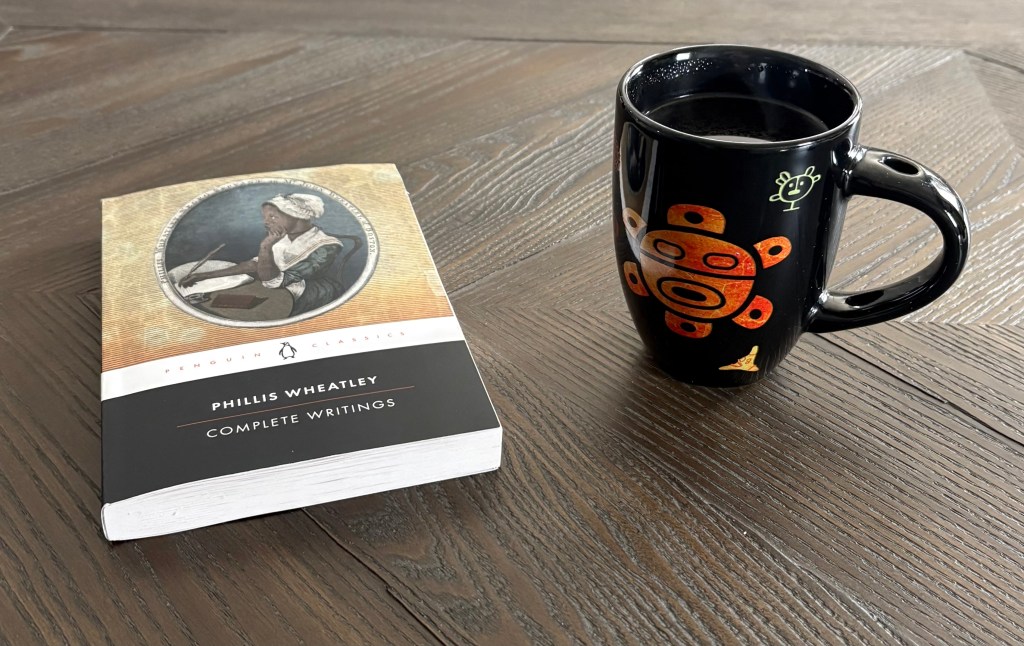
I finished reading The Complete Writings of Phillis Wheatley over the weekend, and I really enjoyed reading her poems and learning more about her life. Most importantly, I learned that people often think less of others when they make no real effort to understand them, their culture, and what connects them.
Phillis Wheatley Peters (c. 1753 – December 5, 1784) was an American writer who is considered the first African American author of a published book of poetry. Born in West Africa, she was sold into slavery at the age of seven or eight and transported to North America, where she was bought by the Wheatley family of Boston. After she learned to read and write, they encouraged her poetry when they recognized her talent. The publication in London of Poems on Various Subjects, Religious and Moral on September 1, 1773, brought her fame in both England and the American colonies. Wheatley was emancipated by the Wheatleys shortly after the publication of her book. The Wheatleys died soon thereafter, and Phillis Wheatley married John Peters, a poor grocer. They lost three children, all of whom died young. Wheatley-Peters herself died in poverty and obscurity at the age of 31.1
I first heard about her while watching The American Revolution documentary by Ken Burns back in December. The documentary mentioned Phillis and her poems a few times, so I was surprised to learn that she was the first African American woman to have her poems published. That one fact led me to purchase the book. The editor of this book, who also wrote the introduction, was Vincent Carretta, an Emeritus Professor of English at the University of Maryland. He did a phenomenal job with this book, and I would add that it is an important one in an era where banning books is not uncommon.
I read a lot of reviews, and most of them mentioned the excellent introduction, which consists of 25 pages of solid historical background. The introduction alone is worth the price of the book.
The book contains all of her poems and their variants, since many of the poems were edited for clarity over time.
The introduction included two quotes that provoked many thoughts about people’s tendency to think less of others. The following two quotations stirred these reflections. The first was from a 1774 letter from Voltaire to Baron Constant de Rebecq, in which Voltaire said:
“Wheatley’s very fine English verse disproved Fontenelle’s contention that no black poets existed.” (p. xv)
Bernard Le Bovier de Fontenelle was a French writer and a member of three academies of the Institut de France, noted especially for his accessible treatment of scientific topics during the Age of Enlightenment.2 Fontenelle never visited Africa, so his uninformed worldview is typical of that era. Of course, this made me search for information about when the first poem was written, and I found that the oldest surviving speculative fiction poem is The Tale of the Shipwrecked Sailor, written in Hieratic (Ancient Egyptian writing) and dated to around 2500 BCE.3 The poem reached France in the 1800s, but Fontenelle died in 1757.
The second quote is from the third president of the United States, Thomas Jefferson, who wrote the following in 1787 in Notes on the State of Virginia, Query 14 regarding African Americans:
“Comparing them by their faculties of memory, reason, and imagination… in memory they are equal to the whites; in reason much inferior… and in imagination they are dull… But never yet could I find that a black had uttered a thought above the level of plain narration… Among the blacks is misery enough, God knows, but no poetry… Religion, indeed, has produced a Phillis Wheatley; but it could not produce a poet.”4
There was a shorter quote on page xxxvi of the book, but I wanted the full context of what Thomas Jefferson was saying, and what I quoted above indeed reveals his complete thoughts on the matter. Of course, they were wrong and biased. He never set foot in Africa, so his opinion is certainly not fact. Besides, he was a slave owner with hundreds of enslaved people working his land.
In response to Thomas Jefferson, Gilbert Imlay, an American businessman, writer, and diplomat, wrote the following:
“I will transcribe part of her Poem on Imagination, and leave you to judge whether it is poetical or not. It will afford you an opportunity, if you have never met with it, of estimating her genius and Mr. Jefferson’s judgment; and I think, without any disparagement to him, that, by comparison, Phillis appears much the superior. Indeed, I should be glad to be informed what white person upon this continent has written more beautiful lines.” (p. xxxvii)
Like I mentioned at the beginning, this book contains all of her poems, and all are wonderful, but these two are amazing in my opinion. Let me share a portion of each. I have also included the source in case you want to read the rest.
On Virtue5

“O thou bright jewel in my aim I strive
To comprehend thee. Thine own words declare
Wisdom is higher than a fool can reach.
I cease to wonder, and no more attempt
Thine height t’explore, or fathom thy profound.
But, O my soul, sink not into despair,
Virtue is near thee, and with gentle hand
Would now embrace thee, hovers o’er thine head.
Fain would the heaven-born soul with her converse,
Then seek, then court her for her promised bliss…”
On Imagination6

“Thy various works, imperial queen, we see,
How bright their forms! how deck'd with pomp by thee!
Thy wond'rous acts in beauteous order stand,
And all attest how potent is thine hand.

From Helicon's refulgent heights attend,
Ye sacred choir, and my attempts befriend:
To tell her glories with a faithful tongue,
Ye blooming graces, triumph in my song.
Now here, now there, the roving Fancy flies,
Till some lov'd object strikes her wand'ring eyes,
Whose silken fetters all the senses bind,
And soft captivity involves the mind.

Imagination! who can sing thy force?
Or who describe the swiftness of thy course?
Soaring through air to find the bright abode,..”
Reading this book, I also learned that even though Phillis’ poems were the first published by an African American woman, the first African American woman poet was Lucy Terry with her poem “Bars Fight,” and the first African American poem was published in 1760 by Jupiter Hammon (p. xv). Lucy Terry’s and Jupiter Hammon’s poems are included in this book.
Most reviewers had issues with the way Phillis wrote her poems, and I think it is a common mistake to read books like this and compare the content—in this case poetry—to contemporary writing. When I read her poems, I kept in mind that she was brought from Africa when she was very young and then educated by her white owners. She adopted their Christian faith, and her worldview was shaped through those lenses.
I was fascinated by the subjects she wrote about. She wrote poems lamenting the deaths of children, neighbors, and Christian leaders. She wrote a poem to George Washington and explored deep subjects such as Atheism and Deism, a rationalist philosophy holding that a supreme being created the universe and established natural laws but does not intervene in its affairs. We know that Thomas Jefferson was a deist, so maybe that is one reason he thought less of her.
For a young enslaved African American woman to write on such subjects, and to see the love and care she felt for others through her poems—that is what I really focus on. To me, others’ descriptions of how good or bad her poems are become irrelevant when you truly see her heart.
This book may not appeal to everyone, but it is worth owning for the writings of this extraordinary woman. She deserves to be celebrated, especially during this month when we celebrate Women’s History.
- https://en.wikipedia.org/wiki/Phillis_Wheatley ↩︎
- https://en.wikipedia.org/wiki/Bernard_Le_Bovier_de_Fontenelle# ↩︎
- https://en.wikipedia.org/wiki/History_of_poetry ↩︎
- https://teachingamericanhistory.org/document/notes-on-the-state-of-virginia-3/ ↩︎
- https://www.poetryfoundation.org/poems/45466/on-virtue ↩︎
- https://www.poetryfoundation.org/poems/52632/on-imagination ↩︎
 Thoughts about leadership, history, and more
Nice read thanks for sharing
LikeLiked by 2 people
You’re welcome.
LikeLiked by 1 person
Visitar tu blog es un constante aprendizaje, además despiertas el interés por la lectura y gracias Edward por compartir y bueno tu foto está genial con esa taza que combina perfectamente.
Disfruta de un delicioso café y una semana encantadora.
LikeLiked by 3 people
Gracias, y me alegra mucho que encuentres mi blog informativo. A mí me gusta mucho compartir lo que estoy aprendiendo con mis amistades aquí en WordPress. Y, como puedes ver, el café nunca puede faltar.
LikeLike
Link & thanks Edward
Regards
Juan Ré
https://latinosenglishedition.blog/2026/03/20/book-review-the-complete-writings-of-phillis-wheatley-by-edward-ortiz/
LikeLiked by 3 people
Thank you for publishing the review, Juan.
LikeLiked by 1 person
Edward! Thank you for this review and leading me to my next favorite book.
LikeLiked by 3 people
You’re very welcome, my friend.
LikeLike
Excellent celebration of women’s history, Edward. I am so glad Ken Burns made sure to include her story in his documentary. I’m glad her work was published and we still can read the words she wrote.
LikeLiked by 4 people
Right? The documentary was excellent and full of interesting facts, but the mention of this poet really caught my attention the first time I heard her name and part of her poems.
LikeLiked by 1 person
I’ve read so little by her, I definitely hope to read more. The book sounds fantastic and her writing is definitely very impressive and so empathetic considering the time she lived in and her circumstances.
LikeLiked by 3 people
“Empathetic,” that’s a great description, Pooja. She’s definitely aware of her condition, but you wouldn’t necessarily know it from reading her poems. There are a handful in which she addresses slavery and the right to freedom, but overall she was concerned with the difficulties of others.
LikeLiked by 1 person
My knowledge, in total, before this was that Phillis Wheatley was a poet. That’s all of it. This greatly enhances my understanding, for sure.
I am an unsophisticated philistine when it comes to the arts, and poetry in particular may be at the top of that list. That said, I have often found that “I like what I like.” I’ve encountered works where ‘experts’ say it’s amazing, and I just don’t get it, and others by locals or a hobbyist that I thought was wonderful. I know that’s off topic, but to each their own. That Mrs. Wheatley created what she did, under the circumstances that she did, without being nurtured and guided in her pursuit, is incredibly impressive and admirable!
I love when forgotten people and topics get some light shined on them; thanks for coaching me up on this, Edward!
LikeLiked by 3 people
Thank you, Scott. Poetry and other areas of literature weren’t high on my list of priorities for years, but the more I study philosophy on my own, the more I understand the importance of writers engaging with the world through the written word, and through art and other forms that give people freedom of expression. Hopefully, I can continue sharing what I’m learning along the way.
LikeLiked by 2 people
I look forward to you exposing me to more!
LikeLiked by 1 person
I’ll do my best. Happy Sunday!
LikeLiked by 1 person
Hi Edward, this sounds like an amazing collection of poetry by a most unusual writer. Poetry is a reflection of the heart at a point in time and criticism about irrelevant aspects due to lack of conformity with imposed literary standards always irritate me.
LikeLiked by 3 people
Thank you for your comment, Robbie. You described the issue perfectly, and I agree with you completely. Sometimes we just need to read and enjoy poetry without judgment.
LikeLiked by 1 person
🌟💛
LikeLiked by 1 person
I did not realize Wheatley was born over 100 years before Paul Laurence Dunbar! I used to teach Black Lit to college students, but I don’t remember much of Wheatley’s work, if I’m being 100% honest. I’ve read the entirety of Dunbar’s poetry, which is available free on Project Gutenberg. Random question: why do you refer to the author by her first name but everyone else by their last names?
LikeLiked by 3 people
I guess I could have used her last name throughout to keep some kind of consistency, but I felt that using her first name was more appropriate in some cases. Sometimes when I’m reading a draft I kind of follow my instincts, but I can probably clean that up next time.
About the work of Dunbar and Wheatley, I guess that’s part of the problem with bias, not from your side of course, but from academia. For example, in Puerto Rico the emphasis was always on literature written by men. Women were usually mentioned as “special topics” in high school and college. I’m sure there was a lot more poetry written by African American women during that time that we simply don’t know about.
Thank you for reading, and for the great comment.
LikeLiked by 1 person
Ah, that’s a great point. What you’re describing is who gets out into the literary canon. Instead of adding people other than white men, academia made sub-canons, which irritates me to no end. The literary canon doesn’t have a specific number of slots for great work.
LikeLiked by 1 person
Exactly. I would say the more works of literature we have, the better. Each piece serves the purpose of highlighting people, society, and issues at a specific place and time. The so-called experts who try to control what is or isn’t worthy are problematic.
LikeLiked by 1 person
“To me, others’ descriptions of how good or bad her poems are become irrelevant when you truly see her heart.” And they are also windows into the era/times outside the realm of ‘historical facts & suppositions’ – always a fascination to me.
LikeLiked by 3 people
Absolutely! Some of the “good” comments were somewhat condescending, so “good” comes with a caveats because they treated her poems as juvenile and “good enough” given her circumstances, referring, of course, to her being enslaved.
LikeLiked by 2 people
You’re welcome, Edward.. I trust you are well, sir.
LikeLiked by 2 people
Wow, this was an amazing find, and a great share, Edward. Her story is truly wonderful yet tragic. To die at 31… thats sad.
This line in the poem yiu shared stood out “But, O my soul, sink not into despair,
Virtue is near thee, and with gentle hand
Would now embrace thee, hovers o’er thine head.”
Such a powerful line.
LikeLiked by 3 people
Thank you, Nigel. She was an amazing poet with so much potential. Sad, indeed.
LikeLiked by 1 person
Edward, thanks for bringing the poetry of Phillis Wheatley Peters to our attention. A touching and well-researched review. How sad that she lost her children and died so young. I wonder who received the royalties for her book after the Wheatleys died.
LikeLiked by 2 people
You’re welcome, Rosaliene. My guess is that the first publisher back in London, and whoever purchased those rights over the years, but most of them are in the public domain. I also read that her husband sold some of her work to pay his debts. I looked to see if there was some kind of foundation, but I couldn’t find anything.
LikeLiked by 1 person
Sighing. Thanks for checking, Edward.
LikeLiked by 1 person
I know, sad. You’re welcome.
LikeLiked by 1 person
So sad, she died young! Thank you for sharing!
LikeLiked by 2 people
Absolutely sad. So much potential.
LikeLiked by 2 people
Thanks for this double introduction, Edward. I don’t recall hearing the term Taíno, and I had not seen the work of Phillis Wheatley. You’ve made it sound very appealing. I appreciate you posting your review. Hugs.
LikeLiked by 2 people
You’re welcome, Teagan. I’m glad I was able to introduce you to this phenomenal lady and to my ancestors, the Taínos, who, with a little bit of white from Spain and black from Africa, gave me my awesome permanent suntan. 😀
LikeLiked by 2 people
Haha! I grew up in years when people spent hours lying in the sun, getting as tan as possible. Most even deliberately got a slight sunburn at the beginning of summer because it gave them a head start on the tan. When I burn, I’m whiter than ever once the red goes away. Yet my grandfather was half Cherokee, and my DNA report showed a tiny percent from Cameroon. People have seen a family portrait of me and that side of the family — taken in the summer, and sincerely asked if I was adopted (ignoring the facial resemblance). My skin is as pale as it gets, very little pigment, so no tan regardless of what I did. I’ve always said I was robbed. 👻
LikeLiked by 1 person
Wow, that’s pretty cool. I totally understand. My mom is white, and her dad was white. My grandmother was Afro-Taíno, and from the few pictures I’ve seen, my father was white too, so you can imagine.
LikeLiked by 1 person
I just looked her up and was happy to note “Wheatley’s faith was a central component of her life and poetry, with her work often reflecting a deep personal connection with Christ.”
LikeLiked by 2 people
Absolutely, and her poems beautifully show her faith, some in the form wonderful prayers. She was theologically savvy, too, and unafraid to add some Greek mythology to the mix.
LikeLiked by 2 people
Oh dear, really? All those silly man made gods.
LikeLiked by 1 person
😂 Yes! Apparently, learning Greek and Latin was part of her educational curriculum, so she added elements of the things she was learning. Even more impressive in my view. She came from Africa, learned English, and then went further by studying Greek and Latin. My assumption is that she started studying theology by going back to the sources, but after she was freed, all of that came to a halt, and she died young.
LikeLiked by 1 person
Interesting movie. 👌👌
LikeLiked by 2 people
I never heard of her before, and I thank you, Edward, for bringing her to my attention.
LikeLiked by 2 people
You’re very welcome, Dawn. I didn’t know anything about her either until I saw the documentary in December. It’s my pleasure to pass along what I’ve been learning.
LikeLiked by 1 person
Thanks for posting these great reviews.
I have noticed your collection of coffee mugs. They are fantastic.
LikeLiked by 2 people
You’re very welcome, and thank you for your comment about the mugs. I have collected so many over the years, so this is giving me an opportunity to get them out of storage.
LikeLiked by 1 person
It’s a great touch.
LikeLiked by 1 person
Thank you. 🙏🏼
LikeLiked by 1 person
I really have to admit that I love reading your articles because you are such a talented writer. One question, how long have you been blogging for? hope you’re having a wonderful week 🙏 God bless! I’m looking forward to reading your next piece of work!
LikeLiked by 2 people
Thank you. I’ve been blogging since 2023 and have really been enjoying it so far. Blessings to you as well.
LikeLiked by 1 person
That is so amazing
LikeLiked by 1 person
Thanks for this introduction to this extraordinary woman, Edward. I love how you noted what pulled you in — “to see the love and care she felt for others through her poems.” Beautiful review of your fascinating reading list, my friend!
LikeLiked by 4 people
You’re very welcome, my friend. I really enjoyed reading her poems.
LikeLike
Thank you for all of this, Edward. I love learning from you and this introduction to Phillis made my day. As did the wonderful find – the quote from Gilbert Imlay – a new hero in my eyes. ❤️
LikeLiked by 4 people
You’re so welcome, my friend. I know, his response was awesome, very direct but respectful. Totally different from what we get from a person I’m not going to mention, who spills nastiness every time he opens his mouth.
LikeLiked by 2 people
You said it! Right on! ❤️❤️❤️
LikeLiked by 1 person
Thank you for highlighting this significant American writer and for mentioning the introduction, which does sound a valuable read on its own. The textbooks I taught from did not give Wheatley the recognition her legacy and contributions deserve.
LikeLiked by 3 people
You’re welcome, Michele. The editor did an excellent job with the introduction, and he even provided suggestions for further reading, including criticism and scholarly work on the subject of Black literature. I might add a few of those books to my reading list. CJ suggested that a movie should be made, and after reading the introduction, especially about her travels to London and her interactions with leading men and women of that time, I would heartily agree. I hope someone takes on that project and produces a quality film one day.
LikeLiked by 2 people
Excellent idea! 👍
LikeLiked by 1 person
Thank you Edward for bringing this poet to light, and thank you for the links to Phillis Wheatley Peters’ and Lucy Terry’s poetry. It’s enlightening to be able to read them in their entirety. I can imagine a past where many people no matter gender or heritage were far more intelligent and capable than allowed to be by the racist, sexist people around them.
LikeLiked by 2 people
You’re very welcome, Rose. Absolutely! I often wonder how many achievements by women and men have been lost to history because they were crushed under the evils of racism and sexism. It’s also interesting to see how the rich contributions of ancient civilizations in Africa and the Middle East are sometimes “erased,” leading some people to believe that everything good began on the European continent.
LikeLiked by 2 people
Great review, nice to know about her work.
LikeLiked by 2 people
Thank you so much.
LikeLiked by 2 people
I watched The American Revolution too. I’m so impressed that you followed up by reading this book! Thank you for sharing your thoughts and your favorite poems. I’m saddened (but not surprised) by what our illustrious, racist founding father had to say about her. And also that she lost all her children and died at 31 in poverty. Still, your post gives me hope. Humanity shines through in the end for here we are talking about the genius of Phyllis Wheatley 250 years later.
LikeLiked by 3 people
Thank you very much, Mary. Her story is such a tragedy, not only because she was part of the slave trade, but also because of how quickly her life ended once she was finally free. She apparently married a man with all kinds of financial problems, and they weren’t able to survive the hardships of those days. He outlived her and the children and went on to profit from her poems. Putting all that aside, it’s important to recognize her talent and her contributions to this country. I’m glad that I learned about her by watching that documentary and that I was able to read her work.
LikeLiked by 1 person
Love your last phrase Mary – “Humanity shines through in the end for here we are talking about the genius of Phyllis Wheatley 250 years later.”
LikeLiked by 2 people
Thank you Rose.
LikeLiked by 1 person
What a beautiful story and life lesson! Sometimes life has strange ways of showing us that what truly matters is beyond race, continents, wealth, and literacy. That, as you wisely said, others’ opinions are irrelevant when you truly see the heart. And Phillis had a beautiful and big one. Certainly a great, talented woman of our history that you honored here with your amazing book review. You also touched a valuable aspect of human behavior, much worth our greatest consideration: “People often think less of others when they make no real effort to understand them, their culture, and what connects them.” This alone defined and limited generations over generations throughout the ages and is still so active in our “modern” society. Grateful for this great read, Edward! Truly enjoyed! Light and blessings to you, always, my friend! ✨🙏🍀
LikeLiked by 2 people
Thank you so much, Susana. The world would be a better place if we practiced a little more empathy. I hope you have a great rest of the week, my friend. 🙏🏼
LikeLiked by 2 people
Gosh, you have such a diverse and interesting reading list! great review! 🙂
LikeLiked by 2 people
Thank you so much, Linda.
LikeLiked by 2 people
🌞💖🌟
LikeLiked by 2 people
Thank you for this insightful review. It’s fascinating to learn more about Phillis Wheatley and the historical significance of her writings. Your post highlights not only her literary talent but also the strength and faith reflected in her work. Reviews like this encourage readers to explore important voices from the past and appreciate their lasting impact.
LikeLiked by 3 people
You’re very welcome, and absolutely! Thank you, John.
LikeLiked by 2 people
🤝👏
LikeLiked by 1 person
With the zeal you shared for this amazing writer’s work, it is very obvious that she is an intriguing writer.
LikeLiked by 2 people
Absolutely, and her poems are an important part of this country’s history.
LikeLiked by 1 person
I couldn’t agree more
LikeLiked by 1 person
Thank you for this thorough and thoughtful review, Edward. I’ve always loved poetry, but haven’t read any in years. Until weeks before he passed at almost 90 yrs old, my dad could recite poetry he learned in elementary school – some of those poems were lengthy and he recalled every word.
LikeLiked by 3 people
You’re welcome, Terry. That’s amazing that he was able to recall the words. My great-grandmother used to sing songs in her late 90s, but I think songs are a bit easier than poetry, so it’s awesome that he was able to do that.
LikeLiked by 1 person
Thank you for the review, Edward. I knew of Phillis Wheatley as a poet but not the specifics of her life and work. Your following thought surprised me:
“Most reviewers had issues with the way Phillis wrote her poems, and I think it is a common mistake to read books like this and compare the content—in this case poetry—to contemporary writing.”
Using contemporary poetry standards and conventions to judge poetry written in a different historical period results in conclusions that are invalid.
LikeLiked by 2 people
You’re welcome, Liz. I know, and it’s really sad when readers do that. I’m not an expert on the ins and outs of poetry, but I know that when I read a poem, I really try to figure out the motives behind it. Sometimes you need to read the poem a few times and do a little bit of research to understand its meaning. But I guess some people who purchased the book were expecting your typical poetry book. I even think she used poetry as a way to journal the events she was experiencing.
LikeLiked by 2 people
I’ve seen many contemporary poets use poetry as a way to journal about their experiences.
LikeLiked by 1 person
I have seen that too. A lot of her poems are prayer-like, and when I read them, it seems like she wrote them daily, so I’m sure there are more of her poems that have been lost.
LikeLiked by 1 person
As was this post!
LikeLiked by 2 people
Long? Or Well done? 😂
LikeLiked by 1 person
Well done. I think wordpress is putting my comments in the wrong place in this thread which is confusing 😅
LikeLiked by 1 person
🤣 Good! Yeah, I had that problem last year, and it was really bad.
LikeLiked by 1 person
Wonderful, thoughtful, and very positive review. I really enjoyed reading your thoughts.
LikeLiked by 2 people
Thank you very much, Willie.
LikeLiked by 1 person
You are very welcome… And I L❤️💙VE your coffee Mug…
LikeLiked by 1 person
Gracias. 🇵🇷 🙏🏼
LikeLiked by 1 person
Yes Sir…. Taino
LikeLiked by 1 person
🙌🏼
LikeLiked by 1 person
Oops, so sorry. I guess copying your flag was not a good idea… Didn’t mean to put a huge flag on your post…
LikeLiked by 1 person
It’s perfect, my friend.
LikeLiked by 1 person
Sorry again… But I am glad you are okay with it…
LikeLiked by 1 person
Not a problem.
LikeLiked by 1 person
I just started watching that Ken Burns series. 2 hours per episode, may take me a while to get through. I love that you saw the bit about her in the first episode and ran down a research rabbit hole with it, even making it into a post. 🙂 funny I saw this post and thought “that name sounds familiar” – it was 2 or 3 nights ago that I watched that episode.
LikeLiked by 2 people
It’s a long one. I watched it back in December, one episode a day. I know, my brain works in mysterious ways. I hear something I’m not familiar with and off I go down the research rabbit hole. 😂 The documentary was really well done.
LikeLiked by 1 person
Sound like an amazing movie
LikeLiked by 3 people
It would be. Thank you for reading and commenting.
LikeLiked by 2 people
Edward I’ll love to know more about you interested movie i really enjoy reading it
LikeLiked by 1 person
Oh you welcome darling ☺️
LikeLiked by 1 person
I like all film genres, but if I had to pick, I’d say action and horror movies are my favorites.
LikeLike
This is a very thoughtful, thought-provoking and interesting read, and thank you for sharing the poems.
LikeLiked by 2 people
You’re very welcome, and thank you for reading and commenting.
LikeLiked by 1 person
Kudos on reading and reviewing with an open mind Edward.
LikeLiked by 2 people
Thank you, Brad. It’s amazing what you learn when you start digging. I’m glad I watched that documentary.
LikeLiked by 2 people
Thank you for sharing this extraordinary poet and accomplished writer. I had never heard of her before. I think her poetry is beautiful.
LikeLiked by 2 people
You’re so welcome. There are so many historical figures we don’t know about. I’m glad I watched that documentary. It was illuminating.
LikeLike
Sounds like it would be a great movie too!
LikeLiked by 3 people
Oh, you are so right about that. Her trip to London and the work on her book there, along with the other poets I mentioned, would make a great movie.
LikeLiked by 2 people
i agree on the conclusion of your well written review Edward. the poems themselves, I feel, are already exceptional. to see them in the context of the author’s life really gives her work depth! Mike
LikeLiked by 4 people
Absolutely! Thank you, Mike.
LikeLiked by 3 people