“Happiness—true happiness—is not to be found in vacations or the like. It’s to be found in the love of learning and doing what you really want to get up and get to each day.” – David McCullough
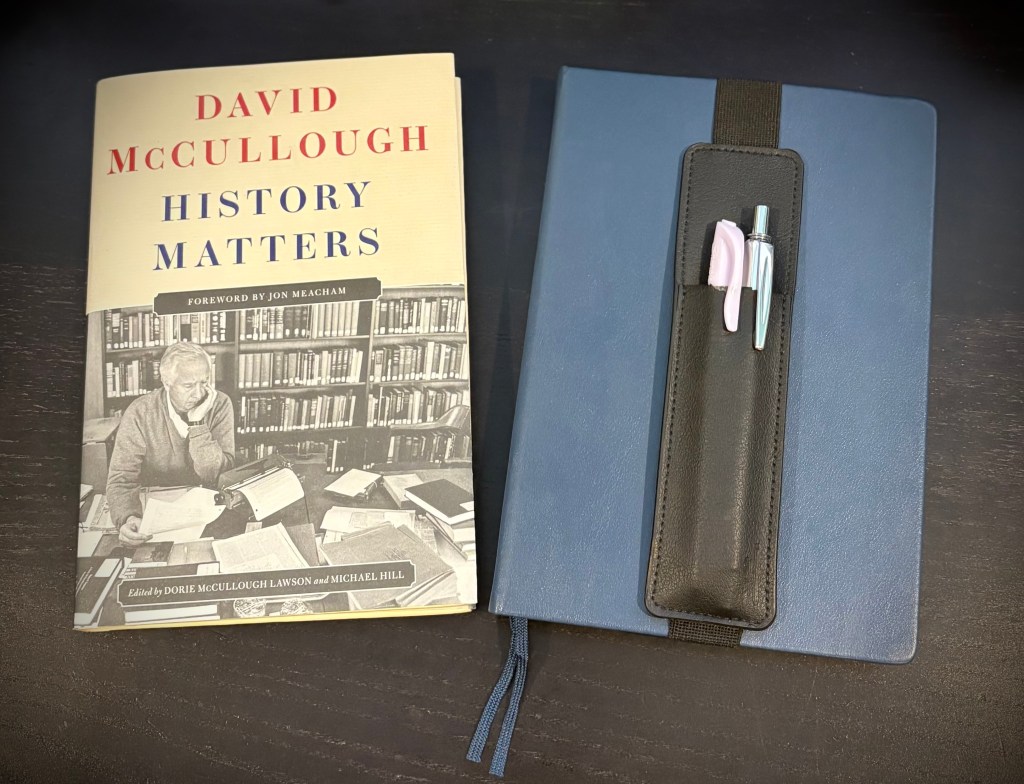
I must confess that I have never read any of David McCullough’s work before. In fact, the book I am about to review wasn’t written by him directly, but by his daughter, Dorie McCullough Lawson, who worked with him for almost 30 years, and by his researcher, Michael Hill. This posthumous book is a compilation of speeches, essays, and interviews that David McCullough wrote and delivered over his professional lifetime.
When I was looking for a biography of John Adams, the second president of the United States, McCullough’s book was among the top three recommendations. I ultimately went with Page Smith’s two-volume biography because experts considered it the most complete. However, I have heard that McCullough’s 1776 is excellent, so I added it to my reading list.
Jon Meacham, an American writer, historian, reviewer, and presidential biographer, wrote the foreword. He captured something central to understanding why history matters and how McCullough viewed the people and events of the past:
“They did not dwell in some land called ‘History’ or ‘the past.’ Like all of us, they dwelt in a vivid, living, chaotic present. And McCullough’s mission was to make their present real to the future—a key task, perhaps the key task, of the historian and the biographer.” (p. xii)
After reading History Matters, and seeing McCullough’s passion for history, I have to agree with Meacham’s assessment. McCullough brings history from the past into the present and makes it real for us.
History Matters was published in September 2025, and the book is divided into four parts:
- Why History? – This section lays out McCullough’s central conviction that history is essential.
- Figures in a Landscape – McCullough reflects on notable historical figures such as George Washington and Harry S. Truman.
- Influences – Presents McCullough’s reflections on the people, books, artists, and experiences that shaped his life.
- On Writing – Discusses how he conducted research and how curiosity drove each of his projects.
During a 1995 speech in which he received the National Book Foundation’s Medal of Distinguished Contribution to American Letters, McCullough said two things that particularly resonated with me:
“Indifference to history isn’t just ignorant, it’s rude. It’s a form of ingratitude.” (p. 3)
Reflecting on Thomas Jefferson’s famous quote, “Any nation that expects to be ignorant and free expects what never was and never will be,” McCullough added:
“And if the gap between the educated and the uneducated in America continues to grow as it has in our time, as fast as or faster than the gap between the rich and the poor, the gap between the educated and the uneducated is going to be of greater consequence and a more serious threat to our way of life. We must not, by any means, misunderstand that.” (p. 4)
Four years earlier, during the National Preservation Conference in San Francisco, he said:
“I hope that we will become a people who care about the past because we care about the future. I hope that we will become a people who are less self-centered, self-conscious, and selfish in terms of our own time.” (p.11)
McCullough emphasizes that we should not discard the past thinking we are somehow superior in our current era. Our present-day actions—on the economy, environment, and civic life—affect future generations. He encourages awareness of the past and present to improve the future.
In one essay, he outlined lessons from the past:
- “Nothing of lasting value has ever come without effort.” (p. 23)
- “Congress acts when the country wants action.” (p. 24) – highlighting women’s suffrage and Social Security as examples.
- “If the politicians of our time fail to meet the challenges of our time, we have only ourselves to blame. If we don’t vote, if we are unwilling to pay taxes, or even take part in the census, then what good are we as citizens?” (p. 24)
- “Our creative vitality has been an example for the world… Our creative energy and output, it should also be noted, has seldom had much to do with our politics… it was in the 1920s, for example, the time of the Teapot Dome Scandal, the era when the president of the United States, Calvin Coolidge, spent a good part of every afternoon asleep; when Gershwin composed An American in Paris, when Faulkner, Hemingway, and Fitzgerald burst upon the scene; when Lindbergh built his plane… when Michelson measured the speed of light… we are the people who built the Panama Canal, the Golden Gate Bridge, the Mount Wilson Observatory, the Library of Congress…” (pp. 24–25)
Regarding historical figures, McCullough notes that President Harry Truman believed every U.S. president “should know American history at least, and world history, ideally” (p. 84) and that Truman “enjoyed Cicero in the original Latin” (p. 95).
McCullough repeatedly stresses that democracy requires knowledge, liberty depends on informed and engaged citizens, and transparency is essential. Without public knowledge of leaders’ character and conduct, self-government becomes an illusion. He quotes John Adams:
“Liberty cannot be preserved without general knowledge among the people who have the right to that knowledge and the desire to know. But besides this, they have a right, an indisputable, unalienable, indefeasible, divine right to that most dreaded and envied kind of knowledge – I mean of the character and conduct of their rulers.” (p. 96)
He also highlights young Americans’ historical illiteracy. In one example, he and Tom Brokaw discussed World War II with students, who knew “a great deal about the Holocaust” but were vague about the war itself. Based on his teaching experience, McCullough observed that “twenty-five seniors majoring in history, none knew who George Marshall was” (p. 132).
He also shares a remarkable story of a conversation on a flight with a physician who, despite a strong education, expressed disinterest in history, claiming, “you never know what’s true and what isn’t true,” and even questioned the reality of the Holocaust (pp. 132–133).
On writing history McCullough writes:
“I write narrative history because I love the pull and power of a story and particularly plots driven by character.” (p. 133)
“It’s when you begin writing that you begin to see how much more you need to know.” (p. 146)
Toward the end of the book, the reader will discover the history of his typewriter and his preference for a typewriter over computers. The book also shares his recommended reading list and his love of art, particularly painting.
I was surprised by how much I learned about David McCullough and now understand why he was such a successful historian. If you want to know more about him, his passion for history, and how it shaped his life, this is the book for you.
About the Authors:
David McCullough has twice received the Pulitzer Prize, for Truman and John Adams, and twice received the National Book Award, for The Path Between the Seas and Mornings on Horseback; His other widely praised books are 1776, Brave Companions, The Great Bridge, and The Johnstown Flood. He has been honored with the National Book Foundation Distinguished Contribution to American Letters Award, the National Humanities Medal, and the Presidential Medal of Freedom.1
Dorie McCullough Lawson is David McCullough’s daughter and worked with him for nearly three decades. She is the author of three previous books, including Posterity: Letters of Great Americans to Their Children.2
Michael Hill As a historical researcher for over forty years, Michael Hill has assisted such authors as Michael Beschloss, Susan Eisenhower, Sebastian Junger, Michael Korda, David McCullough, Jon Meacham, and Nathaniel Philbrick. He won an Emmy in 1991 for his work as a co-producer on the Ken Burns PBS “Civil War” series narrated by David McCullough. He also served as a historical consultant on the HBO mini-series, “John Adams” and the ABC-TV mini-series, “Challenger” about the space shuttle disaster.3
 Thoughts about leadership, history, and more
Impressive to learn how relevant these quotes are to the present time. Lots of material to reflect on. Thank you for sharing your reading experience.
LikeLiked by 3 people
You’re very welcome. Thank you for reading and commenting, Rosana.
LikeLiked by 1 person
My pleasure, Edward.
LikeLiked by 1 person
Haven’t read him/them, but I couldn’t agree more: History does matter.
(And we’re seeing a very bad replay right now…)
LikeLiked by 2 people
I know, it’s a horrible lack of understanding. Thousands of years have shown that force might get you a short-term win, but it never solves the long-term problem.
LikeLiked by 2 people
Indeed. The number of long-term problems currently generated is mind-blowing.
LikeLiked by 1 person
Oh, yeah, and it’s going to get worse.
LikeLiked by 1 person
This books sounds empowering, that our votes matter and Congress will act when people show the way.
LikeLiked by 1 person
Absolutely! He had a lot to say about that. His interviews and speeches were filled with valuable historical insights.
LikeLiked by 1 person
I have read the Truman biography, Edward, but you’ve encouraged me to look at his more recent work. I am glad you underlined the lack of the knowledge of history. The absence sets us up for vulnerability to those who wish to manipulate and alter it. We face that problem today, as you know.
LikeLiked by 1 person
Absolutely! We are definitely paying the consequences of that absence now. I think a lot of people are falling for the alternate history being offered across different platforms on the internet.
He said many interesting things about Truman. If I decide to read Truman’s biography, I will choose McCullough’s. He also wrote a book about the Johnstown Flood, which I didn’t know anything about until he explained it in this book.
LikeLiked by 1 person
HI Edward, thank you for this insightful review. I have always held this view about knowing history. Of course, leaders also need to understand economics. A balance is required. Having one without the other is dangerous. The UK is an example of this imbalance with leadership.
LikeLiked by 1 person
I agree with you, and that is why we need to select the best people to lead our countries. Even if their knowledge in certain areas is limited, they should be able to hear all sides of an argument and come up with a solution that reaches a consensus. Thank you, Robbie.
LikeLike
Awareness of the past is so important right now, nice review!
LikeLiked by 1 person
You’re absolutely right about that. Thank you very much.
LikeLike
Edward, thanks for this excellent review. From the excerpts cited, David McCullough was a wise man. Thanks for bringing this book to our attention. By the way, I like the way you personalize the book cover.
LikeLiked by 1 person
Thank you very much, Rosaliene. He was a very insightful man, and his love for history came through clearly in this book.
LikeLiked by 1 person
The thought that “Indifference to history isn’t just ignorant, it’s rude. It’s a form of ingratitude” feels especially piercing. It reframes history not as an academic subject, but as a moral responsibility. A quiet acknowledgment of those who lived, struggled, and shaped the ground we now walk on.
And the reminder that they did not live in some distant realm called “the past,” but in a vivid, chaotic present just like ours dissolves the illusion of distance. It makes history feel immediate, human, and unsettlingly relatable.
Thank you for bringing this superb review. I couldn’t help reading it twice. 🙏🏻💛
LikeLiked by 3 people
You’re very welcome, and absolutely. What he said about history was profound, and it should make us think differently about history. I really appreciate your comment.
LikeLiked by 2 people
🙏🏻💛
LikeLiked by 2 people
Great review, and fantastic thoughts and pulls. I admit to being a complete nerd, so dry history works fine for me. That said, I’ve long been baffled at how so many people “hate history”, and believe people really object to how it’s taught.
Most people watch movies, TV, read novels, etc. What is history but real life stories of the greatest, the most amazing, the worst, most impactful, most dramatic, most consequential people and events?
LikeLiked by 3 people
Thank you, Scott. I don’t understand people pushing back against history. I know school teachers sometimes didn’t do a good job teaching, but nowadays, with AI, a person can get highlights and keep up with history. History is important.
LikeLiked by 2 people
Now more than ever!
LikeLiked by 1 person
Indeed.
LikeLiked by 1 person
I read John Adams’ biography for one of my American history courses in uni and really liked it. His schedule, understand and mind were so impressive.
I totally agree with the importance of knowing (accurate and factual) history. Not only does it help stop us from making similar mistakes in the future, it also helps us gain empathy for others and what they’ve been through. A lot of people lack empathy especially for minorities because they’ve never properly understood what they’ve been through.
LikeLiked by 3 people
Thank you, Pooja. His schedule, and the one his whole family followed, was definitely impressive. Your point about understanding minorities through studying history is spot on. It’s important to know the background of different races and ethnic groups in order to have empathy, as you said.
LikeLiked by 2 people
Have you read The Hardest Job in the World by John Dickerson? I find him a fascinating historian, and one thing I took from the book I mentioned is how badly behaved SO many presidents are, but in the past, White House staffers would often take the presidents’ vile scribblings and hide them away; now, according to Dickerson, many such letters are now in archives and museums. Do you have plans to read the new book, American by Jon Meacham? The part of your post that scares me is where you write about people choosing to care for one another, but based on what I’m seeing in the US, not enough of us care to be a majority. That’s terrifying.
LikeLiked by 2 people
I read the book, and it was fantastic. I actually wrote and posted a review earlier this year. I saw the Jon Meacham book as well, but I’ll probably read it next year. I think there are enough to form a majority, but I’m still struggling with the millions of people who didn’t vote in the last election. That’s problematic.
LikeLike
I actually forget millions of people did not vote. I suppose that’s because I ask myself how you could not.
LikeLiked by 2 people
That’s why I think voting should be mandatory in this country.
LikeLiked by 1 person
This is such an informative and generous review. Thank you so much for taking time to write it. And I especially like this quote, “Indifference to history isn’t just ignorant, it’s rude…”
LikeLiked by 2 people
I really appreciate your comment. I felt the same about the quote. It’s so powerful.
LikeLike
A wonderful review, Edward! I found it interesting that the author relates so strongly freedom and knowledge, and it made a huge impression on me that, for him, happiness is connected to self-development. I relate here. If we don’t learn from the past, we’ll continue to make the same “mistakes,” depriving ourselves, individually and collectively, of evolution. Thank you, my friend, for summarizing it in such an interesting and profound way. A great read! Light and blessings to you and yours, today and always!!! ✨🙏
LikeLiked by 2 people
Thank you, Susana. I also relate to that kind of happiness, which is one of the reasons I’m so attracted to Stoic philosophy. Growth in the areas we can control, such as personal education, is important because it helps us learn from our past and make better decisions about the future. I’m glad you enjoyed the review, and I hope you have a wonderful day, my friend.
LikeLiked by 1 person
What a fascinating review, Edward. I confess I haven’t read any David McCullough either. I think he had it spot on with, “McCullough repeatedly stresses that democracy requires knowledge, liberty depends on informed and engaged citizens, and transparency is essential. ”
“It’s when you begin writing that you begin to see how much more you need to know.” (p. 146)
And the other quote you pulled about indifference to history being comparable to ingratitude. Both get right to the heart of it.
Thank you for this great discussion of what is important, how we can continue to improve, and books that help us do it! Such a great post!
LikeLiked by 2 people
You’re very welcome, Wynne. I know, that quote from page 146 was so good. I was thinking about the different ways it can apply: writing about past hurts, realizing that there are still things that need to be worked out, and understanding more about why you acted a certain way. There’s so much there. I’m glad you enjoyed the discussion.
LikeLiked by 1 person
So much there — and in this great post. Thank you, my friend!
LikeLiked by 1 person
Great to read your review of this book. I now look forward to reading it. I love David McCullough’s work and his book on John Adams is one of my favorite books. I read it more than once. Thanks, Edward!
LikeLiked by 2 people
You’re welcome, Donna. If you like his work, then you’ll definitely enjoy this book. The book discusses why he wrote his books, and I found it very interesting, especially the part about the Johnstown Flood, which I didn’t know anything about until I read this book.
LikeLiked by 1 person
“Indifference to history isn’t just ignorant, it’s rude. It’s a form of ingratitude.” (p. 3) <—–THIS!!
LikeLiked by 2 people
“Educated” is a relative term. Someone can have a PhD and still be ignorant and closed-minded. And our educational system has not proven itself to be much more than a tool for indoctrination. Although I enjoy history, the way it was taught in school was boring and uninspiring. Working on my family genealogy really brought to life the lives of my ancestors in ways that no history class could ever do. They were real people with real problems to solve. They loved, hated, fought, struggled, built, created, destroyed, and did what they could to survive – no different from people anywhere in the world.
LikeLiked by 2 people
I completely agree with you, and oh my goodness, history classes were super boring in school. I’m finding that the narrative style of some historians is much better than a typical textbook, especially when they include letters.
LikeLike
Thanks for your share!😊
LikeLiked by 2 people
You’re very welcome. Thank you for reading.
LikeLiked by 1 person
Thanks for this great post, Edward. History matters although it doesn’t seem as such to leaders these days while trying to put their name on everything.
I so agree with this”
““I hope that we will become a people who care about the past because we care about the future. I hope that we will become a people who are less self-centered, self-conscious, and selfish in terms of our own time.”
❤️❤️❤️
LikeLiked by 3 people
You’re welcome, Cindy. I know, and it’s frustrating because they are always talking about protecting the Constitution, but sometimes I wonder if they even know what’s in it or if they are just repeating what others are saying.
LikeLike
Oh my…the power of seeing an indifference to history as ingratitude. Thank you for all of this, Edward. I, too, have never read McCullough but your essay here provided the urging to do so. 💝
LikeLiked by 3 people
You’re welcome, my friend. I never thought of indifference to history as ingratitude, but my goodness, he’s so right about that.
LikeLiked by 1 person
So simple – that phrase – and so powerful. Thanks again, dear Edward! I’m cheers-ing you with my coffee!
💝😉💝
LikeLiked by 1 person
Awesome! I was just about to get myself some coffee. So, cheers, my friend. ☕️☕️
LikeLiked by 1 person
❤️😉❤️
LikeLiked by 1 person
I can’t imagine anyone choosing not to be interested in History. The inspiration and education from the past are immensely valuable. Through studying history, we learn to be better, more creative, inventive, innovative people.
I read your review yesterday but didn’t have the time to respond then. I thought of your review of this book and the importance of history as the president gave the state of the union speech. I tried to watch because I want to be an informed citizen but oofta, I didn’t see much of it…. 😑😞 It was so disappointing.
LikeLiked by 3 people
So true, and if politicians spent more time reading history and reviewing the mistakes of the past, we would probably be in a better position now.
I didn’t watch the State of the Union because I really can’t bring myself to hear his voice anymore. I’ll read the analysis in the newspaper later this week. I was thinking that the last time I heard him speak was during the Zelenskyy Oval Office fiasco.
LikeLiked by 1 person
I have saved David McCullough’s 60 Minutes interview for watching later as my main reading is The Holy Bible and gentle fiction. Thank you for bringing him to my attention.
LikeLiked by 2 people
You’re very welcome, Lana. I also read the Bible, and nonfiction is my favorite, though I’m trying to add more fiction.
LikeLiked by 1 person
Nice review — I enjoyed this. It’s easy to forget that history isn’t just school stuff but actually helps us understand what’s happening now. You made the book sound meaningful without overhyping it. Good read 👍
LikeLiked by 3 people
Thank you, John. History is one of those subjects that should be part of lifelong learning for adults.
LikeLiked by 1 person
We are stories. The Bible. Well-researched and written historical books. This is how we learn and understand the human condition, how we hopefully, learn from our mistakes. Even fables help us understand humanity. Thank you for this referral, Edward. It’s in my Amazon cart.
LikeLiked by 4 people
You’re welcome, Mary. You’re absolutely right, and that aspect of our human condition came across clearly as I read this book. I really enjoyed reading his speeches and the script of one of his interviews. It’s not often that you have the opportunity to take an inside look into a historian of his caliber.
LikeLiked by 1 person
Great review, thanks for taking the time, very helpful.
Great quote, “it’s when you begin writing that you begin to see how much you need to know”.
LikeLiked by 3 people
Thank you very much! I felt the same way when I read it.
LikeLiked by 1 person
Both hubs and I have always been avid history buffs. Thank you for this review, Edward. Unfortunately I’m going to have to take a pass on reading the book, as I won’t live long enough to read all of the history and historical fiction books that I have downloaded to my e-reader.
LikeLiked by 5 people
You’re welcome, Terry. Tell me about it. I have several in my stack and a couple more on their way.
LikeLiked by 1 person
Thank you for this review, Edward. I would say that every American citizen should read History Matters, including those who attempt to change or erase historical events.
LikeLiked by 5 people
You’re very welcome, Liz. Definitely, especially when it comes to those attempting to change or erase our history. My goodness, there’s a lot of nonsense going on right now.
LikeLiked by 2 people
It’s so irrational and deluded, it boggles the mind.
LikeLiked by 1 person
I know. The more technologically advanced we become, the worse we are with respect to human connections and the sensibilities associated with them. Things might improve, but I’m afraid it won’t happen during our lifetime.
LikeLiked by 1 person
You’re probably right that the shift back to human connections and associated connections and associated sensibilities probably won’t happen in our lifetime—
LikeLiked by 1 person
Oops, sorry Edward! I hit Send by mistake.
LikeLiked by 1 person
You’re probably right that the shift back to human connections and associated sensibilities probably won’t happen in our lifetime. On the other hand, I still have faith that the humanities have the capability and the power to forge those connections and develop those sensibilities. I go back to William Faulkner’s Nobel Prize acceptance speech whenever I need to renew that faith. https://www.nobelprize.org/prizes/literature/1949/faulkner/speech/
LikeLiked by 2 people
Thank you for sending the link to his speech. I just read it, and it’s amazing. I went ahead and printed a copy for my personal binder. For my part, I’m focusing on the things that are under my control and doing my best to treat others well. I’m trying not to get sucked into the current narrative because it’s emotionally taxing.
LikeLiked by 1 person
You’re welcome, Edward! I’m so glad the speech struck a responsive chord.
LikeLiked by 1 person
It’s excellent, and I’ve already highlighted what he said toward the end about the human soul.
LikeLiked by 1 person
So glad to read this review, Edward. I agree heartily with the belief that a well educated population is essential for our country and democracy, and a deep study of world as well as American history are essential elements of that education.
LikeLiked by 4 people
Thank you, Lori. So true, even if our education system doesn’t support that kind of deep study anymore, we should definitely study history on our own. It’s so important.
LikeLiked by 1 person
Yes, Edward—we have libraries! We can all learn. 🥰
LikeLiked by 2 people
Yes! 🙌🏼 And then there are Google and ChatGPT for those who don’t want to read books. There is really no excuse for being ignorant about history.
LikeLiked by 1 person
I love that quote at the very start about happiness.
LikeLiked by 5 people
I had to include it at the start of the review because it was awesome. Thank you, my friend.
LikeLiked by 1 person
No, thank you!
LikeLiked by 1 person
You’re so welcome. 🙏🏼
LikeLiked by 1 person
Searching for happiness is an illusionary goal. Happiness is the byproduct or the reward of noble pursuit.
LikeLiked by 3 people
great review Edward. I will look into his writings! Mike
LikeLiked by 5 people
Thank you, Mike. I’m definitely going to read 1776.
LikeLiked by 1 person