Today is the International Day of the Girl Child, established on December 19, 2011, by the United Nations to recognize girls’ rights, address the challenges they face, and promote their empowerment and the fulfillment of their human rights.1
On October 9, 2024, the United Nations International Children’s Emergency Fund (UNICEF) released a report on sexual violence ahead of the International Day of the Girl Child stating that:
“more than 370 million girls and women alive today—or 1 in 8—experienced rape or sexual assault before the age of 18.”2
The same report indicated that between 410 and 530 million boys and men experienced sexual violence in childhood.
UNICEF defines sexual violence against a child in the report as:
“any deliberate, unwanted, and non-essential act of a sexual nature, either completed or attempted, that is perpetrated against a child, including for exploitative purposes, and that results in or has a high likelihood of resulting in injury, pain, or psychological suffering.”
Below is a graphic from the report.
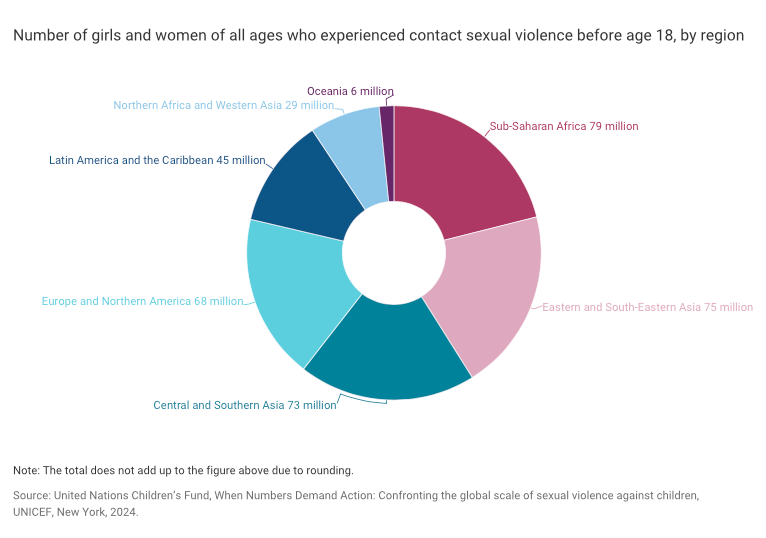
I look at these statistics and ask myself, what are we doing? I hear politicians and religious leaders talking about how children are a priority, but with these statistics, I don’t believe they are doing enough, and the same goes for us.
As citizens, we can do much to stop this tragic trend, and a lot of it involves changing the culture. We cannot keep electing men to higher office who constantly degrade women, and the same applies to religious leaders. Attending a church where the pastor, priest, or reverend preaches that women are not equal to men—based on a few Bible verses or any other sacred text taken out of context or upheld by “church tradition”—is absolutely wrong. Men and women are watching and listening, among them children, and over time, this kind of rhetoric becomes inculcated in our minds and accepted as normal. It is not, and we need to push back on politicians, religious leaders, and institutions that promote this narrative.
We can also set boundaries regarding what we consume in our daily lives. Why are we watching reality shows featuring young men and women staying in a house or on an island, engaging in unhealthy behavior? Yes, they are adults and can do whatever they want, but think about the message they are sending and how that behavior becomes normalized.
Then there’s social media. Why are we allowing our children free and unmonitored access to TikTok, Facebook, Twitter/X, and other messaging platforms? According to the Child Crime Prevention & Safety Center:
“there are an estimated 500,000 online predators active each day. Children between the ages of 12 and 15 are especially susceptible to being groomed or manipulated by adults they meet online. The F.B.I. states that over 50 percent of the victims of online sexual exploitation are between the ages of 12 and 15, and an estimated 89 percent of sexual advances directed at children occur in internet chat rooms or through instant messaging. In over a quarter of all reported exploitation incidents, the predator asks the child for sexually explicit photos. Four percent of children receive aggressive solicitations from adults online, including attempts to contact them in person or over the phone.”3
This applies to any content available on the internet that fuels this harmful behavior. We need to push back and be very judicious about what we consume.
This past weekend, I discussed how alcohol drives reckless behavior in young people. I talked about my time in college and how, on more than one occasion, I had to intervene when I saw guys trying to get my female friends drunk to take advantage of them later. My actions didn’t involve fighting with the drunk young men—though I was prepared for that scenario—but I would quietly pull my friend aside and tell her it was time to get home. I usually called one of her roommates to help once my friend was safely at her apartment.
When I was in the U.S. Army, we received sexual assault prevention training every year. I remember one time we watched a video as part of that training, and it remains the best training I received in my entire career. Here is the video:
The bottom line is that there are many things we can do daily to prevent and stop sexual violence and abuse, and we don’t need to wait for the government to do it for us. We just need to act—whatever that looks like at your level. Every little bit helps, and maybe, in the not-so-distant future, we will see a UNICEF report with significantly reduced numbers—maybe even zero. Then, we can proudly commemorate the International Day of the Girl Child as the day we finally eradicated sexual violence and abuse not just for girls but to women, boys, and men.
References:
 Thoughts about leadership, history, and more
Great
LikeLiked by 1 person
Thank you.
LikeLike
The numbers are staggering and this amid such a sound and well informed post, Edward. Love the video. I totally agree with you, we need to do better and expect more from our leaders! I would love some tea, Edward !!! Lemon grass with honey! Hold the sex 😝
LikeLiked by 3 people
You crack me up with your last comment. Jasmine tea for me. 😂 It’s incredible how many high-level officials and famous people attended gatherings and parties hosted by the late Jeffrey Epstein and rapper P. Diddy, who is now in prison awaiting trial, and thought that having young women and men (minors in some cases) performing sexually inappropriate acts was okay. That’s part of the problem – the normalization of this behavior.
LikeLiked by 2 people
Thanks for shining light on this, Edward 😊 lots of very deep and noble stuff you’ve been bringing up lately! That was nice how you provided also an example of how alcohol can fuel that kind of bad scenario and that you were there to help your female friends 🙏 women can often feel so vulnerable, forget even adding alcohol into the mix. It definitely can cause a trauma that is almost nearly impossible to heal from totally. Thanks again for sharing about this very important issue 🙏
LikeLiked by 3 people
Thank you so much, Laura, for your comments. It’s really sad how some men take advantage of certain situations, by using alcohol or drugs, as in the case of Bill Cosby, to impose their dominance and abuse women. We need to watch out for each other and step in when we see something wrong.
LikeLiked by 2 people
Thankfully that there are men out there like you that do that 🙏 it really does go a long way instead of just looking the other way 😊 happy Sunday! ☕️
LikeLiked by 2 people
🙏🏼 Happy Sunday! ☕️☕️
LikeLiked by 2 people
Very important topic, Edward! The numbers are dramatic! They express well the general degradation of humanity, or how far we have deviated from our original divine grace. A grace that includes, cares, respects, and loves all – girls, boys, woman, and man. And whenever we call attention to that “deviation”, in whatever form we can (like you did here), we are helping to dissolve the lack of sensibleness and virtue from society. Well done, my friend. Light and blessings to you 🙏 🌟 have a wonderful weekend 🍀🌈
LikeLiked by 3 people
Thank you so much, Susana. I liked what you said about deviating from our grace to care for, respect, and love all people. You’re absolutely right, and sadly, we are seeing the consequences around us. Blessings to you as well, my friend.
LikeLiked by 2 people
Thank you, Edward. There are no limits, sadly, to the need to educate on this topic. (And thank you for the video. I agree — it’s a good one.) 💕
LikeLiked by 3 people
Agreed, Vicki. This is one subject we need to overcommunicate and ‘overeducate,’ if that’s even a word.
LikeLiked by 3 people
With you all the way! Thank you again, Edward.
LikeLiked by 2 people
Hi Edward, this is an interesting post. I know there is a great deal of rape and sexual assault but that number is huge.
LikeLiked by 3 people
It’s extremely sad. I read the report, and I was shocked by the numbers.
LikeLiked by 2 people
😢❤️🔥
LikeLiked by 3 people
Thanks for reporting these alarming statistics. This is another epidemic that thrives on secrecy and silence. People on the internet can be dangerous, but most tragically women and girls who suffer this abuse most often know the abuser (relative, acquaintance or family friend). We need to be that trusted adult, the person who is willing to intervene to help the child we see with behaviors that belie their experience.
LikeLiked by 3 people
Thank you, Rebecca, for your comment. You’re absolutely correct and being the trusted adult is key. Communication with our kids is essential. They need to know it’s safe to tell their parents (or another trusted adult, as sadly there are cases where the parents are the abusers) if they are victims of abuse so intervention can occur.
LikeLiked by 1 person
Another fantastic post. The statistics are frightening. Thanks for adding things we can do. And the Tea video while sort of funny, is no joke. It makes Consent very easy to understand.
LikeLiked by 2 people
Thank you, Rose. The statistics are indeed frightening. The video was really good and the highlight of that training session—simple but very effective.
LikeLiked by 1 person
Bravo, Edward, for highlighting this egregious behaviour on the part of so many men. If anything, at the moment we seem to be falling backwards. Thank you for raising the issue with both facts and passion.
LikeLiked by 2 people
You’re welcome, Jane. It definitely seems that way, and most leaders are tap dancing around the problem without addressing the main causes.
LikeLiked by 1 person
Thanks for caring and highlighting this important issue Egidio.
LikeLiked by 2 people
You’re very welcome. I think it’s important that we continue educating the community on this issue, which is affecting so many.
LikeLiked by 1 person
Agreed.
LikeLiked by 2 people
Thank you for this informative post, Edward. The statistics you cite are very alarming, but we need to know them.
LikeLiked by 2 people
You’re welcome, Liz. These are alarming indeed. We need to continue to educate and press the issue to get rid of this once and for all.
LikeLiked by 1 person
Your topic is important and well-written, Edward. I appreciate that you included males, as well. When I was young, I thought only girls were abused. Then I learned of all the young boys who were treated this way. When children are harmed, their whole life changes. We destroy the joyful part within for the future of the world.
LikeLiked by 3 people
Thank you, Mary. The sad reality is that this evil affects all genders, and it seems to be getting worse every year.
LikeLiked by 1 person
Well said, Mary.
LikeLiked by 1 person