“It’s strange how you give the people you love so much power over you.” (p. 199)
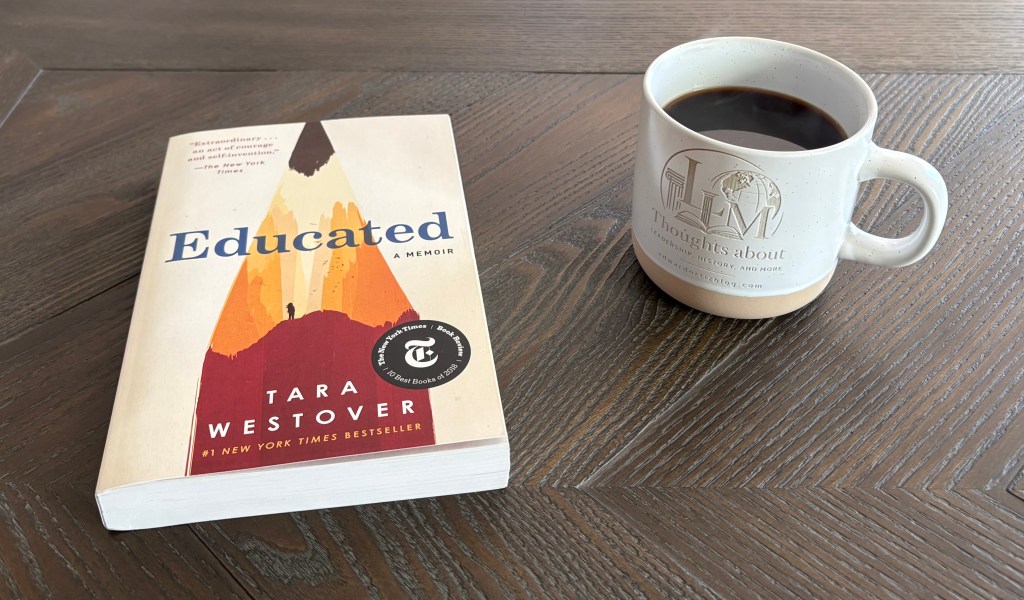
Educated by Tara Westover has been on my mind for a while now, but it wasn’t until I interacted with Rose from Of All The Things I’ve Ever Dreamed and Pete Springer about banned books that I decided to buy and read it. It was excellent, so thanks to Rose and Pete for the recommendation.
Educated is a memoir written by Tara Westover in 2018 that became a New York Times bestseller. In it, Tara recounts her life in Idaho as part of a very conservative Mormon family. She is the youngest of seven children, and in the book, she describes how her parents didn’t send their children to school because her father believed in conspiracy theories about the government. This included refusing to vaccinate them or obtain birth certificates. She describes the neglect and abuse, both mental and physical, that she and her siblings suffered while growing up in their home.
It was truly heartbreaking to read about their lives and all the abuse they endured. It’s hard to describe the feelings that come up as she goes on talking about all the things her father did. Some of the things are unbelievable and, quite frankly, insane.
But her story is also about resilience. She was able to teach herself enough to pass the college admission test and was admitted to Brigham Young University (BYU) in Utah without a high school diploma. She went on to earn a master’s degree and a PhD from the University of Cambridge. She was poor, but she managed to finance her education through money from her work, some support from her parents, scholarships, and eventually a Gates Cambridge Scholarship, which covered her expenses.
No amount of highlights can describe what I felt while reading her book. You need to read it to understand, and I’m sure the reading experience will be different depending on your background and how you grew up. Some ultra-conservative religious people probably wouldn’t want this kind of story to be published and reach a wider audience. Perhaps that’s one of the reasons this book has been banned or restricted in certain places. I can understand why some people wouldn’t want these realities brought to light and would rather keep them in the dark. After all, it’s about power and manipulation. Readers will see all of this play out in Educated.
There were car accidents in which Tara’s mother was severely injured, as well as work-related injuries at home in which children were cut, burned, or knocked unconscious, among other incidents. The most incredible part is that none of these injuries were treated at a medical facility. Instead, they stayed home and relied on natural remedies.
Here are a few highlights:
Tara was trying to fit in with other girls and started attending dance classes behind a gas station called Papa Jay’s. Here is how she described one of her experiences with the group:
“The other girls rarely spoke to me, but I loved being there with them. I loved the sensation of conformity. Learning to dance felt like learning to belong. I could memorize the movements and, in doing so, step into their minds, lunging when they lunged, reaching my arms upward in time with theirs. Sometimes, when I glanced at the mirror and saw the tangle of our twirling forms, I couldn’t immediately discern myself in the crowd. It didn’t matter that I was wearing a gray T-shirt – a goose among swans. We moved together, a single flock.” (p. 79)
Here is how Tara envisioned her future before a discussion with her brother about going to college:
“I said nothing. College was irrelevant to me. I knew how my life would play out: when I was eighteen or nineteen, I would get married. Dad would give me a corner of the farm, and my husband would put a house on it. Mother would teach me about herbs, and also about midwifery, which she’d gone back to now the migraines were less frequent. When I had children, Mother would deliver them, and one day, I supposed, I would be the Midwife. I didn’t see where college fit in.” (p. 123)
Tara’s father discussing college with her:
“I’ve been praying about your decision to go to college… The Lord has called me to testify…He is displeased. You have cast aside His blessings to whore after man’s knowledge. His wrath is stirred against you. It will not be long in coming.” (p. 133)
After a conversation with her BYU Jewish history professor, Dr. Kerry, he saw her potential and told her that she should apply to Cambridge University. Dr. Kerry said, “It’s highly competitive and extremely demanding. You might not be accepted, but if you are, it may give you some idea of your abilities.”
On her way back to her apartment, she wanted to hear some kind of advice from Dr. Kerry that aligned with her thoughts about being a wife and mother. But Tara heard something else, as if Dr. Kerry were saying:
“First find out what you are capable of, then decide who you are.” (p. 230)
After that, she applied for admission to Cambridge.
At Cambridge, she learned about Isaiah Berlin’s two concepts of political freedom: negative liberty and positive liberty. During a lecture, here is how one student and the lecturer described positive liberty:
“Is freedom from internal constraints… positive liberty is self-mastery–the rule of the self, by the self… is to take control of one’s own mind; to be liberated from irrational fears and beliefs, from addictions, superstitions and all other forms of self-coercion.” (p. 256)
Back in her room after this lecture, she opened an email from her friend Drew that included a song by Bob Marley, “Redemption Song.” As Tara listened, these lyrics came to mind:
“Emancipate yourselves from mental slavery
None but ourselves can free our minds.” (p. 257)
After that, Tara called the university nurse to schedule her vaccinations, since she had never received any vaccinations in her life.
Tara went on to complete her master’s degree and then a PhD in history. The title of her thesis was “The Family, Morality, and Social Science in Anglo-American Cooperative Thought, 1813-1890.” (p. 318)
An interesting fact is that the three children who left the family earned PhDs: Tara in history, Tyler in mechanical engineering, and Richard in chemistry. The other four did not receive any formal education and remained part of the family and its troubling environment.
If you haven’t read Educated, I highly recommend that you do. Her story will keep you hooked until the end and will leave you thinking about her experiences for a long time.
About the Author:1
Tara Westover is an American memoirist, essayist and historian. Her memoir Educated debuted at No. 1 on The New York Times bestseller list and was a finalist for a number of national awards, including the Los Angeles Times Book Prize, PEN America’s Jean Stein Book Award, and two awards from the National Book Critics Circle Award. The New York Times ranked Educated as one of the 10 Best Books of 2018. Westover was chosen by Time as one of the 100 most influential people of 2019.


I read that book when it first came out. I had no idea it was being banned! That’s pretty disturbing. There’s another memoir I read around the same time called The Glass Castle by Jeanette Walls. Her parents were neglectful for entirely different reasons (they were not religious conservatives), but she managed to become a successful journalist. Makes you wonder how many ordinary children will never reach their full potential due to selfish parents with crazy ideas keeping them out of public schools and other settings where they could get help. Walls and Westover are exceptions, I think.
LikeLiked by 3 people
You have a great point. From Tara’s story, we learned that those who left her family were able to reach their potential. The whole banning issue was a surprise to me, and I found out about it while reading Rose’s post. Apparently, the book was banned or restricted in some places because of its discussions of abuse. This doesn’t make sense to me at all, but some people don’t want to talk about the realities that some families are living with.
LikeLiked by 3 people
Ed, fine review, and you chose the right lines. One thing the highlights don’t mention: Westover footnotes her own book where her brothers remember the same events differently, and lets both versions stand. Her parents later called her memories distorted, through a lawyer. She had already answered them, in the footnotes. Joe
LikeLiked by 2 people
Thank you, Joe. You’re absolutely right about her footnotes. It was interesting to read the different versions, not to mention the analysis of her mother’s own memoir. In the end, it’s clear that what Tara described is pretty accurate.
LikeLiked by 3 people
This sounds like a deep and interesting read, Edward. Thanks for the excellent review!
LikeLiked by 2 people
You’re welcome, Terry. It’s a really good read.
LikeLiked by 2 people