What an election night! I know the votes are still being counted, but it’s clear that the country wants to move in a new and better direction. We’ll see if the new leadership in the U.S. Congress puts its leadership skills into practice for the common good or wastes the next two years fighting the other side.
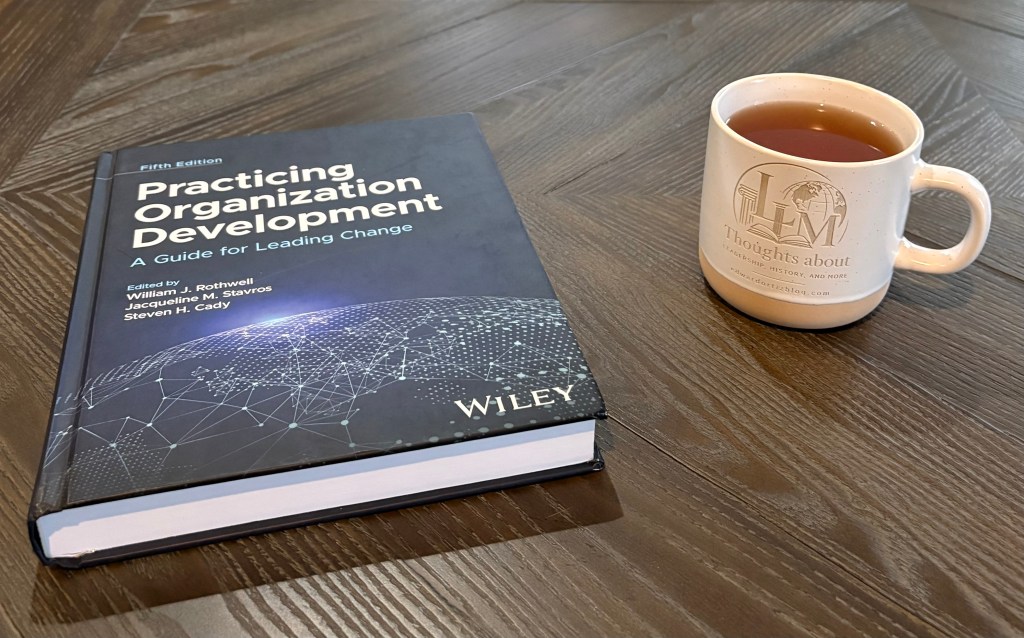
I just finished reading Practicing Organization Development: A Guide to Leading Change, a book that members of Congress should read. My journey to this book was an interesting one and started with a conversation with Elizabeth (Liz) Gauffreau. She mentioned Dr. Lindsey N. Godwin and Appreciative Inquiry, which piqued my interest. So, I started following Dr. Godwin on LinkedIn, and she highlighted the book and her contribution to it. She worked on a chapter called “Appreciative Inquiry – The Design of Net-Positive Organizations” with two other scholars. It was a great chapter, and I learned a lot about Appreciative Inquiry (AI). Here’s what they said about Appreciative Inquiry:
“AI is about the search for the best in people, their organizations, and the strengths-filled, opportunity-rich world around them.” (p. 77)
Good, right?
I’m not going to write a review of this book, which is actually a textbook, because I don’t think anyone in my WP community will buy it. However, I know there are a couple of consultants in the community who could find some goodness in this book because it really breaks down how to lead an organization through a deliberate change process using Organization Development and Change (OD&C) best practices.
I like how the editors defined OD&C:
“is an interdisciplinary, values-driven field that applies social and behavioral sciences to facilitate system-wide, planned, and adaptive change in organizations and communities. Through collaborative engagement, OD&C professionals (scholars and practitioners) enhance organizational effectiveness and vitality while fostering human potential and ethical leadership.” (p. 16)
This book is best suited for current leaders and managers. So, I think it’s better if I highlight a few areas that can be put into practice in our daily lives, regardless of where we are.
Many of you have heard about writing personal vision, mission, and purpose statements. There is tremendous value in writing those statements, and the book describes the three as follows:
“A meaningful personal vision provides an ideal to strive for and a basis for action in various domains of life… Mission is what you do and for whom, and purpose is why you do it.” (p. 70)
As a blogger, I’m framing my vision, mission, and purpose as follows:
A lifelong learning journey by engaging with a global audience in meaningful discussions in order to exchange ideas and share what I’m learning along the way.
I think it’s important to write out, or at least think through, your vision, mission, and purpose for your blog. Visualizing what you want will drive your motivation for blogging. Will this change? You bet it will, because as Peter Drucker says:
“Change is not an event but a constant state in which we live.”
Another aspect that I found interesting was the concept of a “thought leader,” which technically refers to an individual who is an authority in a specific area and is capable of thinking critically, challenging ideas, and answering important questions.1 I would translate that to the blogosphere as someone who wants to share knowledge acquired over a lifetime.
The book talks about the development of a “thought leader” through four steps: credentialing, skill development, subject matter expertise, and producing scalable wisdom while actively engaging with a community of practice. (p. 121)
Most bloggers in my community are thought leaders because, in one way or another, they have been through those four steps and are actively pursuing scalable wisdom and engaging with a community. Here, you can see the magnificent work that poets, storytellers, photographers, artists, writers, educators, psychologists, business owners, and many others share on a weekly basis in our WordPress community.
The last thing I want to share is a framework called SOAR (Strengths, Opportunities, Aspirations, and Results). This is a framework for strategic thinking, planning, leadership, and conversations. It is a reframing of the traditional concept of SWOT (Strengths, Weaknesses, Opportunities, and Threats), which I used many times throughout my professional career.
The importance of both frameworks is that they help you see the possibilities in everything you do throughout your life.
SWOT is very business-centric, but SOAR can be used wonderfully as a blogger. The book describes each component of SOAR on page 230 as follows:
Strengths: What you do well.
Opportunities: Where you can grow and innovate.
Aspirations: What you want to achieve.
Results: The measurable outcomes you aim to deliver.
This will look different for each blogger, but if you spend a little time thinking through how SOAR applies to your particular circumstances, I believe you will see things more clearly and probably find that extra motivation to continue blogging or pursue a project you have in mind.
As you can see, while reading this book, I was thinking about my WordPress community. I know many of you are thinking about your future as bloggers. Some are thinking about writing a book, moving to other platforms, or just moving away from the blogosphere altogether. I extracted three areas from the book that could help you make your decision.
Taking some time to think about your vision, mission, and purpose for your blog or project, recognizing that you are a “thought leader,” and using a concept such as SOAR to explore your possibilities can help you with your decision-making process.
My real hope is that you get a motivational boost from reading about the areas I highlighted and find something that resonates with you.
If that’s the case, I would love to hear from you.


Ed, your discussion of organizational development brought back some wonderful memories of my late wife, Joan, who earned her PhD in organizational leadership from George Washington University. During our 13 years together, she taught me an extraordinary amount about leadership and organizational behavior. She used to joke that I’d never had an original idea because I’d become so adept at adopting her teachings. Perhaps that’s the finest compliment a student can pay a teacher: making the lessons so thoroughly one’s own that the distinction eventually disappears. Your observations about lifelong learning certainly brought a smile to my face today. Thank you, my friend. Joe
——— GMJoe™ ——— https://gmjoe.org/engagements/
Joe Cozart GMJoe™ Consulting Clarity. Strategy. Sovereignty. Author, Consultant, Writer The Olive Ann Hotel Lobby Grand Forks, ND 58201 Mobile: (701) 885-2684 Email: joe@gmjoe.org
Website: https//:GMJoe.org
>
LikeLiked by 1 person
You’re welcome, Joe, and thank you for your comment. The whole theory behind leadership and organizational behavior is fascinating to me. I wish more leaders and managers would spend more time studying these areas, but I understand that many companies and organizations don’t prioritize professional development, at least not at the same level we’re used to in the military.
LikeLiked by 1 person
Wow, what an election night. I’m truly stunned.
LikeLiked by 1 person
Absolutely, especially what happened in Iowa and Texas. Crazy!
LikeLiked by 1 person
I know. And Kansas. And maybe Mississippi! 😳
LikeLiked by 1 person
Yes, Kansas too! The first Democrat since the 1930s. Incredible! I’m monitoring Mississippi; it’s super close. What about South Carolina? That was another surprise.
LikeLiked by 1 person
Right!
BTW, just saw your Gov with Heather Cox Richardson live on YouTube. He sent a 75-page letter to incoming Congress on what they need to do for the people STAT. I like him.
LikeLiked by 1 person
I just found the letter. He is a strong governor, and I think he would make a great president.
LikeLiked by 1 person
I am sincerely happy and relieved that things turned out so greatly in the elections. For America and the world things were looking very bleak. The people have spoken. Now let’s hope the leaders will listen.
LikeLiked by 1 person
Absolutely, Michael! There are a lot of happy people in this country and around the world, for sure.
LikeLiked by 1 person
I love the invitational nature of the SOAR model. It’s so important to take time to reflect, rather than forge ahead — even when we think we’re headed in the “right” direction. So good, Edward!
The appreciative inquiry approach reminds me of ‘strengths-based leadership’ models that we’re very in vogue in the 90’s. Maybe they still are?
I love the interaction you described with Liz and how you go forth and explore…returning here to share. Many thanks! And side note: Woohoo! Your opening paragraph reflects what I’m feeling…relief…and hopefulness. 💝💝💝
LikeLiked by 1 person
Absolutely! The components of strengths-based leadership models are highlighted in the book. They are still applicable to our current environment, for sure. Yes, I like that interaction loop. I learn something new from one of you, and then I’m able to come back and share what I’ve found. It’s so useful for me.
And yes, my goodness, what a night! Relief definitely came to mind last night, as I think the results will disrupt some very concerning trends we’ve been observing over the last couple of years.
LikeLiked by 1 person
I love the journeys you take, digging deep and bringing great inspiration back for us, Edward! Thanks for the generosity…again and again!
And yes…those results. I think there were a lot of sleep deprived, but happy people in my path today. So good to feel a sense of joy returning about where we’re headed in this country. xo! 💝
LikeLiked by 1 person
You’re so welcome! I think you can count me among the sleep deprived. I don’t watch much TV these days, but last night I broke the rule for a good reason.
LikeLiked by 1 person
Same! ❤️😉❤️
LikeLiked by 1 person
Awesome! Well, we will sleep like babies tonight. 😀
LikeLiked by 1 person
Yes!!! I had to restrain myself from another cup of coffee this afternoon! 🤪
LikeLiked by 1 person
Same here. Tea and a smoothie. I’m thinking about hot chocolate before calling it a day.
LikeLiked by 1 person
Ohhhh! Yum. A well-deserved treat!
❤️😉❤️
LikeLiked by 1 person
Yes! 🙌🏼
LikeLiked by 1 person