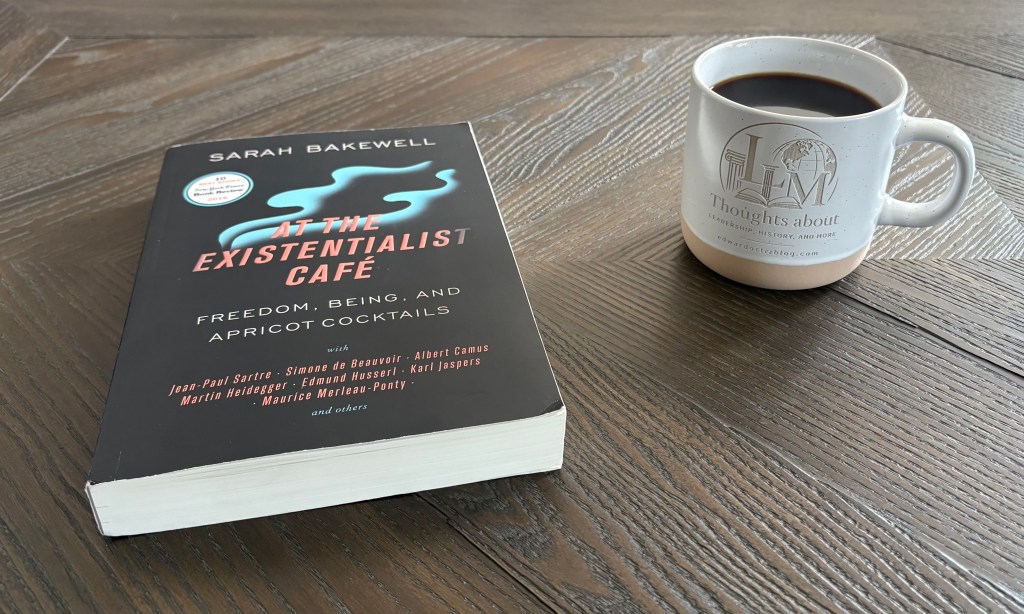
Today, I want to share something I found while reading At the Existentialist Café by Sarah Bakewell that made my coffee neurons happy. Then, I’ll talk a little bit about a collaboration I did with my blog friend Teagan from Teagan’s Books.
Let me start with the existentialist part. No, I’m not turning into an existentialist, which, in essence, is a philosophy that explores ways to live an authentic life.1 The reason I’m reading about existentialism is that it’s part of a deeper study I’m doing on Stoicism and its relationship with other philosophies, especially as I look for similarities.
One of the fundamental aspects of Stoicism is that worrying about things outside your control is futile and isn’t going to make you happy. Instead, happiness is based on what you can control, such as living virtuously, learning, and engaging in activities that strengthen your ability to remain unaffected by external factors.
Existentialists try to enjoy things, objects, or events as they present themselves to a person in the moment they are experiencing them. Here’s the example I read in the book that triggered my coffee neurons and made me stop to get myself a cup of coffee.
It started with the question, “What is a cup of coffee?” The explanation went on to say that a person holding a cup of coffee might start thinking about its chemical composition, where it came from, the type of plant it grew on, or how caffeine affects the body. A better approach is simply to enjoy the cup of coffee and describe what the person is experiencing in that moment.
“This cup of coffee is a rich aroma, at once earthly and perfumed; it is the lazy movement of a curlicue of steam rising from its surface. As I lift it to my lips, it is a placidly shifting liquid and a weight in my hand inside its thick-rimmed cup. It is an approaching warmth, then an intense dark flavour on my tongue, starting with a slightly austere jolt and then relaxing into a comforting warmth, which spreads from the cup into my body, bringing the promise of lasting alertness and refreshment. The promise, the anticipated sensations, the smell, the colour and the flavour are all part of the coffee as phenomenon. They all emerge by being experienced.”2
Was that good or what?
So, put aside the theory behind things and just enjoy the moment.
As I mentioned at the beginning, the second part of this post is about my collaboration with Teagan. By the way, if you’re not following her blog, I highly recommend that you do.
A few weeks ago, she reached out to me because she was thinking about writing a post about shapeshifters that she intended to publish close to Halloween weekend. Teagan recalled a discussion about the Taínos, the Indigenous people of Puerto Rico, in one of my posts and asked me if I could write a few lines about shapeshifters in Taíno culture or perhaps share some other Puerto Rican lore.
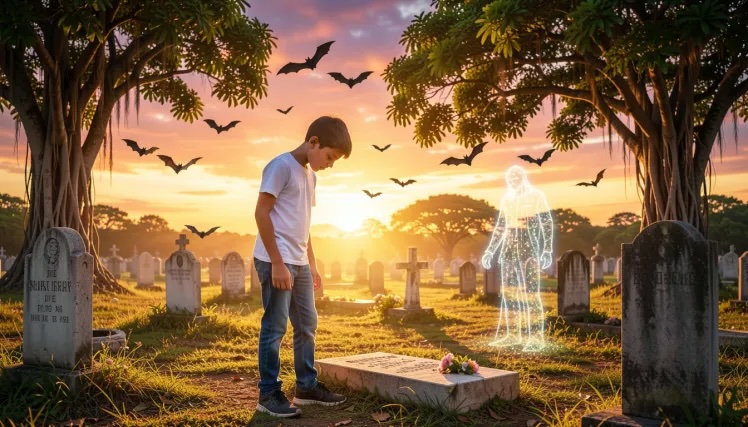
I told her that I knew a few stories but needed to do some research to get the details right. So, I did the research and wrote a couple of paragraphs. As I was thinking about sending her what I had written, I somehow saw a story in those paragraphs, so I decided to turn them into a short story called A Tale of the Jupías.
I would like to invite you to visit Teagan’s blog by clicking here or on the image below. I hope you enjoy her wonderful post and my short story.
I hope you have a wonderful rest of the week while enjoying a nice cup of coffee, tea, or whatever your favorite drink may be. Just remember to disconnect from the world for a moment and simply enjoy your drink.
- https://en.wikipedia.org/wiki/Existentialism ↩︎
- Bakewell, Sarah. At the Existentialist Café. (p. 41). New York: Other Press, 2016 ↩︎


My first thought when reading about existentialism, was “Oh, you sweet summer child.” That doesn’t sound polite. Let me explain. I have lifelong anxiety. I only live in the past and in the future, and I analyze the ever-loving shit out of it. My husband has ADHD, so nothing but the present exists to him. Our house is about as weird as the Time Warp that Dr. Frankenfurter sang about when it comes to fighting with being present but not too present, thinking about the future but not obsessing over it, learning about the past but not analyzing it to death. Fun!
LikeLiked by 1 person
I understand what you mean. I’ve battled anxiety and PTSD, and in many ways, I’m still recovering. CBT (CPT for PTSD) has been helping me. It’s based on Stoic philosophy, and that’s how I became interested in studying the Stoics. It’s a lifelong battle.
LikeLike
Love this discussion. I’ve been reading up on the Stoics for years. We could discuss this forever. I’ll be following Teagan as well. Thank you my friend!
LikeLiked by 1 person
I know, this is one of those conversations to have while sitting in a coffee shop and enjoying a nice cup of joe. Thank you, my friend. ☕️
LikeLike
Fun story Edward, and clearly that person enjoys and savors coffee, unlike me. 😊
LikeLiked by 1 person
Thank you, Brad. Right? I read that and knew I needed to share it with the WP community. I think the same concept applies to tea, beer, and even water. I’m sure we can come up with a nice description for any of those. 😀
LikeLike
Brewing coffee is my favorite scent! I enjoyed your story about the shapeshifters in Taíno culture. Stories are a great way of teaching children to avoid danger.
LikeLiked by 1 person
I know, it’s so good. I really appreciate your comment, Rosaliene. I spent a few days writing that little story, so I’m glad you enjoyed it. You’re absolutely right about the value of stories.
LikeLike
Many admirable men, including Marcus Aurelius, Epictetus, and Marcus Brutus, were stoics. You might want to read about Vice Admiral James Stockdale, who was a POW for seven years during the Vietnam War. He attributed his survival to his reliance in the teachings of Epictetus. He eventually became a VP candidate, among other things
LikeLiked by 2 people
Absolutely! I heard about Admiral Stockdale on The Daily Stoic, and some articles he wrote are on my to-read list. A fascinating story!
LikeLiked by 2 people
Glad you are ahead of me, Edward. Stockdale and his wife wrote a memoir of his experience during the war and her experience at home trying to advocate for him. Not much about Stoic philosophy there, but quite a story otherwise.
LikeLiked by 1 person
Okay, that’s good to know. The articles I found are deeply rooted in Stoicism, so it’s going to be interesting to read about how he applied the philosophy during his career.
LikeLiked by 1 person
I enjoyed the flash fiction piece, Edward. I know you said you’re not into fiction, but you should drop a few more pieces throughout the year it was a good story.
Congratulations.
LikeLiked by 3 people
Thank you very much, my friend. Let’s see if I get more inspiration like that.
LikeLiked by 1 person
You’re welcome 😊
LikeLiked by 1 person
Hi, Edward. I love the subtitle of that book — not to mention the idea of apricot cocktails. LOL. The paragraph you shared from it, deep contemplation of the coffee… Yeah… my brain isn’t capable of that until *after* I’ve had the coffee, but I do like it. 🙂
Many thanks for your kind words about my blog, and for linking to our post. Your story-form of describing the mythology was wonderful, and collaborating with you was a joy. Hugs to you and yours. Happy (almost) Halloween.
LikeLiked by 3 people
Thank you, Teagan. Yes, me too, after coffee! It was a real pleasure collaborating with you, my friend.
LikeLiked by 1 person
Ah yes.. I have been doing my best to live by faith… it feels closer to stoicism to me at least. So I guess to some degree I am a stoic.
I am currently writing a series about a shapeshifter (lagahoo) in caribbean folklore, specifically Trinidad folklore. I will definitely sink my teeth into Teagan’s story some time today. I’ve been putting it off, but I have the time today.
LikeLiked by 2 people
Nigel, your story will be fascinating. I’ve enjoyed any research I’ve done that dips into Caribbean lore, voodoo, and Santería. Maybe exercise a little Existentialism and click over to visit with Edward and me. 😉 (Although my part of the post is actually in the form of a tarot reading.) Hugs!
LikeLiked by 2 people
My poetry tends to lean into existentialism… takes a lot to unlearn a lifetime of indoctrination. 🤭
I’m always happy to read you guys, time permitting.
LikeLiked by 1 person
Absolutely, Nigel. I’m also comparing it with Christianity, and there are definitely similarities. Early Christians drew on a lot of Stoic philosophy in their writing and adopted many of its ideas. The Stoics believed in God from a pantheistic perspective. I’m finding that many things Christian leaders struggle to explain clearly are explained wonderfully by the Stoics.
LikeLiked by 2 people
Yes, that has been my experience over the last several years. There is compatibility on certain levels that makes it easier for me to approach the stoic’s approach, Christian mysticism, and the like.
LikeLiked by 1 person
Indeed. I noticed that as soon as I started reading the Stoics early last year.
LikeLiked by 1 person
I look forward to reports on this quest. Enjoy the process, Edward.
LikeLiked by 1 person
👍🏼 Thank you!
LikeLike
The subject matter reminds me of this quote “If you have one eye on yesterday, and one eye on tomorrow, you’re going to be cockeyed today.” A good reminder to live in, and fully enjoy the present.
LikeLiked by 4 people
Great quote, Lana. It’s so true. Thank you!
LikeLiked by 1 person
Great quote.
LikeLiked by 2 people