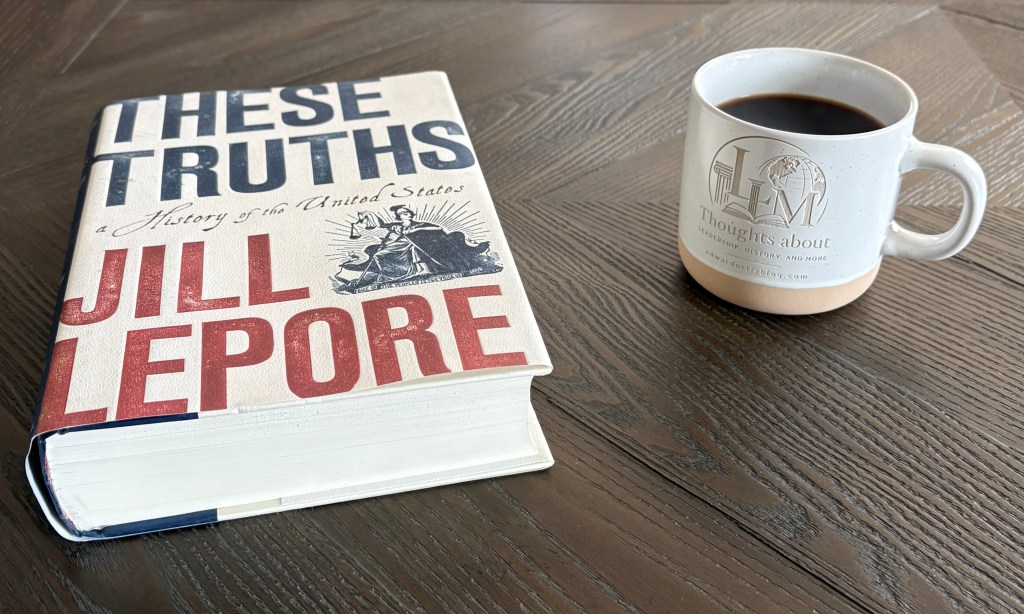
Reading about our history is fascinating. In How to Read a Book by Adler and Van Doren, the authors write that “if you want to discover the truth of the past, you had better read several books about it rather than one.” The more you read, the more you fill in the gaps. After all, the history we learn in school is condensed. So, it is up to each person to continue their education if they want to understand different aspects of their country’s history.
It’s difficult to find a good single-volume history book that covers the entirety of a country’s history. I have several books covering the creation of the United States, the American Civil War, and U.S. participation in different wars, but now I’m focusing on the whole of our history. I read my son’s high school history textbook, which was very good and provided snippets of this country’s history, but I wanted more.
In my search for a single-volume history book, I found These Truths: A History of the United States by Dr. Jill Lepore, published in 2018. Her approach focuses on politics, highlighting the contradictions between the ideals upon which this country was founded and the reality of its history through 2016. The book is highly readable and engaging.
The book is over 800 pages long, and it took me about 40 days to read. It is divided into four parts: The Idea (1492–1799), The People (1800–1865), The State (1866–1945), and The Machine (1946–2016).
Because she describes how politics and worldviews shaped this country, Lepore begins the story in 1492 with Columbus’s voyage to the Americas. She mentions the Native Americans who lived here before the arrival of Europeans and highlights, for example, the people of Cahokia. They built the largest city in North America, located on the Mississippi floodplains (p. 8). I had the opportunity to visit Cahokia Mounds in Collinsville, Illinois, during my Route 66 trip, and the site is amazing.
The book was a pleasure to read, although toward the end, beginning in the 1990s with Bill Clinton, the 42nd president of the United States, I sensed a bit of a rush. The solid theme and narrative the author had developed from 1492 onward seemed to lose some of their strength. I’m not sure why this happened, but writing a book of this scope is difficult, so I’m willing to give her some grace here.
The title says it all: These Truths. From the title, you can deduce the book’s central theme. The words come from the preamble to the Declaration of Independence, written by Thomas Jefferson, which states:
“We hold these truths to be self-evident, that all men are created equal, that they are endowed by their Creator with certain unalienable Rights, that among these are Life, Liberty and the pursuit of Happiness.”1
The conflict inherent in the words “These Truths” begins at the very beginning of the country’s history. The ideals expressed in the Declaration of Independence are incompatible with the reality of Thomas Jefferson’s life as a slave owner.
It is in this context that Dr. Lepore takes us on an exploratory journey, identifying the points of friction throughout U.S. history where “These Truths” were not as “self-evident” as we might expect.
Lepore describes the arrival of Spanish conquistadors in North America beginning in 1513, as they occupied lands in what we now know as Mexico and territories stretching from California to Florida, northward to Virginia and even Canada. She then describes the first English settlement in Virginia in 1606.
From that point on, her narrative describes the injustices suffered by Native Americans, women, enslaved Africans, Chinese immigrants, Irish immigrants, Jewish people, and many others. The author does a really good job of highlighting how “These Truths” were meant to apply only to a select group of people. Expanding that group to include everyone would require a constant fight for individual rights—a fight that, sadly, continues to this day.
The history of the United States is vast, and most people know the basics. I’m only going to highlight some things I learned or was reminded of because, let’s be frank, I’m getting old and starting to forget things.
“In 1504, the king of Spain assembled a group of scholars and lawyers to provide him guidance about whether the conquest ‘was in agreement with human and divine law’…Under the Roman law, government exists to manage relations of property… since, according to Columbus, the natives had no government, they had no property, and therefore no dominion… Regarding sovereignty, the king’s ministers turned to Aristotle’s Politics… Slavery, for Aristotle, was not a matter of law but a matter of nature: ‘he who is by nature not his own but another’s man, is by nature a slave… The king was satisfied: the natives did not own their land and were, by nature, slaves.” (pp. 20–21)
“James, a pope-like king… In 1606, he issued a charter, granting to a body of men permission to settle on ‘that part of America commonly called Virginia,’ land that he claimed as his property, since as the charter explained, these lands were ‘not now actually possessed by any Christian Prince or People’ and the natives ‘live in Darkness,’ meaning that they did not know Christ.” (p. 32)
“Religious dissent in seventeenth-century England was also a form of political dissent…the battle… would send tens of thousands more exiles across the vast and furious ocean, seeking political freedom in the colonies.” (pp. 39–40)
“In 1655, a Virginia woman with an African mother and an English father sued for her freedom by citing English common law, under which children’s status follows that of their father, not the mother. In 1662, Virginia’s House of Burgesses answered doubts… by reaching back to an archaic Roman rule… (you are what you mother was). Thereafter, any child born of a woman who was a slave inherited her condition.” (pp. 47–48)
“Eighteenth-century Americans borrowed from Aristotle the idea that there are three forms of government: a monarchy, an aristocracy, and a polity; governments by the one, the few, and the many. Each becomes corrupt when the government seeks to advance its own interests rather than the common good. A corrupt monarchy is a tyranny, a corrupt aristocracy an oligarchy, and a corrupt polity a democracy. The way to avoid corruption is to properly mix the three forms so that corruption in any one would be restrained, or checked, by the others.” (p. 112)
“Before the rise of the factory, home and work weren’t separate places. Most people lived on farms, where both men and women worked in the fields… In towns and cities, shopkeepers and the masters of artisanal trades – bakers, tailors, printers, shoemakers – lived in their shops, where they also usually made their goods… With the rise of the factory came the division of labor into steps done by different workers… ‘work’ came to mean not simply labor but a place… a place men went every day for ten or twelve hours. ‘Home’ was where women remained, and where what they did all day was no longer considered work – that is, they were not paid.” (pp. 193–195)
“By 1860, more than one in eight Americans were born in Europe, including 1.6 million Irish and 1.2 million Germans, the majority of whom were Catholic. As the flood of immigrants swelled… hostility towards Catholics, fueled by the animus of evangelical Protestants… In Philadelphia riots between Catholics and Protestants left twenty Americans dead.” (pp. 208–209)
“Although hardly reported in the press, the years between 1830 and 1860 saw more than one hundred incidents of violence between congressmen, from melees in the aisles to mass brawls on the floor, from fistfights and duels to street fights.” (p. 244)
“Chinese immigrants began arriving in the U.S. in large numbers during the 1850s, following the gold rush…they worked as miners, first in California and then in Oregon, Nevada, Washington, Idaho, Montane, and Colorado… Chinese workers began settling in Boise in 1865 and only five years later constituted a third of Idaho’s settlers… Their rights under state constitutions and statutes, were markedly limited. Oregon’s 1857 constitution barred ‘Chinamen’ from owning real estate, while California barred Chinese immigrants from testifying in court.” (pp. 324–325)
“In California, the legislature passed a constitutional amendment providing for universal health insurance. But when it was put on the ballot for ratification, a federation of insurance companies took out an ad in the San Francisco Chronicle warning that it ‘would spell social ruin in the United States.’ Every voter in the state received in the mail a pamphlet with a picture of the kaiser and the words ‘Born in Germany. Do you want it in California?’ The measure was defeated (November 1918).” (pp. 379–380)
“In 1922… Walter Lippmann… wrote a book called Public Opinion, in which he concluded that in a modern democracy the masses, asked to make decision about matters far removed from their direct knowledge, had been asked to do too much. ‘Decisions in a modern state tend to be made by the interaction, not of Congress and the executive, but of public opinion and the executive’… Mass democracy can’t work… because the new tools of mass persuasion – especially mass advertising – meant that a tiny minority could very easily persuade the majority to believe whatever it wished them to believe… To govern, the people need truth, sense out of the whole, but people can’t read enough in the morning paper or hear enough on the evening news to turn facts into truth when they’re driven like dray horses all day.” (pp. 401–402)
“Nine years into their marriage, Franklin began an affair with Eleanor’s social secretary, and when Eleanor found out, he refused to agree to a divorce, fearing it would end his career in politics, Eleanor turned her energies outward…Eleanor Roosevelt not only brought women into politics and reinvented the role of the First Lady, she also tilted the Democratic Party toward the interests of women.” (pp. 431–433)
“As (Reverend Billy) Graham’s influence grew, Eisenhower came to see his lack of membership in any church as a political liability. Raised a Mennonite, he decided to convert to Presbyterianism, becoming the first president to be baptized while in the White House. His administration inaugurated the practice of national prayer breakfasts… mandated the inclusion of ‘In God We trust’ on all money and added ‘under God’ to the Pledge of Allegiance.” (p. 569)
“Phyllis Schlafly… ‘Women’s lib is a total assault on the role of the American woman as wife and mother, and on the family as the basic unit of society,’ she wrote in 1972.” (p. 658)
“In the 1970s, determined to protect the family and the church from the state, evangelicals joined the conservative revolution.” (p. 662)
“(Jerry) Falwell, who in 1979 founded the Moral Majority… rallied his followers around the issues with which Schlafly had already recruited an army: opposition to gay rights, sexual freedom, women’s liberation, the ERA (Equal Rights Amendment), child care, and sex education, and, above all, abortion.” (pp. 663–664)
“Phyllis Schlafly, whose last public act, in 2016, at the age of ninety-one, only months before her death, would be to endure Donald J. Trump as the nation’s next president.” (p. 668)
“More money was made by more people interested in profiting from political decay after the Supreme Court ruled, in a 2010 case called Citizens United v. Federal Election Commission, that restrictions on spending by political action committees and other groups were unconstitutional… (p. 760)
“Roscoe Conkling’s fateful maneuver of 1882 – telling the Supreme Court that when he’d helped draft the Fourteenth Amendment, the committee had changed the word ‘citizens’ to ‘persons’ in order to protect the rights of corporations… Citizens United granted corporations a First Amendment right to free speech. By 2014, the court would grant corporations First Amendment rights to freedom of religious expression.” (p. 760)
Note: The idea that corporations are treated as “persons” is often associated with the Supreme Court case Santa Clara County v. Southern Pacific Railroad in 1886.
After reading These Truths, you come to realize that “these truths” are not self-evident and are open to all kinds of interpretations, depending on the perspective from which we approach a particular issue. It was illuminating to read this book, and although much of the information was familiar to me, I still learned a lot.
Returning to the quote I highlighted at the beginning, “if you want to discover the truth of the past, you had better read several books about it rather than one,” I will continue reading other books on U.S. history. Next year, I’ll be reading A People’s History of the United States by Howard Zinn and How to Hide an Empire: A History of the Greater United States by Daniel Immerwahr.
If you are an avid history reader and want to expand your knowledge of the history of the United States, I recommend These Truths by Jill Lepore. It’s a great resource.
About the author:
Jill Lepore is an American historian and journalist. She is the David Woods Kemper ’41 Professor of American History at Harvard University and a staff writer at The New Yorker, where she has contributed since 2005. She writes about American history, law, literature, and politics.2


Lepore is indeed a brilliant woman and the book reflects that brilliance. The history of our country is complicated, and the enlargement of the non-white population is testing the country’s long-standing difficulty with accepting and embracing “the other.” The coin is in the air. Thanks for this, Edward.
LikeLiked by 1 person
You’re very welcome, and you’re absolutely right about the testing this enlargement is creating. You can sense it vividly, especially over the past year. It’s definitely pushing all of us, and I hope we can endure it because this experiment has a lot of potential. I like her writing style, so I’m thinking about adding her book on the history of the U.S. Constitution to my reading list at some point.
LikeLike