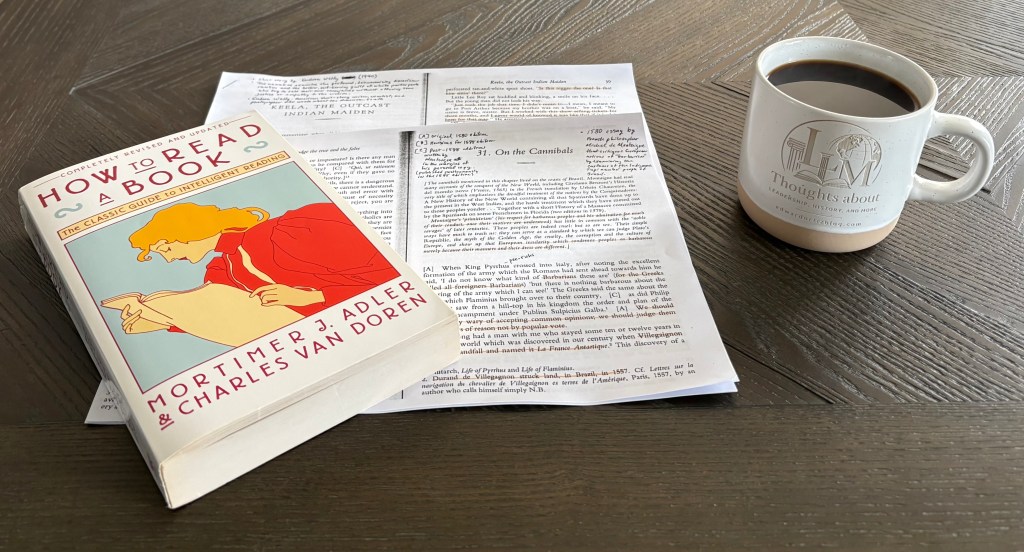
Back when I was starting this blog, I wrote a short book review of How to Read a Book: The Classic Guide to Intelligent Reading by Mortimer J. Adler and Charles Van Doren. In that post, I mentioned that my first attempt to read the book was in 2009, but I wasn’t ready for it. Then, in 2013, I gave it another try and was able to read the whole book. I learned a lot about the four different levels of reading: Elementary, Inspectional, Analytical, and Syntopical.
Fast-forward to this year. In late August, I wrote a piece titled “Artificial Intelligence and the Future of Books,” which was selected as “Freshly Pressed” by the WordPress Staff. At the end of that post, I mentioned that I was thinking about enrolling in the University of Chicago Basic Program of Liberal Education for Adults. After attending their information session, I decided to enroll, starting with their Introduction to the Basic Program: How to Read Classic Texts. It’s a four-week course that meets online on Tuesdays for three hours, and the first session starts tonight.
From the course description, I knew that the main text was How to Read a Book: The Classic Guide to Intelligent Reading, and I was already excited because, aside from already having the book, the course would give me another chance to really dig into it. But what really surprised me were the other texts that the group would be discussing.
The reading assignment for today was the first five chapters of How to Read a Book, an essay by French philosopher Michel de Montaigne titled On the Cannibals, and Keela, the Outcast Indian Maiden, a short story written by American short-story writer and novelist Eudora Welty.
Over the following three weeks, the group will continue reading How to Read a Book, but we will also discuss Nicomachean Ethics by Aristotle, Meditations by Descartes, The Death of God by Nietzsche, On Suicide by Durkheim, The Scholar by Weber, Ode to a Grecian Urn by Keats, Ode to a Pair of Socks by Neruda, Brief by Chekhov, and Idiots First by Malamud.
After reading the list, I was horrified at first. I thought, “That’s a lot of reading.” But after completing today’s reading assignment, I’m at ease.
First, rereading the first five chapters of How to Read a Book and writing notes was awesome. Because the program uses the Socratic Method, I want to be prepared for the discussion.
The first five chapters are really an introduction. They lay out the foundation for engaging in serious reading by walking readers through the different reading levels, from Elementary, where children learn the ABCs, through ages 13–15, when students should have the skills and maturity to do high school work, to the last level, Syntopical reading. This is the highest level, where a reader should be able to do comparative reading using many books in order to develop an analysis of a particular subject. Most importantly, the authors emphasize that reading is a lifelong journey and that we continue to improve over time.
Here are three quotes that made my day:
“We must be more than a nation of functional literates. We must become a nation of truly competent readers, recognizing all that the word competent implies. Nothing less will satisfy the needs of the world that is coming.” (p. 30)
“Full ownership of a book only comes when you have made it a part of yourself, and the best way to make yourself a part of it…is by writing in it.” (p. 49)
“Reading a book should be a conversation between you and the author… marking a book is literally an expression of your differences or your agreements with the author. It is the highest respect you can pay him.” (p. 49)
Then came the essay by Montaigne, On the Cannibals, written in 1580. He is basically arguing that what we call “barbarians” and “savages” is based on our worldview rather than reason.
“Every man calls barbarous anything he is not accustomed to; it is indeed the case that we have not other criterion of truth or right-reason than the example and form of the opinions and customs of our own country. There we always find the perfect religion, the perfect polity, the most developed and perfect way of doing anything! Those ‘savages’ are only wild in the sense that we call fruits wild when they are produced by Nature in her ordinary course: whereas it is fruit which we have artificially perverted and misled from the common order which we ought to call savage.”1
After reading this, what happened to Native Americans after the arrival of foreigners came to mind.
Lastly, I read Keela, the Outcast Indian Maiden, written by Eudora Welty in 1940, which examines racism in the United States. The story is about a disabled African American man named Lee Roy who was forced to play the role of a Native American woman in a circus. The people in charge painted Lee Roy red and dressed him as a woman, forcing the character to behave as a savage and eat live chickens on the circus stage.
The story includes two white men. One of them, Steve, was part of the circus and witnessed the abuse of Lee Roy but did nothing. Feeling remorse, he asked an older white man, Max, to help him find the African American man so they could compensate him and apologize. They found Lee Roy, and Steve began to describe the abuse and how badly he felt to Max, oblivious to the fact that the man he was talking about was standing right in front of him.
At the end, Steve didn’t have any money to give Lee Roy, so Max gave him what he had in his pocket, and they left Roy’s house. To me, it was essentially a story about the self-serving guilt of white participants who try to ease their own consciences without offering justice or empathy to the victim. The story not only shows racism toward African Americans but also toward Native Americans, whom the white men portrayed as savages.
Such incredible reads—ones that I probably would never have encountered if it weren’t for this University of Chicago Basic Program. I’m really looking forward to tonight’s discussion, the next three weeks, and, hopefully, the next four years if I have a chance to enroll in the rest of the program in the winter.
- Montaigne, Michel. Essays: A Selection. Tr. Screech. P. 82, Penguin Classics. ↩︎


This seems like an interesting class and good fit for you Edward. I love to read and read two books a week. But I mostly read fiction and you seem to read mostly purposeful non-fiction. Enjoy!
LikeLiked by 1 person
Thank you, Brad. I’m trying to add more fiction to my life, but I guess I’m fascinated by what people have to say about life from a non-fiction point of view. That said, Welty’s short story is fiction with strong social commentary.
LikeLike
I’m thrilled that you chose to take this course Edward. Thank you so much for sharing what you’re reading. It gives the rest of us an opportunity to explore these topics. While we won’t have access to instructors, discussions, and homework, we can still learn something. I hope you have wonderful, lively discussions with your instructors and classmates. Please keep us updated.
LikeLiked by 1 person
Thank you, Rose. Absolutely! I think this course will allow me to explore some interesting classics, which I’ll definitely share with the WordPress community. I’m really looking forward to learning and sharing.
LikeLiked by 1 person
I so agree with all you say here. As a retired college professor, I once told a student that the product I was selling was critical thinking, when he asked why he had to do the work. Trying to get students to read for the pleasure of it, rather than whether it would be on an exam, was exhausting. I told them that nothing you read will go unused some time in your lives. I love reading for the pure joy it brings me, and I wish I could sell that in a bottle.
LikeLiked by 2 people
Thank you for your excellent comment. There is something wrong with the way reading is being taught in schools. The authors described a situation in the book in which teachers are obsessed with perfection. For example, they mentioned how teachers teach Shakespeare by taking students scene by scene and looking up strange words in the glossary instead of allowing students to read the whole thing first and discuss what they got from it. Then they could go back and read it more intentionally. I think that by making reading so tedious early on in our lives, we reach a point where we no longer want to engage in reading. As you said, reading is a pure joy, and hopefully, more people will find reading appealing.
LikeLiked by 1 person
I am glad you are fitting right into the Basic Program, Edward, as I expected you would. There are many more delights ahead of you. You might even make a few new friends along the way. Continued good luck.
LikeLiked by 2 people
Thank you for introducing me to the program, Dr. Stein. You’re right about making new friends; it seems like there are opportunities to make a few. As I look at the program and all the available options for meeting others and traveling, I think it’s fantastic.
LikeLiked by 1 person
Although it has been a while since I took a class, keep an eye out for Noah Chafetz, Clare Pearson, Eliot Krick, and Amy and Charles Elder. All were fine instructors.
LikeLiked by 1 person
Excellent! Thank you.
LikeLike
This is great! So perfect for you. Will look forward to hearing more. Enjoy tonight’s class.
LikeLiked by 1 person
Thank you so much, Donna. 🙏🏼
LikeLiked by 1 person
So many pithy topics to dig into here, Edward. The four stages of reading which I had never heard of despite a degree in Spanish and Latin American Literature: Elementary, Inspectional, Analytical, and Syntopical. Topic 2: I love how in 1580 someone had the viewpoint that another culture is not barbaric simply because we don’t understand it is such an underrepresented point of view. Topic 3: The self serving resolution of white guilt in 1940 continues to this day, sadly.
LikeLiked by 1 person
I thought the same thing about topics 2 and 3. It’s incredible that these excellent writings are out there, yet there isn’t much public discussion about them. I’m sure scholars are discussing them in academic settings, but my goodness, how much we need them to come to light. I hope I can learn how to read these classical texts (Analytically, and Syntopically) and bring some of them to our WP community.
LikeLike