“By ‘reading and reasoning’ on politics they had learned ‘how to define the rights of nature, – how to search into, to distinguish, and to comprehend, the principles of physical, moral, religious, and civil liberty,’ how, in short, to discover and resist the forces of tyranny before they could be applied.” (p. 4)
They – the Americans who fought for independence and helped establish the United States. Those “they” would not recognize today’s political system, though by 1787, just a little over 10 years after the independence, politicians were beginning to depart from philosophical political theories and enter a partisan system were competition and interests were entering the arena.
This quote was interesting and set the tone for the rest of the book.
“As early as 1775 Edmund Burke had noted in the House of Commons that the colonists’ intensive study of law and politics had made them acutely inquisitive and sensitive about their liberties. Where the people of other countries had invoked principles only after they had endured ‘an actual grievance,’ the Americans, said Burke, were anticipating their grievances and resorting to principles even before they actually suffered.” (p. 4-5)
Somewhere and somehow, we have lost that inquisitive spark, to the point where we are selecting people to run this country who seem to care more about personal branding.
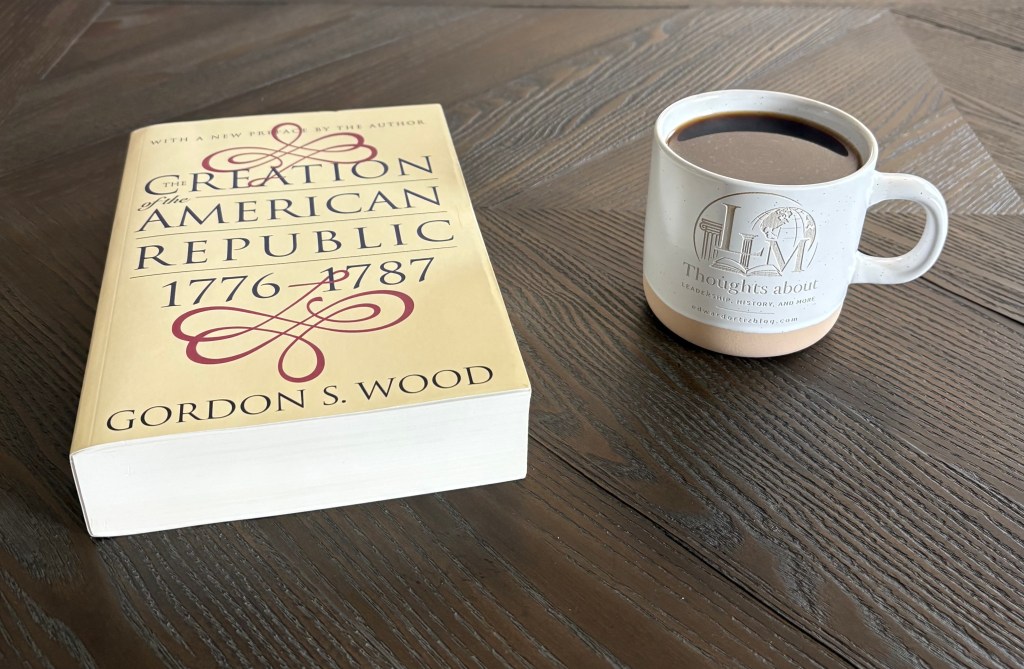
The Creation of the American Republic 1776-1787, written by Gordon S. Wood, was a fascinating read focusing on the political events between the Declaration of Independence and the ratification of the Constitution. The book is divided in six parts, with fifteen chapters covering topics such as the Whig science of politics, republicanism, moral reformation, the nature of representation, law and contracts, and the American science or politics, just to name a few.
This is the first time I read a book that highlighted the detailed discussions among the Founding Fathers and other leaders as they debated and drafted the Declaration of Independence and the Constitution. The author did an amazing job capturing the back-and-forth between leaders, which at times became very intense.
During the Virginia convention to ratify the U.S. Constitution, we read the following debate between Patrick Henry, an Anti-Federalist, and James Madison, a Federalist, regarding federal taxation:
“Without effect Madison argued that the tax collections between the general government and the states would be similar to those between the states and the various counties and petty corporations within their boundaries. ‘The comparison,’ retorted Henry, ‘will not stand examination.’ The taxes collected within the state, whether form the state, county, or parish level, all ‘radiate from the same center. They are not coequal or coextensive. There is no clashing of power between them. Each is limited to its own particular objects, and all subordinate to one supreme, controlling power – the legislature.’ All right, answered Madison. If there had to be one supreme, controlling power over the tax collections of the general and state governments, then one could be found. ‘To make use of the gentleman’s own terms, the concurrent collections under the authorities of the general government and state governments all radiate from the people at large. The people is their common superior.’” (pp. 531-532)
They are many more debates throughout the book, and it’s fascinating to see how each person argued his point and how people voted after the debate was over. In the case of Virginia, it was almost a month of debates. Because of the kind of partisan politics we have now, debates in Congress don’t lead to much since everything goes down party lines.
I learned a lot about the two main political philosophies during that important period of our history. At some point, I will read more about the Anti-Federalists’ ideas to get a clearer picture of both sides.
Here are some highlights from other parts of the book that I found interesting.
“There was, however, for all Whigs, English and American, one historical source of republican inspiration that was everywhere explicitly acknowledged – classical antiquity, where the greatest republics in history had flourished.” (p. 49)
“The sacrifice of individual interests to the greater good of the whole formed the essence of republicanism and comprehended for Americans the idealistic goal of their Revolution.” (p. 53)
That republicanism is not the same as the Republican Party in this country. In the classical sense, republicanism meant a government based on the people’s consent, with elected representatives, and in opposition to monarchy and hereditary rule. Citizens should put the public good above private interests, while corruption and concentrated authority were seen as dangers to liberty.1 2
“Religion and republicanism would work hand in hand to create frugality, honesty, self-denial, and benevolence among the people.” (p. 118)
“The theory of mixed government was as old as the Greeks… it was based on the ancient categorization of forms of government into three ideal types, monarchy, aristocracy and democracy.” (p. 197)
I have read about this many times, and I knew that the Founding Fathers were forming our government using this mix, but I understand now that they were looking at the presidency, the Senate, and the House of Representatives as representation of it. Basically the one (President), the few (Senate) and the many (House of Representatives), as historian Jill Lepore described it in her book These truths – A History of the United States.
The idea was that since a corrupt monarchy turns to tyranny, a corrupt aristocracy becomes an oligarchy, and a corrupt polity becomes a democracy, having a president, a Senate, and a House of Representatives would allow each branch to check the others and maintain a balance. Clearly, a party controlling all three wasn’t part of the equation. Or maybe they simply expected men and women of character to do the right thing.
“The republican emphasis on talent and merit in place of connections and favor now seemed perverted, becoming identified simply with the ability to garner votes, thus enabling ‘the most unfit men to shove themselves into stations of influence, where they soon gave way to the unrestrained inclination of bad habits.’” (p. 398)
That observation is from around 1787, and we can see it at its peak in today’s political environment.
“Returning home from congress in the winter of 1785-1786, Madison at once began an intensive study of ancient and modern confederacies in search of an understanding of ‘the science of federal government’ which Americans direly needed.” (p. 472)
“Everywhere ‘Specious, interested designing men,’ ‘men, respectable neither for their property, their virtue, nor their abilities,’ were taking a lead in public affairs that they had never quite had before, courting ‘the suffrages of the people by tantalizing them with improper indulgences.” (p. 477)
“The Antifederalists thus came to oppose the new national government for the same reason the federalist favored it; because its very structure and detachment from the people would work to exclude any kind of actual and local interest representation and prevent those who were not rich, well born, or prominent from exercising political power. Both sides fully appreciated the central issue the Constitution posed and grappled with it throughout the debates: whether a professedly popular government should actually be in the hands of, rather than simply derived from, common ordinary people.” (p. 516)
I think this last quote describes the complexity and the intellectual rigor with which our Founding Fathers and leaders in each of the states engaged in the process of establishing the foundation of the government we have now. For better or worse, the citizens of this country are at the center of our government. We can only hope that, seeing how important our role is, we will take this responsibility seriously and elect capable men and women to lead this country – something that we badly need right now.
If you are interested in what actually occurred during those years between the Declaration of Independence and the ratification of the U.S. Constitution, this is the book for you. The extensive notes throughout the book provide primary sources for those who want to know exactly what those leaders said during this important period of our history.
A great source that I will visit again and again, for sure.
About the Author:
Gordon Stewart Wood (November 27, 1933 –June 7, 2026) was an American historian and academic who was a professor at Brown University. He was a recipient of the 1993 Pulitzer Prize for History for The Radicalism of the American Revolution (1992). His book The Creation of the American Republic, 1776–1787 (1969) won the 1970 Bancroft Prize. In 2010, he was awarded the National Humanities Medal by President Barack Obama.3
 Thoughts about leadership, history, and more
i really didn’t know much about this period of history, so it’s especially timely to learn about at this time in our history –
LikeLiked by 1 person
Those debates and how passionate they were were an eye opener. I don’t think we have those kinds of debates now.
LikeLike
You are amazing, Edward. I love this reminder…a great reference and clarification:
“In the classical sense, republicanism meant a government based on the people’s consent, with elected representatives, and in opposition to monarchy and hereditary rule.”
I crave that. Good intentions…gone awry these days. Your deep reading and sharing give hope. 💝
LikeLiked by 1 person
Thank you, Vicki. My hope is that we get a handle on what’s going on in this country soon. We need people to do the right thing in November.
LikeLiked by 1 person
Amen! ❤️❤️❤️
LikeLiked by 1 person
Great review of what sounds like a deep text, Edward. I’ve seen what happens to “some” (not all) people when they get the perceived power that comes from a position of authority, be it in government or any institution. Some just don’t know how to handle it and end up abusing it with often disastrous results.
LikeLiked by 1 person
Thank you, Terry, and you are absolutely right. Some people who come to serve in government with good intentions end up seduced by power and doing terrible things. That’s why checks and balances in government are so important, but at least for now, those are nonexistent in this country.
LikeLiked by 1 person
And there’s also the Peter principle, Edward – which is very real, despite the fact that Mr Peter wrote about it as an intended satire.
LikeLiked by 1 person
That’s true.
LikeLiked by 1 person
Thanks for another solid review, Edward.
I think, from very early in the establishment of this colony that became an empire, the financial brokers were determined to maintain their hold on power. The revolution and setting up of a government of the people for the people would have been met with immediate subversive elements. We see it executed now very openly when certain members in government stray from party lines, how the massive surge in financial support to their opponents will swing the vote.
It was no different 250 years ago.
The ideals of the federalists and those who wanted a truly representative system were anathema to the capitalist brokers who saw the Americas as their investment. Can’t fight the will of the people, but they could certainly reshape their government.
LikeLiked by 1 person
You’re welcome, and I couldn’t agree more. My main problem right now is that a lot of people are complaining about what’s going on in the country, especially the same ones who voted for what we have now. At some point, people need to wake up and stop the absurdity. Like you said, the rich have ways to reshape the government, but we can stop that if we want to by voting smartly. Thank you, Nigel.
LikeLike
The intentions and integrity of the original leaders were elevated—for the greatest good of all. Somehow far from what we see today. You said it well here: “Those ‘they’ would not recognize today’s political system.” They could not have imagined the “degradation” of conduct and values that would eventually follow. Sad but true! Still, the power to change is in the people; only they can see and choose better. Thank you for this review, Edward—your post is not only informative but also eye-opening. Much light and many blessings to you, dear friend, always! ✨🙏
LikeLiked by 1 person
Thank you, Susana. Despite all their deficiencies, they were absolutely for the greater good of the country. I agree that we, the people, can change the situation. I hope we will wake up and start choosing better people to run our country.
LikeLike
Thanks for another great review and lots to ponder here, Edward! It’s hard to imagine how we’ve ended up where we are now after such thought went into its creation.
😉
LikeLiked by 1 person
You’re welcome, Cindy. I know, we keep electing incompetent people. 🤦🏻♂️
LikeLike
Hi Edward, as I’ve written before, the problem with all political and social ideologies is the people involved. The SA constitution was also written post a period of oppression and the writers had pure motives. No sooner was Nelson Mandela gone, the entire system started being corrupted and now our constitution is a joke amid an administration filled with corruption and mismanagement. It seems humans never learn from the past and never remain pure of mind and soul in the face of power and wealth.
LikeLiked by 1 person
I agree with you that the main problem is the people involved, not only the politicians but also the people who vote for them. It’s like people get brainwashed, accepting at face value everything they hear. We definitely don’t learn from the past. Thank you, Robbie.
LikeLike
A thought-provoking reflection on the foundations of a healthy republic. Your emphasis on character, civic responsibility, and the common good is deeply meaningful—good government ultimately depends on the values of the people who serve and sustain it.
LikeLiked by 1 person
Thank you so much, John.
LikeLike
What a fascinating and thought-provoking review! 📚👏 You have done much more than describe the book—you have brought its central political ideas and the passionate debates of America’s founding period vividly to life.
LikeLiked by 1 person
Thank you very much. 🙏🏼
LikeLike
Edward, thanks for your excellent review. Setting up a new government was no easy task. They could not have foreseen the combination of elements that have led to our current administration.
LikeLiked by 2 people
Extremely difficult! What surprises me is their dedication to studying history and learning about the different forms of government in order to create a brand new government. I think if today’s Congress studied half of what the Founding Fathers studied and applied what they learned, the country would be in a better place.
LikeLiked by 1 person
Without a doubt, Edward!
LikeLiked by 1 person
Thank you for the review, Edward. I think the country has reached a point in its history where it needs to engage in these fundamental philosophical debates all over again. It just occurred to me that in higher ed administration, we had to do formal program reviews on a regular basis (every five or ten years, depending on the review requirement). Every one of those reviews started and ended with the college’s mission.
LikeLiked by 2 people
You’re welcome, Liz, and I agree with you wholeheartedly. The Senate was supposed to be made up of intellectuals with strong backbones so they could challenge the president, the House of Representatives, and the Supreme Court. But it is just as bad as the House.
LikeLiked by 1 person
It sounds like a great book to understand where we started as a country and why. Sadly, the checks and balances have been badly corrupted by big money, party politics, and self serving leaders in all three branches. And I’m still stumped by how we return power to the citizens with the current corruptions.
LikeLiked by 2 people
I agree, and I’m with you about returning power to the citizens. I’m not sure how, but somehow, we need to break the two-party system and have more parties so Congress and the people can actually debate and compromise. Or maybe we just need to get rid of political parties and have individuals running on their own platforms. But big money is involved, so there’s no quick solution.
LikeLiked by 1 person
No parties sounds interesting, and I like England’s system with each of many parties proportionately represented.
LikeLiked by 1 person
Yes, and when they don’t have a majority, they need to work on compromises to get legislation done. We definitely need to add more political parties to ours.
LikeLiked by 1 person
I’d like to see the presidential election in the hands of the people rather than the indirect system we have now. The phrase that made me want to hit the reset button in the house and senate was “public good above private interests.”
LikeLiked by 2 people
I would like to see that too, but we definitely need to reinforce the importance of an informed vote. Thank you, Rebecca.
LikeLiked by 1 person
You’ve penned an excellent review. Maybe this book will become required reading in some high schools and colleges.
LikeLiked by 3 people
Thank you. It probably already is, since it’s a classic.
LikeLike
Amen, my Brother. A lot to think about here, and it really is sobering to see how much character and personal responsibility mattered to those who built this country. 🙏
LikeLiked by 3 people
That’s true. What’s incredible is that all of them worked for free, and it took time to establish salaries for government officials.
LikeLiked by 2 people
I think it’s safe to say that “The republican emphasis on talent and merit in place of connections” is currently dead in the water.
LikeLiked by 3 people
Indeed! Whatever little talent there was is leaving this government in a hurry.
LikeLiked by 1 person
Getting tossed out on its collective ear.
LikeLiked by 1 person