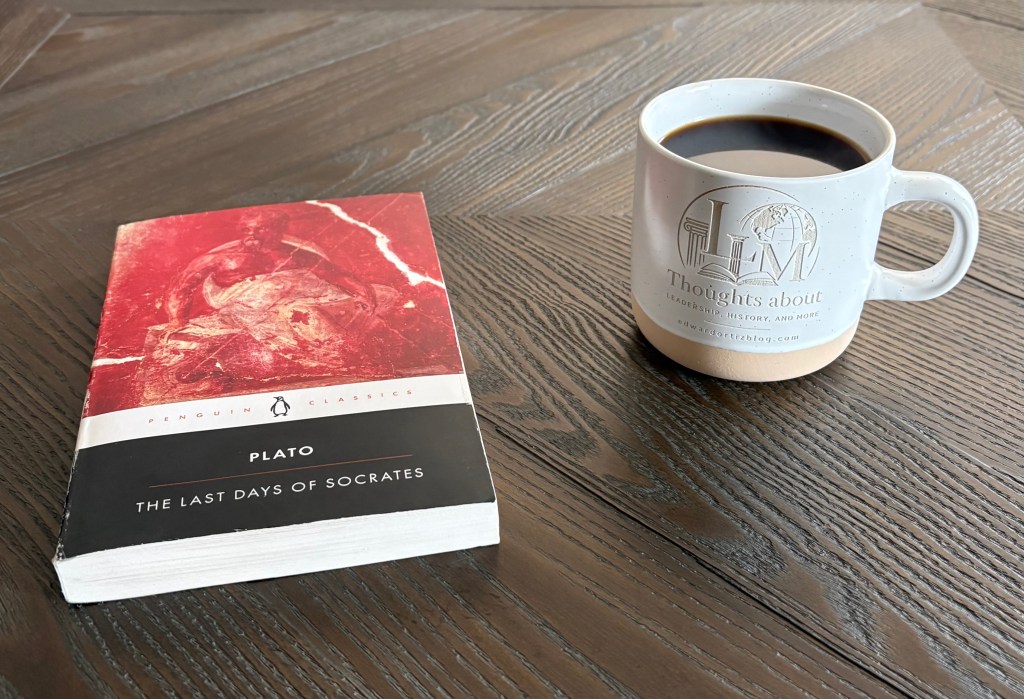
I have been focusing part of my reading plan on the subject of philosophy. My main interest is the Stoics, but I took a little detour to examine Socrates. After all, the Stoics considered him a role model and a sage. I read The Republic by Plato, which focuses on justice and what a just city and its citizens should look like, but I wanted to learn a little more about Socrates as a man and about his philosophy. I decided that The Last Days of Socrates was the best way to do that.
The Last Days of Socrates is a collection of four philosophical dialogues written by Plato: Euthyphro (events outside the court of Athens, right before Socrates enters his preliminary hearing), Apology (his trial), Crito (his time in prison), and Phaedo (his execution). Together, they chronicle the final weeks of Socrates’ life in 399 BC. This book explores Socrates’ philosophy on the subjects of living and dying, which is what I’m more interested in.
I’m not a philosopher, just a man in pursuit of knowledge in areas that are of great interest to me. I guess this is my mid-life crisis. I know some men enter this phase and want to feel young again. Maybe that’s why they buy a new sports car. In my case, books and learning are how I’m managing my mid-life crisis.
With all that said, I just wanted to highlight that I’m not an expert, so I’m only going to highlight the areas that I found interesting. Of course, I always read with a critical eye, and my Christian bias is always there, although I’m always open-minded. In the book The Scandal of the Evangelical Mind, Dr. Mark A. Noll stated:
“American evangelicals are not exemplary for their thinking, and they have not been so for several generations… modern American evangelicals have failed notably in sustaining serious intellectual life.”1
I don’t want to be part of that group that refuses to engage in meaningful intellectual work, so part of my reading plan focuses on closing some of my learning gaps. I know some true philosophers will read this review and find gaps. I know. But my reading goal is to find information that is valuable to me as I continue to improve my knowledge, not to enter a public stage and start debating philosophers.
As I stated at the beginning, The Last Days of Socrates is a collection of four dialogues. The edition I read was published by Penguin Classics and translated by Hugh Tredennick and Harold Tarrant, who also wrote the introduction and notes. The notes are excellent.
The first dialogue is Euthyphro, and the setting is outside the court of Athens. There, Socrates meets Euthyphro, a religious prosecutor who is taking his own father to court for murder. Socrates has been accused of impiety and corrupting the youth. The dialogue between Euthyphro and Socrates is about the subject of holiness, or piety.
In this dialogue, Euthyphro claims to be an expert on religion and defines “piety” (morality/holiness) as “whatever all the gods approve of, and that its opposite, what all the gods disapprove of, is unholy.” (Euthyphro 9e). Socrates then asks Euthyphro the following:
“Is the holy approved by the gods because it’s holy, or is it holy because it’s approved?” (Euthyphro 10a). (p. 20)
What a great question! In other words, does morality exist independently of God, or is morality whatever God says it is?
Of course, you can come up with your own conclusions and answers to that question. But it’s definitely a good one. In the end, Euthyphro couldn’t provide a satisfactory answer to Socrates.
The second dialogue is Apology, and it takes place during Socrates’ trial. Socrates was charged with “corrupting the minds of the young, and of believing in supernatural things of his own invention instead of the gods recognized by the State.” (Apology 23c). (p. 48)
Socrates argues that he is not receiving payment for teaching, so basically, the people listening to him, young and old, are doing so voluntarily. With respect to not recognizing the gods, Socrates is just challenging the intellectual laziness of the citizens by challenging their beliefs.
This dialogue was excellent and very stimulating. For example, when asked if Socrates feels hesitation about pursuing an activity (philosophy) that could bring him the death penalty, Socrates answered:
“You are mistaken, my friend, if you think that a man who is worth anything ought to spend his time weighing up the prospects of life and death. He has only one thing to consider in performing any action; that is, whether he is acting justly or unjustly, like a good man or a bad one… Where a man has once taken up his stand… there I believe he is bound to remain and face the danger, taking no account of death or anything else before dishonor.” (Apology 28b-d). (p. 54)
Powerful statement, and a lot to think about.
Here are some other powerful quotes from this dialogue:
“The true champion of justice, if he intends to survive even for a short time, must necessarily confine himself to private life and leave politics alone.” (Apology 32a). (pp. 58-59)
To me, this means taking action at the community and grassroots level because politics are corrupt and will let you down.
“The attention I paid to death was zero… but that I gave all my attention to avoiding doing anything unjust or unholy.” (Apology 32d). (p. 59)
“You too, gentlemen of the jury, must look forward to death with confidence, and fix your minds on this one belief, which is certain: that nothing can harm a good man either in life or after death, and his fortunes are not a matter of indifference to the gods.” (Apology 41d). (p. 70)
The third dialogue is Crito, and it is set in prison. Socrates’ friends formulated an escape plan, but he refused to escape. Here, Socrates explains that after benefiting from the laws of Athens, deciding to stay instead of leaving, and raising his family, he is under a personal agreement of sorts. After explaining all these reasons to Crito, he gives the following response on what others would say:
“You had seventy years in which you could have left the country, if you were not satisfied with us or felt that the agreements were unjust. You did not choose Sparta or Crete—your favorite models of good government—or any other Greek or foreign state…” (Crito 52d – 53a). (p. 93)
Basically, he enjoyed the benefits and security provided by Athenian laws his entire life. He agreed to obey their judicial decisions even when they were unjust to him personally, so he is not going to leave now, even after receiving a death penalty. This shows his character and one of the reasons why the Stoics considered him a sage.
The last dialogue is Phaedo, and it covers his execution. Some heavy and important subjects are discussed in this dialogue.
Regarding suicide:
“Tell me then, Socrates, what are the grounds for saying that suicide is not legitimate?… we must not put an end to ourselves until God sends some necessary circumstance like the one which we are facing now… God is our keeper and we are his possessions.” (Phaedo 61e-62d). (pp. 121-122)
Socrates opposes suicide as a personal choice, I guess to escape despair or other difficult situations, but he accepted drinking the hemlock because he was submitting to an external action mandated by the state as part of his death penalty. This is another one of those subjects that each person needs to come to their own conclusions about. It’s a difficult subject and I always recommend that people get the necessary help and support rather than resorting to this final act.
Socrates also discusses what happens to the soul after death. He insists that true philosophy is a preparation for death, freeing the soul from physical distractions.
Here are some highlights from this dialogue:
“All wars are undertaken for the acquisition of wealth; and the reason why we have to acquire wealth is the body, because we are slaves in its service… We are in fact convinced that if we are ever to have pure knowledge of anything, we must get rid of the body and contemplate things in isolation with the soul in isolation… It seems that as long as we are alive, we shall keep as close as possible to knowledge if we avoid as much as we can all contact and association with the body… instead of allowing ourselves to become infected with its nature, purify ourselves from it until God himself gives us deliverance.” (Phaedo 66d-67a). (pp. 127-128)
The body here represents physical desires and greed. Socrates is saying that we need to free our minds from these desires, pleasures, and greed, and he sees philosophy, with its focus on virtue, as the ultimate way to reach the end of our lives in peace.
“True philosophers exhibit self-control and courage… a philosopher’s soul will take the view which I have described. It will not first expect to be set free by philosophy, and then allow pleasure and pain to reduce it once more to bondage… by following Reason and abiding always in her company, and by contemplating the true and divine and unambiguous, and drawing inspiration from it; because such a soul believes that this is the right way to live while life endures.” (Phaedo 83e-84b). (p. 153)
The dialogue ends with Socrates drinking the poison as the court directed, and then we read the following:
“This, Echecrates, was the end of our comrade, who was, we may fairly say, of all those whom we knew in our time the bravest and also the wisest and the most just.” (Phaedo 118a). (p. 199)
To me, this was an incredible read. I learned a lot as I continue my learning journey. As in reading the Stoics, virtue continues to be a focus, and while reading this book and what Socrates said about virtue, I decided to read four books, each focusing on courage, justice, prudence, and wisdom. I’m looking forward to learning what philosophers have to say about those four virtues.
If you are interested in learning what Socrates thought about living and dying gracefully, then I recommend that you read this book. It goes into much more detail than what I highlighted here. I’m sure others have better recommendations, and all are welcome, but in my opinion, this is the book to read.
- Noll, Mark A. The Scandal of the Evangelical Mind. (p. 3). Michigan: Wm. B. Eerdmans Publishing Co., 1994. ↩︎


Your decision to state both the learning gap and your interpretive lens before discussing the dialogues suggests a Reading Position Card: write what you are trying to learn, the prior commitments you bring, and the kind of claim you are not equipped to make. At the end, add one question that changed and one source to read next. That makes a detour in a reading plan cumulative without pretending curiosity has produced expertise.
LikeLiked by 1 person
I appreciate your comment. Philosophy is very interesting, and I’m trying to learn the basics. It’s definitely a great journey I’m embarking on.
LikeLike
Love Plato and specifically Socrates’ thoughts on the existence of the soul. Subscribed!
LikeLiked by 1 person
That part was super interesting. The Stoics had similar ideas and opened up a whole new perspective that I’m still thinking through.
LikeLike
Interesting article, regarding this section:
Here are some other powerful quotes from this dialogue:
“The true champion of justice, if he intends to survive even for a short time, must necessarily confine himself to private life and leave politics alone.” (Apology 32a). (pp. 58-59)
To me, this means taking action at the community and grassroots level because politics are corrupt and will let you down.
My thoughts:
Human beings in general are corrupt If a big enough carrot is dangled in front of them i would argue, most would take it. 1 Million, 2 million a billion. So what are the solutions that can be explored to counter the carrot?
Socrates and Plato spoke about a Philosopher/Wisdom king being another solution, yes it is difficult in a world run by Power and not morality, the more solutions the better.
Community and grass roots are great and part of the multi solution approach, but engaging and voting in Politics must be also simultaneously regardless of the monopoly and difficulty faced.. Yes politics is captured. Many independents try to capitalise on the people who do not vote because they have lost faith.
We should explore all solutions.
LikeLiked by 2 people
Absolutely! I personally consider voting a grassroots action and a civic duty.
LikeLiked by 1 person
Thanks, I agree also, so many people are disengaged and feel it’s pointless. The more engagement the better.
LikeLiked by 1 person
You’re welcome, and absolutely!
LikeLike
It sounds like the book for you, as you say, Edward. As I wrote in my own recent post, at the U. of Chicago’s Basic Program, we were discouraged about reading the opinions of others, the better to form our own. And, we were “taught” (the wrong word) by instructors who were themselves steeped in the Socratic method of instruction. That meant no lectures and only questioning by our professors. Moreover, if memory serves, they had learned the Ancient Greek language. I think you might want to consider that program. You would learn much from a different point of view than reading the book by yourself. It made an astonishing difference for me, both a new way of reading of learning, and thinking.
LikeLiked by 1 person
Thank you, Dr. Stein. I just did a quick search and found the program, so I’m going to read about it. Your recommendation is greatly appreciated. I definitely need a program like that.
LikeLike
I enjoyed all the quotes. And books and learning is a wonderful thing to do with your midlife crisis. 😊
LikeLiked by 1 person
Thank you! It’s definitely safer and more economical than buying and going crazy driving a Lamborghini. 😂
LikeLiked by 1 person
Lol, it most certainly is! 🤣
LikeLiked by 1 person
I really enjoyed this one, Edward. I’ve never spent much time with Socrates beyond the usual stuff you pick up along the way, but some of these passages really make me want to dig into him a little more. I have great admiration for an intellectually consistent mind and character, and these excerpts are surely indicative of that!
LikeLiked by 1 person
Thank you, Scott. It was fascinating to learn more about Socrates. I’ve been studying the Stoics for about a year now, and Socrates keeps coming up as their ideal philosopher. I actually had to pause my Stoic reading to go through The Republic and this book to learn more about him. There’s a lot of great insight into human behavior.
LikeLiked by 1 person
Thanks for sharing
LikeLiked by 1 person
You’re very welcome, and thank you for reading.
LikeLike
thanks for sharing. have a good time reading and a beautiful day!
LikeLiked by 1 person
You’re welcome, and thank you very much for reading.
LikeLiked by 1 person
i hope that when my time comes, it’ll be with dignity and grace…
LikeLiked by 1 person
Yes! I’m hoping for the same.
LikeLiked by 1 person
oh wow – sounds like intense reading – yay you for doing the hard work for us!
LikeLiked by 1 person
Thank you, Linda. It wasn’t too bad. I think it was the edition I read, along with the notes throughout, that were super helpful.
LikeLiked by 1 person
Hmm 🤔 An unexpected choice, Edward. Your wide range of interests keeps your blog fresh and interesting. I’ve always found Socrates a fascinating figure but I’ve never taken time to do a deep dive. Thanks for sharing what you learned with this book. Hugs to you and yours.
LikeLike
Your review entices me to read this book, Edward. I’ve wanted to go back to Socrates for years, and I like the way the book guides you through his works. You take on the heavy topics and bring them to us in a concise and clear way. Thank you!
LikeLiked by 1 person
You’re so welcome, my friend. What I really like about this book are the notes. The editor did a great job, making it easy to understand the difficult parts.
LikeLike
“…My reading goal is to find information that is valuable to me as I continue to improve my knowledge.” A wise and important goal for us all, Edward. Kudos to you, my friend.
LikeLiked by 1 person
Thank you so much, Natalie. 🙏🏼
LikeLike
I read some Plato in college and found it pretty interesting. I’m sort of a hybrid midlife crisis guy myself: I’d like to read philosophy from the front seat of my sports car!
LikeLiked by 1 person
🤣 That’s a good one, Mark! Well, I had a sports car once, a 1999 Mustang V8. It was a sweet ride until a couple of close calls driving in the snow. I swapped it for a Subaru Outback, and Subaru became the car of choice in our house.
LikeLiked by 1 person
I know those sacrifices well, Edward. I swapped my sporty Mazda3 coupe for an AWD Hyundai when I moved to South Dakota and had to drive up a snowy hill to get home. Sometimes, adulting sucks.
LikeLiked by 1 person
Those Mazdas are very cool, but AWD is definitely a must if you live in an area that snows a lot.
LikeLike
Great observation about the grassroots actions 👌
LikeLiked by 1 person
Thank you, my friend. I think communities can solve a lot of problems that we are facing instead of waiting for Congress.
LikeLiked by 1 person
You know that’s right! 👌
LikeLiked by 1 person
Great work! I really enjoyed this piece. I just released some new work at https://weurd.com, and I’d love to get some feedback. Thank you so much, and keep up the good work!!
LikeLiked by 1 person
Thank you very much.
LikeLiked by 1 person
Thank you for all of this, Edward. You’ve inspired me to read and learn…my knowledge is so cursory and surface level where Socrates is concerned. Just the nudge I needed.
I think there is a call, for me, too, to be more introspective at this stage of life. A desire to better understand, listen and absorb as much as possible about the human condition, from philosophers. From Socrates, especially. I’ve used a quote often attributed to him “an unexamined life is not worth living” but I’ve never tracked down the exact source or attribution. But the words? They hit home! Thank you, my friend! ❤️
LikeLiked by 2 people
You’re so welcome, my friend. Well, your question will be answered today because that quote is in this book! The source is Apology (38a): “If on the other hand I tell you that to let no day pass without discussing goodness and all the other subjects about which you hear me talking and examining both myself and others is really the very best thing that a man can do, and that life without this sort of examination is not worth living…” (page 66 in my edition.)
LikeLiked by 1 person
Aha! Look at you! I love having the full citation. Thank you so much! Talk about fast, fabulous and reliable! You’re the best, Edward! 😉❤️😉
LikeLiked by 1 person
You’re welcome! Luckily, it’s still fresh in my mind, and, of course, in my reading notebook. You know how it is, I’m getting older, and if I don’t write things down, I’ll forget! 🫶🏼
LikeLiked by 1 person
Love your thoroughness, Edward! We all appreciate it…makes what you share so compelling. Keep going! You share and summarize so beautifully — love learning from you. ❤️😉❤️
LikeLiked by 1 person
Thank you, my friend. 🙏🏼
LikeLiked by 1 person
😊💝😊
LikeLiked by 1 person
thanks for your distillation, and it’s clear to see that much of this is still relevant today
LikeLiked by 2 people
You’re welcome, Beth. I know, it’s incredible how many of his thoughts are still relevant.
LikeLiked by 1 person
wisdom does not age –
LikeLiked by 1 person
Absolutely!
LikeLiked by 1 person
I appreciate that this book reads in an accessible fashion. If I were to see the notes as well, to help me navigate what is written, that would be a bonus! Sounds like you got a good version of some old writing. Also, kudos to you for continuing to improve your knowledge as you age. I find that many people in the US don’t keep learning, and it shows. I’m glad that both of my parents are the kind of people who continue learning. In fact, I think my mom is in like three or four book clubs. Such a better use of time than having an affair with a young person or buying a silly car.
LikeLiked by 2 people
The notes are fantastic. This edition has a great overall introduction, as well as an introduction to each of the dialogues. The editor also added brief explanatory paragraphs before each transition within the dialogues, which is extremely helpful. All the endnotes are consolidated at the back. Thank you for your kind words! My goal is to keep reading and learning for the rest of my life.
LikeLike
I wish all books had side notes like my copy of Pride and Prejudice rather than endnotes.
LikeLiked by 1 person
A great post, Edward! It has to be, given that you are writing about one of the greatest figures of our history. So much ahead of his time and even of our time. It’s not by chance that he’s still well known and a reference these days (contrary to those who condemned him or led them there!). I found this point in particular very interesting: “Nothing can harm a good man either in life or after death.” It expresses well his depths, virtue, and conduct. Death was not an issue for him, only unjustice, unvirtue, and ignorance. I so enjoyed this read, my friend. Thank you for keeping us on the pursuit of goodness and knowledge! Light and blessings to you, always! ✨🙏🍀🌞
LikeLiked by 2 people
Thank you so much, Susana. Yes, he was an incredible thinker! Even though he died in 399 BC, his ideas remain as relevant as ever. His pursuit of virtue shines through, and it’s a true pleasure to study his life and philosophy. Blessings, my friend. 🙏🏼
LikeLiked by 1 person
Edward, great distillation and discussion of some deep issues…the kind of thing that drifts around your brain for a few days… “is it approved bc it’s holy or bc [the gods] say it’s holy?” 🤔 And much cheaper than a Corvette! 😉
LikeLiked by 2 people
Thank you very much, Darryl. It’s definitely much cheaper than a Corvette and the insurance that goes with it. 😂
LikeLiked by 1 person
Thanks for the straight forward summary Edward as I have never read any philosophy. This comes to mind “Beware lest any man spoil you through philosophy and vain deceit, after the tradition of men, after the rudiments of the world, and not after Christ.” Colossians 2:8. As a non Christian for so many years of my life, I read occult and self help books so for me I just stick with scriptures as my go to now 🙂
LikeLiked by 1 person
You’re welcome, and I totally understand. As I read books besides the Bible, I keep in mind the advice in Ecclesiastes that after all studying and learning, what really matters at the end is to “fear God, and keep his commandments; for that is the whole duty of everyone.” (Eccl. 12:13). Sometimes we need to engage people who are called by God but still have questions or doubts, so having a basic knowledge of philosophy and other religions is helpful.
LikeLiked by 2 people
Understand – my “speciality” so to speak is occult/new age so I can engage with those still in that movement.
LikeLiked by 1 person
I was thinking the exact same thing when you mentioned it, and it’s probably more useful. I think I’ve engaged with more people who came out of that movement than anything else. Even Catholicism in the Caribbean has a tone similar to occultism and New Age thinking, not a direct equivalent, but definitely along those lines.
LikeLiked by 1 person
I have read and studied each of these dialogues separately but I love how you analyze and understand them in such a deep way
LikeLiked by 2 people
Thank you so much! The notes included with this edition were extremely helpful.
LikeLike
A thoughtful reflection on The Last Days of Socrates. What stands out is how you move beyond the book itself to the deeper question of how we live: whether we have the courage to examine what we believe, pursue truth, and remain faithful to our principles when they are tested. Socrates reminds us that wisdom is not simply knowledge—it is the integrity to live by what we know to be right. Your reflection makes that ancient lesson remarkably relevant today.👌👍
LikeLiked by 1 person
Absolutely! Thank you for reading and commenting, John. 🙏🏼
LikeLiked by 1 person
🤝👏🎉
LikeLiked by 1 person
Well, what is right?
Although ‘right’ was regarded as an absolute value right up until the Classical period. The progress of the modern era lies in viewing it as relative. What is right or just is no longer a normative value; it depends on the circumstances.
Whilst Socrates and Plato knew what was right and just, nobody today can be certain of knowing that. That is the end of dogmatism.
The Fab Four of Cley
🙂 🙂 🙂 🙂
LikeLiked by 2 people
You’re correct. We need to evaluate the context, especially since we all live in different countries with distinct cultures, religions, and philosophical ideas.
LikeLiked by 2 people
It is known among scholars of the Buddha that the nature of the audience to whom he was speaking must always be taken into account, since he accommodated language, imagery, and recommendations for achieving balance very much to his individual audiences, and without these perspectives he can actually appear to have contradicted himself.
LikeLiked by 1 person
Thank you, Ana. That makes a lot of sense.
LikeLiked by 1 person
👍
LikeLiked by 1 person
That’s a fair and thought-provoking challenge. I agree that we should be humble about claiming absolute certainty on what is right, especially when circumstances and perspectives differ. Perhaps that is where Socrates remains so relevant: not in giving us easy answers, but in teaching us to keep examining our assumptions, seeking truth, and questioning ourselves honestly.
LikeLiked by 2 people
We absolutely agree with you, Johnbritto.
LikeLiked by 2 people
🤝🙌🎉
LikeLiked by 2 people
Well I don’t know much about philosophy Edward but i do know that having a partner who stays a steady course is usually preferable to one who decides they want to do something “more exciting” in midlife ☺️
It’s so cool that books and learning are where it’s at for you!
LikeLiked by 2 people
Thank you, CJ. I figured that adding the midlife crisis comment to the mix would be fun. Absolutely safer that way. There are a lot of middle-aged men getting into trouble nowadays. 😀
LikeLiked by 1 person
I really enjoyed this post and review… You don’t have to be a philosopher to ask meaningful questions, and I like that you approached Socrates with both curiosity and a critical mind. H
LikeLiked by 3 people
Thank you, Willie. It’s absolutely important that we question everything in order to find the truth.
LikeLiked by 1 person
Amen 🙏👍 I totally agree
LikeLiked by 1 person
Edward, I like the way you’re managing your mid-life crisis 🙂 Thanks for the review and your selected quotes of wisdom from Socrates. I’m also not an expert in the works of the Greek Stoics.
LikeLiked by 1 person
Thank you, Rosaliene. It’s safer to stay with books. 😀
LikeLiked by 1 person
Unless they’re books that stir up bad trouble 😀
LikeLiked by 1 person
That’s true. There are many books that just stir up trouble. I read one of those and decided to keep it as a reminder of what not to do.
LikeLiked by 1 person
Wise decision 🙂
LikeLiked by 1 person
Thank you.
LikeLiked by 1 person
I love your open-mindedness, Edward, and all that you share in your admirable pursuit of knowledge. I find it fascinating that Socrates wouldn’t try to escape because he had benefitted from being a citizen of Athens. There’s an internal consistency there that seems admirable even when we know the outcome. What an interesting topic and book review. Thank you so much, my friend!
LikeLiked by 2 people
You’re so welcome, Wynne. The part about not escaping was fascinating, especially because he explained that even bringing family members to court so the jury feels sorry for him is unacceptable. He said that he would fight the charges by debating and presenting facts only, and nothing else. That’s so counter to how most of us think. Thank you for your kind comments, my friend.
LikeLike
You and my son would get along just fine. He loves those ancient books.
LikeLiked by 2 people
Awesome! Thank you for sharing that Jacqui.
LikeLiked by 1 person
I am amazed how much Socrates words still resonate today, especially “All wars are undertaken for the acquisition of wealth.” I think I studied him in college, but your clear presentation was quite educational.
LikeLiked by 2 people
Thank you, Rebecca. The way he connected wars to personal desires and greed was interesting. I wish I had studied Socrates in college, but I figured it’s never too late to learn.
LikeLiked by 1 person
Interesting that Socrates embraced a “love it or leave it” relationship with Athens—even when faced with his own death penalty
LikeLiked by 2 people
I know, and you can probably guess that my mind went to what we’re experiencing in this country. I know that what’s happening now is going to pass and things will get better, as history shows. But what’s the trigger to make the decision to leave it? That’s a good and interesting question.
LikeLiked by 1 person
I remember studying these dialogues when I took an ethics course in college. I really enjoyed how the course examined the philosophical underpinnings of how various schools of thought approach and define The Right and The Good. (My prof capitalized the words on the blackboard!)
LikeLiked by 1 person
Thank you, Liz. How fortunate that you were able to experience the subject in college! I didn’t, so I have some catching up to do. The definition of “right” and “good”, oh, I need to keep that in mind as I continue to study the different philosophical approaches.
LikeLiked by 1 person
You’re welcome, Edward!
LikeLiked by 1 person
Also, I saw your other comment. There is a bit of a delay because I manually approve each comment. I had no other option because I was receiving a lot of hateful comments or comments that had nothing to do with the topic.
LikeLiked by 1 person
Thanks, Edward! I’ll try to remember next time.
LikeLiked by 1 person
You’re welcome, and thank you for understanding. Some of the comments are horrible. I know I can delete those comments later, but I don’t want the discussion to get polluted with nonsense, especially when it has nothing to do with the post.
LikeLiked by 1 person
You’re welcome, Edward. I had no idea! It’s so distressing to know that there are people like that out there. You’re absolutely right to pre-screen and delete.
LikeLiked by 1 person
As always, a compelling review from your read. I enjoy your take on the books you read. I am compelled to consider my own character and what I truly believe. Socrates stood by what he valued, wrong or right. His core values were intact. He serves as an example of a man who lived and died by what he believed. Very interesting. Thank you for sharing.
LikeLiked by 2 people
Thank you very much, Sandra. Great point about him keeping his core values and dying as a consequence of that. As I was reading the dialogue, my mind went to Jesus’s teachings. Are we going to stay strong in our beliefs if faced with danger? A lot of self-examination needs to take place before answering that question.
LikeLiked by 1 person
Self-examination is a requirement we all should practice as adults. Jesus’ teachings require us to do just that.
LikeLiked by 1 person
Absolutely!
LikeLike
Like Cindy, I admire and respect your focus on continued learning and growing. I also enjoy your book choices and reviews, some of which stimulate me to explore, as this review has done. Thank you Edward.
LikeLiked by 2 people
You’re so welcome, Brad. I’m enjoying this phase of my life where I can spend time reading and learning about different subjects, and seeing what those great men and women from the past had to say. Thank you for your kind words.
LikeLiked by 1 person
This whole world is fascinating. Admittedly I only know of Socrates teachings in college. I have read quite a bit by the Stoics over the past few years because of fierce discussions I’ve had with friends in a daily philosophical life group on Facebook.
Here’s what I was thinking though…
“In the end, Euthyphro couldn’t provide a satisfactory answer to Socrates.”
Well…could Socrates private the right answers or just what he perceived to be the correct responses? It really is sooo intriguing.
Thank you my friend. I love your reviews and thoughts. They are so thorough and inviting. 😊😊😊
LikeLiked by 4 people
It’s great that you’re having those discussions. I’m really enjoying Stoicism and about to start The Cambridge Companion to the Stoics.
As for Socrates’ dialogue with Euthyphro, you’re right, it’s really intriguing. I think for Socrates, much like the Stoics, the answers come through studying philosophy and reasoning things through. Euthyphro couldn’t deliver a satisfactory answer to Socrates because his views relied on religious tradition rather than reason. That’s just my take, though, I still have a long way to go with all of this.
LikeLiked by 1 person
What I love most about you and this post is you honest humble introductions and set of values; learning through books not chasing woman driving fancy cars, Edward.
I love this book on Socrates and his insights and wisdom shared. i can see why the stoics looked up to him. So sad for me he was brought trial and his death. His words shed light on his humility and humbleness. Thanks for sharing Edward❣️
LikeLiked by 3 people
You’re welcome, Cindy. Yes, I think my wife is happy knowing that wherever she turns, I’m probably curled up with a book. 😂 It’s fascinating how deeply these philosophers thought and how much time they spent reasoning through it all. Not that I want to live like them, but it’s definitely worth taking a moment to think about what we believe and why. Thank you, my friend.
LikeLiked by 1 person
I’m certain of that-:)
😂💕!
It truly is fascinating and we are the gifted recipients which is awesome!
Questioning and insight is always expansive and opening! Good for you! You’re always welcome, always!❤️💕❤️
LikeLiked by 1 person
🤣 Oh, I love that: “Questioning and insight is always expansive and opening!” Yes, it’s so true. 🫶🏼
LikeLiked by 1 person
Yes, indeed!!! 💕💕❤️
LikeLiked by 1 person