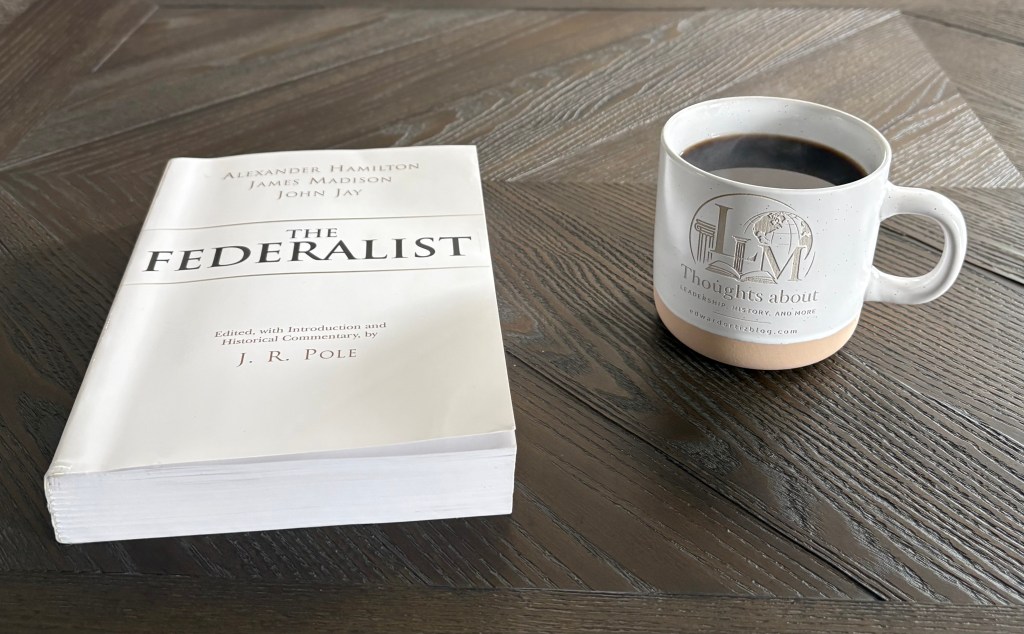
The Federalist, edited by J.R. Pole, was a great read, but I’m glad the American Heart Association says it’s fine to drink up to five cups of coffee a day because I needed a few of those—especially while reading Alexander Hamilton’s essays. Still, the book was absolutely worth it.
For those who may not know, The Federalist, commonly referred to as The Federalist Papers, “is a series of 85 essays written by Alexander Hamilton, John Jay, and James Madison between October 1787 and May 1788 and published in various New York state newspapers. They were written and published to urge New Yorkers to ratify the proposed United States Constitution, which was drafted in Philadelphia in the summer of 1787. In lobbying for adoption of the Constitution over the existing Articles of Confederation, the essays explain particular provisions of the Constitution in detail. For this reason, and because Hamilton and Madison were each members of the Constitutional Convention, the Federalist Papers are often used today to help interpret the intentions of those who drafted the Constitution.”1
The essays covered a wide range of subjects, including commerce, the military, the structure of the branches of government, taxation, and much more.
When you read these essays, you quickly realize the remarkable depth of thought behind each one. Whether or not you agree with every argument, it is hard not to conclude that many of today’s elected officials in Congress have a long way to go if they hope to match the intellect, clarity, and passion of these Founding Fathers.
I receive regular email updates from my representatives in Congress and at the state level, and they usually boil down to a couple of paragraphs saying, “Look how bad the other side is, and here’s everything great I’m doing for you.” Can you imagine our elected officials writing detailed essays explaining and defending their positions and then publishing them in local newspapers? Revolutionary, if you ask me. But I also understand that most politicians fear political blowback, so we probably won’t see anything like that anytime soon.
The 2005 edition of The Federalist is excellent. It includes a superb introduction, a concise chronology of political events from 1688 to 1791, an overview of the major themes of the essays, the text of the Articles of Confederation, and—perhaps most helpful of all—the text of the Constitution with cross-references to the relevant Federalist essays. The editor’s historical notes and explanations are outstanding and greatly enhance the reading experience.
Although the chronology officially covers political events from 1688 to 1791, its first entry actually begins with the Magna Carta of 1215 under King John of England, highlighting one of the foundations of modern due process and the right to trial by jury. It reads:
“No Free-man shall be taken, or dispossessed, or imprisoned, of his free tenement or liberties or free customs, or be outlawed, or exiled, or in any way destroyed; nor will we condemn him, nor will we commit him to prison, save by the lawful judgement of his peers or by the laws of the land.”
There is so much valuable material in this book and in each of the essays that it would be impossible to do it justice in a short blog post. These papers have been studied, analyzed, and debated for more than two centuries, with thousands of articles written about their content. Rather than attempting to summarize everything, I’ll simply highlight a few passages and historical notes that caught my attention as I continued researching what the Founding Fathers actually wrote compared with what we often hear from today’s politicians and pundits.
Two interesting entries from the chronology
1688 – Mennonites (a Christian group) petition in Pennsylvania condemning slavery. (p. xxv)
Many sources identify 161923 as the beginning of slavery in the English colonies, when approximately twenty enslaved Africans were brought to Jamestown, Virginia. It was encouraging to see that organized opposition to slavery emerged very early in colonial history.
June 12, 1776 – Virginia adopts the Declaration of Rights and a new constitution. Separation of church and state later becomes an American constitutional principle. (p. xxxv)
John Jay on the importance of the Union
“The importance of their continuing firmly united under one federal government, vested with sufficient powers for all general and national purposes. The more attentively I consider and investigate the reasons which appear to have given birth to this opinion, the more I become convinced that they are cogent and conclusive… providing for their safety… security for the preservation of peace and tranquility, as well against dangers from foreign arms and influence, as from dangers of the like kind arising from domestic causes.” (p. 9)
Alexander Hamilton on taxation
“The ability of a country to pay taxes must always be proportioned, in a great degree, to the quantity of money in circulation, and to the celerity with which it circulates.” (p. 62)
In other words, governments collect tax revenue more easily when the economy is healthy and money circulates freely than when economic activity is weak and money is scarce.
James Madison on the separation of powers
“The accumulation of all powers, legislative, executive and judiciary, in the same hands, whether of one, a few or many, and whether hereditary, self-appointed, or elective, may justly be pronounced the very definition of tyranny.” (p. 261)
“In a free government, the security for civil rights must be the same as that for religious rights. It consists in the one case in the multiplicity of interests, and in the other, in the multiplicity of sects. The degree of security in both cases will depend on the number of interests and sects.” (p. 283)
That last quote from James Madison is powerful because he saw diversity as the best safeguard against any single group—whether political, economic, or religious—dominating the rest.
John Jay on the Senate’s role in treaty-making
“The 2d. section (Article II of the Constitution) gives powers to the president ‘by and with the advice and consent of the senate to make treaties provided two thirds of the senators present concur.’ The power of making treaties is an important one, especially as it relates to war, peace and commerce; and it should not be delegated but in such a mode, and with such precautions, as will afford the highest security that it will be exercised by men best qualified for the purpose, and in the manner most conducive to the public good… The inference which naturally results from these considerations is this, that the president and senators so chosen will always be among those who best understand our national interests, whether considered in relation to the several states or to foreign nations, who are best able to promote those interests, and whose reputation for integrity inspires and merits confidence. With such men the power of making treaties may be safely lodged.” (pp. 344–345)
I highly recommend this book to anyone interested in U.S. constitutional history. It provides invaluable insight into what three of America’s Founding Fathers were thinking as the Constitution was being debated and defended before the states ratified it. I have read that The Federalist is one of the most important works ever written about our system of government. After reading it, I wholeheartedly agree.
About the Editor:
Jack Richon Pole, was a British historian of the United States. After holding posts at University College, London and the University of Cambridge, he was Rhodes Professor of American History and Institutions at the University of Oxford from 1979 to 1989.4


Siempre un gusto visitar tu blog Edward, gracias.
Disfruta tu fin de semana
LikeLiked by 2 people
Gracias por lo que compartes Edward
siempre interesante.
Bonito fin de semana.
LikeLiked by 1 person
De nada. Gracias por tu comentario, y que pases un buen fin de semana.
LikeLiked by 1 person
I admire your reading list, Edward. Very interesting the points you gleaned to share with us. This quote seems the most salient at the current moment, that our leaders’ “reputation for integrity inspires and merits confidence” Electing felons might not be wise, folks.
LikeLiked by 1 person
Thank you, Rebecca. I have so many questions and not enough time or money to attend college courses to answer all of them, so books and self-study will have to do. About your last comment, it’s insane, and if that is the best we can do, then this country is in serious trouble.
LikeLiked by 1 person
You do have some interesting reading, Edward. I dug a bit in the writings of Madison for a post I wrote last year. The separation of powers is critical.
Precisely what is now under siege.
Thanks for your post
LikeLiked by 1 person
Thank you. It’s just interesting to read about that time in our history, what these men said and how they formed the government. They didn’t just establish the separation of powers; they also discussed the dangers of any single political group from dominating all three branches, which is exactly what is happening now.
LikeLiked by 1 person
They based part of their thoughts on Montesquieu’s “L’esprit des lois”, which in turn drew part of his thinking opposing Hobbes…
LikeLiked by 1 person
Yes, that’s something I learned while reading the papers and the history book I’m currently reading. These men were intellectuals, very different from what we see now.
LikeLiked by 1 person
They were. Hamilton, Jefferson and Madison most likely spoke French, to read Voltaire, Montesquieu, Rousseau et al. They also most likely knew Latin to read the Roman authors…
Buena lectura, amigo.
LikeLiked by 1 person
Absolutely! As part of his college admission, John Adams had to pass an oral exam in which he was required to read and speak Latin. Gracias!
LikeLiked by 1 person
I took Latin for 3 or 4 years. And I’m probably the last generation to have had Latin as part of the regular programme. Greek was already out…
(Can’t read Latin any more though.)
🤗
LikeLiked by 1 person
That’s a difficult language to stay proficient in. I guess that if you listen to Mass celebrated by priests of the Society of Saint Pius X, it might refresh your memory. 😀
LikeLiked by 1 person
Probably. I can pick a word or two, but the structure of Latin is very complicated…
LikeLiked by 1 person
Oh, I bet.
LikeLiked by 1 person
What a wonderful overview of The Federalist Papers, Edward, and such an accomplishment. Really important content! You do all of your readers a very great service by bringing these important works to our attention. Thank you truly for all you do!
LikeLiked by 1 person
Thank you, Lori, so kind of you. I do my best to share what I’m learning along the way. I think it’s important to review our foundations because the rest is shaky, and it’s good to find out how we got here.
LikeLike
Wow, Edward! Amazing accomplishment for the editor, Jack Richon Pole, and also you, for your indepth review. It does seem like all Americans should read this book, or at least parts of it, but few will actually do that. Thank you so much for bringing this important book to our attention.
LikeLiked by 1 person
Thank you, Mary. The editor did an amazing job with this book, and his explanatory notes are excellent. I completely agree that more Americans should read it, and review the history behind it to better understand the Founding Fathers and the extraordinary effort it took to unite the colonies and establish this nation.
LikeLiked by 1 person
Heavy as it can be at times, it really is a mandatory, irreplaceable read for any engaged citizen of this country. It also infuriates me when modern politicians attempts to invoke or co-opt the thoughts or positions of the Founders to support a position of theirs. I just want to scream, “Hey, they were very clear with their thoughts on *insert topic here*!”.
Good stuff, as always, Edward!
LikeLiked by 1 person
You are absolutely right about the importance of these papers. I also get infuriated when politicians do that. I wish that instead of saying we need to do X, Y, and Z because it’s good for the country or to support the president, they would explain their position clearly with facts instead of using other people’s words. Thank you, Scott.
LikeLiked by 1 person
Amen to that!
LikeLiked by 1 person
My daughter, who is nine, just had me buy her the Federalist Papers. She is obsessed with Hamilton! Looking forward to reading her copy soon!
LikeLiked by 1 person
Cool! Well, he wrote most of the papers, so she’s in for a treat. I’m not sure which edition you bought, but if you’re interested, I can send you a copy of the Constitution that came with mine. At the end of each article/section, it has a reference number pointing back to the corresponding essay.
LikeLike
Thank you, Edward. Your choice of excerpts makes an important argument. I only wish that you underlined the conclusion of that argument, as well.
The founders, if they were here to observe the state of the nation they left us, would not likely have shown that hesitation. By signing the Declaration of Independence, they signed their own death warrants if the revolution had failed. Brave men, all.
Thank you again, Edward.
LikeLiked by 1 person
You’re welcome. They were absolutely brave men because, in the eyes of the British Crown, they were committing treason. You’re probably right that, if they were here today, they would be telling current politicians—especially members of Congress—that they are failing to fulfill their constitutional duties, and they would do so in a very direct manner.
I also wonder whether they would have imposed term limits on the executive, Congress, and even the Supreme Court. At the same time, I understand why they didn’t do so. Their primary goal was to create a lasting union, and that required a great deal of compromise.
The Founding Fathers were extraordinarily serious in their approach to creating the Constitution. They expected public officials to use reason, defend their positions thoughtfully, and place the long-term interests of the country above short-term political gain. Sadly, that seems to be much less common today. Too often, political gain comes before everything else.
Thank you for reading, and for your great comment, Dr. Stein.
LikeLike
I’ve read bits and bites of The Federalist Papers, but never the entirety. Thank you for doing that for me. You’re right about essay format. Few write them anymore, but I believe there is hope. The long form interview seems to more popular than before. The Dwarkesh Patel interviews and Joe Rogan’s overly long ones (I rarely get through four hours). I’m always stunned to see the viewer numbers on these.
LikeLiked by 1 person
You’re welcome, Jacqui. That’s good to hear because discussions are needed and politicians need to start explaining their positions clearly. I’m glad that these long form interviews are filling some of the gaps.
LikeLiked by 1 person
Great post, James Madison on the accumulation of all powers, legislative, executive, and judiciary, in the hands of one or a few is the definition of tyranny, very powerful, seems like we are trying to put all the power in the executive branch of government, very dangerous.
LikeLiked by 1 person
Thank you. My concern is that one political party controls all three branches. I hope that changes and that we can return to some kind of balance.
LikeLiked by 1 person
I used to be signed up to a bunch of politicians email subscriptions, but you’re right. They just say the same thing repeatedly. “Other side bad, me side good!” It basically became a waste of time to even get those and have to delete them. There was one guy in my area who is actually emailing about what he had done and what he was concerned about. But that’s super rare.
LikeLiked by 1 person
I know, it’s insane. I just received a card from our state senator, and it doesn’t say anything of substance. Sending that kind of mail is just a total waste of state funds.
LikeLiked by 1 person
Kudos on getting through the essays, Edward, and gleaning insights. Regardless of content, the language itself of that era can be challenging. Once I find the rhythm of it, it begins to flow, but then depending on the content… there might be some dams in the way. I enjoy reading fiction from a little later, the Victorian Era. The language is similar, but not quite as “big.” That maybe a strange way to describe it, but I’m sticking with it — big. 🙂 Have a lovely weekend and happy August. Hugs.
LikeLiked by 1 person
Thank you, Teagan. “Big” is a nice way to describe it. As I read, I keep thinking about how incredible those conversations were back then. I’m sure there are people getting together and having profound discussions today, but I’m not seeing that among our politicians, at least not in public. Wow, yes! Tomorrow is August, this year is passing incredibly fast. I hope you have a wonderful weekend.
LikeLiked by 1 person
As much as I like Lin Manuel-Miranda’s “Hamilton,” I think I’d have a hard time powering through the actual essays, though I bet they’re fascinating in retrospect.
LikeLiked by 1 person
They are definitely a hard read, but absolutely fascinating because what I’ve been reading lately is answering a lot of my questions regarding what the Founding Fathers said vs what we hear from current politicians.
LikeLike
I remember being enamored with the Federalist Papers in college. It sounds like it was a heavy read, but my kind of book. The little nugget about the Quakers’ opposition to slavery is something I’ve been looking into recently, as I have been trying to figure out why there was such a silence by congregations to something so antichristian. It was a good lead for me to pursue.
There is no fixing the current state of affairs. The way the system is currently set up is very far from what the founders intended. It is so corrupt that the only thing to change it, which I shall not mention, will come at a very high price.
The boot is firmly on the neck at this point. Maybe the voters will decide to make a real difference at the polls.
A great share, Edward.
LikeLiked by 2 people
Thank you, Nigel. Many Christians were vocal opponents of slavery, but the church itself was likely too politicized to address the issue directly, much like today. The current political environment is hard to read, and we may have to wait until the midterms and 2028 elections to see where the country is heading.
LikeLiked by 1 person
You’re welcome, Edward.
LikeLiked by 1 person
I attended a Mennonite ( Brethren ) college and found that there is much to appreciate about the Anabaptist tradition that they spring from.. but I didn’t know that they petitioned against slavery early on…
Another group within this tradition are the Amish who inspired some of Leo Tolstoy’s philosophy.
LikeLiked by 1 person
The Mennonites and the Quakers were very active against slavery. They understood from the Bible that it was wrong, so they pushed for abolition. I didn’t know that aspect of Leo Tolstoy, so thank you for sharing that piece.
LikeLiked by 1 person
I didn’t know that about the Quakers … so thank you:)
LikeLiked by 1 person
You’re so welcome.
LikeLiked by 1 person
🙂
LikeLiked by 1 person
Edward…you have a knack for starting a post with a zinger! You did it this time, for sure!
I applaud you for tackling challenging reads and persevering. Always impressive. Thank you, my friend! 💝
LikeLiked by 2 people
Thank you so much, my friend. I caught the reading bug, and it’s just awesome. So much to learn!
LikeLiked by 1 person
You are amazing! ❤️😉❤️
LikeLiked by 1 person
🙏🏼🫶🏼
LikeLiked by 1 person
A fascinating review of an important historical work. The Federalist Papers remain a valuable source for understanding political ideas, governance, and the foundations of democracy. Thank you for sharing your insights and making this classic work more accessible to readers.
LikeLiked by 1 person
You’re welcome, and thank you very much for reading and commenting.
LikeLike
I like very much the point on diversity, for biologically speaking, diversity is what allows a species to survive and thrive. A certain species population that, for instance, lacks genetic diversity is in great danger if any unexpected change happens. The same applies to societies; the trap of totalitarianism or leadership by just a few takes the whole to doom. While reading your book reviews on the Founding Fathers, the huge disparity between their mindset and concerns and the mindset and concerns of current leaders comes to mind. Thank you, Edward, for breaking it down for me in such a meaningful way. You help me have a broader picture of our world. With appreciation, light and blessings to you, always my friend 🙏✨
LikeLiked by 2 people
You’re welcome, Susana. The difference between the Founding Fathers and our current leaders is extraordinary, even though we have a lot of professionals such as lawyers and doctors. What always gets me is seeing professionals promoting and engaging in irrational discussions about the environment, health, homelessness, etc., when they should know better and use their education not only to inform citizens, but also to push back when people are trying to promote misinformation. It’s always a blessing having you here, my friend. Hope you have a great rest of the weekend!
LikeLiked by 1 person
Dear Edward
Thanks for introducing us to ‘The Federalist’. It’s a pity where it ended now.
The Fab Four of Cley
🙂 🙂 🙂 🙂
LikeLiked by 1 person
You’re very welcome. I agree with you. We are seeing a very dysfunctional government.
LikeLiked by 1 person
Having read this in its entirety did you find them to be intelligent founders and leaders speaking for the nation as a whole or was it a bunch of back stabbing men out for their own ill-gotten purposes? I pray they truly were about us, the American people as a whole? Has politics in your opinion always been so divisive and full of hatred for our fellow man? Sadly I lost my rose colored glasses. I did 12 years of schooling in MA, a pretty colonial state but when I would visit the state house as a student I think I saw people working together to get things done then again they may have always been out for themselves. I am so sick of all of them and now will demand term limits for those deciding on our fate lol I am a rebel at heart I guess. One set of laws for all! No one is above me or better than me, maybe just despicable in their intent 🙂
Remember this? Our leaders leave me desiring less government. Beginning in 1976, many children in the United States learned the words of the preamble from a Schoolhouse Rock! segment titled “The Preamble”.[79][80][81] Later studies showed that the segment was effective in teaching and reinforcing long-term memory of the words, although a spoken version was more effective for understanding their meaning.[80][82] Though “The Preamble” proved memorable, for metric reasons it deviated from the actual wording by omitting the words “of the United States” from the first line. I will read the book thank you.
LikeLiked by 1 person
Thank you for your comment. They were definitely intelligent people, and it was impressive what they did to establish the government. Of course, they had character flaws, and some were slaveholders, but I get the sense they had the best intentions for the country. As I read this book and others, division was always there, even hate. Thomas Paine had some strong words for George Washington, but the difference was that they worked through disagreements and found consensus. Slavery was one of those sticking points, and for the sake of the Union, they put the subject aside. Nowadays, politics is stronger than common sense in our current environment, so not a lot of common ground is found.
LikeLiked by 1 person
Fascinating and thought-provoking, as always, Edward. Thank you. Sadly, the words and intentions of the “founding fathers” did not apply to all people. That hypocrisy is the one thing current elected and appointed officials are continuing, though sans any semblance of intellect.
LikeLiked by 1 person
You’re welcome, Natalie. You are so right about the hypocrisy, especially with regard to slavery. They knew it was wrong, even Christians knew that, but they did it anyway. I think that is one of the problems that has affected society from the very beginning. I’m always monitoring the Protestant church, since I’m part of it, and it’s amazing to see the things that are happening on a weekly basis.
LikeLike
Love that you are going to the source, Edward. What a great way to get grounded – and some perspective on what we have now. I’m glad you explained that Alexander Hamilton passage on taxation. And James Madison on the separation powers is good. I’m grateful for these founders that provided a strong (not perfect) foundation. Thanks for the great info and review, my friend!
LikeLiked by 1 person
Thank you, Wynne. It’s fascinating to see how committed they were to the cause. Not only were they debating in Congress, but they also spent significant time and effort informing and convincing their constituents. It’s just incredible.
LikeLike
Your review thoughtfully underscores the enduring significance of The Federalist as a cornerstone of constitutional thought. By connecting its historical context with its continuing relevance to democratic governance, you encourage readers to reflect on the principles of liberty, federalism, and the rule of law. An informative and well-presented review—thank you for sharing these valuable insights.
LikeLiked by 1 person
You’re very welcome, John. I really appreciate your comment. 🙏🏼
LikeLiked by 1 person
This was a really enjoyable read! Great work. I’d love for you to check out my latest work at lucazani.ink, if you’re interested! Appreciate any feedback.
LikeLiked by 1 person
Thank you very much.
LikeLiked by 1 person
You’re very welcome sir!
LikeLiked by 1 person
A compelling post, Edward! I wish I knew how the wrongs could be right again. Thank you for highlighting these nuggets from the essays.
LikeLiked by 1 person
Thank you, Lauren. Yes, I think there are a few of us in our WP community thinking the same thing: How can we fix it?
LikeLike
I commend you in reading The Federalist Papers and appreciate the snippets you’ve shared with us. I imagine it must be difficult/maddening for Hamilton, Madison, and Jay to witness from the Other Side how far we have strayed from their ideals for our nation.
LikeLiked by 1 person
Thank you, Rosaliene. I think they would had established term limits for congress and the Supreme Court just to mention a couple of things. They would be appalled if they were alive and witnessing our current way of governing.
LikeLiked by 1 person
Term limits would definitely make a difference.
LikeLiked by 1 person
Absolutely!
LikeLiked by 1 person
Yeah, I would probably feel compelled to drink more than 5 cups of coffee to read this. And I do not drink coffee. Great review, as a Black British I have an interest in slavery in the British colonies as well as in America. Thank you for sharing.
LikeLiked by 1 person
You’re very welcome. Yes, as I read U.S. and Puerto Rican history, slavery and religion are always in the back of my mind. I’m always interested in reading what people back then thought about these subjects. Slavery is the one that hurts me the most because of the way people thought back then. It is very painful to read some of the narratives.
LikeLiked by 1 person
It does like a book many in Congress would struggle to understand. I can see where some of the more conservative values can trace themselves to these documents – the amount of money in circulation being the basis for taxation sounds a bit like trickle down economics!
LikeLiked by 1 person
Oh, I’m sure some in Congress who talk about the Federalist Papers have never read them. I definitely saw conservative talking points as I read the papers, but some liberal ones as well, mainly from Madison. Regarding taxation, Hamilton was pointing to the fact that you can’t tax people if they don’t have money, that’s it in a nutshell.
LikeLike
Nice review! Read these many years ago. I think it might be time to pick up a copy!
LikeLiked by 1 person
Thank you, Phil. It would be ideal if you could find this copy and use the cross-references to read essays corresponding to a particular article of the constitution. It will save you time. I know I’ll be using them to review arguments in the future.
LikeLiked by 1 person
Thanks for sharing your review, Edward, especially as we face non-stop ads for the next election cycle. This book sounds like a great resource for learning more about the Federalists. I immediately looked in my local library system to see if I could borrow it, but so far no luck, I may have to expand my search.
Just reading your snippets from the book makes me so disappointed in our current politicians and their lack of knowledge and ability to communicate properly with the public. I am so sick of sound bite hatred – as you so succinctly summed up – “Look how bad the other side is, and here’s everything great I’m doing for you.” (My eyes ache from rolling every time I hear a politician speak.)
Did this book mention the Anti-federalists? Their concerns were important when it came to the creation of the Bill of Rights. The Anti-Federalists advocated for a more decentralized form of government with greater protections for individual rights and stronger representation for the states.
LikeLiked by 1 person
You’re welcome, Rose. It is absolutely sickening to hear what some of our politicians say sometimes. They didn’t mention the Anti-Federalists per se, but a lot of the essays are responses to anti-federalist arguments. For example, Federalist No. 10, written by Madison, responds to the fear that a large republic cannot survive and that factions will destroy liberty. My next project is to find a good Anti-Federalist book to read, and I heard that The Anti-Federalist Papers by Morton Borden is a good one. So, I might go with that one.
LikeLike
Thank you for this blog post, Edward. Maybe you can continue to share small gems/nuggets of historical perspective with the rest of us as you continue your reading. I also appreciate you adding some perspective/reminders regarding African-American history. 1619! I would love to see Professor Gates of FINDING YOUR ROOTS trace the genealogy of those original enslaved human beings into the present day. Maybe this has already been done? Those folks would have roots on this continent going back more than 400 years…
LikeLiked by 1 person
You’re welcome, Will. It’s my pleasure to share what I’m learning along the way. I’m not sure how many researchers are working on tracing genealogy, but I know at least one: Dr. Edda L. Fields-Black, the author of Combee, who is doing that and actually has a database/website with the information. In her book, she provided data on some of the enslaved people who were brought to America by ship name and who bought them. Also, she traced some to the present day (including one of her own ancestors). It’s absolutely amazing, the work that she and others are doing to trace their genealogy.
LikeLike
I thoroughly enjoyed reading your review/thoughts about The Federalist, Edward. I recently purchased The Federalist Papers e-book. I now wish I’d purchased Pole’s book. It sounds like the cross-references to the Constitution make that book extremely beneficial. As a political science major, I read The Federalist Papers, of course, but that was 50 years ago. I look forward to reading them again — perhaps just one or two of them each day, since I cannot have caffeine. You make so many good points. Yes, it is beyond my imagination that anyone in Congress today could write even a short essay about any of the constitutional foundations and ideals on which our country was founded. It has always amazed me that our young nation was blessed with so many learned and eloquent leaders out of such a relatively small population and time when education was just for the wealthy. Your post today has inspired me. Perhaps I’ll start reading The Federalist Papers tonight. Thank you for making me aware of Jack Richon Pole’s edition.
LikeLiked by 2 people
You’re very welcome, Janet. Cross-referencing to the Constitution is the best tool. Now that I’ve read through the whole thing, I can just go to particular areas of it and read the corresponding papers. Just genius. Your point about education is excellent, and I now wonder if current politicians are getting an education just to climb the ladder instead of using it to improve their understanding of society with the goal of bettering it.
LikeLiked by 2 people
I read a similar book that gave a summary to the Hamilton papers and why they felt the Constitution was a necessary upgrade. Thanks for highlighting some key aspects in the papers and clear failings in our current political climate. Like you, Liz, and Robbie, I want to learn and improve, but don’t know how we get there. In theory, it’s up to us, but we don’t have the same power with so much big money currently in politics.
LikeLiked by 2 people
You’re welcome, Brad. Yeah, it’s definitely a head-scratcher. You are absolutely right that big money is moving politics in the wrong direction. I still believe that voters can remove politicians who are after big money, but it will take a lot of self-education to understand the issues and then challenge current politicians when they come up with their nonsense. I’m not sure a lot of people are willing to do that.
LikeLiked by 2 people
All the way up through the Civil War, even young back country Privates regularly wrote letters home full of beautiful sentiments and honorable aspiration, all in the most beautiful prose.
Literacy has been declining for generations here ~ and literature right along with it.
LikeLiked by 2 people
I agree with you, Ana. I read Bruce Catton’s Civil War Trilogy, and it’s amazing to see the depth of what Americans wrote about the things they saw.
LikeLiked by 2 people
I remember reading certain essays from The Federalist Papers in college but not the whole thing. Just reading the passages you’ve highlighted infuriates me to the point of despair. I don’t know which is worse: refusal to follow the thinking behind the formation of our federal government or ignorance of it.
LikeLiked by 4 people
I hear you, Liz. Frustrating indeed. I’m actually reading another history book, The Creation of the American Republic by Gordon Wood, and so far what I’m getting is that not just the Founding Fathers, but local leaders, historians, educators, philosophers, and clergy were focused on individual freedoms (though slavery was a terrible contradiction) and benevolence that collectively created a common good to counter selfishness, greed, hate, and the use of wealth to gain influence. Not sure how we went from that to what is going on today, I guess it’s just human nature, but it’s infuriating because this country can do so much good for the world.
LikeLiked by 2 people
We’ll need to understand how this nightmare happened to keep it from happening again.
LikeLiked by 2 people
A nightmare indeed. Part of the problem is our politicians, from both parties, not taking citizens’ concerns seriously. People will do very irrational things when they are not heard.
LikeLiked by 1 person
Here’s what I find hard to wrap my head around. I was on a number of committees to represent my department and led many projects on behalf of the department. I made decisions based on the needs and desires of the people I represented. I would disagree on but I’d speak my piece to the department and if their decision didn’t go my way, it didn’t matter. That’s how I always understood representation to work. I don’t get it.
You are so right about people doing irrational things when they aren’t heard. Right now, I feel that we’re in a powder keg that could go off any time now.
LikeLiked by 1 person
That’s so true, Liz. I’m experiencing all that here in our city. I attend the council meetings and people are asking for unrealistic things. The city has a revenue problem and the mayor is trying to bring in new businesses, but citizens are so closed-minded about what businesses they want that it’s almost impossible. There is no money, but people want new parks, better sidewalks, no reduction in the police force, no tax increases, etc. I wonder how in the world the city is going to pay for all that. It’s just a circular discussion because people don’t want to listen to reason and see reality.
LikeLiked by 1 person
School districts across my state had million-dollar deficits the past year, and had to make some unpopular cuts to staff and services. When the federal Department of Education cuts their funding, the districts have to make up the shortfall somehow. NH has no income tax, and schools are funded on the backs of homeowners’ property taxes.
LikeLiked by 1 person
I think the same thing is going to happen here. There are going to be cuts, and people are not going to like them. I’m about to listen to the city meeting to discuss the Comprehensive Plan, so that is going to be fun.
LikeLiked by 1 person
Absolutely! It points to just how much we’ve lost. Sad and infuriating.
LikeLiked by 3 people
☹️
LikeLiked by 1 person
An excellent commentary about these papers, Edward. Many of us know that something has gone very wrong with modern politics and society. No one seems to know how to set about fixing it though.
LikeLiked by 2 people
Thank you, Robbie. I have been thinking a lot about that lately, and I’m not even sure what the best approach to fix it is. In theory, we should be electing capable leaders to run our country, but that is clearly not happening. I know the problem is us, the electorate, for not demanding excellence, but how can we persuade citizens to do that? It’s something that needs a lot of thought.
LikeLiked by 2 people
Yes, I see the same quandary. It’s even worse in Africa where a vote can be bought for a bag of mielie meal (porridge staple).
LikeLiked by 1 person
Wow, and I thought giving $1,000 per child in this country was bad, but food, my goodness!
LikeLike
I know 🫣
LikeLiked by 1 person
It sounds like a pretty heavy read, Edward. Thanks for the recap.
LikeLiked by 2 people
You’re welcome, Terry. It was, but I learned a lot.
LikeLiked by 1 person