Two years ago, I wrote a post titled Reflecting on Puerto Rico’s 72-Year Constitutional Legacy. As the island approaches the 74th anniversary of its Constitution on July 25, I decided to update that post. At some point, Americans will have to decide what to do not only with Puerto Rico but also with American Samoa, Guam, the Northern Mariana Islands, and the U.S. Virgin Islands. Staying informed about what is happening in these territories will become increasingly important.
I think these territories need to do a better job of informing Americans on the mainland so they can encourage Congress to make a decision about the future of all U.S. territories. After all, Congress is the only body with the authority to do so.
I’m not sure most Americans are aware of what is happening in these territories, and that’s understandable because the federal government rarely talks about them. Instead, public discussion often focuses on ideas such as annexing Canada or Greenland rather than resolving the status of the territories the United States already has. Puerto Rico has spent decades trying to find a permanent solution to its political status. I can only speak about Puerto Rico because it is where I’m from and where I stay connected through local news and, of course, my family, who still live there.
I’ll begin, as I did two years ago, with a brief history of the creation of Puerto Rico’s Constitution.
The United States government authorized Puerto Rico to draft its own constitution through legislation passed in 1950. The Constitutional Assembly met for several months between 1951 and 1952 to draft the document. The law required the framers to meet only two basic requirements: establish a republican form of government and include a Bill of Rights. The proposed constitution was approved overwhelmingly by nearly 82 percent of voters in a referendum held on March 3, 1952. The United States Congress and the President approved the constitution but required that Article II (the Bill of Rights), Section 20, which guaranteed the right to education and various economic rights, be removed. They also required language to be added to Section 3 of Article VII regarding non-governmental schools. On July 10, 1952, Puerto Rico’s Constitutional Convention reconvened and accepted those conditions. The changes were later ratified by voters in a referendum held in November 1952. Finally, on July 25, 1952, Governor Luis Muñoz Marín, Puerto Rico’s first elected governor, proclaimed the Constitution to be in effect.1
To better understand how Puerto Rico reached this point, it’s also helpful to briefly review its history.
In 1898, during the Spanish-American War, U.S. forces landed on the island of Puerto Rico and defeated Spain. The following year, Spain ceded Puerto Rico to the United States under the Treaty of Paris. In 1917, Puerto Ricans were granted U.S. citizenship, and in 1947 Congress authorized the island to elect its own governor. Luis Muñoz Marín was elected in 1948, and the Constitution was approved in 1952, officially establishing Puerto Rico as a commonwealth.
Politics in Puerto Rico can be chaotic—possibly even more than in the mainland United States—and many people treat politics almost like a national sport.
For many Puerto Ricans, July 25 commemorates not only the adoption of the Constitution but also two other significant and painful events in our history.
The first occurred on July 25, 1898, when the United States invaded Puerto Rico and, within a few months, gained control of the island from Spain.2 Ponce was among the first major cities to surrender on July 28.3
The second occurred on July 25, 1978, and is known as the Cerro Maravilla massacre. At Cerro Maravilla, two young Puerto Rican pro-independence activists, Carlos Enrique Soto-Arriví and Arnaldo Darío Rosado-Torres, were killed in a Puerto Rico Police ambush.4 I still remember watching news coverage of the investigation on television.
The events set in motion by Christopher Columbus’s arrival in 1493, followed by four centuries of Spanish rule and the United States’ victory in the Spanish-American War, created a complex political identity that continues to shape Puerto Rico today.
Puerto Rico faces many challenges, but corruption and government mismanagement remain among its most serious problems.
In 2014, Puerto Rico defaulted on its debt after accumulating approximately $72 billion in bond obligations and an additional $55 billion in unfunded pension liabilities.5 On June 30, 2016, President Obama signed the Puerto Rico Oversight, Management, and Economic Stability Act (PROMESA) into law, creating the Financial Oversight and Management Board—known locally as La Junta.6 Ten years later, the board remains in place.
Many Puerto Ricans oppose the oversight board, although I believe it played an important role in stabilizing the island’s finances. Eliminating the board will not make Puerto Rico’s debt disappear. Only responsible fiscal management and long-term financial discipline can accomplish that. Whether people support or oppose the board, one reality remains: Puerto Rico has little authority over its operations. In May 2023, the U.S. Supreme Court ruled that the board enjoys sovereign immunity, limiting lawsuits against it by local plaintiffs.7
Then came Hurricane Maria in 2017, one of the most devastating disasters in Puerto Rico’s history. More than 3,000 people died as a result of the hurricane, and nearly a decade later, parts of the island are still recovering.
Rather than focusing solely on reconstruction, Governor Ricardo Rosselló’s administration became consumed by scandal. In 2019, Rosselló resigned after leaked Telegram chats revealed offensive, sexist, homophobic, and misogynistic remarks made by him and members of his administration.8
Because Puerto Rico did not have a Secretary of State at the time, the governorship passed to Secretary of Justice Wanda Vázquez, who completed Rosselló’s term before losing the 2020 election. In August 2022, the FBI arrested Vázquez on federal corruption charges.9 She later pleaded guilty to campaign finance violations and was pardoned by President Trump earlier this year. Some news reports have questioned the circumstances surrounding that pardon.10
Now Governor Jenniffer González and members of her administration are reportedly facing allegations that could become another corruption scandal, although it remains too early to know how those investigations will unfold.11
The people of Puerto Rico are still searching for a path forward. Most are divided between statehood and maintaining the current commonwealth status, while a smaller group supports independence.
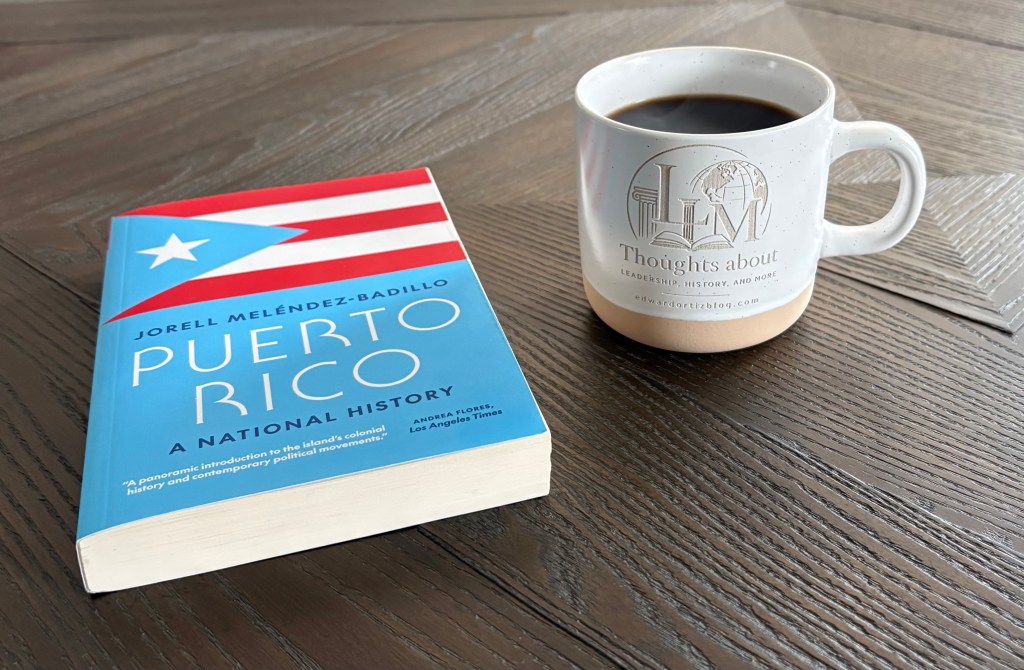
Interestingly, the latest history book I finished—Puerto Rico: A National History by Joel Meléndez-Badillo—provides considerable detail about the island’s independence movement and its revolutionary tradition. It is one of the most comprehensive accounts of the subject that I have read so far. It is an outstanding book, although I believe the author overstates the strength of the independence movement. Puerto Rico never experienced a revolutionary moment comparable to Cuba’s after the Spanish-American War. Today, supporters of independence must persuade the people of Puerto Rico that their vision offers the best future for the island, but they have not made significant progress in doing so.
Congress has shown little interest in resolving Puerto Rico’s political status. Until that changes, I believe Puerto Ricans would be better served by focusing on reducing corruption and improving government management.
I agree with Resident Commissioner Pablo Hernández that Puerto Rico should continue improving under its current status while Congress remains unwilling to act.12 However, I disagree with his characterization of the island’s relationship with the United States.13 Although Puerto Rico is a self-governing territory, Congress ultimately retains authority over the island.14 That reality continues to fuel debate over whether Puerto Rico’s current status should be considered colonial. The United Nations also continues to discuss the issue periodically.15
This week, Puerto Ricans will commemorate the adoption of their Constitution. For many, however, July 25 will also serve as a reminder that Puerto Rico’s political status remains unresolved. Whether one calls it a territory, a commonwealth, or a colony, the island does not enjoy the same political rights and representation as the fifty states.
- https://en.wikipedia.org/wiki/Constitution_of_Puerto_Rico ↩︎
- Jimenez de Wagenheim, Olga. Puerto Rico An Interpretive History from Pre-Columbian Times to 1900. (P. 195). Princeton: Markus Wiener Publishers, 2006 ↩︎
- Pico, Fernando. History of Puerto Rico A Panorama of its People. (P. 236). Princeton: Markus Wiener Publishers, 2017. ↩︎
- https://en.wikipedia.org/wiki/Cerro_Maravilla_murders ↩︎
- https://oversightboard.pr.gov/faq/ ↩︎
- https://www.congress.gov/bill/114th-congress/senate-bill/2328 ↩︎
- https://www.scotusblog.com/2023/05/justices-puerto-rico-public-records-dispute/ ↩︎
- https://en.wikipedia.org/wiki/Telegramgate ↩︎
- https://www.cbsnews.com/news/fbi-puerto-rico-governor-wanda-vazquez-garced-bribery-arrest/ ↩︎
- https://www.cbsnews.com/news/trump-pardoning-puerto-rico-former-governor-wanda-vazquez-officials-say/ ↩︎
- https://www.miamiherald.com/news/nation-world/world/americas/article316188931.html ↩︎
- https://hernandez.house.gov/media/op-ed/opinion-puerto-ricos-democrats-their-commonwealth-status ↩︎
- https://www.sanjuandailystar.com/post/at-washington-event-resident-commissioner-insists-pr-is-not-a-colony ↩︎
- https://www.usatoday.com/story/news/politics/2016/06/09/supreme-court-puerto-rico-independent-sovereign/85155382/ ↩︎
- https://transcripts.un.org/en/asset/k1a/k1ab0p6z0q ↩︎


The most fascinating stories are the ones still being written, and Puerto Rico’s future may be one of them. ✍️
LikeLiked by 1 person
You’re absolutely right, and I hope I get to witness it. Thank you!
LikeLiked by 1 person
Thank you for this, Edward. It is informative.
LikeLiked by 1 person
You’re very welcome.
LikeLiked by 1 person
Is the reticence of Congress due, in whole or part, to the brown skin of Puerto Ricans, especially in this moment in our history? Is the failure to recover from the climate disaster you mentioned at all due to treating Puerto Rico like a stepchild of a far bigger power? I hope you will address these issues, Edward. Thank you for the history lesson you have offered.
LikeLiked by 1 person
Great questions, Dr. Stein. The answer to the first one is complicated, so I’ll do my best to summarize the situation.
When the United States arrived in Puerto Rico in 1898, the circumstances were very different from those in Cuba. Puerto Ricans had resisted Spanish rule, but the independence movement was never as organized or as widespread as Cuba’s. The two islands were closely connected in their struggle against Spain. In fact, if you compare the Cuban and Puerto Rican flags, you’ll notice they share the same design, with the colors reversed, symbolizing that connection.
The Cuban independence movement was well organized and enjoyed broad support. In Puerto Rico, however, many political leaders focused on securing greater autonomy and equal representation within the Spanish Empire rather than full independence. The United States recognized Cuba’s long revolutionary struggle, while Puerto Rico was viewed differently. As a result, Cuba eventually became independent, whereas Puerto Rico remained a U.S. territory.
As for today, I think the situation is much more complex. Some people argue that partisan politics play a significant role because, if Puerto Rico became a state, Democrats would likely gain two senators and several members of Congress, which could affect the political balance in Washington. Others argue that Puerto Rico’s strategic importance plays a role. The location was critical during WWI and WWII, and Puerto Ricans’ U.S. citizenship allowed for easier enlistment during the wars.
Regarding the recovery after Hurricane Maria, I believe the biggest problem has been mismanagement and incompetence by administrations from both major political parties in Puerto Rico. It has been well documented that billions of dollars in federal aid were allocated, yet much of that funding was delayed or left unused. Even former U.S. Secretary of Education Miguel Cardona, whose family is of Puerto Rican descent, publicly questioned why millions of dollars allocated to Puerto Rico’s Department of Education after the hurricane had not been spent.
LikeLike
Thanks for the update on Puerto Rico, Edward. It’s sad to think we’re still operating from the same modus operandi and this continues to be about the same as last time you reported in. Let’s hope congress can get something done for the people! It must be so frustrating for you! ❣️
LikeLiked by 1 person
You’re welcome! It’s frustrating indeed. I hope that at some point, Congress takes action on this. Thank you, Cindy.
LikeLiked by 1 person
It most certainly is! Fingers crossed.. we can dream right? They haven’t taken that from us yet! ❣️
LikeLiked by 1 person
Absolutely! At least we still have hopes and dreams.
LikeLike
Thanks for the heads up about the book and the overview of PR’s political situation. I don’t know much about it except that it was wrested away from
Spain and is now a territory sitting in limbo. It seems to me that statehood or independence are the logical, democratic choices going forward.
LikeLiked by 1 person
You’re welcome, Lynette. I agree that those are the logical choices to resolve the political situation on the island. I hope our Congress takes action in the future. Thank you.
LikeLiked by 1 person
Thank you for the history of Puerto Rico, Edward. It seems to me countries that take over other countries and territories should maybe do something more constructive. Maybe even give them their own sovereignty (ya, unlikely). I’m afraid PR is going to have to hope for a real president to help things along because this congress ain’t the one to do anything.
LikeLiked by 1 person
You’re very welcome. You’re right about Congress. Not a lot is going on there. A real president with actual leadership skills might get things moving.
LikeLiked by 1 person
Let us pray. 😊
LikeLiked by 1 person
Hi, Edward! Sorry it has taken me so long to get here. I have been doing intense training at work for the last three weeks (this is week four). I’m confused about why the U.S. still has/wants PR. It certainly seemed to shock Donald Trump that Puerto Ricans are US citizens after he questioned why we were supposed to help them with, you know, anything. Does the US use that area for military purposes, or is it just that we’ve had it for so long that now it’s just ours?
LikeLiked by 1 person
The U.S. used to have a large naval base there, but it has been closed for years. They did use the island during operations in Venezuela, but that is finished now. So the island still has strategic value. In my opinion, it’s one of those issues Congress simply doesn’t want to act on because it isn’t a priority. Thank you for reading and commenting. Hopefully, your training slows down a bit.
LikeLiked by 1 person
Also, I didn’t realize you’re from PR. Do you get to visit often?
LikeLiked by 1 person
I try to visit my family every year or two.
LikeLiked by 1 person
Excellent post. Just to make sure I checked with AI: so you guys can’t vote for a US election unless you’re not on the island. Kafkaïan…
What would you say the balance in PR is between Reps and Dems? Is there any data?
LikeLiked by 1 person
Correct. Puerto Ricans living in Puerto Rico cannot vote in U.S. general elections, yet they can participate in U.S. presidential primaries. This means their votes help select each party’s presidential nominee, but they cannot vote in the election that actually chooses the President. Amazing, right? There are more Democrats than Republicans on the island. Currently, the governor is a Republican, while the Resident Commissioner in Washington, D.C., is a Democrat. Here is what Wikipedia says: https://en.wikipedia.org/wiki/2024_United_States_presidential_straw_poll_in_Puerto_Rico
LikeLiked by 1 person
It does look… bizarre. Thinking about the military Puero Rican can die for their country but not vote… How crazy is that?
Thanks for the link. If I do the math correctly there would be 500,000 additional popular votes for the Dems. Not sure the Reps would like that.
Bonita semana.
LikeLiked by 1 person
Yeah, crazy politics for sure. That’s a huge part of it, giving statehood would add two Democrats to the Senate and several seats in the House, especially since the island’s population is bigger than 18 current states. ¡Igualmente! Que tengas una bonita semana.
LikeLiked by 1 person
Thanks for this informative and mindful post, Edward. It astounds me that the status of those places has been left unresolved for so long. Honestly, if the same “players” were in the game decades ago, Alaska and Hawaii still would not be states. The crass phrase “Either s&!# or get of the pot!” comes to mind.
You make a good point about “I think these territories need to do a better job of informing Americans on the mainland.” For years I’ve been in denial about the remarkable level of what I call “willful ignorance” of an overwhelming number of Americans. (“Willful” because with so many ways to self-educate available to nearly everyone, there’s little excuse.) I worked with people in the Fed government, holding management-equivalent level pay grades, and those people had no idea that New Mexico was a state. One woman said “Pfft! What’s the difference?” (between Mexico and New Mexico). One man in a GS-15 could not grasp that Albuquerque was not in Arizona. Sorry, to digress… I mean that as an example of how most people know even less than that about “territories”, what that means, and what places they are. They understand “annexing” but territories are beyond comprehension. I’ll step down from my Julia Sugarbaker Soapbox now. Wishing you a wonderful rest of this weekend and a peaceful new week. Hugs.
LikeLiked by 1 person
You’re welcome, Teagan. It’s good to learn everything we can about our country so we don’t get fooled by our leaders. Thank you for highlighting those examples, as I’ve also encountered a few of them in the past. I hope you have a great week, my friend.
LikeLiked by 1 person
This was very helpful information for me, Edward. I have a friend that has lived and worked in PR for several years now, and when I ask about the state of PR, he largely has the same response: an interesting place with great people that shoulder the burden of a mess of an ineffective system and suffer for it (the hurricane recovery, for instance). For an outsider like me, those terms are too broad for me to infer accurate meaning on specifics.
LikeLiked by 1 person
Thank you, Scott. I hear you. I think my vantage point is of someone who grew up there, experienced the education system from kindergarten to college, saw the government through various political parties, and then had the opportunity to compare it to other parts of the United States. It’s an eye-opening experience, one that helps me see the problems in Puerto Rico, and the missed opportunities.
LikeLiked by 1 person
It’s definitely a vantage point valuable to helping my understanding. Thanks, Edward!
LikeLiked by 1 person
You’re very welcome, Scott.
LikeLiked by 1 person
“… encourage Congress to make a decision”? The US still has a Congress? I thought they abdicated to the executive branch about a year and a half ago. To your main point, it seems that Congress (back when we had a Congress) has made its decision — status quo/commonwealth — so when PR has these referenda (I don’t know which way the votes have gone), does Congress even respond at all?
LikeLiked by 1 person
Yeah, that’s right. We don’t have a Congress—I forgot about that! 😂 Well, except for the last two, all of them resulted in keeping the status quo. In the last two, statehood won, but there was no action whatsoever from Congress.
LikeLiked by 1 person
Interesting. I found a reference to the 2012 referendum, after which Obama stated, “the people of Puerto Rico want the issue of status resolved, and a majority chose statehood.” A previous White House statement had said, “Now is the time for Congress to act … so that the people of Puerto Rico can determine their own future.” But then I didn’t see any explanation of why nothing happened.
LikeLiked by 1 person
Yeah, that was a weird referendum. The leaders in favor of the current status told their followers to leave their ballots blank in protest because the referendum was manipulated. About half a million ballots were blank, meaning statehood didn’t get the majority. It was basically a corrupt process.
LikeLiked by 1 person
😢
LikeLiked by 1 person
Ah.. the great independence conundrum. I think it is safe to admit that no empire relinquishes power or control. Especially to a country in their own backyard. Neo colonialism can paint a picture of independence, but the power structures will remain in place. I think a major factor, is that militarily, it allows the US critical control of regional waterways or access to. The recent “exercises” against venezuela comes to mind. The island location allows the US project its regional power in the Caribbean and Latin America to our friends in the east who may have ideas of encroachment. Indepndence is a good idea. I would love to see it happen, but I know that the old masters dont give up territory.
LikeLiked by 2 people
Thank you, Nigel, for your comment. I completely agree with you. Nothing will change until Congress decides what to do with Puerto Rico and the other U.S. territories. I believe the status quo will remain for a long time because Congress can’t even agree on how to address many of the country’s basic priorities. So, the territories are not even on its radar.
LikeLiked by 1 person
I saw something in the news today, that they were using PR as testing ground for Ending Birthright Citizenship for US Territories.. H.R. 9724.. starting Jan 2027.
So its on the radar, but for all the wrong reasons.
LikeLiked by 1 person
Interesting! I need to read what the bill says, but maybe that’s the issue that will finally force Congress to act, either by admitting the territories as states or granting them independence. Thank you for sharing this.
LikeLiked by 1 person
You’re welcome, Edward. My fear is that they would leave the territory to fend for themselves, and without the means to do so, it will become a haven for every nefarious actor around.. another “failed state”. But I am pro independence
LikeLiked by 1 person
I personally don’t think the bill is going to pass, but if it does, it will provide even more ammunition for the midterm elections to flip Congress.
LikeLiked by 1 person
yes it would. I don’t think it would either, it seems to be political posturing to appeal to the hardcore elements who are demanding these measures. Divisive policies only serve a particular group of people, and I hope that the general voting population is aware of what is happening.
LikeLiked by 1 person
Absolutely! They’re just trying to feed their base to keep them happy.
LikeLiked by 1 person
Thank you for this history and synopsis of the choices facing Puerto Ricans, Edward. After almost five and a half centuries of rule by governments far away must make it hard for Puerto Ricans to envision what true independence would look like. Here’s to the beautiful country of Puerto Rico and the best for its citizens!
LikeLiked by 1 person
You’re so welcome, Wynne. That’s true. After so many centuries it’s going to be difficult, but at least they have been practicing governance since the creation of the constitution. The only aspect that concerns me and will impact their ability to govern independently is their lack of financial management. I know every country has corruption, but in Puerto Rico, it seems like that is the default way to operate, finding ways to profit at the expense of the people.
LikeLiked by 1 person
Hi Edward, the story of Puerto Rico and the corruption and mismanagement perpetrated by government is the same as the whole of Africa. I’ve heard from Philippino friends it’s the same there. South Africa is in a downward spiral that is gaining momentum and civil unrest is increasing as government waxes fat and the poor have no service delivery or jobs. All public services are starting to fail here including water, power, health and schooling. It’s a sorry state of affairs and seems endemic to developing countries that had histories under colonialism. My sons are looking to leave South Africa for Europe in the new few years.
LikeLiked by 2 people
It’s incredibly sad what’s happening. I blame most of it on greed. How leaders who profess love for their country can do things like that is beyond me. I’m sure your sons want peace and stability. It would be wonderful if things improved and they decided to stay.
LikeLiked by 2 people
Yes, it would 🩵
LikeLiked by 1 person
Thanks for this informative post, Edward. I had no knowledge of Puerto Rico’s history. I hope the status is resolved soon and the Puerto Rican people can gain control of their future.
LikeLiked by 2 people
You’re very welcome, Michelle. I hope so too. It would be nice if they could control their own destiny after centuries of being controlled by someone else.
LikeLiked by 2 people
Being pardoned by T is definitely not a badge of honor! I think becoming a state or not should be their decision!
LikeLiked by 1 person
I agree. The decision part, yeah, they’ve tried that for decades and there’ve been like seven referendums, but Congress doesn’t want to act on the results.
LikeLike
As always, Edward, you present a thorough and credible account. What are your personal thoughts on independence versus statehood for Puerto Rico?
LikeLiked by 1 person
Thank you, Mary. I believe independence is the best way forward for the island. The potential is there, and I think the island is missing out on a lot of businesses because of the restrictions imposed on it.
LikeLiked by 1 person
You are an educator at heart, Edward. Thank you for all of this. I’m ashamed to say my scant knowledge about Puerto Rico has enormous gaps and you’ve provided such a thoughtful summary here of the history, the strife. Your thought about priorities at the moment – focusing on the reduction of corruption – makes sense, but I can only imagine how embattled Puerto Ricans feel. And ten years, really? Since Maria? Shameful, the lack of progress.
LikeLiked by 1 person
Thank you so much, my friend. Absolutely shameful. There are still houses with blue tarps covering the roofs, if you can believe that. I read a report from RAND that recovery will take until 2051.
LikeLiked by 1 person
Absolutely awful. 😞
LikeLiked by 1 person
I know. 😞
LikeLiked by 1 person
Thank you for this insightful historical perspective. Your post clearly shows that a constitution can provide self-government while still leaving deeper questions of political identity and sovereignty unresolved. It is a thoughtful reminder that constitutional development is often an ongoing journey rather than a final destination.
LikeLiked by 1 person
You’re very welcome, John, and thank you for reading and commenting.
LikeLiked by 1 person
Thanks so much for this history, Edward. As far as corruption in politics goes, I’ve come to believe that sadly, it’s everywhere. It seems that man’s greed and indiscriminate hunger for “more” is a a natural byproduct of power.
LikeLiked by 1 person
You’re welcome, Terry. You’re absolutely right. Greed and the need for more are leading society to some dark places.
LikeLiked by 1 person
A very comprehensive post, addressing key contemporary issues of Puerto Rico’s archipelago and its people, Edward. In the end, it seems all to be a question of interests—political, financial, strategical, etc. How could annexing Greenland be more important than resolving the status of a land that is already under the US Constitution?! The lack of will certainly has an agenda behind it, certainly covering the “big fish” and their interests. It is sad, but the hope should never fade. Thank you for sharing it, my friend. It’s a way of not allowing it to fall into forgetfulness. Lots of light and blessings your way, always! ✨🙏
LikeLiked by 2 people
You’re so welcome. You’re absolutely right about the lack of will and the agenda behind it. Both main parties are guilty of that, for sure. The discussion will continue until the island reaches a resolution. Thank you, and have a blessed rest of the week, my friend.
LikeLiked by 1 person
A thoughtful reflection on Puerto Rico’s constitutional journey. Looking back on its history offers an opportunity to appreciate the island’s resilience, identity, and ongoing conversations about its future. Anniversaries like this encourage us to reflect on the past while considering the challenges and possibilities that lie ahead. 🇵🇷✨
LikeLiked by 1 person
Absolutely! Thank you very much. 🙏🏼
LikeLiked by 1 person
I really enjoyed learning all of this Edward! I didn’t know anything about Puerto Rico until now 🤔
LikeLiked by 1 person
Thank you very much, CJ. I’m glad to hear that you learned something new about my beautiful island.
LikeLiked by 1 person
Edward, thanks for this informative post about Puerto Rico. As I see it, the island would be better served if its people had total control of its destiny.
LikeLiked by 1 person
You’re welcome, and I completely agree with you.
LikeLiked by 1 person
🙂 ❤
LikeLiked by 1 person
I’ve read just enough to know there are many problems, including those you mentioned and a big push for continued fossil fuel imports, seemingly pushed by US oil interests. Whereas, many locals would prefer a greater emphasis on sustainable energy development like Uruaguay did. What’s your take Edward? And your preference for statehood, independence, or continued territory?
LikeLiked by 1 person
Thank you, Brad. You’re completely right about the massive push by oil interests. The governor is heavily pushing Liquefied Natural Gas even securing a $4 billion LNG supply contract. While there was a mandate to transition to 100% renewables by 2050, the government now wants to shift course to bring in more natural gas.
The island gets sunlight year-round; in fact, my in-laws disconnected from the power grid a few years ago and run completely on solar, and they’re doing fine. Solar and wind should be the primary energy sources, but as you know, big money keeps driving policy. I believe the island should be an independent country, as it has all the potential to be a great nation.
LikeLiked by 1 person
Thanks for sharing your views Edward. I hope PR gains independence and can focus on sustainable energy.
LikeLiked by 1 person
My pleasure, Brad. Me too. The people deserve better than what they’re getting now.
LikeLiked by 1 person
Agreed.
LikeLiked by 1 person
Idk if you’ve ever thought of going into office but I’d vote for ya
LikeLiked by 1 person
Thanks for the vote of confidence, Rojie! 😀Politics is such a mess nowadays that I really don’t think I want to get involved, except for casting my vote.
LikeLiked by 2 people
I’m ashamed to say that I know little to nothing about Puerto Rico. Thank you for providing the relevant history and current status. I agree that it’s not fair to its citizens to leave its status in limbo.
LikeLiked by 1 person
You’re very welcome, Liz. I hope the status gets resolved at some point, hopefully long before 2098, when it marks 200 years since American soldiers landed on the island.
LikeLiked by 1 person
Hopefully, when sanity is restored to the federal government.
LikeLiked by 1 person
My goodness, yes! I can’t wait!
LikeLiked by 1 person
Same here!
LikeLiked by 1 person
Thanks for this history! I visited Puerto Rico with my family in August 2016 (the year Before Hurricane Maria) and I remember discussion of the Debt. I had wanted to visit for decades after going to college with several Puerto Rican students. I got the feeling they were all from wealthy families. We loved PR, but it was SO hot. (I would never go back to the Caribbean in summer again.) I’ve never been to a resort anywhere else where the people sitting around the pool were just as diverse as the staff. I liked the vibe a lot.
My only observation on your post is that none of the other US territories has anywhere near the CULTURAL impact of Puerto Rico. From West Side Story to Ricky Martin to Lin-Manuel Miranda to Bad Bunny to AOC, Puerto Rico is like—HUGE, culturally. It makes the US so much richer – and better. Guam or American Samoa are a totally different case!
LikeLiked by 1 person
I don’t blame you. I’m from there, and I only visit in December and January when it’s a bit cooler, not by much, though. I agree about the cultural aspect. Much of that comes from the island’s connection to New York, which started way before the Spanish-American War as Puerto Ricans escaped Spanish control and organized financial support for the island. I know Bad Bunny is pro-independence, but I’m not sure about the other three. Thank you for your comment, Mary.
LikeLiked by 1 person
What exactly does “pro-independence” mean? Becoming its own independent country?
LikeLiked by 1 person
Correct. Separation from the U.S. to become an independent country.
LikeLiked by 1 person
Congress acts only out of its best interests, and particularly in cases where it’s a clear benefit for U.S. gain. Should rare earths or precious metals be suddenly discovered beneath the islands surface, senators would be all over social media urging action…
LikeLiked by 1 person
That’s so true.
LikeLike
I hope the US Congress will give PR the freedom and support to be independent or offer statehood. The current limbo takes away too many rights from the islanders.
LikeLiked by 1 person
I completely agree with you. Those are the only two options I see. Sure, we could stick with the status quo, but like you said, Puerto Ricans remain in limbo and, in my opinion, can’t reach their full potential.
LikeLiked by 1 person
Especially the business limits that require PR to concentrate on commerce with the US can be damaging to the PR economy. There are many potential markets for their goods and PR should be able to explore that. I found it really offensive to see so many US chains dominating the once vibrant restaurant scene on the island.
LikeLiked by 1 person
I agree. The Jones Act limits PR in a big way when it comes to shipping goods to the island.
LikeLiked by 1 person