“People bind themselves into political teams that share moral narratives. Once they accept a particular narrative, they become blind to alternative morals worlds.” (p. XXIII)
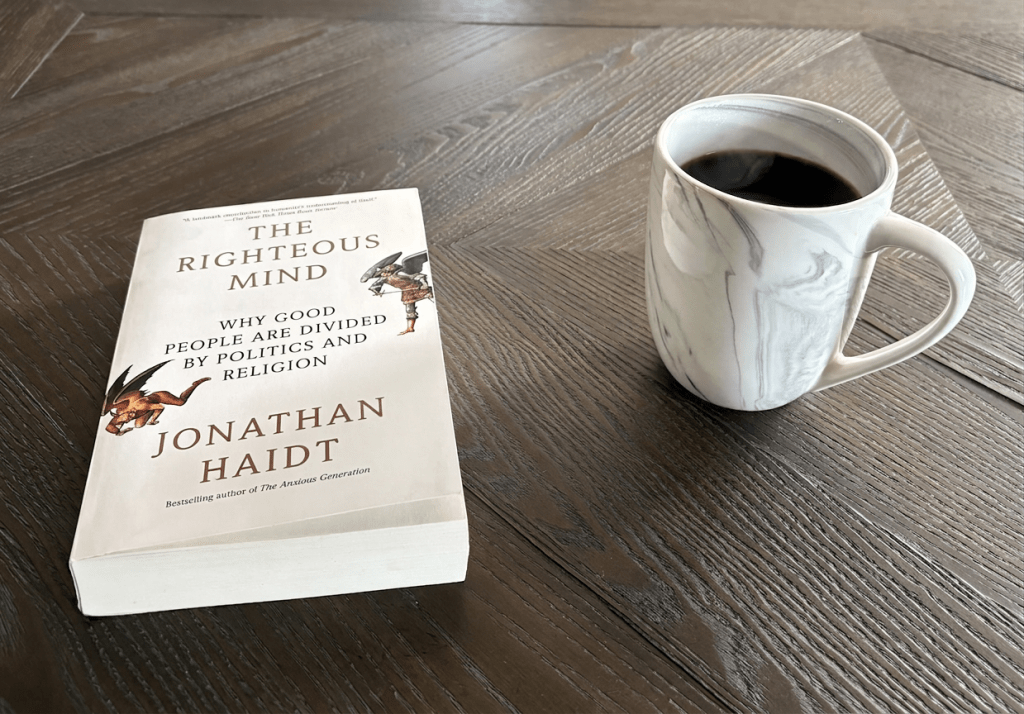
In early June, I wrote a post titled The Human Side of Economics. In it, I discussed a review by The Economist of Alvin Roth’s book, Moral Economics. The reviewer commented that while Roth demonstrated a strong concern for individual autonomy and reducing suffering, he tended to avoid deeper debates about why people find certain transactions morally offensive. I mentioned at the time that I was reading The Righteous Mind by Jonathan Haidt, and wondered if Haidt might have the answer to that question. Having finished it, the book definitely provides an answer to that question—and to many others, for that matter.
In his conclusion, Haidt summarizes his core premise:
“This book explained why people are divided by politics and religion. The answer is not, as Manichaeans would have it, because some people are good and others are evil. Instead, the explanation is that our minds were designed for groupish righteousness. We are deeply intuitive creatures whose gut feelings drive our strategic reasoning.” (p. 370)
Perhaps that is the answer The Economist’s reviewer was looking for, but I am still not totally convinced.
The Righteous Mind: Why Good People are Divided by Politics and Religion was an excellent read, though it wasn’t without its challenges. I found myself getting angry with the author at times. However, a comment previously made to me by Dr. Stein kept coming to mind: “Haidt is a research psychologist and will give you quite a different view than…” Remembering this helped me work through my initial friction. It allowed me to shift my focus, evaluating the book through the lens of social psychology rather than ethics and philosophy, and I ended up enjoying it.
I think philosophers, especially the Stoics, are right in arguing that human beings have the capacity to evaluate what is right and wrong, good and bad, through reason. At the same time, biology and genetics may play a role in shaping human behavior. That is one possible explanation for how figures such as Hitler and Mussolini emerge in history. Of course, that is merely my opinion, so let me return to the review.
Moving back to the review, Haidt divides the book into three parts: Part 1, Intuitions Come First, Strategic Reasoning Second; Part 2, There’s More to Morality than Harm and Fairness; and Part 3, Morality Binds and Blinds.
One feature I really liked, and that I also noticed when reading The Anxious Generation, is that Haidt provides a summary at the end of each chapter. I find this tremendously helpful.
He doesn’t shy away from telling readers that he is both a liberal and an atheist. That doesn’t bother me in the least because I always try to keep an open mind and engage with different viewpoints. However, I can see how some readers might shut down, stop reading, or simply dismiss his arguments because of those disclosures.
To illustrate his points, Haidt relies heavily on narrative. I won’t recount those specific stories here because they are quite provocative, but I recognize why they were necessary to properly assess people’s moral intuitions.
He proposes many hypotheses, but I’m not sure he definitively answers any moral questions. He also draws from philosophers such as David Hume, as well as scientists and psychologists, to frame many of his views and hypotheses. As a result, it can be difficult to pinpoint his personal position—or at least it was for me. This book is worth a second reading, however, and perhaps I’ll see it more clearly the next time around.
It is also worth noting the book was published in 2012, well before the modern political era. One of the hypotheses Haidt discusses, drawing on Glaucon’s dialogue with Socrates in The Republic, is:
“The most important principle for designing an ethical society is to make sure that everyone’s reputation is on the line all the time, so that bad behavior will always bring bad consequences.” (p. 86)
Looking at the current political landscape, that principle unfortunately feels like a relic of the past.
Several other highlights stood out to me during my reading:
“Confirmation bias, the tendency to seek out and interpret new evidence in ways that confirm what you already think.” (p. 93)
“But in psychology our goal is descriptive. We want to discover how the moral mind actually works, not how it ought to work, and that can’t be done by reasoning, math, or logic.” (p. 141)
To map this descriptive psychology, Haidt and his colleagues created the Moral Foundations Questionnaire, which measures how strongly people value Care, Fairness, Loyalty, Authority, and Sanctity. On pages 184 through 187, he maps this data on a scale from 0 (not at all relevant) to 5 (extremely relevant). The data shows that “very liberal” individuals score exceptionally high on Care and Fairness but very low on Loyalty, Authority, and Sanctity. Meanwhile, “very conservative” individuals score relatively high across all five areas.
I generally dislike questionnaires, but data collection is a necessity in social psychology. They even created a website where readers can answer questions and see how they score on the various moral foundations. If you’re interested, you can learn more at YourMorals.org.
One of the biggest points of personal disagreement for me came from page 283:
“When I began writing The Happiness Hypothesis, I believed that happiness came from within, as Buddha and the Stoic philosophers said thousands of years ago. You’ll never make the world conform to your wishes, so focus on changing yourself and your desires. But by the time I finished writing, I had changed my mind: Happiness comes from between. It comes from getting the right relationships between yourself and others, yourself and your work, and yourself and something larger than yourself.”
That argument was confusing to me, and I disagree with it. I believe happiness begins within. Once a person develops inner stability and contentment, they are better able to enjoy relationships, meaningful work, and something larger than themselves.
Haidt uses two heavily overlapping definitions to ground his final chapters:
- Moral Systems: “…interlocking sets of values, virtues, norms, practices, identities, institutions, technologies, and evolved psychological mechanisms that work together to suppress or regulate self-interest and make cooperative societies possible.” (p. 314)
- Moral Capital: “…the degree to which a community possesses interlocking sets of values, virtues, norms, practices, identities, institutions, and technologies that mesh well with evolved psychological mechanisms and thereby enable the community to suppress or regulate selfishness and make cooperation possible.” (p. 341)
A lot of repetition, I know. Haidt does that throughout the book, but he uses these concepts to make a poignant political point:
“…if you are trying to change an organization or a society and you do not consider the effects of your changes on moral capital, you’re asking for trouble. This, I believe, is the fundamental blind spot of the left. It explains why liberal reforms so often backfire, and why communist revolutions usually end up in despotism.” (pp. 342- 343)
Following this, he spends a significant portion of the book (pages 343 to 364) framing modern politics through the lens of Yin and Yang, leaning on the philosophies of John Stuart Mill and Bertrand Russell to suggest that liberals and conservatives are both necessary, balancing elements of a healthy political ecosystem.
He leaves the reader with some practical advice on how to bridge these deep divides:
“So the next time you find yourself seated beside someone… don’t just jump in. Don’t bring up morality until you’ve found a few points of commonality or in some other way established a bit of trust. And when you do bring up issues of morality, try to start with some praise, or with a sincere expression of interest.” (p. 371)
That’s good advice, assuming people are open-minded and willing to engage in that kind of discussion.
There weren’t many “aha” moments for me in this book. Haidt learned through his experiences in India and other countries that cultures and moral systems vary considerably around the world, and those experiences clearly shaped his thinking. He seems to suggest that morality begins with gut feelings and intuitions, and that people then use reason to justify those intuitions and align themselves with groups that share similar values.
That may be true for many people. However, I believe there are also individuals who carefully examine competing worldviews and arrive at moral convictions through reflection and reason. Such people may understand different perspectives without feeling compelled to abandon their own moral framework simply to fit a new narrative or cultural trend.
I recommend this book to anyone looking for a basic understanding of our current, fractured political environment, especially if you want to understand the tribal instincts behind group alignment. However, if you are looking for a deep, rigorous ethical or philosophical argument, this is definitely not the book for you.
About the Author:
Jonathan Haidt is a social psychologist at New York University’s Stern School of Business. He received his Ph.D. from the University of Pennsylvania in 1992.


Un análisis muy constructivo y claro sobre Thoughts about leadership, history, and more. Destaca aspectos clave esenciales para entender el tema.
LikeLiked by 1 person
Muchas gracias.
LikeLike
Really interesting and rings so true as to why changing minds does not happen easily.
LikeLiked by 2 people
Absolutely!
LikeLiked by 1 person
A thorough review, Edward. Thanks for sharing.
I don’t think I’ll read the book, though. Those “divides” we see everywhere have one major flaw, they tend to “excuse” unacceptable behaviour. When a head of state calls his political opponents “animals” he just gives his followers an excuse for hatred. And History has taught us where hatred leads. And it’s ugly.
Thinking out loud, would a -limited- definition of “good” people be:
“Don’t hurt anybody”? (Or maybe it’s just a start.) (I also like “follow the rule of Law.”)
Anyway, thanks for the thoughts and reflection.
Cuídate.
B.
LikeLiked by 2 people
You’re welcome, and you are absolutely right. It’s despicable when heads of state talk that way. It personally turns me off, and I lose respect for anyone who talks that way. Yes, “good,” I think, can include not hurting anybody and following the rule of law. I think it aligns with philosophy and Christianity. I’m sure it is the same with other religions, but I’m not as knowledgeable about them.
LikeLiked by 2 people
“I believe there are also individuals who carefully examine competing worldviews and arrive at moral convictions through reflection and reason.” I think so too. Online, we only see extremes but in real life I do think there are people that are much more moderate in how they think and try to see all viewpoints even those they don’t necessarily agree with.
LikeLiked by 2 people
What you said about online extremes is so true. There are definitely more moderate people in the world, and I think that’s what we need more of. Extremes are dangerous, and they just create more division. We need more listeners and more people who use reason if we want to solve some of our biggest problems. Thank you for this great comment, Pooja.
LikeLiked by 2 people
I completely agree and I’ll add that we need more empathy too. We can have our morals and beliefs without losing empathy for people that may have different ones.
LikeLiked by 1 person
You’re spot on. It’s so important not to lose our humanity and to have empathy for those who think differently than we do. Thank you for adding that.
LikeLike
Interesting thoughts, per usual, Edward. I had to laugh (laugh now, cry later, right?) at your description of the published year, 2012, as being long before our modern political environment. That was not that long ago. And yet, you’re completely correct!
Here’s wishing you a pleasant weekend!
LikeLiked by 1 person
Right? He probably needs to come up with a new theory and publish a new edition—hopefully after the 2028 elections so it can be a bit more accurate. Thank you, Scott, and have a great weekend!
LikeLiked by 1 person
A thought-provoking quote that highlights how powerful shared narratives can be. It’s a valuable reminder to stay open-minded, listen to different perspectives, and remain willing to question our own assumptions.
LikeLiked by 1 person
Absolutely! Thank you for reading and commenting.
LikeLike
Many thanks for your very comprehensive and thoughtful review. I keep running across references to this book and do plan to read it.
LikeLiked by 1 person
You’re very welcome. It was a great read. I think there is a lot of interest in knowing why people are so divided on certain issues. This book explains why that is.
LikeLiked by 1 person
Hi Edward,
I read this book awhile ago, I may give it another look. Thanks for sharing your review. It is nice to meet you and read your blog.
Blessings,
Lisa
LikeLiked by 2 people
You’re very welcome, and thank you for reading and commenting.
LikeLiked by 2 people
You are welcome, Edward ✌️
LikeLiked by 1 person
Thanks for reviewing this book revealing very interesting herd dynamics. Sounds like parts of polarization are hardwired. Making a connection with someone before entering political subjects is very wise.
LikeLiked by 2 people
You’re welcome, Rebecca. Absolutely wise to make a connection before discussing politics with someone. It leads to very interesting, honest, and deep conversations.
LikeLiked by 2 people
Kind of like what I read about kids, that it’s important to connect before you direct. But in this case it’s connect before you contradict. ; )
LikeLiked by 2 people
😆 So true. I actually had a nice conversation with my neighbor about politics yesterday.
LikeLiked by 2 people
“Groupish righteousness” – what a term. I get it, and I think it’s true of far too many people. The same for that chapter title, “Morality Binds and Blinds.” Indeed.
I liked what you said near the beginning about considering the book from a perspective of “social psychology rather than ethics and philosophy.” When we consciously decide to frame things in one way or another, it can have a huge impact on how we perceive them. Once I mentioned a fantasy book (series) I enjoyed to a colleague. “Ugh! I hated that book. All the characters were awful, the worst group of people I could imagine” (i.e. immoral, unethical, etc.), he exclaimed. I was startled, but delighted to get such a different (and strong) reaction to my own. I replied that I thought it was extremely funny and loved how outrageous they were. He went silent and still – shocked. “I didn’t think about it being funny,” he said. “I should read it again.” Thanks for this review, Edward. You always get me thinking from several different perspectives. Hugs to you and yours.
LikeLiked by 2 people
You’re so welcome, Teagan. I know, right? That term is something. Yeah, I bought the book because it was supposed to be an ethics type book. Even on the copyright page, the first subject identified is ethics—but it’s okay. I refocused and ended up enjoying the book. He made a lot of excellent points.
LikeLiked by 2 people
As for you, Edward, I also found it strange when Haidt in The Happiness Hypothesis defended that happiness doesn’t come from within. Then I remember myself this came from a “non-spiritual” person whose vision is merely “human.” Not a philosopher, not a mystic, but a psychologist. Valuable, certainly, but not dwelling in deeper aspects of being and of soul. Thank you for this precious review, my friend. Much enjoyed and thoughtful. Light and blessings your way, always 🙏🌟
LikeLiked by 2 people
You’re so welcome, my friend. Yes, we are always interested in the deeper meaning of things, since we already know most of the superficial aspects of life. Still, it was a great read to better understand the “us versus them” rationale that some people have.
LikeLiked by 2 people
Thank you for mentioning me, Edward. Haidt has encountered a good deal of push back from those within the academic community that existed when the book was published. There are certainly not the simple moral answers some people are looking for here. To the good, his research is thought of as very sound, while the conclusions produce some amount of disagreement. I was impressed back when I read it, shortly after its publication. I am glad you found it a useful and provocative book. We all have ideas that benefit from being challenged, the better to refine them.
LikeLiked by 2 people
You’re very welcome, Dr. Stein. I can definitely see why he got a lot of pushback. His findings were interesting and added a lot of value to the conversation, especially in today’s political environment.
LikeLiked by 2 people
Your essay/review has opened my mind a bit. I thank you.
Neil S.
LikeLiked by 1 person
You’re very welcome, Neil.
LikeLiked by 1 person
Great review, very interesting, you probably made the most profound statement, “Examining and understanding other competing worldviews and people’s different perspectives while not abandoning your own moral framework”, well said.
That is what I try to do but I have my bias and prejudices, so once start reading or listening to something that oppose my belief in any area I can tune out, but I am getting better.
Thanks for all your reviews, very helpful.
LikeLiked by 1 person
Thank you very much. I totally understand, but it’s good to read and hear opposing views to see how other people perceive the world. I’ll listen, as long as they are presenting their views respectfully. Sometimes my own beliefs get strengthened because the opposite view is not that strong.
LikeLike
Great review, Edward. I’m not sure I would agree with Haidt’s conclusions, but reading another’s well-reasoned point of view doesn’t bother me.
LikeLiked by 1 person
Thank you, and I agree with you. I’m not sold on his point of view, but it’s good to be informed on the different views out there.
LikeLiked by 1 person
this sounds fascinating to me. i’ve been curious what makes people make the choices they do, myself included. it is definitely a choice, but what might lead us to those decisions, may be based on much more that logic or science.
LikeLiked by 1 person
Absolutely! He focuses on the empirical science, but I want to get down to the core logic and philosophical reasoning behind the issue.
LikeLike
I try not to comment too much on political posts. That said, I can’t help wondering if a lot of the polarization is firmly rooted in the two party system.
LikeLiked by 1 person
Definitely! I think political parties are experts at using keywords and causes to attract those who focus on single issues.
LikeLiked by 1 person
An interesting and thoughtful review that encourages reflection on how much our moral beliefs are shaped by intuition and group identity.
LikeLiked by 1 person
Thank you so much. 🙏🏼
LikeLiked by 1 person
Confirmation bias is more pervasive than many of us realize. I was struck several years ago by Adam Grant’s call to “think like a scientist” and look for evidence that we are wrong, not right. Thank you for putting this book on my radar with your thoughtful and thorough review, Edward.
LikeLiked by 1 person
You’re very welcome. You’re absolutely right. Not everyone is going to think that way, which is a shame, but it’s very rewarding for the few of us who are willing to step back and challenge things. You know how much BS we could stop if people actually challenged what politicians say?
LikeLike
i wonder if Haidt meant that happiness doesn’t necessarily come from isolation?
LikeLiked by 1 person
Good question, and maybe. He seems to believe that happiness comes from the right relationships.
LikeLiked by 1 person
Hi Edward
Thank you very much for your review. It helps to understand Jonathan Haidt’s ideas. Like Thomas, I have heard about him but haven’t read anything he wrote. Now I might look into his ‘Righteous Mind’, although I am not interested in morals.
Klausbernd 🙂
LikeLiked by 1 person
You’re very welcome! If you’re not interested in morals, then you’re going to enjoy this book. Haidt focuses on the science aspect of morality: why people join groups that support a particular cause or belief. You are definitely not getting a lecture in morality with this book.
LikeLiked by 1 person
Great.
LikeLiked by 1 person
I have definitely heard about this author even though I have not read this book. It sounds like a great book and you wrote a great and very helpful review for it. I may get it.
LikeLiked by 1 person
Thank you. It was definitely a good read.
LikeLiked by 1 person
If I read this book, it needs critical thinking, and a deep understanding that each person has different perspective. Atheist or not, we are all similar in many ways. And he has an interesting views on happiness. Very honest review, Edward.
LikeLiked by 1 person
Thank you, Hazel. You’re absolutely right that we need to use critical thinking while reading this book, and that we are similar in many ways. We are all imperfect people trying to do the best we can to make our lives better.
LikeLiked by 1 person
Absolutely! My pleasure, Edward. Enjoy your day!
LikeLiked by 1 person
Thank you! You too, my friend.
LikeLiked by 1 person
Love and gratitude, Edward!
LikeLiked by 1 person
An insightful review. The reminder that people often arrive at different conclusions because they are guided by different moral intuitions—not necessarily bad intentions—is especially valuable today. Understanding before judging can help bridge many of the divisions that surround us. Thank you for highlighting this important message.
LikeLiked by 1 person
You’re very welcome, and thank you for your thoughtful comment, John.
LikeLiked by 1 person
🤝👏🎉
LikeLiked by 1 person
I enjoyed reading your review. You were honest about the author’s perspective, what you agreed with, what you found lacking. I do agree that there is so much confirmation bias in our word today. Our media is divided and people remain in their echo chambers which isn’t helping discourse.
LikeLiked by 1 person
Thank you so much, and I agree with you. The echo chambers are not helping at all, in fact, they are making things worse.
LikeLike
Thank you for this in-depth analysis of The Righteous Mind. This passage reminds me of the criminology course I took in college:
“The most important principle for designing an ethical society is to make sure that everyone’s reputation is on the line all the time, so that bad behavior will always bring bad consequences.” (p. 86)
In order for punishment to deter illegal behavior, the punishment must be 1) certain and 2) swift. We’re seeing that theory in action today. Punishment is the illegal behavior of those currently running the federal government is neither certain nor swift—so the illegal behavior continues.
I wonder how Haidt would write the book now.
LikeLiked by 2 people
You’re very welcome, Liz. Great comparison with the criminology course that you took. After reading this book, I don’t think he can’t, unless he changes his theories. My guess is that he might need to revert to the theory of “good” and “evil.”
LikeLiked by 1 person
Sometimes the only causal explanation is evil.
LikeLiked by 1 person
Absolutely, and there’s plenty of research on that. Dr. Barbara Kellerman talks about evil leadership and followers in her book, Bad Leadership.
LikeLiked by 1 person
I didn’t know that there is research behind it!
LikeLiked by 1 person
Part of that is because the subject is taboo in this country. The findings from studying evil leaders throughout human history perfectly describe a leader we know today—one who is driving this country crazy.
LikeLiked by 1 person
Absolutely. The talking heads can talk all they want about his unloved childhood, personality disorders, and pathologies, but they fall short. He’s evil.
LikeLiked by 1 person
I agree totally, Liz. As an example, in France, justice is so saturated, trials may take as long as 8, 10 years or more… Nothing swift…
(You took a Criminology course in College? Amazing…)
Have a great week both of you.
Brian
LikeLiked by 2 people
Thank you, and I hope you have a great week.
LikeLiked by 1 person
Hi, Brian. In college, I was required to take a social science course for general education. The jargon used in psychology and sociology offended me, so I took criminology.
LikeLiked by 2 people
I understand. Social sciences jargon can be thick. (Now I regret not taking criminology too…) 😉
Be good, Liz.
LikeLiked by 2 people
You, too, Brian.
LikeLiked by 2 people
I had similar feelings reading The Righteous Mind, but overall he had some great points. I love your highlights!
LikeLiked by 1 person
Thank you so much. I really enjoy the reading, and he definitely had some great points.
LikeLike
This is one of those books that makes us ponder. From my perspective, you are a philosophical person,, Edward, a deep thinker. I value what you read and your opinions.
LikeLiked by 1 person
Absolutely! A lot of what he said got me thinking about where we are as a country. I really appreciate your kind words, my friend. 🙏🏼
LikeLike
I would say you are spot on with your point regarding happiness originating within. Much can still be gleaned from Buddhist and Stoic philosophies without being a strict adherent of either. I find it hard to swallow that either “liberal or conservatives” can be graded on “moral foundations” or either label be shown to grade higher than the other. Heard any sound bites from capitol hill that remind you of Socrates lately?
LikeLiked by 1 person
Absolutely! The more I read philosophy, the more I’m convinced of that. Yes, grading liberals and conservatives was one of the things that made me a little angry, but then he is a researcher and needs to find ways to measure things to validate his theories. I think it is wrong, but I guess he doesn’t have any other choice. Soundbites? All the time. Sometimes I get this urge to write posts with philosophical quotes and what is coming out of Washington, D.C., but I hold back and just think about those things during my reading and journaling time.Thank you for reading and commenting.
LikeLiked by 1 person
Edward, a fantastic and comprehensive review of the book. Great job on the post!
it is very very tough – as you have seen – to neatly wrap up our moral platform in one book….HONESTLY. and i emphasize this because much of morality, whether it is in a group setting or by individuality is contextual and can be moved by certain forces and constraints.
i personally feel that books like these, especially in the way you have comprehensively reviewed it, skew to “directionality” of the concept rather than the actual concept itself. I have thought about this in varying degrees enough to conclude that a directionality is not precise enough to make conclusions on because on a long enough time axis, i.e. the formation of nation states, a very different consensus could emerge and the spectrum of it could literally stretch from one side being completely autonomous to the other side of it being constrained by illiberal forces.
all this being said, your comprehensive review looked at the entire spectrum of the argument and that is why I appreciate the post. the book, as you and I could both objectively look at, is a different story.
again, great job Edward. you should definitely get a cup of coffee or something as I’m sure typing and proofreading this for rigor must have been quite a project.
Mike
LikeLiked by 2 people
Thank you very much, and absolutely. A couple of days of work and a lot of coffee. There is no other way. 😂 You made some great points, and what I’m finding out is that a lot of current experts are trying to come up with answers to moral problems that philosophers and religion already answered hundreds and thousands of years ago. It’s like they don’t like those answers, so they need to come up with new theories. I believe that those from the past have the right answers.
LikeLiked by 1 person
you’re right Edward. i often make the point that the difference between those older answers and today’s newer ones are far smaller than people think and it’s only because those answers accounted for the generalities of a world that was not stratified under layers and layers of nuance.
i am aware someone can say that this is using directionality but I would also argue that once the “language” of the moral dillema is simplified and distilled to its most common denominator, we will come precisely to the answer of those philosophers 2 millennia ago and up!
enjoy that coffee!
LikeLiked by 1 person
You’re spot on, my friend. It’s amazing to see the clarity of those philosophers—well, after some translation and language updates, of course. That’s why I’m spending a portion of my day reading those guys and trying to understand how they saw the world.
LikeLiked by 1 person
Why did he call his book The Righteous Mind?
LikeLiked by 1 person
Good question, JT. In page XIX, he said the following: “I could have titled this book The Moral Mind… But I chose the title The Righteous Mind to convey the sense that human nature is not just intrinsically moral, it’s also intrinsically moralistic, critical, and judgmental.”
LikeLiked by 1 person
I often think righteousness and morality are two different things.
LikeLiked by 2 people
Me too, and in my opinion, they are different. Morality is about rules, I think, and righteousness is living in accordance with a standard—whatever that may be.
LikeLike
I’ve been looking forward to your review of this book and you did not disappoint. As I mentioned before, I read it 5 or 6 years ago and remember coming away feeling like I gained a new way of thinking about why there might be such a divide in our politics although I couldn’t remember details. I think you review it quite well and appreciated that you shared some of your thoughts and ideas you disagreed with and also pointing out that he was coming from a social psychologist perspective rather than an ethical or philosophical one. I was glad to get a refresher. Thank you Edward!
LikeLiked by 1 person
You’re very welcome, Donna. I think I understand his perspective and see how he is trying to tackle the issue, but to me, it was at a superficial level. It’s kind of telling people how to deal with those on the right and on the left of the spectrum, but that was it. Don’t get me wrong, it’s very useful advice for our current environment, but I’m not sure that was what I was looking for.
LikeLiked by 1 person
I struggle to fathom reasons why or how there can be such a divide. I see it in my large extended family who were all raised in similar religions and in the same county in the same state. Maybe the social psychological perspective was what I was looking for as I was a psychotherapist most of my career. I understand you were looking for something deeper or different. Will you say a little bit more what you were hoping for or what you’d like to know. I would like to understand. Thank you.
LikeLiked by 1 person
Putting religion aside for a second, I think that I’m currently aligned with the Stoic philosophy, but I’m trying to understand human ethics. Like I mentioned in another comment, I believe that we need to be in agreement with nature: (1) wisely using natural resources and what this planet provides, and (2) following the societal norms agreed upon by the majority of people. I’m working and thinking through that right now. How do we get there?
LikeLiked by 2 people
That helps me understand a bit more. I have to process it some more …
LikeLiked by 1 person
I applaud you for tackling books like this. I’m a nearly 100% fiction reader, with the occasional intriguing memoir mixed in.
LikeLiked by 2 people
Thank you, Mary. I was almost 100% non-fiction (I’m a fan of Isabel Allende, so that was where I focused my fiction reading) because I’m interested in learning everything I can on certain subjects, so I look for books that can help me in that journey. But I’m adding more fiction to my reading habits to bring some balance.
LikeLiked by 1 person
Your intellectual thirst is great and, according to all reports, will help you have a wonderful, fulfilling retirement. Your mind is popping! There really is some great historical fiction out there. For example, “The Director” by Daniel Kehlmann truly enhanced my understanding of life under the Nazis for creatives. Looking forward to your fiction reviews!
LikeLiked by 1 person
Thank you for your comment and recommendation. I added it to my reading list. I’m looking for more historical fiction, so if you have more, send them my way.
LikeLiked by 1 person
Will do!
LikeLiked by 1 person
This sounds like an interesting read. I do wonder how we define ‘good’ people in generally.
LikeLiked by 2 people
Thank you very much. I’m also trying to understand what “good” means from a philosophical point of view. From my limited knowledge, what I’m finding is that the “good” consists of things in agreement with nature, from two perspectives: (1) wisely using natural resources and what this planet provides, and (2) following the societal norms agreed upon by the majority of people. I’m still working through what that means exactly, but I figure I’d add that to the conversation.
LikeLike
Thanks for all of this thoughtfulness, Edward. It’s been so long since I peeked at this book that I’d forgotten how much I appreciated Haidt’s straightforward words about confirmation bias and how we can delude ourselves into faulty thinking. I loved that you included this part as one of your highlights:
“Confirmation bias, the tendency to seek out and interpret new evidence in ways that confirm what you already think.”
I see that behavior, that personality flaw, in play so often right now. Used to fuel needless arguments and conflict.
Many thanks, my friend! 💝
LikeLiked by 1 person
You’re so welcome, my friend. He made some good points about why people behave the way they do, and confirmation bias is driving some of that. I’m sure you have experienced this in your professional life as you counsel students and other professionals. OMG—circular arguments and endless debates that don’t go anywhere are the worst!
LikeLiked by 2 people
Yes, a million times YES! 🤪🤪🤪
LikeLiked by 1 person
I know. 😂
LikeLiked by 1 person
Xo! Thanks for being the voice of sanity, Edward! 😉❤️😉
LikeLiked by 1 person
You’re welcome, my friend. 🙏🏼
LikeLiked by 1 person
Edward, thanks for this excellent review of Haidt’s book. It’s a complex subject that needs our attention.
LikeLiked by 1 person
You’re welcome, Rosaliene. With all the political divide and tribalism, it’s definitely good to discuss this subject in an open and respectful manner. We need to find our way back to sensible discourse.
LikeLiked by 1 person
We do, indeed, Edward.
LikeLiked by 1 person
As always, I enjoy reading your book reviews but this book review I must say you’re a better man than me fore I could not have read this book. I am grateful that you took the time to not only read the book but to give a clever book review.
LikeLiked by 1 person
Thank you, Joe. I wanted to read it because it was recommended as a good source for ethics, but it definitely isn’t. Still, it was a good read.
LikeLiked by 1 person
What a thoughtful and balanced review. I especially appreciated how you engaged with Haidt’s ideas critically yet fairly, remaining open to perspectives that challenged your own assumptions. Your reflections on the tension between reason, intuition, psychology, and philosophy add a depth that goes beyond a simple book review.
LikeLiked by 1 person
Thank you very much! I’m glad you found the review informative, and I really appreciate you taking the time to read and comment.
LikeLiked by 1 person