Back in November 2024, I reviewed the book Of Boys and Men by Richard V. Reeves. He studies the reasons men are falling behind women with respect to education, and he emphasizes the need for men to begin transitioning into fields traditionally dominated by women—what he calls HEAL jobs (health, education, administration, and literacy).
Pamela Paul, a journalist for The Wall Street Journal, wrote a piece about the absence of male psychologists and the implications for boys and men.
In the piece, she highlighted that psychology was originally male-dominated and focused on issues like aggression, trauma, and conflict. As more women entered the field—eventually becoming the majority—the focus expanded to include topics like relationships, meaning, and well-being, which is generally seen as a positive development. However, this shift has also coincided with less attention to issues specifically affecting boys and men.
Today, men are underrepresented in mental health professions, and some experts argue this comes at a critical time.
In the U.S., men account for only 18% of social workers and 20% of psychologists, down from 38% and 68% in 1968, respectively, according to the American Institute of Boys and Men (AIBM)1, a research and advocacy organization founded in 2023. According to the CareerExplorer website, the 2026 numbers are 19% for social workers2 and 21% for clinical psychologists3.
The article explains that many men are struggling—with rising suicide rates, academic decline among boys, workplace challenges, and social isolation—yet there is relatively little focus on how to help them. Some critics say the field often approaches men from a “deficit perspective,” emphasizing what’s wrong with them rather than understanding their differences.
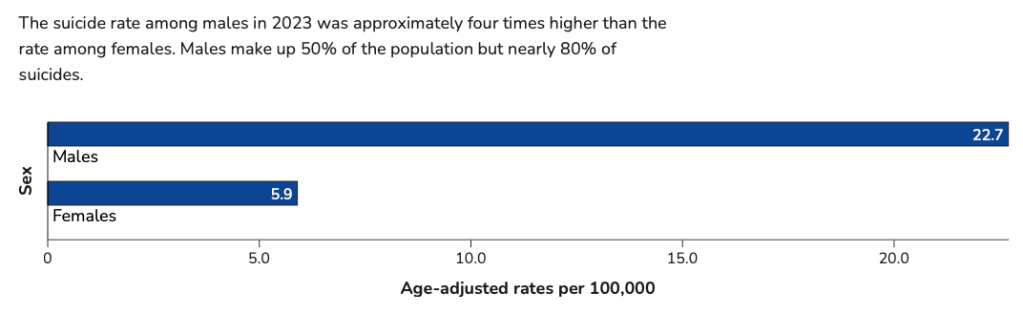
AIBM reported that men are four times more likely to die by suicide than women, and that there was an 8% increase in the suicide rate among young men aged 15 to 24 from 2020 to 20214. There were no changes in the suicide rate among males in 2023 (latest data). According to the Centers for Disease Control and Prevention (CDC), males make up about 50% of the population but account for nearly 80% of suicides5.
The article suggests that although a therapist’s gender doesn’t usually determine outcomes, some men feel more comfortable opening up to male therapists, especially when discussing sensitive or personal topics. This is particularly true for men in traditionally masculine professions like the military or emergency services. As a retired Army officer, I can attest to this, and I believe it is partly due to how the military has historically viewed mental health as a sign of weakness. The military has improved significantly, but it still has a long way to go. This aligns with what the article identified: cultural expectations around masculinity, discomfort with vulnerability, and a lack of male representation in the field can make it harder for men to engage in mental health care.
After reading Of Boys and Men and the Wall Street Journal article, I began to wonder: why don’t more men pursue careers in mental health professions?
After doing some research, various sources identified the following as possible reasons why fewer men are entering fields like social work and psychology:
- Cultural expectations about masculinity. From an early age, many men are steered away from “helping professions,” which society has traditionally labeled as feminine.
- Lower pay and prestige. Fields like social work and counseling tend to pay less than careers many men are encouraged to pursue such as engineering, business, and tech.
- Lack of representation and role models.
- Perception of bias or not feeling welcome. Some male students report feeling out of place in training programs or that men’s issues are minimized in coursework.
- Different communication and emotional norms. On average, men are less expressive about emotions. That can make careers centered on emotional processing and verbal communication feel less intuitive or appealing.
- Alternative career paths for similar motivations. Men who want to “help” others may look toward fields seen as more traditionally masculine—like the military, law enforcement, coaching, or firefighting—rather than therapy or social work.
When did the shift happen? The consensus is that the key shift began in the 1960s as women started attending college and graduate school in large numbers. At the same time, psychology itself began to change—from a focus on behaviorism, pathology, and experimental research (traditionally dominated by men) to counseling, therapy, and human development, which aligned more with interests traditionally encouraged in women.
It was particularly interesting to read this article in the context of today’s environment, where some public figures seem intent on projecting exaggerated versions of masculinity. In the United States, the Secretary of Defense and the Secretary of Health and Human Services come to mind. You see it in narratives around women in combat or in performative displays meant to signal toughness—like working out in the gym shirtless and in jeans—which bring to mind images of Vladimir Putin riding shirtless on a horse, or the larger-than-life persona of Fabio Lanzoni in the late 1980s and early 1990s.
At the same time, the rise of the manosphere is concerning. I consider it dangerous, as it may deepen the challenges already faced by boys and men rather than help solve them. It certainly won’t encourage more men to enter the mental health professions—fields where they are clearly needed.
If there’s any doubt, just look at how often high-profile men—who once projected invulnerability—seek professional help after personal or moral crises, even if they were previously dismissive of mental health services. That pattern alone shows the importance of accessible and relatable mental health support.
Men don’t need to do anything extraordinary to prove their manhood. Those who choose to pursue careers as psychologists, social workers, or in any mental health–related field are already providing a great service to humanity—and proving their strength through actions, not words.
- https://aibm.org/research/men-in-social-work-psychology/ ↩︎
- https://www.careerexplorer.com/careers/social-worker/demographics/ ↩︎
- https://www.careerexplorer.com/careers/clinical-psychologist/demographics/ ↩︎
- https://aibm.org/why-we-exist/focus-areas/mental-health/ ↩︎
- https://www.cdc.gov/suicide/facts/data.html ↩︎
 Thoughts about leadership, history, and more
Such wise words
LikeLiked by 1 person
Thank you. 🙏🏼
LikeLiked by 1 person
I really don’t have anything more to say than I absolutely appreciated this post!
LikeLiked by 2 people
Thank you for reading.
LikeLiked by 2 people
I like how you generate discussion about key issues, Edward. Well reflected comments. The balance of women in STEM and men in HEAL is an important indicator of how we’re doing as a society. Gender and racial background diversity is important in all fields to make forward strides in our culture.
LikeLiked by 2 people
Thank you, Rebecca. I absolutely agree with you about diversity. Those fields should mirror society as much as possible. Taking full advantage of our diversity is the only way to prosper.
LikeLiked by 1 person
I see the advantages for both men and women to seek jobs on both sides of the fence. Men can tone down the aggression in gentler fields, and they tend to demand fair pay, which helps everyone in that field.
LikeLiked by 2 people
The point about pay is a good one. They could probably raise the pay scale a bit if there were more male therapists.
LikeLiked by 1 person
Interesting; a similar situation applies in Australia, which surprised me when I looked at the stats. That suggests that the same mental health issues apply here.
BTW teaching also suffers the same shortage of men, especially at Primary level. I can’t help but wonder about the consequences of a lack of decent male role models.
Thanks for another thoughtful post.
DD
LikeLiked by 2 people
There are a lot of theories out there, but one that comes up often is how hard it can be for some men to adjust to changes in society. I think some are still stuck in the old mindset, that they have to follow traditional paths and stick to “masculine” jobs. Meanwhile, women seem more flexible and open to working in just about any field.
Here in the U.S., you see women in construction, trucking, and all kinds of roles—there’s really not much they won’t take on. Men, on the other hand, still seem to struggle with getting into fields like healthcare or teaching, like you mentioned. Hopefully, more men start to realize it’s okay to move away from those old expectations and reinvent themselves.
LikeLiked by 2 people
Very interesting read thank you Edward. The British Psychological Society states that male psychologists are a significant minority in the UK, roughly 20% to 23.5%
LikeLiked by 3 people
Thank you very much, Lana. Those numbers are similar to ours, and my guess is that the causes are about the same, since the author of Of Boys and Men, Richard Reeves, is British-American and studies the factors affecting boys and men in both countries. I hope those numbers improve over time, because there is a real need for male therapists, as many men feel more comfortable discussing their problems with other men than with women.
LikeLiked by 1 person
I can totally understand that, plus (hopefully)this stops any type of romantic attachment one hears about. Never a good idea in such circumstances. I saw a man try to take his own life. He deliberately walked in front of a bus on a fast road. It was during recession time in 2008 so it could have been linked. I called ambulance. Whilst waiting for it he was furious at this nearby nurse who came along to assist him, and immediately started getting violent. So many men are suffering, feeling unable to express themselves, way less so than women.
LikeLiked by 1 person
There is always an increase in suicide and self-harm during economic crises. I remember when an oil refinery closed in Puerto Rico in the early ’80s, many men took their lives because they lost everything. We saw a similar trend during the COVID-19 pandemic, though I don’t think it was as severe. We men definitely don’t know how to fully express our emotions. It takes a lot of effort and time to work through that; I know I’m still a work in progress.
LikeLike
Es fascinante tu forma de compartir temas interesantes y de interés Edward lo cual se agradece.
Sería importante que se hagan cambios para beneficiar y procurar la salud sobre todo de los jóvenes, encontrar la forma de un mejor futuro para todos.
Muchas gracias, feliz semana.
LikeLiked by 3 people
Muchas gracias, Elvira. Estoy de acuerdo contigo. Nuestros gobiernos y nuestras comunidades tienen que trabajar juntos y encontrar la manera de mejorar la situación de la salud mental que tanto nos está agobiando. Espero que la situación mejore en un futuro cercano. Espero que tú también pases una feliz semana.
LikeLike
20% of psychologists? That’s astounding! I had no idea. Love how you connected this topic to your previous post about Reeve’s book.
“If there’s any doubt, just look at how often high-profile men—who once projected invulnerability—seek professional help after personal or moral crises, even if they were previously dismissive of mental health services. That pattern alone shows the importance of accessible and relatable mental health support.” – that is so powerful. And it’s what we want for our young men.
Thank you for taking on this incredibly important topic and raising awareness. I had no idea. I appreciate you, my friend!
LikeLiked by 3 people
Those stats are incredibly sad, and I hope they improve in the future. We’ll definitely need more male psychologists. Thank you so much for your comment. I really appreciate it, my friend.
LikeLike
This is interesting stuff, Edward. As unpopular in many circles as it is, I’m going to take it a step further. There is some very concerning data that shows well-established, alarming trends regarding mental health and how boys are treated (particularly by school systems). The thing is, as your mental health statistics point out, none of this is new; it’s just ignored.
I’m not overly familiar with (nor would I defend) the “manosphere”, but it does seem to be a symptom of a real problem, IMO. There are multiple major issues facing boys today (and for many years now). That there are some in the manosphere that would capitalize on it is an unfortunate reaction that we all should’ve seen coming.
I love that you find these interesting topics, Edward. It’s always interesting stuff!
LikeLiked by 3 people
Absolutely! The trend is alarming, and my concern is that, instead of using reason to address it, some men in positions of influence are making it worse by trying to turn back the clock. You hear a lot about “the old days,” but the old days were tough, and I don’t think some of the men promoting this nonsense could have survived them. It’s easy to romanticize the past from the comforts we have today. Mental health among boys and men is a real issue that needs capable men and women to address it. Thank you, Scott.
LikeLiked by 1 person
Very well said, Edward. I admire your ability to delve into legitimately important (and interesting) topics without running to the dogma of *insert political theme here*. I greatly respect your thoughtful approach to your topics.
Have a great weekend!
LikeLiked by 1 person
I really appreciate that, Scott. Have a great weekend.
LikeLike
This is such an insightful post, Edward and your percentages certainly match the findings I’ve seen in mental health. It’s a sad scenario of our times with so many cuts and not enough time to give to those needing help and on the time clock. I’ve found that men do much better with men therapists that are sensitive, strong, true to themselves, compassionate and have been in the trenches in connecting with what men are dealing with emotionally. Well researched and shared my friend❣️
Happy Fri-Yayyy
💕
LikeLiked by 3 people
Thank you, my friend. What really gets me about the government’s focus on “saving money” by cutting what’s important is that we just spent about $12 billion in the first week of this unnecessary war, and we’ll likely be hovering around $30 billion by the end of the month. Oh, and by the way, the Pentagon is asking Congress for an additional $200 billion to cover the cost of this war.
I thought we were broke and needed to cut funding immediately. 🤦🏻♂️ This money could be better used to support mental health in this country, among other things, of course.
But hey—Happy Fri-Yayyy! I’m assuming you’ve published your Friday post, so I’m heading over there soon.
LikeLiked by 1 person
This floored me as well, Edward!!!!
“x“saving money” by cutting what’s important is that we just spent about $12 billion in the first week of this unnecessary war, and we’ll likely be hovering around $30 billion by the end of the month. Oh, and by the way, the Pentagon is asking Congress for an additional $200 billion to cover the cost of this war.”
It’s sooo maddening and I so agree.
Yep, we celebrate anyway right?! I mean what else are we going to do?
Maybe march and have a pitty party but who has time.. haha. Cheers to the weekend🥂💃🏻❤️
LikeLiked by 1 person
Yes, but November is around the corner. That’s our chance to express our feelings by voting to change this craziness. Cheers!
LikeLiked by 1 person
It sure is. Fingers and toes crossed❣️🤞🏼🤞🏼🤞🏼🤞🏼
LikeLiked by 1 person
Yes! 🙏🏼
LikeLiked by 1 person
Edward, to what you said about the rise of the manosphere, I absolutely agree with you. You’ve written a splendid post, and the diverse comments are proof. To the amount of men vs women in this field, also consider this: In past decades, even centuries, men dominate the jobs in certain areas, especially new one, such as technology, until women started getting some jobs there/. Teachers, professors, telephone operators (which were at first considered highly technical), technical writers), and now therapist/psychologists — all of these were almost exclusively male jobs, and paid well. Now these are mostly female — and pay and prestige went down compared to other fields. I’m only saying this is an additional element. Bullies and jocks disdain jobs associated with women, and they push their opinion on other men.
I do agree with you. To me, masculinity has nothing to do with athletics, muscles, or posturing. A man treating an animal, child, or elderly person with kindness is the definition of masculinity. Can a woman speak to what is masculine? 🌲 If a tree falls in a forest and no one is around to hear it, does it make a sound? Well, if a man acts or looks masculine and no woman is there to see it, is he masculine? The kindness would still have its effect, so that man’s masculinity would be true. But the shirtless jock’s posturing would be useless with no one watching. 👀. . Hugs to you and yours.
LikeLiked by 4 people
Thank you, Teagan. What you said about men dominating jobs, and really every aspect of life for centuries, is spot on. I even highlighted that in my review of Of Boys and Men. Most of the problems men are facing today have been centuries in the making.
Men held power for so long and discriminated against women relentlessly throughout history that what’s happening now isn’t surprising. From the very beginning, men knew that women were essential in every aspect of life, not just inside the home, and there are countless historical accounts that prove it. The problem is that men often failed to acknowledge women’s contributions and took all the credit. Not only that, but they also pursued ways to suppress women’s rights.
Women fought hard for their rights, and I think it’s important for us, as men, to recognize those mistakes and start treating women as equals and partners in every aspect of society. Men who continue to suppress women ignore history, and they’re bound to fail.
I’m laughing at your “shirtless jock’s posturing” line. The problem is that they’ll try to make sure you see it anyway by posting their photos on social media, and, well, you know how that goes.
LikeLiked by 2 people
Ho Edward, my older son suffers from OCD. He’s seen three male psychologists and three female psychologists over time. I think the last one, a man, was the best for him. My younger son who suffers from depression, sees a female therapist. This works well for him.
LikeLiked by 2 people
Thank you for sharing that, Robbie. The psychologist who helped me with my PTSD was a woman, and she was excellent. I really believe it comes down to connection. Once you build a healthy relationship with a therapist, healing has a real chance to begin. I hope people of all genders continue entering this field, because it’s truly needed.
LikeLiked by 3 people
🙏🩵
LikeLiked by 1 person
Good article Edward, with lots of good comments.
It’s odd how society swings from one extreme to another concerning men and women’s mental health. I’m reading “The Feminine Mystique” by Betty Friedan. At that time, because housewives were ‘unhappy’, terrible ideas circulated. One idea suggested that women no longer be admitted to 4-year colleges because too much education kept them from enjoying being a housewife. Another thought the problem of unhappy housewives could be solved by taking away their right to vote, because making decisions for their family and for politics was too much for them.
There needs to be a healthy balance in men and women’s mental health care.
It’s quite disturbing that the faces of government exaggerate who men and women are and what they’re capable of. Not only has government created massive divides between political parties, but they also create ridiculous division between men and women as well. I just don’t understand a society that can’t see we all want to be treated equally valuable.
LikeLiked by 4 people
Thank you, Rose. Whoever thought that women would be happy by being denied the right to go to college or vote must be from another planet. Clearly, women were unhappy without those rights and had to fight hard to achieve them. Maybe the ones who are unhappy are those proposing such idiotic ideas. I also don’t understand why all people aren’t treated equally, especially couples. That’s why, when something happens to a husband or wife, the other often struggles. I have a few friends in that situation, and it’s troubling to see what they’re going through.
LikeLiked by 2 people
My understanding is the military not only thinks mental health issues are a sign of weakness, but also a possible reason for discharge. Is that correct?
The list of reasons men don’t join mental health professions looks to me like an opportunity for allyship. On the one hand, I’m sad that men are underrepresented in certain professionals, but I can’t help but notice women were forced to help everyone but themselves and are underpaid and underappreciated for doing it. In what ways might male professionals pick up the burden of emotionally helping everyone while elevating the pay and prestige of the work? I’m also not surprised they feel like they don’t fit in when women have been relegated to this kind of work due to lack of options.
I do find it interesting that men are encouraged to do helping profession tasks if it’s more volunteer based. Consider how many veterans will talk with a church official or form a group of men who talk about their emotions, but it’s all volunteer operated with no licensed professional there.
What you’re describing is a big issue that negatively affects everyone, including my field: sign language interpreting. Male interpreters are in high demand because Deaf men want men to represent their voice or be available for sensitive appointments, typically medical in nature. (White) women dominate the profession because it used to be considered a “helper” role. Now, though, we’re moving into becoming a profession the same as other licensed and certified professionals. It’s funny to go to a Deaf event when interpreting students show up, if there is a male interpreting student, the Deaf guys are ALL OVER that student, encouraging him, telling him how much male interpreters are needed, etc.
Thanks for another engaging post!
LikeLiked by 3 people
Thank you for your thoughtful comment. I’m not speaking officially for the Army, so this is my personal opinion.
The Army—and all the services, for that matter—have strong programs in place to support soldiers and their family members. When a soldier needs professional help, they are evaluated to determine the severity of the issue and what type of treatment or medication may be required. Once the soldier begins treatment, they can often return to their normal duties.
Depending on the severity of the condition and whether the medication affects certain responsibilities, the soldier may be reassigned to a non-deployable unit. If separation from service is recommended, a medical board process is initiated. This is a lengthy procedure that includes a review of medical records, performance evaluations, interviews, and medical examinations.
If the board recommends separation, the soldier has the right to appeal, which leads to further review. But, if the final determination is that the soldier should be medically discharged, the process moves forward, and the soldier leaves the Army with compensation from both the Army and Veterans Affairs.
The perception of weakness often stems from leaders or peers who may not fully understand the medical condition. As a result, they may treat the soldier differently. For example, they may not understand why a soldier dealing with depression feels constantly fatigued or is less inclined to participate in certain activities. This lack of understanding can create serious problems, especially when suicidal ideation is involved.
At the end of the day, the core issue is a lack of knowledge about how to handle these situations, perhaps more than anything, a lack of empathy.
I firmly believe that both men and women are capable of performing any profession, job, or task. The problem starts when people assign gender roles to certain careers, which only limits the available talent pool. A society that encourages maximum participation from everyone is better positioned to succeed.
LikeLiked by 1 person
I absolutely love this comment, and I do thank you for explaining the process of what happens when a soldier addresses medical health needs. Thank you so much! I appreciate your time.
LikeLiked by 1 person
You’re very welcome.
LikeLike
Wondering if you happen to have seen the show “Shrinking” on Apple+ (starring Harrison Ford). It’s about a group of therapists. Ford plays a therapist and there’s another male therapist as a main character, plus many male patients, including one ex-military main character. It’s funny, but they also address some real issues. We like it a lot!
LikeLiked by 2 people
I haven’t, but my wife has, and she likes it a lot.
LikeLiked by 1 person
This is a very thoughtful post and a great question. Things have dropped off tremendously, in terms of the men nowadays. I work at a pharmacy and many men come through, without any money to pick up medicine for their children. And they will call their girlfriends to cash app them $5! I just don’t get it. The dating pool is in deeeeepppp trouble! 😔
LikeLiked by 2 people
Wow, that’s a new one to me. Pretty sad indeed. I remember during the COVID-19 pandemic reading reports of men struggling and women being forced to pick up the slack. Women often appeared more mentally resilient and were able to focus on taking care of the family.
LikeLike
Such an important post, Edward. I saw the shift and decline during my graduate school years…fewer and fewer male classmates and future mental health providers. As you suggest, the reasons are layered and complex with fewer “in the field” providing support when the rise of toxic masculinity seems pervasive. As always…I appreciate your deep regard for what matters most. Highlighting important issues and concerns with care and thoughtfulness. Thank you. 💝
LikeLiked by 3 people
You’re very welcome, and thank you for sharing your experience, Vicki. It’s always valuable to hear from someone in the field. I’m glad to share what I find along the way and contribute, even in a small way, to advancing the cause.
LikeLiked by 2 people
Ahh! You contribute greatly by writing and sharing such enlightening content. Much appreciated, my friend! ❤️😊❤️
LikeLiked by 1 person
Thank you, my friend. 🫶🏼
LikeLiked by 1 person
❤️😊❤️
LikeLiked by 1 person
There’s a component of “force” and “emotionless” associated with men and manhood that keeps being cultivated within society up to these days, no matter what studies and numbers reveal. I can’t help but think that this is closely related to the impressive and alarming male suicide rates. Strangely, in such an “advanced” society, outdated stigmas keep prevailing, and very little is done to turn them around. Men are naturally caring if they are not “trained” otherwise. This post is a relevant call of attention for a colossal issue that keeps weakening the structure of society in general and the well-being and recognition of men’s value beyond manhood-created standards in particular. A very important share, Edward! Thank you for bringing it to light here! Light and blessings your way, today and always, my friend! ✨🙏🍀
LikeLiked by 4 people
Thank you, Susana. You’re absolutely right about that persistent “force” that continues to push some men into believing the old ways were better. That mentality keeps men stuck, and the consequences are palpable, as reflected in the statistics, which show not only the gender gap in the mental health profession but also the troubling rise in suicide rates.
LikeLiked by 1 person
I have never thought of this imbalance before – in Australia, we have a shortage of mental health workers (irrespective of gender). It’s always so sad to see statistics on suicide… here’s to a world where we need less counsellors, but until then, as you said, many thanks to those who make helping others their purpose, xx
LikeLiked by 2 people
Thank you, Linda. A world where less support in this area is needed is a wonderful goal. There’s still much work to be done to get there, and we’re truly grateful for those taking on this important and difficult task.
LikeLiked by 1 person
💯❤️
LikeLiked by 1 person
Interesting article. I worked for 30 years as a counselor in a nonprofit agency where a clear majority of counselors were women. The doctors who worked with us were men. CEOs and department heads in the agency were about 50% men, though the current CEO is a Black woman who’s been in the position a long time. There were times when working in the nonprofit agency (primarily as an addictions specialist) that I had the thought: Most of the men I know would not put up with what I put up with, (thinking about the expectation to be nurturing, diplomatic, working long hours, and all the challenges that addiction brings…) I realize that thinking may be considered inappropriate, but I it was real and I remember thinking that more than once. Maybe it’s because most men are taught differently by our culture. Maybe most men are not taught to value the skills of nurturing, etc. Reading this post, I also thought about teachers….
LikeLiked by 3 people
Thank you for sharing your experience, JoAnna. I think we all have those thoughts at some point in our lives, it’s just part of the culture. You’re right, teachers are part of that equation as well, and there are definitely more female teachers than male. The nurturing aspect is an interesting one, and I think men need to learn how to be more nurturing. A lack of nurturing can be a challenge in parenting and can especially affect single fathers, who may need a crash course if they want to succeed.
LikeLiked by 2 people
Yes, to men learning to be more nurturing. I would love for our cultures to cherish nurturing enough to give us more balance.
LikeLiked by 1 person
Amen to that.
LikeLiked by 1 person
A timely and important piece. You’ve highlighted a reality that often goes unnoticed—many men are struggling in silence, and the absence of male mental health professionals only deepens that gap. The point about relatability and the need for safe spaces where men can open up without judgment is especially powerful. This isn’t just about representation; it’s about access, trust, and saving lives. Thought-provoking and necessary—thank you for bringing attention to an issue that deserves far more conversation.👍
LikeLiked by 2 people
Thank you very much, John. 🙏🏼
LikeLiked by 1 person
As someone who comes from this world, there’s the added benefit of gender bias so men who do enter these fields often are promoted over women. Is it fair? No. Do I like it? Also no. But it happens.
LikeLiked by 2 people
Really? That’s shocking. Do you think it was to retain those men, or just the old “good boy” network at work?
LikeLiked by 1 person
I live in the south, where every career trajectory has the good ole boy network at work. But it’s no secret as a whole men promote up faster than women.
LikeLiked by 1 person
Absolutely, but I always thought that only occurred when the number of men and women was similar. It doesn’t seem to make sense if women are the majority, unless the men are superstars, then it might happen. I guess I was wrong. Thank you for answering my question.
LikeLiked by 1 person
Those are interesting stats. I trained as a psychiatric nurse in the early 70’s. I checked my graduation group photo because I was sure that males made up almost half of our class. I was very wrong. 6 males out of a class of 30. I worked with a lot of male social workers, psychologists, psychiatrists, and psych nurses in the early years of my career (before I transitioned to medical nursing), but when I look back now, I know that the mental health area was definitely dominated by women. Your post was definitely an eye opener, Edward.
LikeLiked by 2 people
Thank you, Terry, for providing that information. I knew there was a gap, but I wasn’t expecting such a large difference until I read the article and reviewed some of the material for this post. I agree with you, it’s definitely an eye opener.
LikeLiked by 1 person
A very thought-provoking discussion, Edward. What has become clear to me in the Trump era is that the root causes of toxic masculinity need to be researched and addressed with appropriate action. services, and intervention before more boys grow into predatory sadists.
LikeLiked by 1 person
I agree. There is a movement, and they’re using podcasts and other platforms to spread the wrong message about masculinity. They’re reaching thousands, if not millions, of men, which is very dangerous in the current environment. We’ll probably see the effects 10 or 15 years from now, so I hope we have professionals in place to deal with it. Thank you, Liz.
LikeLiked by 1 person
You’re welcome, Edward. The societal damage in the future from the current insanity is incalculable. You’re right that we are going to need professionals in place to deal with it.
LikeLiked by 1 person
I have to respectfully disagree with the book you read and the WSJ. I worked in mental health for 15 years and in nursing over 20 years. Most of our psychiatrists and psychologists were male. We most definitely had male nurses and techs. Males are highly prized because of their physical and mental strength and ability to relate to difficult patients. Unless the situation has changed since 2021, when I retired, then I doubt the accuracy of these sources. Both the medical and mental health fields have been losing workers (male and female) due to stress, overwork, being unappreciated by their employers, and insufficient funding. COVID drove a lot of people out. Social workers and therapists are almost worthless when it comes to dealing with difficult patients. They aren’t trained for that. They always called security or the police or asked me to intervene if I was working. As far as mental health patients, males will open up if they are approached in the proper way. Not all psychologists/psychiatrists/therapists are equal in their people skills. RESPECT is the key word.
LikeLiked by 3 people
Since the statistics are a nationwide average, I’m sure the number of males will vary. Maybe in the state or states where you worked, the numbers were higher. The hospital we go to has 19 psychologists, 7 of whom are male, which is about 36%. I agree that respect is key, and in that kind of environment, people are more willing to open up about their problems.
LikeLiked by 1 person
Insightful and well-researched review, Edward. Praying that more men feel encouraged and supported to step into these roles, and that the stigma around seeking help continues to fade.
LikeLiked by 3 people
Amen! We definitely need more men to step up, close the gap, and help their fellow men.
LikeLiked by 2 people
So interesting Edward! I did not know this! It’s surprising to me that there are less men in social worker/psychology roles now than in the 60’s because back then macho-ism (i feel like) way more dominated than it does today….there’s so much more awareness now around mental health and specifically men’s mental health. (But obviously not enough), I’m sure in the 60’s it was absolutely non-existent.
LikeLiked by 4 people
Thank you, CJ. Yeah, I was kind of surprised. I mean, I knew there were more females than males, but the gap is significant. From what you said, you would think the gap should be closing, but I guess the stigma is still there, and it will take a lot of education to close it. I think nurses and teachers face the same problem.
LikeLiked by 3 people
Yep where have all the men gone?!
LikeLiked by 2 people
Yep! Great question, my friend. 🤷🏻♂️
LikeLiked by 1 person
Making very very good points!
LikeLiked by 4 people
Thank you very much.
LikeLiked by 1 person
I had no idea there were so few male social workers and psychologists. Thanks for this thoughtful update!
LikeLiked by 6 people
You’re very welcome. I knew there were more females than males, but I didn’t realize the extent of that gap until I read the article. It’s significant, but also a great opportunity for those who aren’t sure what career to pursue.
LikeLiked by 2 people
Amen 🙏🤗👍
LikeLiked by 1 person