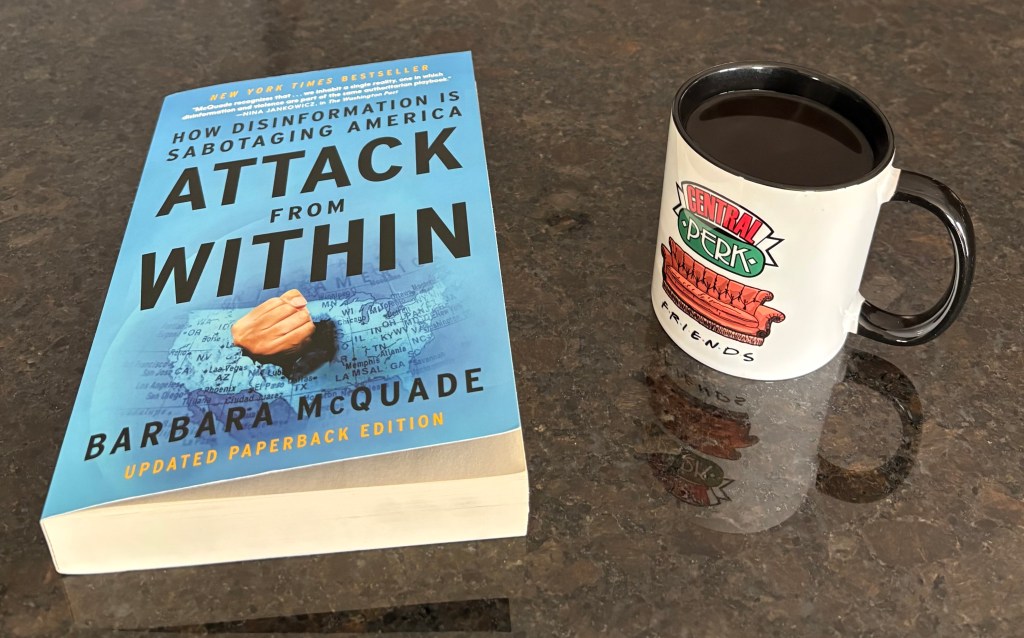
“Disinformation is the deliberate use of lies to manipulate people, whether to extract profit or to advance a political agenda. Its unwitting accomplice, misinformation, is spread by unknowing dupes who repeat lies they believe to be true.” — Barbara McQuade
Disinformation and misinformation are major problems not only in the United States but around the world. In the U.S., disinformation is ongoing and is likely to intensify as the midterm elections approach. During the last election cycle, we heard countless false stories—from claims about people eating dogs and cats in Ohio to the JD Vance ‘couch’ joke that was hinted at by Senator Elizabeth Warren during the Democratic Convention.
Why do some people resort to these tactics? I’m not completely sure. Perhaps their political platforms are so weak that they feel compelled to use disinformation and misinformation to manipulate people into voting for them.
According to Merriam-Webster, disinformation is “false information deliberately and often covertly spread (as by the planting of rumors) in order to influence public opinion or obscure the truth.”1 Misinformation is defined as “incorrect or misleading information.”2
Last year, I attended the Printers Row Lit Fest, a book festival in the city of Chicago. There, I heard a panel discussion on disinformation and misinformation that included the author of the book I am reviewing today. Based on my experience and her contributions to the discussion, I found her arguments persuasive and accurate, which led me to purchase her book.
Attack from Within: How Disinformation Is Sabotaging America, by Barbara McQuade, and my edition was published in 2025. In it, she does an excellent job describing the problem and presenting evidence to support her case. The book is divided into ten chapters, with chapter nine proposing recommendations on how to address the issue.
Right from the start, McQuade goes straight to the heart of the matter, describing how a Russian state-sponsored group called Doppelgänger operated. In 2024, the Department of Justice seized internet domains used by Doppelgänger to spread disinformation aided by artificial intelligence, including replicated pages from The Washington Post and Fox News. The group posed as Americans and posted links on social media that redirected users to cloned pages containing disinformation (pp. xi–xii). U.S. Cyber Command published a news bulletin describing their activities and delivery methods:
“This cross-platform campaign amplifies the deceptive content distributed through its cloned web pages across various social media networks, including Facebook and Twitter. Videos, articles, and polls designed to manipulate public opinion are disseminated seamlessly, blurring the lines between fact and fiction.”3
In the following quote, Barbara McQuade effectively highlights the root cause of what is happening in this country:
“In addition to technology, an important factor in information warfare is our nation’s deep polarization. If technology is the ‘how’ of disinformation, then tribalism is the ‘why.’ Both political parties have campaigned in recent years by portraying their opponents not as fellow Americans with different ideas about the best ways to govern, but as existential threats to our way of life… And while some people are genuinely fooled by disinformation, others simply don’t care about truth, only whether a narrative advances their own political viewpoint.” (p. xv)
Below are some highlights from the book:
“If we want to overcome the dangers of disinformation, we must choose truth over tribe.” (p. xix)
“Federalist Paper No. 63 warned of the risk of being ‘misled by the artful misrepresentation of interested men.’” (p. 14)
“In fascist politics, language is not used simply, or even chiefly, to convey information but to elicit emotion.” — Jason Stanley, Professor of Philosophy (p. 21)
When I read this part, all the news articles I have read over the past year highlighting the chaos in this country came to mind—troubling, to say the least. “Tactics in the authoritarian playbook include appealing to emotion over reason, exploiting division, undermining critics, dismantling public institutions, stoking violence, and creating an image of the Great Leader as both an everyman and a superman.” (p. 25)
“In 2016, Russia sought to exploit divisions in American society through a covert disinformation campaign… The Russia-based Internet Research Agency ‘created accounts in the names of fictitious U.S. organizations and grassroots groups and used these accounts to pose as anti-immigration groups, Tea Party activists, Black Lives Matter protesters…’ The names of their fake online groups ranged from ‘Stop All Immigrants’ and ‘Tea Party News’ to ‘LGBT United’ and ‘Muslims of America’… The Russian plan was ‘designed to provoke and amplify political and social discord in the United States.’” (p. 30)
On pages 69 and 70, the author describes the episode in 1971 when The New York Times published the Pentagon Papers, revealing how the American public had been misled about the Vietnam War by four presidential administrations. The Justice Department threatened action against The New York Times, but the Supreme Court sided with the newspaper. In its written opinion, the Court stated:
“The only effective restraint upon executive policy and power in the areas of national defense and international affairs may lie in an enlightened citizenry—in an informed and critical public opinion which alone can here protect the values of democratic government.”4
“Political scientist Thomas Rid writes that the goal of disinformation is ‘to exacerbate existing tensions and contradictions within the adversary’s body politic, by leveraging facts, fakes, and ideally, a disorienting mix of both.’” (p. 74)
“Another indoctrination technique popular among misinformers is message repetition… Hitler wrote in Mein Kampf that propaganda ‘must confine itself to a few points and repeat them over and over.’” (p. 77)
The author asks the following question: “Why is disinformation such an effective tool?” She then provides a possible answer: “One reason is that much of the news we receive today leaves us feeling anxious and looking for answers. Human nature plays all sorts of tricks on us. When we are uncertain or uneasy, we become more susceptible to persuasion and manipulation.” (p. 100)
“Why do we love conspiracies? Researchers say it begins with a desire to simplify a complex world.” (p. 105)
“Researchers have determined that with ‘shares’ and ‘likes,’ online disinformation can reach 1,500 people six times faster than the truth.” (p. 118)
“In 2022, the average adult spent an astonishing 6.5 hours online each day… When we spend so much time alone and never actually meet people with opposing viewpoints, it is easy to dehumanize them.” (p. 130)
“Turning news into infotainment may boost ratings, but it also increases dysfunction in our democracy.” (p. 138)
“Al-Qaeda and ISIS engaged in a tactic known as ‘stochastic terrorism,’ the incitement of violence through the public demonization of a group or individual… provocative speeches inspire supporters to take action, even though the speaker does not know exactly when or how, nor which supporters will act.” (p. 201)
Chapter nine presents proposed solutions. I don’t agree with all of them, but below are the ones I believe could partially address the problem:
- Amend Section 230 of the Communications Decency Act of 1996, which grants internet providers immunity from legal liability. Algorithms are not content, but platform’s own products. Removing immunity could deter platforms from amplifying false and harmful content (pp. 260–261).
- Regulate algorithms by requiring social media companies to disclose how they amplify content and micro target users. Regulations could prohibit algorithms designed specifically to generate outrage and maximize user engagement (p. 264).
- Include media literacy in U.S. public school curricula to teach students how to become more discerning consumers of online information (p. 270).
Two statements in the closing chapter particularly caught my attention:
“We will always have differences of opinion on issues such as criminal justice and government spending—but we must be united in the process of how we solve problems. The ability to solve any problem requires a shared understanding of facts and truth.” (p. 293)
“In a time when we spend inordinate amounts of time and money on spectator sports, movies, and reality television shows, it can be argued that we get the leaders we deserve. In a democracy, a government of the people, we need responsible leadership not just from our elected officials, but from our citizenry.” (p. 297)
The author does an excellent job describing how disinformation and misinformation are contributing to increased division in this country. While examples are more easily identified within the party currently in power, the opposing party also employs these tactics, and I wish the author had addressed those instances more thoroughly. By emphasizing one side more than the other, the book risks limiting healthy debate. Even with this minor flaw, I still recommend this book to anyone who wants to understand how disinformation and misinformation are used—and what steps we can take to minimize their impact.
About the Author:
Barbara McQuade is a professor from practice at the University of Michigan Law School, her alma mater, where she teaches courses in criminal law, criminal procedure, national security, and data privacy.5
- https://www.merriam-webster.com/dictionary/disinformation ↩︎
- https://www.merriam-webster.com/dictionary/misinformation ↩︎
- https://www.cybercom.mil/Media/News/Article/3895345/russian-disinformation-campaign-doppelgnger-unmasked-a-web-of-deception/ ↩︎
- New York Times Co. v. United States, 403 U.S. 713 (1971), https://supreme.justia.com/cases/federal/us/403/713/ ↩︎
- https://www.barbaramcquade.com/home-1 ↩︎
 Thoughts about leadership, history, and more
Modern information environments still believe they are merit systems, but they are not. They are engagement systems. Merit used to be rewarded through durability—work that held up over time, under scrutiny, across institutions. Today, reward is issued through velocity—what spreads, what provokes, what binds a group quickly. That shift quietly replaced one governing logic with another.
The framing restores the original symmetry: if truth once accrued value through credibility, then distortion must accrue cost through consequence. Without that symmetry, the system becomes asymmetrical in favor of manipulation.
The critical insight is that disinformation is not winning because it is more persuasive in a rational sense. It is winning because it is more efficient under current incentive structures. It is faster to produce, easier to tailor, and more likely to trigger emotional amplification. In a system that rewards speed and reaction, efficiency beats accuracy every time.
So the issue is not simply moral or civic—it is architectural.
In earlier eras, consequence was embedded naturally. A publisher risked reputation. A public figure risked exclusion. An institution risked legitimacy. Even informal networks enforced standards through proximity—people knew each other, and credibility was locally enforced. Distortion carried friction.
That friction has been stripped away.
Digital scale removed proximity. Algorithms removed gatekeeping. Anonymity removed accountability. Monetization models removed alignment with truth. The result is a system where distortion carries upside with minimal downside. That is not a flaw at the margins—it is the operating condition.
Restoring cost, then, is not about punishment in a narrow sense. It is about reintroducing friction into a frictionless system.
Social cost means reputational signals must matter again, not just within tribes but across them. Institutional cost means platforms and publishers cannot remain neutral conduits when their systems actively shape amplification. Economic cost means that distortion cannot remain a profitable strategy at scale.
Without these, every proposed solution remains cosmetic. Education helps, but it trains individuals to navigate a system that still rewards distortion. Regulation helps, but it often lags the speed of adaptation. Transparency helps, but it does not alter incentives.
Incentives are the core.
A system that rewards good work produces more good work. A system that rewards distortion produces more distortion. The present environment is simply doing what it is designed to do.
So the line drawn—restoring cost to distortion—is not just a recommendation. It is the threshold condition. Without it, everything else is commentary.
LikeLiked by 1 person
I agree, and you hit the nail on the head with your comment that a “system that rewards distortion produces more distortion.” It’s really a vicious cycle, where distorted views are rewarded and not corrected. A very complex problem.
LikeLiked by 1 person
Disinformation ve misinformation kavramlarını görmek bile insanı düşündürüyor. Gerçeğin peşinde olmak her zamankinden daha önemli. Teşekkür ederim.
LikeLiked by 4 people
Rica ederim, okuduğunuz için çok teşekkür ederim.
LikeLiked by 1 person
Hello, do you have book published on amazon
LikeLiked by 4 people
Hi! I have not published anything yet. Definitely not in my future, at least not yet. Thank you.
LikeLiked by 2 people
It seems Paul Simon was onto something back in 1970:
The Boxer
I am just a poor boy
Though my story’s seldom told
I have squandered my resistance
For a pocketful of mumbles
Such are promises
All lies and jest
Still a man hears what he wants to hear
And disregards the rest
…
LikeLiked by 4 people
Indeed.
LikeLiked by 2 people
I’ve been thinking about how the progressive verification of facts/ reasonable information has disappeared as the foundation of public opinion since the emergence of social media. Not a great situation in any liberal democracy at the moment.
LikeLiked by 3 people
You’re onto something, and there are theories about how social media algorithms feed our tendency to follow only the things we already believe, disregarding opposing views. Social media is creating echo chambers, and people are happy to be fed only what they want to hear, so they don’t feel the need to validate the information they’re getting.
LikeLiked by 2 people
Such an important topic, Edward. Thanks for the lucid summary.
LikeLiked by 3 people
You’re very welcome. I’m glad you enjoyed the review.
LikeLiked by 2 people
The book sounds interesting, Edward. Of course, I’m aware of misinformation and fake news. I’m also angry about the limitations on free press right now. However, I believe we all have to look to credible sources. Buyer beware. I find it interesting that there are people who only trust one television station and think that all others are manipulating images of an event such as the January 6 attack on our Capitol.
LikeLiked by 3 people
I know. I used to watch CNN, MSNBC, and Fox News just to find a little bit of truth in reporting. I can’t do that anymore, it’s exhausting, and I could never catch up. That’s why I stopped watching cable news and moved to newspapers. It’s much better now.
LikeLiked by 3 people
Question, McQuade said disinformation is deliberately putting out information they know is false, do you think in some cases the spreading is by people who know they are lies also. McQuade said the spreading is by people who believe the information. Crazy part is that most disinformation put out is so easily research and found to be false. Great job as always.
LikeLiked by 3 people
Thank you. Definitely, in most cases, disinformation starts with people or entities that know the information is not true and deliberately push it to cause division, doubt, and confusion. Once the false information is out, other people continue to spread it through their social media networks. It’s definitely easy to verify whether the information is valid or not, but the problem is that disinformation is pushed based on people’s ideological preferences. As a result, many people want to believe it’s true because it supports their cause. It’s a very dangerous thing.
LikeLiked by 1 person
There have been blatant lies fed to the public from both sides of the aisle. It begs the question, who are the gatekeepers of information that are manipulating our politicians to defend and propagate such subversive methods?
The.collective media space has either been infiltrated, bought, threatened, or a willing party to the deception. It also implies that every branch of the government is complcit in these acts, or there would be consequences.
But the fact that no one feels the firm arm of justice says that everything and everyone we rely on to be the upholder of truth has been compromised.All media is owned by a few oligarchs. And they are also aligned with big corporate interests that have no interest in a free society.
How do we combat this plague?
Unfortunately, I do not have all the answers, but a start would be stepping away from social media. Stop paying for cable news, or streaming services. Once you hit their pockets, things begin to change. But I suspect we are so well medicated as a society, that the urge to resist is gone from many of us.
This book sounds good. It is a great review, Edward.
LikeLiked by 3 people
Thank you very much, Nigel. I think the problem is like when you take a test and all the answers seem appropriate, so you pick “all of the above.” That’s the same here, it’s all of the above. Everybody is involved, and there are a lot of think tanks receiving a lot of money to push out alternate realities, all protected by our First Amendment.
Yeah, we are too medicated to go that far. It will take a lot of work and critical thinkers to break through this.
LikeLiked by 2 people
I pray we will still have those freedoms when the time comes.
LikeLiked by 2 people
Yes! 🙏🏼
LikeLiked by 1 person
Edward, you’re reading so many interesting books this last month. Thanks for mentioning some of the solutions to disinformation that McQuade presents like: giving internet providers legal liability. I agree that classes throughout school on how to check information are very important,.
LikeLiked by 3 people
Thank you, Rebecca. I think the trial that began in California, where Instagram and YouTube are facing allegations that their platforms’ designs deliberately create addiction in children, is a big one. I think McQuade is right that internet providers and social media platforms need to be liable for their algorithms, and the government needs to police the aspects that are making disinformation and misinformation worse, not to mention their addictive nature, not just for children but for adults as well.
LikeLiked by 2 people
Thanks, yes they need to be liable for the addiction they are creating.
LikeLiked by 2 people
Yes! We’ll see what comes out of the trial.
LikeLiked by 2 people
Hi Edward, the author of this book’s comments on tribalism make perfect sense to me. It is a form of propaganda to dehuminise and vilify a group of people with different beliefs and that is a tactic that has been used by leaderships in situations of war for centuries. It is the technique the British used to rile up poor public opinion in Britain against the Boers (Afrikaners) pre the Second Anglo Boer War. It is also the tactic Hitler used in Nazi Germany. Thank you for this informative article.
LikeLiked by 3 people
You’re welcome, Robbie. It’s terrible how leaders use it for political purposes without regard for the damage done to the country. With all the horrible things that have happened throughout history, it’s incredible how people don’t learn the lessons and continue to support this kind of behavior.
LikeLiked by 1 person
Edward, thanks for bringing McQuade’s book to our attention and for your excellent review. I’ve added it to my To Read List.
LikeLiked by 3 people
You’re very welcome, Rosaliene.
LikeLiked by 2 people
Hi, Edward. I agree that this is a big problem indeed, and perhaps it is the main cause of such an awful divide between people.
Part of the trouble (at least with negating, controlling, or in any way trying to herd and corral the misinformation is the fact that so many people *choose* to believe it, even when it’s utterly outrageous and obviously false intentionally inflammatory. People love to believe the audacious whenever it makes them feel powerful or in the spotlight. People hate to think period, but even more so when they realize they probably believed a lie. This doesn’t only apply to our current political situation. There are dozens of ways in which so many people choose to believe an obvious lie — from child abuse to the “glass ceiling.” It’s a rhetorical question but, how do we combat misinformation when the people it targets are willing and eager to gobble it up?
Thank you for posting your book review, and for your mindful analysis of it. Congrats to Ms. McQuade. Wishing you and yours a happy Valentine’s Day. Hugs.
LikeLiked by 3 people
A big problem indeed. I just read that a Gallup poll from October reported that Americans’ confidence in the news is down to 28%. This is really bad news and highlights how successful disinformation and misinformation campaigns have been.
Thank you, my friend, and happy Valentine’s Day to you.
LikeLiked by 2 people
Edward, great post. Sad that disinformation has led to such deep fractures in our national identity and personal relationships. 🫤
LikeLiked by 3 people
Thank you, Darryl. I’m hopeful we’ll get back on track once we get through the next two or three election cycles.
LikeLiked by 2 people
I have heard a lot more about this lately. Just the fake news and click bait titles get to me on a daily basis.
I have to say Edward you read faster than I can read your reviews!!! Keep it up, love the information you are spreading!
LikeLiked by 3 people
Tell me about it. It’s getting worse every day. Thank you, Melissa.
LikeLiked by 1 person
For what it’s worth, this guy thinks you’re on fire with vitally important topics lately, Edward!
One of the cited passages, “The only effective restraint upon executive policy and power…..may lie in an enlightened citizenry”, for me, is an example that some of the embedded philosophy in our tradition and founding are not at all obsolete. We could do with a collective, deep-dive refresher. Good stuff!
LikeLiked by 4 people
Scott, I really appreciate your comment. It means a lot. It’s interesting that I keep encountering the idea of an enlightened and educated citizenry in what I’ve been reading over the past year. Just this morning, I read an opinion piece in the WSJ by Peggy Noonan that touches on the same theme as she discusses the possible collapse of The Washington Post. There’s a lot to think about as we get closer to the 250th anniversary of this country.
LikeLiked by 3 people
Isn’t that the truth!
LikeLiked by 3 people
Fascinating! I’m posting something similar in a week’s time about a paper that was published on “critical ignoring” it suggests that we are all trained to undertake critical thinking, but that the skill no longer works in a digital landscape flooded with misinformation – the trick now is trying to ignore the noise and seek out the valuable truth. What a time! Good luck to our poor kids! Linda 😦
LikeLiked by 3 people
That’s cool. I’ll be looking for your post on critical ignoring. I wrote about that last month and am looking forward to more information on the topic. It’s getting really difficult right now, so I’m sticking to old-fashioned newspapers and dropping online news for now. I know, kids are going to pay the consequences of all this.
LikeLiked by 2 people
Yeah – I hope that they will have the skills though since it’s their real life – we’re the ones that are struggling to keep up!
LikeLiked by 3 people
Truth over tribe – wow, doesn’t that say a lot in three words? What an excellent summary and review, Edward. Love how many chapters have solutions. I’m trying to think of the book you reviewed last year that did a great job of explaining a problem but didn’t really have a solution but I can’t come up with the name. Nonetheless, it sounds like she has a place to start and that feels hopeful to me!
Thanks for the great information!
LikeLiked by 4 people
You’re welcome, Wynne. Yes, the book was about immigration, “Everyone Who Is Gone Is Here.” It had a lot of information but no solutions. Thank you for remembering that. This one lays out recommendations nicely. I think she did an excellent job, and she is passionate about the issue.
LikeLiked by 3 people
Yes! Thanks for solving that for me, my friend!
LikeLiked by 2 people
Sounds like a fascinating read!
LikeLiked by 4 people
It was. She did a great job laying out the facts and the impact.
LikeLiked by 3 people
I believe people DO eat cats and dogs and not just in Korea :-S
LikeLiked by 3 people
That’s true. I have been to some of those places, and horses, if I might add, but definitely not in Ohio. 😀 Thank you, Lana.
LikeLiked by 3 people
Nothing would surprise me.
LikeLiked by 3 people
There are a lot of great comments here Edward.
Thanks for sharing this book. I’m definitely interested in Chapter 9 solutions.
From the time our children are small, one of our jobs is to help them learn the difference between fact and fiction. But politics/media has blurred that line in terribly inappropriate ways, and if adults can’t tell the honest truth, how can we expect kids to recognize it?
LikeLiked by 4 people
I agree with you, and I like it when people leave comments and engage in the discussion. I know, it’s been getting a little out of control since 2015, I guess. It seems like all politicians and pundits are depending on social media to disseminate their messages, and they don’t care if the content is factual as long as they get the visibility they’re craving. A very disturbing trend.
LikeLiked by 3 people
“In a democracy, a government of the people, we need responsible leadership not just from our elected officials, but from our citizenry.”
That’s my favourite quote in this piece. We can’t blame politicians alone for not providing responsible leadership. We have a responsibility as well.
Misinformation is one of my major bug-bears about social media – because of the willingness of so many to share that misinformation before doing responsible fact checking.
Excellent review, Edward.
LikeLiked by 5 people
Thank you, Terry. That’s one of my favorites too. It’s a conclusion that has been repeated since our founding fathers established the governmental structure of this country. Why we are not accepting that responsibility is beyond me. I understand that when we are in our twenties, just getting out of school and trying to make a living, there’s little time to think about these things. But as we mature, we need to refocus and start taking an active role in our civic duties if we want to maintain the democracy we are currently enjoying.
I’m struggling with social media, well, the one account I still open on LinkedIn. There is so much misinformation on what’s supposed to be a professional platform. But I guess money talks, and they are following everybody else’s business model: “Facts are not important as long as we are making money.”
LikeLiked by 4 people
I’ve spent some time sitting with Attack from Within, not so much to agree or disagree with it, but to locate it in relation to how I already think about disinformation, power, and credibility. What I found was not conflict, but a difference in starting point—and that difference matters more than conclusions.
The book treats disinformation as an active threat to an otherwise functional system. Its posture is defensive. The assumption, implicit but steady throughout, is that democratic institutions are fundamentally sound and are now under coordinated attack—by foreign actors, domestic opportunists, and algorithmic incentives that reward distortion. From that vantage point, the work is coherent, urgent, and internally consistent. If the system is intact, then disinformation is sabotage. If it is sabotage, then the task is to contain, regulate, educate, and restore.
My own work does not begin there.
I do not start with the assumption that the system is intact. I start with the observation that legitimacy has already thinned, that authority has become performative, and that persuasion has replaced stewardship. From that angle, disinformation does not feel like an invasion. It feels like what fills the vacuum after credibility leaves the room.
That distinction quietly changes everything.
Where the book asks how disinformation spreads, I find myself asking why it works at all. Where it names actors, I find myself naming conditions. Incentives. Attention economies. The slow collapse of institutional restraint. Systems that reward speed over accuracy and visibility over competence do not need villains. They manufacture distortion on their own.
This is where the book and I part ways—not adversarially, but philosophically.
The remedies offered—platform reform, regulatory guardrails, media literacy—assume that trust can be restored once the informational environment is stabilized. My experience suggests the inverse. I’ve come to believe that the informational environment remains hostile because trust has already been spent. Facts don’t fail first. Authority does. Once that happens, no amount of correction feels neutral. Every intervention reads as persuasion, and persuasion, once overused, no longer convinces.
In that sense, the book doesn’t compete with my views. It documents the turbulence inside the system. My work tries to explain why the turbulence is permanent.
I don’t read Attack from Within as wrong. I read it as bounded. It stops at the perimeter of institutional faith. My work begins at that perimeter and asks a harder question: what happens when institutions no longer meet the standards they ask others to honor?
That’s why clarity, for me, isn’t a tactic or a fix. It’s a discipline. It’s something institutions must practice before they can plausibly demand it of citizens. Without that discipline, disinformation isn’t defeated—it’s justified in the minds of those who feel governed by spectacle rather than competence.
So I don’t take this book as a challenge to my thinking. I take it as evidence. Evidence that the informational crisis is real, visible, and accelerating—and that addressing it downstream, without confronting the upstream erosion of legitimacy, will never be enough.
If the book is about defending the system, my work is about interrogating whether the system remembers what it was meant to defend.
That difference isn’t ideological.
It’s structural.
And once you see it that way, disinformation stops looking like the disease and starts reading like the signature it leaves behind.
LikeLiked by 5 people
Thank you for your comment. There’s a lot here, but I agree with the author that there are solutions to address misinformation, and education is key. Regular citizens need to understand that when they encounter a false statement, they should reframe that inner itch and avoid disseminating it. Another problem that you addressed, and one I agree with, is the structural issue: how people with long track records in the disinformation arena get elected to higher office or appointed to lead government agencies. This is a problem that, at least in the United States, Congress needs to address.
In other countries, such as Russia, China, and Iran, just to mention a few, the issue is more complicated, since governmental structures, the information environment, and decision-making are concentrated in the hands of one or a very small group of people. Information operations conducted to influence the populace are a high-level subject, which this book didn’t address. I think the author sees the initial step as educating regular people to raise awareness that we are active participants when we use social media. “Liking” and “sharing” things that are obviously false reinforces causes, even when we may not realize it.
LikeLiked by 4 people
Dear GMJoe and Edward,
I very much enjoy reading the lively conversations here and have come to join both of you in reflecting on the significance of this well-written post entitled “Book Review: Attack from Within”, which is published here with Edward’s usual flair of interspersing quotations and insightful commentaries with delectable acuity and admirable sagacity. Since my comment here is going to be very long, I am going to split it into two comments.
Thank you, Edward, for your commendable effort that you put into this latest post, and GMJoe, for your pointing out what can be deemed as oversights or flawed assumptions about the sociopolitical system itself. We now find ourselves here having to face the state of mounting chaos and even fascism in the USA, a country that seems to be imploding, and its cancer has metathesized even more, both within and without!
Barbara McQuade’s excellent book of 2025 aside, there is an important piece of work that sheds light on the sorry and sordid state of the US democracy and partisan politics marred by disinformation and corruption. Published on 13 March 2025 and entitled “A Movement to Destroy U.S. Democracy Controls the Presidency, Congress, and the Supreme Court—But What’s Behind It?“, this is a great article from Religion Dispatches, which “is a publication of Political Research Associates, a social justice research and strategy centre that has been researching, monitoring, and publicizing the agenda and strategies of the U.S. and global Right for over four decades.” I very much concur with the author Katherine Stewart, and I am very impressed by how well and detailed she has described some of the issues. I would like to add some of my own observations and analyses.
The “disease” of the corrupt is spreading far and wide. Rather than the “Bloody Immigrants” as scapegoats, it is actually the bloody plutocrats and their ill-informed supporters, and the matter is much more than a backlash against globalization. There is also the ongoing Christian institutions’ war on knowledge and alignment with power. Some factions of Christianity have even evolved into clerical fascism (also called clero-fascism or clerico-fascism), which is an ideology that combines the political and economic doctrines of fascism with clericalism. For instance, the Silver Legion of America (also known as the Silver Shirts) in the United States led by William Dudley Pelley has combined American Christianity (specifically Protestantism) with American white nationalism.
Indeed, there are numerous compelling and irrefutable reasons as to why there is no justification in supporting such corrupted Christian organizations and their doctrines, whose leaders and followers have aligned themselves with the likes of Trump, and by extension, other corrupt entities, including Putin and numerous wretched rulers, politicians, plutocrats, autocrats, officials and corporations. Sadly, many of those who are supposedly more morally or spiritually attuned to the wise and virtuous seem to have fared even worse, given that a large percentage of Trump’s supporters have been disproportionately Christians. So much for Christianity being the guiding conscience and ultimate salvation!
The blame game is still very much rampant in Homo sapiens, which has firmly ushered in an apocalyptic age of deplorable politics, outright complicity, devious duplicity, shameless mendacity, excruciating inhumanity, extraordinary brutality and unrelenting cruelty! Considering the countless wretched situations and dire outcomes that humans have repeatedly created for themselves and nonhumans through war crimes, holocausts, slaveries, genocides, environmental destructions and ecological disasters plus a litany of gross injustices, unconscionable exploitations and staggering corruptions, any reasonable person may insist or conclude that there is emphatically no longer the need, excuse or justification to blame the old serpent, Devil or Satan, who can permanently retire from being the stigmatized scapegoat, catch-all villain and evil incarnate.
On the whole, how shocking and deplorable it has been that despite these staggering amount of reasons and overwhelming evidences against Trump, he is still becoming the President for the second time as a convicted felon!
The salient issues of democracy versus autocracy (and plutocracy) aside, there are many sobering implications of authoritarianism, which is a very topical area for exploring the many outstanding tensions between (the sociopsychological states of) sanity/stability and insanity/instability, affecting even the very existence and survival of humanity. In recent years, many citizens have willingly aligned themselves with misinformation, disinformation, post-truth politics, demagoguery, plutocracy, oligarchy, ochlocracy, kleptocracy, kakistocracy, narcissistic leadership, neoliberalism, globalization, clerical fascism and Trumpism. We can also agree that the ongoing chaos inflicted by the Trump presidency finally culminated in the infamous riot at the Capitol. You and I can be justified for being cynical, snide, snarky and facetious in characterizing Trump as the symbolic messiah who is going to lead his misguided supporters, sycophants and funders to glory on Earth and the promised land! It is often futile to reason with such misguided folks. Perhaps only when the country truly becomes autocratic or fascist, or when it plunges into a civil war, will such folks wake up, but then it will be too late. Consequently, any reasonable person can conclude that the USA has been plagued by ignorance, dogma, falsity, blind faith, spiritual stagnation and epistemological impasse . . . . .
To make matter worse, even those who are supposed to know better, who are in the most privileged position or at the highest echelon, have displayed objectionable conducts, caused much disunity, and/or generated unwisdom. We have been witnessing so clearly the insidious nature of Trumpism, Machiavellian conservatism and inimical illiberalism perverting democracy for nefarious purposes and for justifying, obfuscating or muddying the waters of systemic sexism, racism, historical negationism, discrimination, marginalization and curtailment of civil rights. In a similar vein, one of my latest posts highlights not just the various traps awaiting us from the fallouts of the main event regarding the SCOTUS’ decisions on abortion and its striking down Roe v. Wade, but also how the capacity of laws and legislation to be legally valid, binding and enforceable in different contexts is both contingent (acceptable only if certain circumstances are the case) and circumscribed (restricted to certain roles or situations), given that the content, relevance and quality of laws and legislation are fundamentally filtered and moulded by class structures, social stratifications, cultural reproductions and communication frameworks as well as by the interaction between legal cultures, and the social construction of legal issues, as discussed in my post entitled “🏛️⚖️ The Facile and Labile Nature of Law: Beyond the Supreme Court and Its Ruling on Controversial Matters 🗽🗳️🔫🤰🧑🤝🧑💉“, published at
Yours sincerely,
SoundEagle🦅
LikeLiked by 3 people
Thank you for your thoughtful comment. I was on my phone when I read your two comments, but I’m now on my computer, so it’s much easier to type my response.
I agree with pretty much everything you said. Politically, there is a huge disconnect in this country, and I tend to blame our elected officials, both in Congress and in the executive branch. They are supposed to be people of character who care more about the people and the country than about personal gain. Instead, they are using their positions to push their respective narratives in order to win elections and obtain power, doing whatever needs to be done to achieve their particular goals.
That’s problematic because they are resorting to misinformation and disinformation, which then confuses their supporters. If Congress really cared about the country, they would be producing and voting for legislation that would actually solve problems instead of doing whatever they are currently doing. If their vote puts them at odds with the president and they lose an election because the president turns the base against them, so be it. That’s why the legislative and executive branches are co-equal branches of government.
It only takes a few minutes of listening to congressional hearings to realize that both parties in Congress are wasting taxpayers’ money and not accomplishing much. They ask a lot of nonsensical questions, and their interactions are captured so they can have their five minutes of fame on TikTok, YouTube, or Instagram. Those exchanges are then uploaded to social media and, with AI, become the basis for much of the misinformation and disinformation circulating today.
It really is a joke, and our Founding Fathers would be ashamed of all of them.
You mentioned Christianity, and that’s one of my main issues with politicians. Christianity, or any other religion, should not be mixed with politics. An individual’s faith is exactly that, individual and personal, not something to be used to degrade others or force them to bend to someone else’s will. It’s nonsense and unbiblical. Most politicians don’t read their Bibles, if they even have one, and whatever they quote is often something they heard someone else mention, repeated without understanding the full context.
All of that fuels division and more nonsense. Mandating the Ten Commandments in schools, for example, is just a gimmick to show their base that they’re doing something, but it accomplishes nothing except displaying ignorance.
I’m not sure whether the majority of our citizens will wake up and start making better decisions about whom we elect to office and to Congress. It might take, as you said in your Part 2, a shocking event or natural disaster that affects every citizen to make that happen.
All I know is that history teaches us that countries and societies go through transformations. We’ve seen this in the past, such as with the downfall of the Roman Empire and others. We’ll survive and come out completely transformed on the other side—only to repeat the cycle again, because one thing we can be certain about is that humans do not learn their lessons.
LikeLiked by 2 people
Dear Edward,
Thank you very much for replying and sharing your thoughts about those issues being discussed by us. I very much concur with you and like your overall assessment of the political quagmires and disinformation propagandas. All in all, I very much concur with what you have concluded here and elsewhere. If I were asked the question “Would you rather live on Earth or elsewhere in the universe?”, I would choose the latter for two major reasons. The first reason is that we spent years accumulating knowledge and wisdom only to see our corporeal form disintegrating in mere decades. The second reason is that the human species is so flawed that there are no long-lasting peace and redemption. Given the escalating social problems and ongoing environmental crises on Earth, it would be easy for some of us to imagine that we could be citizens in the kind of morally and technologically advanced societies portrayed in Star Trek. Unfortunately, we were born several centuries too early. Sometimes one might indeed feel that it would be very nice to join Roy Neary in the movie “Close Encounter of the Third Kind” and to leave the Earth in that giant mothership for good so as to achieve or awaken interstellar or (inter)galactic Spiritual Revolutionaries!
I would be very delighted if you could be so kind as to bestow on me the honour of your visiting and commenting on my aforementioned posts entitled “🏛️⚖️ The Facile and Labile Nature of Law: Beyond the Supreme Court and Its Ruling on Controversial Matters 🗽🗳️🔫🤰🧑🤝🧑💉” and “💬 Misquotation Pandemic and Disinformation Polemic: 🧠 Mind Pollution by Viral Falsity 🦠“, as I treasure your inputs and insights, not to mention that we share so many similar concerns and interests. Most of all, I am intensely curious about what you will make of my two said posts.
Regarding the post entitled “💬 Misquotation Pandemic and Disinformation Polemic: 🧠 Mind Pollution by Viral Falsity 🦠“, I would like to suggest that a weblink to your current post entitled “Book Review: Attack from Within” be included in your forthcoming comment to be submitted to my said post. Please feel free to copy and paste your previous reply as part of this forthcoming comment. You are very welcome to expand on your forthcoming comment if you have additional matters to convey about my post and any salient aspects of its contents framed under the twelve major sections (plus a detailed annotated gallery). Thank you in anticipation.
Yours sincerely,
SoundEagle🦅
LikeLiked by 2 people
You’re very welcome. I think I’d like to stay on planet Earth, even with all the craziness that’s going on. I’ve seen too many space movies that don’t end well.
LikeLiked by 2 people
Dear Edward,
Thank you very much for visiting and commenting on my post entitled “🏛️⚖️ The Facile and Labile Nature of Law: Beyond the Supreme Court and Its Ruling on Controversial Matters 🗽🗳️🔫🤰🧑🤝🧑💉“. I would like to inform you that since my reply to your comment there has been improved and expanded an hour ago, please kindly revisit the post to read my updated reply.
I can understand your apprehension about leaving Earth, to which your whole life and being have been attached. Let me further clarify why someone as rational, educated and clear-minded as SoundEagle🦅 could even entertain asking the question of whether one would choose to stay on Earth or go with the aliens as Roy Neary (played by Richard Dreyfuss) did in the movie “Close Encounter of the Third Kind”. The choice for me would be the latter for two major reasons. The first reason (which has been mentioned earlier in my previous comment) is that the human species is so flawed that there are no long-lasting peace and redemption. Given the escalating social problems and ongoing environmental crises on Earth, it would be easy for some of us to imagine that we could be citizens in the kind of morally and technologically advanced societies portrayed in Star Trek. Unfortunately, we were born several centuries too early. Sometimes one might indeed feel that it would be very nice to join Roy Neary and to leave the Earth in that giant mothership for good so as to achieve or awaken interstellar or (inter)galactic Spiritual Revolutionaries! The reason is also enhanced by my appreciation of the movie “Close Encounter of the Third Kind” for the following compelling grounds on various levels and kinds of consideration, including those pertaining to the music in the movie, as well as what the musical collaboration entailed for a period of seven years, quite unheard of then and even now for any movies, whether they are sci-fi or not. Therefore, unlike other composers, John Williams had a great deal of time to create the “masterpiece”, including the use of extended techniques usually reserved for avant-garde serious music such as that of Iannis Xenakis. Of course, in the music for “Close Encounter of the Third Kind”, there is the famous five-note motif, plus the clever inclusion of “When You Wish Upon a Star” by Leigh Harline and Ned Washington for the 1940 Disney animated film “Pinocchio” to convey the monumentality of inter(galactic)species communication. Yet, there is also the two-note tritone motif. On the whole, the orchestral rendition of the music is (much) more sophisticated and extended than those of other film music composed by Williams, never mind that I am also a composer who graduated from a Conservatorium of Music at a university, though I also possess other degrees gained in totally different disciplines.
Therefore, both the film and music resonate with me in multiple, synergistic ways. Off we go in a UFO 🛸. . . . . You are very welcome to take an intergalactic trip with me boldly Flying Away One Day as a Stranger from Milky Way in an animation-intensive multimedia post entitled “🌌🚀 One Day We’ll Fly Away ✈️💫✨”, available at
The second reason is that we spent years accumulating knowledge and wisdom only to see our corporeal form disintegrating in mere decades. This sentiment or lament plus the longing for true transcendence are acutely expressed in two long rhyming poems in the said post.
Yours sincerely,
SoundEagle🦅
LikeLiked by 2 people
You’re very welcome.
LikeLiked by 2 people
Dear GMJoe and Edward,
I would like to conclude here by stating that the best and most dedicated amongst the likes of us are also inveterate teachers of everlasting, transcendental wisdom to save humans from themselves, their self-interests and their destructive ways. I often even have to coin new words to do so. The latest examples are my three neologisms “Misquotation Pandemic“, “Disinformation Polemic” and “Viral Falsity“, as discussed in my extensive and analytical post entitled “💬 Misquotation Pandemic and Disinformation Polemic: 🧠 Mind Pollution by Viral Falsity 🦠“. This post of mine has twelve major sections (plus a detailed annotated gallery) instantly accessible from a navigational menu, which can help you to jump to any section of the post instantly so that you can more easily resume reading at any point of the post over multiple sessions in your own time. The post can be easily located from the Home page of my blog. For your convenience, it is available at:
As discussed in the post, without proper education, the overall situation and trajectory of democracy and humanity seem to be rather bleak, and even science and politics can provide little comfort in reducing the severity and frequency of some of those outstanding issues, for there are two major Achilles’ heels: Viral Falsity and Paleolithic Emotions. In addition, my own multidisciplinary perspective proposes in the post with detailed analyses that four of the most insidious and corrosive conditions have exacerbated these issues dramatically:
(1) The prevailing anti-intellectualism
(2) The cult of anti-expertise sentiment
(3) The politicization of science
(4) The prevalent manifestation of populism
Gathering all the diverse and important strands together in the grand finale of the said post, I have attempted to sum up and reflect deeply the state of affairs with hard truths, especially in the twelfth and last section named “Denouement: Democracy, Education, Legislation & Sustainability”, which even gives a very dire warning of what humanity is heading towards if there is still no concerted, meaningful and large-scale change for the better.
Saving and rehabilitating the USA aside, we also need the political economy of saving the planet. Yet the entrenched and insidious issues of plutocracy have loomed even larger, thus continuing to thwart many efforts mounted to save the nation and the planet.
In any case, education and legislation are the two major keys for ensuring effective democracy and good governance. However, it is often too late to educate those who have been poisoned for too long and too deeply by the “me” culture driven by self-interest and political expediency to amass power, influence and wealth by plotting control, intrigue, exploitation, corruption and social polarization.
We share many similar concerns for composing posts involving thorough examinations of some of the most salient issues that have led the USA to this moment in time. Needless to say, due to misinformation and disinformation as well as the pandemic and other global issues, 2016 to 2025 have been very difficult and trying, not to mention having to deal with the pandemic. It was all quite surreal, perhaps in some ways more bizarre than ghosts and the paranormal (not that I believe in such things). One could indeed say that we live in interesting times, but often for the wrong reasons. It is all quite a big mess in danger of getting bigger still. Even a global pandemic and an insurrection at the citadel of democracy still cannot unite folks in the USA and wake them up. Perhaps it will take an even bigger crisis to do so, such as a series of shocking events or climate change disasters.
Yours sincerely,
SoundEagle🦅
LikeLiked by 3 people
The ways and reach of misinformation are really frightening. It’s really unbelievable to see what certain humans are capable of doing for power. Such disturbed consciousnesses! This point in particular was very interesting to me: “If we want to overcome the dangers of disinformation, we must choose truth over tribe.” In a simple sentence, so much depth! Worthy of our deepest reflection. Thank you, Edward, for another great book review and share! Very informative—how everything should be! Lots of light and blessings your way, alwasy! ✨🙏
LikeLiked by 4 people
“Disturbed consciousnesses,” what a great observation, Susana. There is definitely something wrong when people resort to such measures. It shows character weakness, in my opinion. Thank you, my friend, and have a blessed day.🙏🏼
LikeLiked by 3 people
I make avid use of fact checkers. It is sad that this has become necessity- but I am thankful to have easy access to several of them.
LikeLiked by 4 people
Yes, I’m doing that too, and it’s time consuming, to say the least. I read somewhere that there’s a web browser plugin that can fact-check information on the spot. I need to find the name and verify that it works.
LikeLiked by 3 people
Great job breaking this down Edward and disseminating the truth in this important book! It truly is mind boggling that the lies continue! Thanks for sharing the anxiety within the words that people go down a rabbit hole with! An important read!❤️❤️❤️
LikeLiked by 4 people
Thank you, my friend. I know, they are still talking about the 2020 election. It’s insane.
LikeLiked by 3 people
You’re so welcome, always Edward! Totally insane!!
🙄
LikeLiked by 3 people
Sounds like a great book that nails the subject well at diaper song the truth behind the lies Edward! Great job breaking it down. Knowledge is power and we need to call out this atrocities! ❤️
LikeLiked by 4 people
Thank you, Cindy. Knowledge is power, and truth matters, as the author says.
LikeLiked by 3 people
It most certainly is!!!!
LikeLiked by 3 people
Great topic and pertinent to the issues of today. This book is definately going on my “To Read” list. I’d like to hear more about her recomendations.
LikeLiked by 4 people
I think you are going to enjoy her book, and chapter nine includes many recommendations. I thought the ones I highlighted were doable and could receive bipartisan support. Another of her recommendations was prohibiting anonymous users. I would love that, but I can already hear privacy and First Amendment concerns from many people. There are people pushing back on age verification for adult sites, so I can see similar pushback with social media platforms, which have far more users than adult sites.
LikeLiked by 2 people
Insightful review. I like how you emphasize that disinformation isn’t accidental noise but a deliberate strategy that exploits emotion and division. The connection you draw between weakened trust, social media incentives, and democratic fragility really stands out. It’s unsettling, but also useful, to see the problem framed not just as individual gullibility but as a systemic issue that requires legal, technological, and civic responses. Thanks for highlighting why media literacy and accountability matter so much right now.
LikeLiked by 5 people
You’re very welcome, John. Thank you for reading and for your thoughtful comment.
LikeLiked by 3 people
🤝🎉🌷
LikeLiked by 3 people
she is excellent and is a professor here at the university in my city. I’ve seen her speak a few times and is a great researcher, lawyer, and communicator. she was a US attorney here in Michigan until trump came into office last time and was cutting people that were not on ‘his team’ and she chose to step down on her own. misinformation is terrifying in the power it wields and can do untold damage, as we’ve seen. you’re right, that all sides have used it to some degree, however we are living through unparalleled times of deception, harm, and danger to our country.
LikeLiked by 4 people
She definitely is, and I want to hear her speak again in the future. I heard what happened to her, and it was a mistake to push out an expert like her. I agree with you that the level of disinformation and misinformation we are currently experiencing is on another level—the worst, at least in my time.
LikeLiked by 3 people
Joyce was on campus interviewing a woman running for governor for our state who was our Secretary of State and fought against Trumps’s fake state electors, then harassed by Trump. He sent armed men to her house one night when she was home with her 4 year old daughter and she had to remain calm for her daughter and quietly called State Police to come and get rid of them. No fear of Trump and will make a great governor. Joyce explained the legal and political aspects of this. The audience suggested she should run for office. Joyce said, ‘no thanks, I prefer to remain on the legal side, don’t have the stomach for it. She is the one you should elect. She is a warrior.” A woman in the audience next to me was a Ugandan activist visiting the U and was amazed that we had such strong women in politics who are allowed to speak out and fight against the regime/president.
LikeLiked by 6 people
Wow, that must have been terrifying for her daughter. We definitely need qualified people who are strong and courageous to run for office at the state and federal level. This country needs to bring professionalism back to the White House.
LikeLiked by 3 people
I applaud you for undertaking this book! I don’t think I could have. Too depressing!
LikeLiked by 4 people
Thank you. I know, but I would rather read this kind of book than ones similar to “You Will Not Have My Hate.” That book was a hard read, and I cried my eyes out.
LikeLiked by 2 people
Misinformation gets under my skin, and I hate realizing I got pulled into it… ugh.
LikeLiked by 5 people
I hate it too, and now I’m second-guessing everything I read and have to search to validate information, which is a real pain when you don’t have the time.
LikeLiked by 4 people
It’s amazing and scary how prevalent disinformation, division, and censorship are. We certainly need educated students, better policy, guidelines, and consequences. And a different president and divorce of media from being controlled by so few companies.
LikeLiked by 4 people
Scary indeed. And a lot of people are doing it, even professionals who should know better. When Maduro was taken and brought to the U.S., there were people on LinkedIn, whom I personally know, pushing AI-generated images of the event, clearly depicting falsehoods. I agree with everything you said, and I hope the presidential candidates don’t push nonsense so we can have a president who is presidential once again.
LikeLiked by 4 people
I hope so too.
LikeLiked by 3 people
I agree with most of this post’s content. It’s one of many reasons I avoid most social media. But one part bugged me: “Both political parties have campaigned in recent years by portraying their opponents not as fellow Americans with different ideas about the best ways to govern, but as existential threats to our way of life… And while some people are genuinely fooled by disinformation, others simply don’t care about truth, only whether a narrative advances their own political viewpoint.” (p. xv)”
This book was published in February 2024. At this point, that was 2 years ago. Much has transpired. We have watched 2 people get killed on camera and we have watched officials tell lies about what happened on the same day. We have watched them call the victims domestic terrorists. You used to have to bomb a federal building to get that label. Right. So I do actually think the current administration and MAGA are actually an existential threat. To our way of life. The tone of the book (giving both sides equal credit) is outdated at this point. However, that being said people do need to use their sense, self regulate and probably follow your model of sticking to the wall street journal and AP or equivalents. I can’t disagree with that part.
LikeLiked by 4 people
I read the 2025 edition with some updates, but it was still published after the incidents you mentioned. I can’t argue against what happened to the two people who were killed on camera. The incident was terrible, and there are no excuses for what happened. I think her point is that both parties are part of the problem, and people are being persuaded to act based on the information they are reading, sometimes with very tragic consequences.
LikeLiked by 3 people
Of course, your “like” button has disappeared on my device screen today, so this is that.
Let me add my own personal encounter with disinformation:..
In the five long years in which I have seen law enforcement universally ignore ~ and even cover up for ~ my targeter, have seen decent citizens convene to stop him and back off instantly, I have been driven to the conclusion that he started, and continues, as a government agent of disinformation regarding the homeless.
In attempting to get me arrested, enormous litter piles have been left around and behind my van. Crimes have been committed in its vicinity and false “evidence” dropped there, complete with footprints left in the snow at night leading from my van to the site.
So many of his victims have been taken in for “psychological problems” (all transients and weed smokers, of course), that statistics actually rise in areas he frequents.
You do the math, right?
LikeLiked by 4 people
Thank you for sharing that experience, Ana. It’s extremely sad that there are people doing that kind of thing to innocent people.
LikeLiked by 3 people
Thank you for saying so 🙏
LikeLiked by 3 people
You’re very welcome, my friend.
LikeLiked by 3 people
I love that you heard Barbara McQuade at the Printers Row Lit Fest last year…it’s such a terrific event/forum and your thoughts about the book…super intriguing. Especially her thoughts here:
“We will always have differences of opinion on issues such as criminal justice and government spending—but we must be united in the process of how we solve problems. The ability to solve any problem requires a shared understanding of facts and truth.”
That feels hopeful to me…
Thank you for this excellent, excellent review! Adding to my reading list – thanks to you! 💝
LikeLiked by 6 people
You’re very welcome, my friend. She definitely knows the subject, and the book is a great resource. There is so much that people don’t understand about this problem and how, unknowingly in most cases, they are active participants in the dissemination of disinformation and misinformation.
LikeLiked by 3 people
Unknowingly…that really comes through, Thank you, Edward. This is a big, messy issue — one we really need to grapple with. Urgently, I think. ❤️
LikeLiked by 4 people
Absolutely, especially if we want to keep enjoying our democracy.
LikeLiked by 3 people
Agree!!!! ❤️
LikeLiked by 3 people
For me, this is the critical action that needs to be taken: “Include media literacy in U.S. public school curricula to teach students how to become more discerning consumers of online information (p. 270).” Knowledge is power. The ALA has already done the work to support the curricula needed, and I fully expect they will update their frameworks and pedagogical strategies on an ongoing basis. However, I don’t think the goal of a universally educated citizenry to support a true democracy can be reached as long as the quality of a child’s education is dependent on the real estate tax base where his parents live.
LikeLiked by 7 people
I agree with you—that’s the perfect target if we want to solve the problem in the long term. Great point about the real estate tax. I’m at a particular advantage because where I live, I can see two states, Iowa and Illinois, and how the cities with higher taxes have better education systems.
LikeLiked by 4 people
I hadn’t thought of this before, but I’m reminded of Brown versus Board of Education. If separation, in that case by race, was deemed inherently unequal by the Supreme Court, shouldn’t the same principle hold true for separation by socio-economic class?
LikeLiked by 4 people
Probably. I’m wondering if anyone has attempted to pursue that in court. I know there is plenty of research on integrating socio-economic classes in urban areas to promote equal educational opportunities. There are cities pushing for affordable housing in affluent neighborhoods to pursue that goal.
LikeLiked by 3 people
The “solution” my state of NH has come up is to divert funds from the public schools for “vouchers” so students can go to a better school. Very wrong-headed. That only makes the divide between the haves and the have-nots even wider. (Sorry. I seem to be on a tear tonight.)
LikeLiked by 4 people
I’m not convinced that vouchers are the solution, so I agree with you. There has to be a better way, but I know there are so many different scenarios and circumstances impacting progress. This is one of those problems that educators across the country need to discuss, bringing not only the issues but also potential solutions, with the hope of finding an approach that meets the needs of most children.
LikeLiked by 3 people
Unfortunately, politics makes such conversations nearly impossible. At least for now.
LikeLiked by 3 people
Such an important topic, Edward. Thank you for highlighting this book and the issues it addresses. I always try to read widely and from a variety of sources, but I don’t always manage it as well as I’d like.
LikeLiked by 6 people
You’re welcome, Lori. Yes, it’s really hard these days because even serious news outlets are falling into the trap of distorting the news slightly to attract viewers, as in the case of CBS and BBC. Sadly, I’ve gone back to old-fashioned newspapers because they go through a more rigorous editorial process.
LikeLiked by 2 people
great work on this Edward. a great article prioritizes technical objectivity and neutrality and this piece achieved both. it’s highly appreciated that you pointed out the quasi-partisan identity of the book but like you said, the main question at hand is the value of the book.
great work on this! Mike
LikeLiked by 5 people
Thank you, Mike. I left out many of those examples that I thought were incredibly helpful in understanding what is currently happening because they targeted only one party, even though I know both parties are guilty of this. The tactics are the same, and a neutral person can see how each party is using them.
LikeLiked by 3 people
The confusion, rage, and cynicism created by the practices you describe from McQuade were widely discussed by George Orwell and Hannah Aren’t.
While siding with one side or the other might be a problem, left and right meet in the middle when they become autocracies individually. One might find more examples from history than we can at a moment when autocracy is more the domain of one side.
The party in power always benefits from the informational conundrum. It causes some to give up, some to believe all leaders are corrupt, some to become cynical, some to become violent, and some to believe lies or conspiracies. It divides people, making them suspicious, but ineffective.
There is a very old adage that has been attributed to many great men. It goes like this: “In a time if moral crisis, the hottest places in hell are reserved for those who remain neutral.”
We must recognize.that the middle place has disappeared.
LikeLiked by 4 people
These are very old practices indeed. This is a big problem, and I’m not sure how we are going to solve it—especially when our two parties are engaging in it, and foreign entities are facilitating the chaos. You are right that the middle has disappeared, though I think there is a minority trying to hang on to it, like me. I hope the people of this country come to their senses soon before we are pushed into a civil war, where everyone (left, right, and center) will suffer greatly.
LikeLiked by 7 people