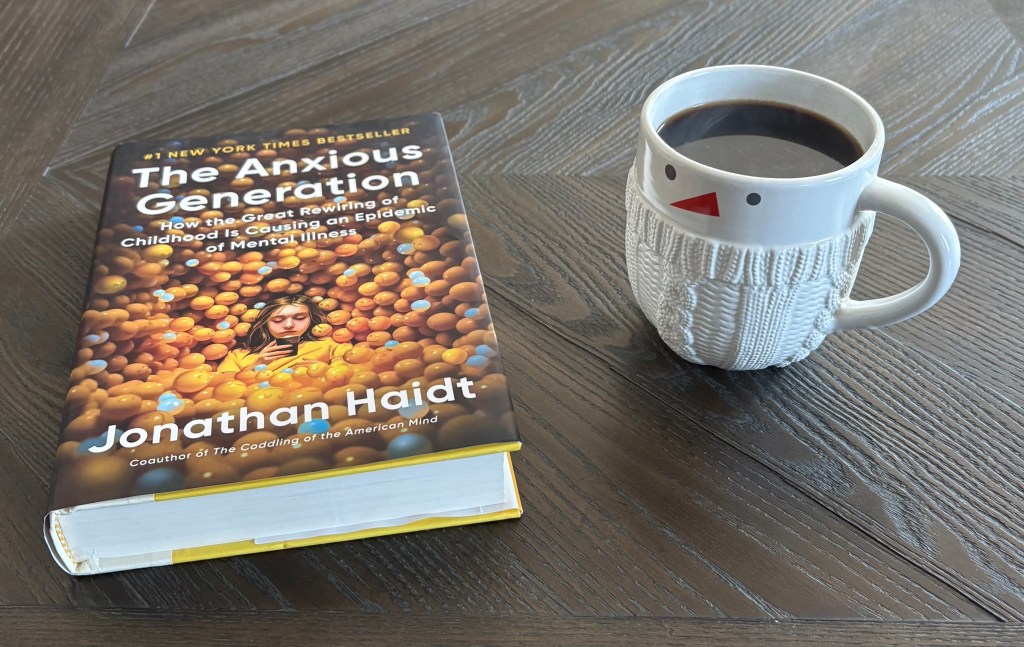
The Anxious Generation by Jonathan Haidt was a great read—slightly boring at times, but the subject is too important to let that stop you from reading it. Haidt doesn’t have the writing touch of Matthew Desmond, author of Evicted and Poverty, By America, but he lays out the facts about the social media epidemic affecting children and teenagers in a clear and highly informative way.
If you don’t think there is a problem, just go back a few years and think about the TikTok controversy and the public pushback surrounding it. Many of those interviewed at the time stated that they weren’t worried about national security or what happened to their personal information. What they feared most was losing their space and their place within the social media environment.
I recently read the following in the Wall Street Journal Weekend Edition regarding attempts to reverse antisocial tendencies: “Meta chief Mark Zuckerberg bemoaned this connection crisis and offered a solution: ‘virtual friend’ powered by generative AI.” Just a few lines later, the article adds: “Long AI conversations can make lonely people lonelier, and in April, Meta’s own virtual friends were found to engage in sexually explicit role play with users who had identified themselves as minors.”
Yes, let’s have “virtual friends” using Meta Quest virtual reality headsets—that will fix the problem. Are you kidding me?
Later, the author of the article states: “Social media’s harms occur because its creators price attention without regard to long-term outcomes.” That observation captures the central theme of The Anxious Generation.
Published in 2024, the book is approximately 367 pages long, including 66 pages of detailed notes, and is divided into four parts.
The introduction sets the stage wonderfully, explaining how we arrived at this point. Part 1, consisting of a single chapter, covers the decline in mental health. Part 2 provides the backstory, explaining how the problem began with the overprotection of parents in the 1990s, which limited children’s and teenagers’ opportunities for free play and real social interaction. This was followed by the invention of smartphones in 2007 and, soon after, the explosion of social media.
Part 3 discusses the “phone-based childhood,” which Haidt defines as “all of the internet-connected personal electronics that came to fill young people’s time, including laptop computers, tablets, internet-connected video game consoles, and, most importantly, smartphones with millions of apps” (p. 7). This section is dedicated to research showing how phone-based lifestyles disrupt child development. Part 4 lays out Haidt’s recommendations for addressing the problem.
I am fully aware of the damage social media is causing in society, which is why I don’t maintain any personal social media accounts, aside from a minimal presence on LinkedIn for professional purposes.
If you are skeptical about the dangers of social media, I recommend reading this book carefully—or with “minute care,” as Marcus Aurelius advised—paying close attention to the notes along the way. It is an eye-opening experience that should, hopefully, inspire action.
Here are some highlights:
“My central claim in this book is that these two trends—overprotection in the real world and underproduction in the virtual world—are the major reasons why children born after 1995 became the anxious generation.” (p. 9)
Overprotection in the real world, according to Haidt, is driven by fears that children walking outside may encounter kidnappers or sex offenders—an issue that continues to concern me and is frequently reported in the news. I personally believe this trend is amplified by social media, which predators increasingly use to target victims, though this observation is anecdotal.
On page 30, the author presents a graph showing that, since 2010, the United States has seen a 188% increase in emergency room visits for self-harm among girls, compared to 48% for boys. On the following page, another graph shows a 167% increase in suicide rates among adolescent girls, compared to 91% for boys. Mental health hospitalizations in Australia have increased 81% for girls and 51% for boys (p. 41).
In the U.K., self-harm among teens reverses the trend, showing a 134% increase among boys compared to 78% among girls. Notably, the U.K. data show that the rate for boys is just over 250 per 100,000, while for girls it is close to 1,250 per 100,000 (p. 41). High psychological distress in Nordic nations shows an increase to 76.3% since 2010, compared to 51.3% for boys (p. 42).
“An important detail in this story is that the iPhone 4 was introduced in June 2010…Instagram had a small user base until 2012, when it was purchased by Facebook…its user base grew to 90 million by early 2013.” (p. 35)
“If world events played a role in the current mental health crisis, it’s not because world events suddenly got worse around 2012; it’s because world events were suddenly being pumped into adolescents’ brains through their phones…” (p. 39)
“By 2014, nearly a third of teen girls were spending over 20 hours a week on social media sites…” (p. 58)
“Social media platforms are therefore the most efficient conformity engine ever invented.” (p. 59)
“For girls, the worst years for using social media were 11–13; for boys, 14–15.” (p. 64)
Haidt identifies four foundational harms caused by this trend:
- Social deprivation: Children replace face-to-face play with virtual interaction. (pp. 120–122)
- Sleep deprivation: Social media use reduces necessary sleep for pre-teens and teens. (pp. 123–125)
- Attention fragmentation: Constant notifications disrupt focus and productivity. (pp. 125–129)
- Addiction: Haidt explains dopamine’s role and introduces the four-step Hooked model: Trigger, Action, Variable Reward, and Investment. (pp. 130–132)1
Anna Lembke, author of Dopamine Nation, describes smartphone addiction bluntly: “Smartphones are the modern-day hypodermic needle, delivering digital dopamine 24/7 for a wired generation.” (p. 135)
Haidt also explains why girls are disproportionately affected, citing visual comparison, relational aggression, emotional contagion, and increased vulnerability to harassment. For boys, the primary trend is a “failure to launch,” characterized by difficulty finding work, disengagement, and prolonged dependence on parents. (p. 179)
The final section of the book presents actionable recommendations for government, schools, and parents, including raising the age of internet adulthood to 16, implementing phone-free schools, and encouraging independence and real-world engagement for children and teens.
Haidt’s book is packed with data, expert insight, and practical guidance.
Unless meaningful action is taken, this problem will persist as technology continues to advance rapidly. Artificial intelligence—especially when paired with virtual reality—will make disengagement from the virtual space even more difficult. The emergence of AI-generated figures such as actress Tilly Norwood2 and recording artist Xania Monet3 illustrates how these technologies will further fuel online engagement.
The Anxious Generation offers valuable lessons and a framework for bridging the gap between virtual and real life. We need to continue guiding our children in this direction, and this book is a strong resource for doing so.
About the Author:
Jonathan Haidt is a social psychologist at New York University’s Stern School of Business. He received his Ph.D. from the University of Pennsylvania in 1992.
- Charles Duhigg, in his book The Power of Habit, calls it “the Habit Loop,” which consists of a cue, the routine, and then the reward. ↩︎
- https://en.wikipedia.org/wiki/Tilly_Norwood ↩︎
- https://www.cbsnews.com/news/meet-the-woman-behind-chart-topping-ai-artist-xania-monet-i-look-at-her-as-a-real-person/ ↩︎


An excellent review, Edward. I’m not much of a fan of social media and took myself off Facebook and Instagram years ago, but I understand the vulnerabilities it causes and/or exacerbates in many people but especially in children.
Parents and society as a whole have been dropping the ball on this. We have just passed legislation controlling social media access for under-16s but the evidence from Australia shows teens working around such rules. Nevertheless, I remind myself that there was a low compliance rate with seatbelt laws when they first arrived, too. There won’t be magical solutions here.
LikeLiked by 1 person
Thank you, Lynette. Great point about the legislation. It will take some time, but I think children will comply eventually. Like seatbelts and people using cellphones while driving, people will begin to change their behavior as more controls are put in place.
LikeLiked by 1 person
I took a university class a couple of years ago about electronic addiction and how it alienates, isolates, and damages people, especially young people, who don’t have the mental capacity yet to make informed decisions. (Brains aren’t fully developed until age 25-26.) And the trend to use A.I. entities as “friends” for “self-fulfillment” is a disaster waiting to happen.
LikeLiked by 2 people
Absolutely, and I couldn’t agree more about AI. I think virtual headsets are going to accelerate the disaster you mentioned.
LikeLike
This is a book that was recommended to me as well. Your review has me leaning toward getting it.
I have limited my social media presence now to just 10 mins every couple of days. Mostly to stay in contact with the nephews and nieces. I realised that I was exhibiting traits of chronic addiction, and that is not my personality. So I went cold turkey.
A great review, btw, Edward.
LikeLiked by 1 person
Thank you, my friend. It’s an excellent book. I hear you about social media. Now I just send texts to family and friends or call them directly. Social media is highly addictive.
LikeLiked by 1 person
It is like Crack on yhe brain. 😏
LikeLiked by 1 person
Yes! 😂
LikeLike
As you probably know, Edward, Haidt is an expert on how people form opinions about such hot button issues as religion and politics. His research supported the outsized role of emotions over rational thought.
His findings were not easily welcomed among academics. The work you cite appears to have much support that he didn’t get in his earlier work. Thanks for this.
LikeLiked by 1 person
You’re very welcome, Dr. Stein. He laid out the facts very clearly, and I was glad to see that his research was used in California and in the work the state is doing to control access to children. The statistics are shocking, and it’s hard to doubt their accuracy when most of us have firsthand experience witnessing how social media is affecting youth (and adults). I’m looking forward to reading his book, The Righteous Mind. That is going to be interesting.
LikeLiked by 1 person
He has lots of YouTube and Ted videos, too. You will have fun, I am sure.
LikeLiked by 1 person
I was reading the website that his research group is maintaining, and there are a ton of good resources there. I need to check the TED Talks, I really like that format. Thank you for the suggestion.
LikeLiked by 1 person
Hi Edward, these concepts make perfect sense to me and I’ve seen an increase in suicides and mental health issues among the junior staff in the workplace. Social media is a contributing factor but so is the new virtual work environment where the expectation is that evenings and weekends overtime has become the expectation. It should not be like that. People need down time to relax and recharge. I find myself constantly stressed and checking emails over weekends. I don’t get them to my phone as an act of personal preservation but I think I’m the only person at my firm who’s taken that stance.
LikeLiked by 1 person
Thank you, Robbie. I think you’re right about the virtual environment. I think the virtual aspect is going to accelerate the problem, especially with those virtual reality headsets. That is going to be more damaging than anything else. The emails and calls at night and on weekends were the parts I hated the most when I was working. We received government-issued smartphones, so there was no way around answering the phones or emails. But I hated it when my boss called me for something insignificant. I always thought they were calling because they were bored at home and needed some attention. 😂 I hear you, people need to have a way to disconnect from work in order to relax, spend time with family, and do other important things. Not having that free time causes all kinds of mental problems, and people get sick. Bosses should know better.
LikeLiked by 1 person
You are right but bosses are selfish and shareholders are driven by profit.
LikeLiked by 1 person
Indeed.
LikeLike
One cannot help but nodding along when going through this. Beautiful!
LikeLiked by 1 person
Thank you very much, Marcus.
LikeLike
Thank you so much for reviewing this book, Edward. This topic is so important — and you have so many great quotes and notes. I was so glad to hear that the middle school Miss O is going to next year is phone free. I love that Jonathan Haidt plus reviews like this are helping parents to address this issue.
LikeLiked by 1 person
You’re welcome, my friend. That’s excellent, and kudos to that middle school.
LikeLiked by 1 person
What an incredible analysis! 😮📚 It’s impressive how Haidt shows the effects of social media and overprotection on the mental health of young people. The data on anxiety, depression, and suicide are truly frightening. This is an urgent topic that we should all reflect on. Thank you for sharing! 🙂🙌💻🧠
LikeLiked by 1 person
You’re very welcome. Absolutely urgent. Thank you for reading and commenting.
LikeLiked by 1 person
I thanks for sharing this book and your take that generated rich dialogue that is so needed. I’m impressed with your take home and how diligent you are with your son. It’s pervasive and hard to navigate in a world so completely absorbed. These 2 year olds are obsessed with grabbing the phone already. I shudder to think of their future! ♥️
LikeLiked by 1 person
You’re welcome, my friend. They are at a good age where restrictions can be easily put in place without much trouble. It’s very difficult to do that when they’re in their pre-teen years. I know Grandma will keep them busy, exercising and helping out around the house. 😉
LikeLike
I’d love some real tips about how we’re supposed to guide kids through this advanced technological age. Our 2 oldest grandchildren have cell phones (ages 15 & 12). When they’re here, I have long lists of activities to keep us busy so they can’t be on the phone. But as soon as we’re done with activities, they run to their phones and start scrolling and texting. It drives me bonkers, and I feel like a drill sergeant asking about the apps and sites on their phones, and instituting time limits. And trying to get them to understand the difference – between sharing truth and hurting others, between privacy, oversharing, and inappropriateness, between fact and fiction, between sites that fight for positive change and sites that are just hate-filled… And I have no idea how to balance this appropriately. There have been times we banned them from bringing phones or any tech into our home. My husband is a computer scientist, so tech is a vital tool in our lives. It’s such a juggling act trying to find the right boundaries.
LikeLiked by 1 person
I hear you, Rose. It’s a difficult one, but I think parents can set the tone early. We gave our son a flip phone when he was in middle school, which he barely used because it wasn’t cool, but it met his communication needs. He was upgraded to a smartphone when he started high school, but before giving it to him, I set up parental controls (no app downloads, no internet during sleep time, only people on the “allow list” can call during sleep time, among a few others). I also set up parental controls on the internet hub in our house.
We explained the reasons for doing this, and he understands. No issues so far. He doesn’t have any social media accounts. He’s going to turn 18 soon, so I’ll remove all of that since he’ll be an adult. But I think he’s going to do well because of the measures we took during his formative years.
It’s a lot of work, communication and parental controls, but parents can definitely navigate this issue with some preemptive measures.
LikeLike
Such an important book and I find myself – and colleagues – returning to it to understand the broader social dynamics and threats which are only now being well-understood. Especially the self-harm aspect which you included. Thank you so much for your thoughtful read and excellent post, Edward. “A strong resource”…what a great way to describe the importance of reading Haidt’s book. 💝
LikeLiked by 1 person
Thank you, Vicki. The part about brain development in children and teens, and how the environment can shape it positively or negatively, is fascinating. Knowing all that, and the dangers, I’m always amazed at how little the government is doing to help in this area. I guess money has a higher priority than children’s development.
LikeLiked by 1 person
I think you nailed it! There’s plenty of money to be made by catering to the young – instilling the perception of social media being a necessity…a birth right, almost for kids in the U.S. I think it will be a long time before protective measures are in place…given our current climate and leadership.
Love this conversation you’ve started…so many terrific comments from your readers here, Edward. Big hugs and stay warm, my friend! 💝
LikeLiked by 1 person
Thank you, my friend. Oh yes, a birthright—I think it’s in the Constitution, right? 🤦🏻♂️
Yes, warm, though it’s only -1 right now. Not too bad.😁
LikeLiked by 1 person
Thanks for the giggle and the perfect emoji! 😉
Right? Who knew we’d cheer for one below! ❄️😳❄️
LikeLiked by 1 person
You’re so welcome, my friend. Hey, we need to celebrate the small things in life.
LikeLiked by 1 person
Yes!!!! Thanks for being you! 🥰
LikeLiked by 1 person
Certainly an engine for comparison, competition, isolation, distraction, and delusion. Something that we, individually and collectively, were not prepared to deal with. Social media grew swiftly, engulfing lives, numbing consciousnesses, and replacing reality. Dangerous to say the least, especially now that IA has entered the game. A great review of a very interesting book and a relevant awareness call for what we are doing here. Its impacts are changing the world forevermore… Thank you, my friend, for bringing it to light. A meaningful read! Light and blessings your way, today and always! ✨🙏
LikeLiked by 1 person
You’re welcome, Susana. Your opening highlighted the key issues with social media very well. The sooner people understand that, the better. There needs to be an awakening very soon if we want to get a better handle on all the new technologies on the horizon. AI is a wonderful technology, but like any other technology, we need to be smart about how we use it. Technology cannot replace human face‑to‑face interaction if we want to remain in balance with nature. Thank you, my friend. Blessings, and have a wonderful weekend.
LikeLiked by 1 person
Thanks for sharing about this book and it sounds important and well done. I am also glad the author made some suggestions – and wow – just not sure what is going to unfold with the AI – but in the last year (since he wrote his book) I have seen numerous articles about the dangers of AI being used for romantic intimacy and role playing and so I wonder if this book with need new versions every other year – hmmm
LikeLiked by 2 people
You’re very welcome. He mentioned AI in the book, but you’re right, it will probably need an update in the next year or two. I think he’s maintaining a website with the latest trends and providing regular updates.
LikeLiked by 2 people
well h sure took on a large topic and even if it might need updates or was not able to include everything – I am sure the book has a very important role to help raise awareness about this very important topic.
LikeLiked by 1 person
Absolutely!
LikeLiked by 1 person
😀
LikeLiked by 1 person
Una reseña muy interesante Edward y además me encanta la taza de tu foto.
Gracias por compartir, feliz fin de semana.
LikeLiked by 1 person
Muchas gracias, Elvira, y espero que pases un buen fin de semana.
LikeLike
Hi, Ed. Excellent article! My daughter and I are discussing these very issues with the grandkids. The biggest challenge is with my granddaughter. She just turned 8 y/o. We are implementing changes, although challenging.
LikeLiked by 1 person
Thank you, Sandra. It’s definitely a tough one. We gave our son a flip phone when he was in middle school and upgraded him to a smartphone in high school. No social media yet, and he’s about to turn 18. We put some parental controls on his phone and the internet. A lot of conversations throughout the years.
LikeLiked by 1 person
Thanks for the review, just bought the book, very interesting, staggering emergency room self-harm visits for children. hopefully action follows the knowledge.
LikeLiked by 2 people
You’re welcome. Yes, that’s my hope too, that it leads to action.
LikeLike
The Anxious Generation is one of my favorite books in the sense that it provided so much eye-opening info. One thing I absolutely love about this book’s impact is watching parents and teachers read it—and then doing something about phone and social media usage in schools. It’s time people finally realized the damage that social media does to the still-developing minds of teens.
Great post, I enjoyed your thoughts on it!
LikeLiked by 2 people
Thank you very much for your comment. I can see how a person might take action after reading this book. The data he presented and the examples he provided were powerful. We made some early decisions about phone usage and social media for our son. He received a smartphone in high school, but no social media yet, and he is about to turn 18. We saw the available data and took some preventive measures.
Parents’ and teachers’ involvement is essential.
LikeLiked by 1 person
I’m glad my children were grown before smart phones became so vital – I feel very sorry for parents today. My daughter moved to Hawaii where her kids can be active in nature year round which helps a lot, but it has been a struggle
LikeLiked by 2 people
Yeah, island life in Hawaii is very unique. Even Oahu had many opportunities for kids and teens, and the communities were pretty tight, at least that was my experience when I lived there in the early 2000s.
LikeLike
It is a very real worry and as a teacher and grandmother I know it to be true. The governor of our state is about to sign a state wide ban on phones at school during teaching hours which is a small step in the right direction, and my worry is even greater in the use of tech by children in their off hours without adults
LikeLiked by 3 people
That’s awesome, Beth. That’s one of the initiatives the author is working on: no phones during school hours. I hope more states start adopting similar policies. Yeah, the off hours is a problem, and parents need to figure out how to address that one.
LikeLiked by 1 person
we did this in my school before I retired and some parents were upset because their kids were upset of course. we stuck by it and said they could use it after school of course, if they needed to reach parents for pickup from activities, etc. but if parents needed to reach them during school they could simply call the office and they would let the student know.
LikeLiked by 1 person
Excellent! More schools need to do that.
LikeLiked by 1 person
This is a lot to take in. I consider myself overly connected to the internet- but the majority of this has never even entered into my orbit! What a sad state of affairs.
LikeLiked by 2 people
It definitely is, Violet. The author highlights adults’ ability to “off-ramp” and avoid the pitfalls of social media because our brains are fully developed and we have a lot of experience dealing with different issues. But, parts of children’s and teens’ brains are not fully developed and are more easily affected by the constant push of media feeds, which can rewire their brains.
I think social media companies suppress some of these facts to protect their businesses, so it’s good that experts are writing these kinds of books and trying to inform the public.
LikeLiked by 1 person
I absolutely love the authors description of “overprotection in the real world and underprotection in the virtual world”. I think most of us of a certain age know exactly what she means.
Anecdotal, but I’ve raised two boys and it wasn’t always puppies and rainbows, as you can imagine. This led me to have discussions with some local therapists and counselors, where, according to them, they experienced massive shifts in their clinical work. Youth became the vast majority of their patients, and according to them, the issues were identical: a combination of vicious social media pressures and a complete inability to face “adversity” (their term). To me, that seems to largely line up as outcomes of what the author describes as parents are both overprotective in the real world, and allow free grazing online.
I appreciate you talking about this, Edward. It scares me to death, and makes me feel terrible for young people. There are major issues, to say nothing about the impact Covid had youth, and all at a time when we’ve insufficient resources available to help clean up the issues. As parents, we need to do better by them.
LikeLiked by 2 people
Thank you, Scott. I thought the same thing when I read that part about “overprotection in the real world and underprotection in the virtual world.” The stats are insane. I think the danger is teens’ ability to stay connected to the school social environment 24/7, which I guess is okay if you’re one of the “cool kids,” but if not, it’s probably a nightmare.
Back in the day, you dealt with the weirdness of other kids and bullying for eight hours or so, then went home and it was quiet until the next day. Then the weekend came, and things were okay. Now, my goodness, kids get a continuous dose of weirdness and bullying right on their phones. I think that’s what is driving so many of the issues teens are facing.
LikeLiked by 1 person
Definitely makes sense to me. Nothing like having bullying and misery delivered right to the palm of your hand. 🤦♂️
LikeLiked by 1 person
Yes, just horrible. The book gave an example of a school where teens create a social media group and call it “Everybody except [the kid’s name].” Can you imagine?
LikeLike
The whole world, with access to the internet, have gone bonkers.
I do love the blog and the people I follow but for me it is like pen pals from so long ago. So innocent compared to what so many are now exposed to.
When I look at Mark Z I see a mad scientist of sorts, with his plan to create a social media site to make us all closer in interaction lol on so many levels I see failure.
Sadly I am still on it for selling my watercolors but I try not to go off the deep end as I see it as such a waste of precious time I have left.
Have a great weekend I will be dodging the bitter cold one minute, then on the John Deere pushing way too much snow around lol
LikeLiked by 2 people
Yes, when I woke up this morning, the “feels like” temperature was −39. It’s going to be very cold this weekend.
I like blogging and don’t consider it a social media platform. To me, it’s more like a collaborative space where people write long-form content and readers interact with it, most of the time leading to meaningful dialogue.
Have a nice weekend, and stay warm.
LikeLike
This book is life-awakening, pinpointing how social media has negative benefits than positive benefits. I feel like parenting becomes a little challenging now because of gadgets and everything screens the children spend to. I wish this book will reach a wider audience, especially parents to be aware how this trends now is a little alarming, considering the high suicide rates. Thought-provoking review, Edward and a great book. I admire the author, too. And… this time, I look longer the mug than the book because it looks cute.🤩🤭
LikeLiked by 2 people
Thank you so much. Yes, this subject is extremely important, so we need to keep communicating and sharing this information to improve the situation. Parents need all the support they can get.
It’s a little cold in my area, so the mug dressed up to stay warm, and the hot coffee, helped a lot. 😁
LikeLike
Thanks, Edward. Those statistics are terribly alarming, especially the self harm, suicide, and interactions with minors. Recently schools are getting the pressure to police against technology invasion of phones in the classroom. I think families, parents and guardians should have in depth discussions after reading the book you just finished.
LikeLiked by 3 people
You’re welcome, Rebecca. I agree, more discussion and collaboration are needed to address these issues. But as I was discussing with Karen, a lot of parents are addicted too, and some see any intervention as a violation of their “freedoms.” It’s just a difficult issue to tackle as a society.
LikeLiked by 1 person
Perhaps a class on healthy phone use would be good to add to ms and hs.
LikeLiked by 2 people
That’s actually a good idea, maybe as part of the start of each school year. 👍🏼
LikeLiked by 1 person
This sounds like an extremely important read and reckoning.
LikeLiked by 3 people
Indeed.
LikeLiked by 1 person
I read this book last year. It’s scary stuff indeed. My daughters grew up in the smartphone and social media era and both struggled with anxiety in high school, even though we did resist getting them phones until high school and gave them opportunities for independence.
I have significantly reduced my time on social media in the past year and feel much better for it. It’s a shame because the original idea and potential to help people stay connected was great. These companies have a lot to answer for.
LikeLiked by 3 people
I gave my son a flip phone in middle school, funny enough, he kept it in his backpack and hardly used it. He then transitioned to a smartphone in high school but does not have a social media account yet.
Companies saw profits in the way people were using social media, so they exploited the situation. It’s like cigarettes—they look cool until you’re addicted to them, and then neither rain nor cold will stop you from smoking outside.
LikeLiked by 1 person
That’s great about your son. My younger daughter, who is 23 now, rarely uses social media. Her older sister does, but is pretty responsible about it. When they were in high school, I think they both quickly saw how phoney and toxic it all was. The teenage years are tough enough, without all that!
LikeLiked by 1 person
That’s true about the teenage years; they were difficult indeed.
LikeLiked by 1 person
This really hit me hard. When my kids were in school I was heavily involved in the PTA. I tried so hard to bring programs about the dangers of social media to the district. The district loved it and developed programs with us but the parents pushed back. It was a bizarre response. Not the type of movement I expected.
LikeLiked by 3 people
Well, some parents are addicted too, and others perceive those efforts as a “violation of their freedom.” It’s a catch-22 with some of these issues.
LikeLiked by 1 person
Just terrible. Thank you for bringing this to light.
LikeLiked by 1 person
You’re very welcome, my friend.
LikeLiked by 1 person
This is a very interesting analysis. I can’t argue that social media does not quite live up to the hype when it first came out. Although, I’m not quite to the place were I want to throw technology under the bus because we have a correlation between “screen time” and “mental health”. The first rule of statistical analysis states “correlation does not mean causation.” I have not read the book, but will put it on my reading list.
You mention that Haidt identified the four foundational harms: Social deprivation, sleep deprivation, attention fragmentation, addiction. A lot of this sounds very familiar to my childhood growing up and we didn’t have cell phones. But there was TV, Magazines, chatting on the phone with friends at night, and “oh my!” Rock N’ Roll Music! My question — where are the parents? My parents were aware of the amount of TV, monitored the music, phone time, ensured I was not distracted and finished my homework every night. The Government didn’t have to do it. The technology didn’t have to do it. Responsible parenting did it. As a teen, I thought my parents were rather restrictive. As an adult, I realize the hard job they had and how hard they worked to help me grow into a responsible adult.
That’s not to say we don’t need some Government regulations to technology. But I’m inclined to want to dig deeper to social changes outside of technological advances. Maybe there is a correlation, maybe not. After all, when we started driving automobiles instead of horse drawn carriages, deaths due to automobile accidents increased. Are we going to ban automobiles? I will be very interested in reading some of his recommendations on managing technological advacements.
LikeLiked by 2 people
Thank you, Joni, and I agree with your comment about parenting. My son is about to turn 18 and doesn’t have social media.
TV… well, I still remember that TV stations went off the air before midnight back in the day. I think the issue with social media, and the book discussed this, is the short length of the content and the rapid transition from one short piece of content to the next. That’s what is hooking children, teens, and adults. If they click or view something, the platform knows to push more of that. I think a lot of parents are addicted too, so they are not able to regulate what their children are doing.
I agree with your comment about the statistical analysis, there are too many variables, but with the number of lawsuits against some of these companies and Congress attempting to regulate some of the access in the past, I think there is a little bit of truth in the numbers. But again, I’m not sure because that is outside my area of expertise.
Every time I go to a restaurant and see couples or families on their phones instead of enjoying each other, I have to think that there is an issue somewhere.
LikeLiked by 1 person
Yes, social media does cherry pick what to display to users. Content is short. But the change started before social media. 50 years ago (1970’s approx), when I entered the workforce, we had offices. Someone had to knock on my door to talk with me and we had purposeful conversations. About 15 years later, the office had changed to cubicles and we were separated by low walls. My neighbor could simply talk over the wall to me, interrupt me as they pleased. Slowly, but surely, the cubicle changed to a bull pen. There were no walls, no privacy. Over the past 50 years, we’ve been breaking down walls, but at the same time increasing sensory stimulation.
What if the addiction to this little phone in our hands isn’t so much the addictive power of social media, but a shutting down, blocking out the noise so to speak?
LikeLiked by 1 person
Excellent point! I didn’t think about that angle. I might need to take some time to reflect on it.
As an introvert, my tendency is to hide and stay disconnected from society because the world is really loud. I know that’s not good for me, so I’m constantly resisting my tendency toward isolation and I purposely go out into the world often. Still, I’m always looking for meaningful engagement, not small talk. That’s one of the reasons I love blogging—it meets, at least in part, the meaningful engagement I’m craving.
I tried social media in the past but lost interest quickly. I would describe it as “superficial,” for lack of a better word, but after your comment, I can see how, for some people, it could be an escape from the noise, a way to spend some quiet time. I’d rather do that by reading a book and drinking coffee, but I can see the point.
LikeLiked by 1 person
I’m right there with you in the introvert category! 🙂 In my opinion, “Social Media”, like anything else that can be addictive, isn’t neccesarily bad. Alcohol is addictive. Pharmeceutical drugs (opioids for example) are addictive. Gambeling is addictive. In my mind, the question isn’t how to regulate addictive substances, but why some individuals succumb to addiction and others do not.
LikeLiked by 1 person
Now that’s a good area to look into. Why do some people not succumb to addiction? I might need to check that out and see if there are any books on the subject.
LikeLike
I just wanted to weep reading this review. Children are being robbed of the chance to become fully-realized human beings by social media.
LikeLiked by 5 people
I know. I’m aware of most of the issues, but it hurts seeing some of the statistics presented in the book. These companies are clearly taking advantage of children and teens to make their millions. I hope adults start to wake up and put an end to this madness.
LikeLiked by 3 people
A good, solid review, Edward, and a subject I don’t think enough people educate themselves on.
LikeLiked by 3 people
Thank you very much. You are absolutely right. I think we need to have more discussions on this subject so that people become educated about the dangers and how to prevent children and teens from getting hooked.
LikeLiked by 2 people
Some really important insights and there needs to be an urgent call to lay down our phones for the sake of the younger generation. We need to be role models.
LikeLiked by 3 people
I completely agree. Parents need to set the example and demonstrate the importance of having relationships outside the virtual space.
LikeLiked by 1 person
I agree!
LikeLiked by 2 people
great read Edward. i am not sure how we can proceed from this point onward but at least we can identify and define the parameters of the problem. Mike
LikeLiked by 5 people
Exactly! I’m not sure either, but we definitely need to keep our kids engaged with the real world as much as we can. I think it’s going to take something significant for people to disengage from social media.
LikeLiked by 2 people
This observation will probably sound very naive, but I think public libraries have a role in breaking (or at least reducing) the social media addiction. What I’m seeing from the libraries in my own state of NH is that they are providing programs for all ages. They are becoming of their local communities. I’ve been impressed and heartened by the work they’re doing.
LikeLiked by 3 people
I think you’re right, and libraries have a big role to play. I know my local library has events throughout the week for kids of all ages.
LikeLiked by 2 people