A week or so ago, I read an essay titled “What self-help books tell us about ourselves” in The Economist. After reading the article a couple of times, highlighting parts, and writing notes, I realized that I wanted to share my thoughts—not only about self-help books, but about reading in general.
The article presented the following question regarding self-help books:
Do they help selves?
I would say yes, with a caveat. People cannot expect to become masters of anything simply by reading one self-help book—or any book, for that matter. Books are not one-hit wonders. A person needs to read deeply on a particular subject to gain the knowledge necessary to improve their life or cope with a specific issue.
The essay mentions The Seven Habits of Highly Effective People, Atomic Habits, and even the Stoics.
It critiques modern self-help books by using The Boy, the Mole, the Fox and the Horse franchise as a symbol of the genre’s current state: hugely popular, emotionally soothing, and light on genuine instruction. The author argues that while such books promise guidance, comfort, or transformation, they rarely deliver concrete change. Instead, they function as cultural mirrors, revealing the anxieties, desires, and values of their time.
The author also contends that much modern self-help is both overly adult—obsessed with efficiency and time—and oddly childish, favoring simplistic language, emotional indulgence, and slogans about “authenticity.” Even when it borrows from Stoicism or philosophy, it distorts those traditions by reframing them as tools for personal happiness rather than guides to living a good life.
Ultimately, the essay questions whether self-help truly helps at all. It says that evidence suggests its benefits are minimal, while greater fulfillment comes from “unselfing”: directing attention away from oneself through relationships, nature, art, and shared experiences. The conclusion suggests that readers might be better off skipping self-help books altogether and choosing something that draws them outward instead.
The premise sounds wonderful—”to draw outward”—but it feels like a fantasy to me. You have to start somewhere, and for me, as for many others, that starting point is books.
What is self-help, anyway?
According to the American Psychological Association, self-help is “a focus on self-guided, in contrast to professionally guided, efforts to cope with life problems. Self-help can involve self-reliance, in which one addresses such problems on one’s own (e.g., by reading self-help books), or it can involve joining with others to address shared concerns together, as in self-help groups.”1
According to the Merriam-Webster dictionary, it is “the action or process of bettering oneself or overcoming one’s problems without the aid of others.”2
I am a believer in self-help books. I have mentioned in many of my posts that I grew up without a father or any male role model, and it wasn’t until I joined the military that I was able to find myself, so to speak. Self-help books were key during my military career and remain essential as I navigate fatherhood. They taught me strategic planning, time management, how to conduct meetings, how to coach and mentor people, and how to discuss annual performance appraisals.
I consider all books to be self-help, because their pages teach me history, philosophy, faith, social and cultural issues, poetry, how to write, and how to read.
Could I learn all that through “relationships, nature, art, and shared experiences,” as the author suggests? Sure—but do you know how much time I would need to spend “out there” trying to learn what I want to know? Books meet my needs just fine.
Another thing that stood out to me while reading the essay was the author’s criticism of “childish, favoring simplistic language” in some self-help books. Some of the best management books out there use simple, even childlike language. I’ll mention just three must-reads for managers and leaders: The One Minute Manager, The One Minute Manager Meets the Monkey, and Who Moved My Cheese? These books have done more for me than many of the more “serious” books I read in college or institutional courses. They are simple—and effective.
Now, I know there are many books out there that are not very effective. I don’t want to call them “bad books,” because even those can teach you something. The key is learning how to assess a book—whether by walking into a bookstore, getting your hands on a physical copy, reading a few pages, or consulting reviews.
A reader also needs to read with an open mind. Authors are not perfect and they do their best to convey their thoughts and experiences on a particular subject. Our task as readers is to dig deep and find that kernel of knowledge and follow it by reading other books until you get a clear picture. Sometimes the subject is complex and one or two books are not enough. I’m experiencing that with the history of the United States. There are some many perspectives. If you think that what you learn in High school or college is enough, you are mistaken.
Also, I know that sometimes books are not enough and one-on-one professional help is needed. When that is the case, you should seek that help. Professionals can help you walk through a particular issue and provide options to resolve it.
I want to end by saying that I read because I want to improve myself so that I can be of use to others. If I don’t take care of the “self,” then there won’t be any “unselfing.” That’s a fact.
One more thing:
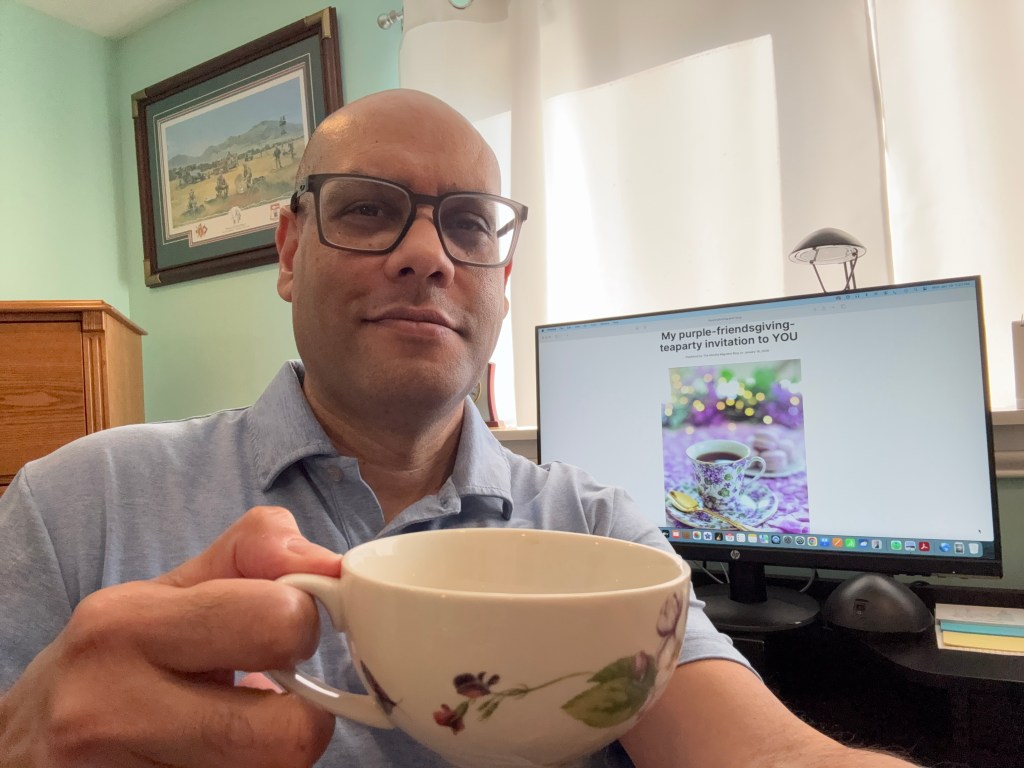
My friend Linda, from The Mindful Migraine Blog, celebrated her 2nd blog anniversary on 17 January 2026. She’s actually having a Purple Friendsgiving (Virtual) Tea Party on the 21st and 22nd of February. I told her that I would be out of town that weekend but that I would be celebrating with her and others in spirit. I really wanted to be part of the celebration, so the photo below is my attempt to show her my celebratory spirit.
Happy 2nd blog anniversary, my friend!
 Thoughts about leadership, history, and more
My collection is gardening and craft ,victorian novels, history and Terry patches books I collected and am yet to read. I avoid self help were personal opinion is involved but I’m all for it
LikeLiked by 1 person
I did an English and history degree and had never studied history before the extensive focus on victoriana reform and the novels I read made me a more focused learner and I could understand politics and reform on how societies evolved to ďate. Books also taught me gardeninģ and crafts I agree in life reading is self help at its best
LikeLiked by 1 person
That’s cool. Mine is in chemistry, but I didn’t fully appreciate history until I joined the military. Now that I’m retired, I have the time to pursue history, politics, poetry, and other subjects fully. I used to have books for everything. I remember buying car repair books back in the day. Now, you can find all kinds of how-tos on the internet, so I donated those.
LikeLiked by 1 person
A self-help book/author is like anyone you might wish to consult. They are only as valuable as their wisdom and experience. Some offer little, while others may trigger all types of thoughts and action on our part. Your posts are always interesting, Edward.
LikeLiked by 1 person
Thank you so much, Mary. I’ve read my share of bad ones over the years, but it’s so good when you find one that, like you said, triggers thoughts and actions.
LikeLiked by 1 person
Brilliant post, Edward. Trying to understand Self has helped me become better at unSelfing. And this is truth: “I consider all books to be self-help, because their pages teach me history, philosophy, faith, social and cultural issues, poetry, how to write, and how to read.”
As always, thank you for sharing your thoughts and insight, Edward.
LikeLiked by 1 person
Thank you so much, Natalie. 🙏🏼
LikeLike
Thanks for the review, well done, yes we must take care of ourselves, like you say, by reading or one on one.
LikeLiked by 1 person
You’re very welcome.
LikeLike
I’m not getting your posts, I have to look for them. I’m subscribed to your site.
LikeLiked by 1 person
The system is sometimes problematic. Thank you for letting me know and for subscribing.
LikeLiked by 1 person
Hi, Edward. I’m sorry that I missed thus post. I enjoyed it a lot. I also enjoy self help books, although in the past decade I haven’t read the usual kind. Now mine tend to be more for what I’ll call “mental processing” and positive. (I’m going to call those a kind of self help.
It seems that the experts don’t tend to want us to help ourselves. But in some cases (including my own) that’s the only way. Desperately wanting to get better, I diligently took five years of therapy, never missing a week. If I had simply failed to improve that would have been one thing, but I got steadily worse and worse. I went from the one-time comfort zone that I’d had for many years (with a lot of stress about getting out) to being unable to go anywhere at all, and severe stress about going out into my own front yard. I don’t fully blame the deterioration on “the experts”, but I’m illustrating the very good point you made. ….. I gave up therapy 18 months ago when NY therapist retired. I can’t report a miraculous turn around, or that I’ve even returned to the degree of “disability” I had when I started. The main thing for me was to stop the decline. Anyway, with my positive thought self help, I’ve improved a tiny bit, which I’ll gladly take over getting steadily worse.
Thanks for this post. Hugs.
LikeLiked by 1 person
Thank you, Teagan, for sharing your experience. This area is sometimes difficult to navigate and often depends on what we are dealing with. Susan Cain’s book Quiet helped me better understand my introversion, and Feeling Great by Dr. David Burns helped me understand CBT. Thanks to that book, I was able to find the right therapist and address my combat-related PTSD more effectively. I guess the key is to be open to both learning through books and getting one-on-one support when needed. I’m a huge supporter of self-help books.
LikeLiked by 2 people
Thanks for the book recommendations.
LikeLiked by 1 person
You’re very welcome.
LikeLiked by 1 person
You have reminded me of Who Moves the Cheese. I used to read a range of self help books and often spiritual books too like I think the Monk and the Ferrari. Managing work and people can be challenging and good books can be helpful.
LikeLiked by 1 person
Absolutely! Books support our wellbeing and keep our knowledge fresh. Thank you.
LikeLiked by 1 person
Cheers back to you! Love your thoughtfulness about the self-help genre. Many offer opportunities for inspiration — providing nuggets of insight to embrace…or not…but the good ones always make think and earn a spot on my bookshelf. Thank you, Edward! 🥰
LikeLiked by 1 person
You’re welcome, my friend. Yes, the good ones, which aren’t that many, hold a special place on my bookshelf as well.
Bundle up and get ready for this weekend, because it’s going to be cold. 🥶
LikeLiked by 1 person
I know, right???? We’re gonna need all the hot coffee and tea we can find. Very worrisome conditions for folks to the south, too. Take care, dear Edward! xo!
LikeLiked by 1 person
Yes, some wicked weather across the country. Thank you, my friend. 🫶🏼
LikeLiked by 1 person
Take care! ❤️
LikeLiked by 1 person
You too, my friend.
LikeLiked by 1 person
What a great post, Edward. I especially agree with “I consider all books to be self-help, because their pages teach me history, philosophy, faith, social and cultural issues, poetry, how to write, and how to read.”
Your growth mindset is inspiring and delightful. I’m intrigued by the three management books you mention and I love your point that reducing a message to simple language is both difficult and effective. Right!
LikeLiked by 3 people
Thank you, my friend. Who Moved My Cheese? and The One Minute Manager Meets the Monkey are excellent and super short. Now that I think about it, Who Moved My Cheese? might be a good fit for Miss O. As she continues to grow, it’s good for her to understand that change is natural and that continuing to evolve is necessary to stay ahead in life.
The one about the monkey is also good because you learn that people are always trying to put their monkeys (problems) on your back, so learning to avoid monkeys—and to put them back on the right backs—is a skill that needs to be learned.
LikeLiked by 2 people
Great suggestions. I love the idea of starting Miss O early. Thanks, Edward.
LikeLiked by 1 person
You’re very welcome, my friend.
LikeLike
Linda is amazing! Also I tend to gravitate towards books from brené brown
LikeLiked by 1 person
I have one of Brené’s books, Dare to Lead, on my reading list. I heard she is good.
LikeLiked by 1 person
she’s very good
LikeLiked by 1 person
Your thoughts on self-help books touch the soul. Each page read is a seed sown, not only to transform ourselves, but to prepare us to serve and love others. I loved how you highlight that true learning comes from the practice of conscious reading: seeking knowledge, comparing perspectives and, above all, applying what is learned. Books are, after all, bridges between the “self” and the world, instruments of silent growth that enable us to share light, attention and care. Thank you for sharing these insights with us.🙂✨📖✍🏻🎁🌌
LikeLiked by 1 person
You’re welcome, and thank you very much for this thoughtful comment. I’m glad it resonated with you. Books are definitely a bridge to the world—past, present, and in some cases, the future.
LikeLike
I’ve read many self-help and how-to books over the years, Edward. Sometimes the self-help ones have helped answer certain questions. The “how-to” ones have been and still are my favourites. Thanks for this post!
LikeLiked by 2 people
Good point about the “how-to” books. I like them very much, and I have a few that I revisit often. Thank you, Terry.
LikeLiked by 1 person
It’s fascinating how many self-help books there are out there. I enjoy browsing the titles whenever I’m at a bookstore.
LikeLiked by 1 person
Yes, a lot. I do the same—self-help, then history, and then the business section. I’ll check other areas if I have time, but I get lost in those three sections for hours.
LikeLike
I like your analysis of the article and thoughtful review of the topic. Most of the self-help books I’ve read have been about relationships and improving skills like assertiveness, knowing that the books were only part of the learning and healing process. I confess that I have often skipped to the sections that give practical suggestions, which is why the relationship book I wrote is short and practical. The suggestion from the article to direct attention “away from oneself through relationships, nature, art, and shared experiences,” is good as long the relationships are healthy. (Nature and art have always been healing for me.) In my opinion, we need balance between introspective work and getting help from others.
LikeLiked by 1 person
Thank you, I couldn’t agree more with your last statement. We definitely need both, and sometimes it’s the only way to get better.
LikeLiked by 1 person
I love how you immerse yourself into every ounce of learning and book you read, Edward. Your take homes are wonderful gifts of your soul you give so freely. While many roads lead to the same outcome, sometimes it takes hearing them a bit different to bring them home. I’ll be working with a concept for what feels like forever and then a client will say.. I just learned blah and I’m like right even though we’ve talked about it a million times.. we all have a shelf life.. and timeframe of when we can absorb things.. xxx Great post.. xxo
LikeLiked by 1 person
Thank you, my friend, and you know that I learned a few things from Re-Create & Celebrate. We learn things, then we share them, and suddenly we see the light or feel refreshed.
LikeLike
Your teacup photo is fun, Edward. I’ve never read a self help book other than one by a blogging friend. Your overview sounds good and useful.
LikeLiked by 1 person
Thank you so much. It took me a while to take that selfie, and I almost finished the tea before getting a decent shot. 🤦🏻♂️
LikeLiked by 1 person
I don’t like taking selfies either.
LikeLiked by 1 person
To me at this stage of life, most self-help books are common sense, although I usually pick up a nugget or two that make them worthwhile and a reminder of what we should be doing is never a bad thing.
Two of my favourites: Things That Matter and Atomic Habits.
One that underwhelmed me: The Let Them Theory.
LikeLiked by 1 person
Atomic Habits is on my reading list. I’ve heard Mel Robbins speak a few times, and I wasn’t impressed. I agree with you, I’ve read so many books that, at this point, some feel kind of repetitive. Now, I’m trying to look for subjects I don’t know much about, and I think that’s one of the reasons I’m focusing on history and social issues.
LikeLiked by 1 person
Self-help books can be truly revolutionary in our personal journey, for no one knows us better than ourselves. However, it is pivotal to have some discernment about what’s been offered. Many of these books come as magic fixes for something that, in many cases, is not really a “problem.” They focus too much on an imperfection of being that needs, at all costs and very fast, to be overcome. Overcome to comply with societal standards that are often far from being real, reasonable, and beneficial. A great post, as always, Edward! I am a big fan of self-help books, but also of awareness and reason. You touched key points here, and I am grateful for this read. Light and blessings to you, my friend, today and always! ✨🙏
LikeLiked by 1 person
You’re absolutely right, Susana. I tend to visit bookstores and skim some of these books to check out the content before buying them in-store or online. I also read a lot of reviews looking for details about the book. You brought up a good point about societal standards. I’ve noticed that some books try to push their worldview, telling readers to follow it if they want to improve their lives. This is dangerous for the undiscerning mind. Thank you, my friend, and I hope you have a blessed day. 🙏🏼
LikeLiked by 1 person
Very interesting discussion on examining ourselves and our lives. This idea struck me as noteworthy:
“greater fulfillment comes from ‘unselfing’: directing attention away from oneself through relationships.” I think it depends if one tends to focus on oneself or on others in daily life. There needs to be a balance of I and We. Personally, more focus on the I would balance out my life. Each person needs to examine themselves to find their own direction.
LikeLiked by 1 person
I completely agree that there is a need for balance. We can’t take care of others if we don’t take care of ourselves first. I’ve seen both extremes, and it’s not good.
LikeLiked by 1 person
Thanks, Edward. We must nurture ourselves and others to find balance.
LikeLiked by 1 person
Absolutely!
LikeLiked by 1 person
As I was about to enter my teens, my eldest sister got me a copy of 7 habits of highly effective people. I was about 13 or 14, and it was the longest book I’d read after The Lord of the Rings. Both taught me a lot. Both are still browsed even 30 odd years later.
Books, in general, are good “self-help” tools.
And sometimes, it’s the first and most accessible source that anyone can turn to for advice or information.
LikeLiked by 1 person
Absolutely, they are the first and most accessible source. I think AI will take over as the most accessible source in countries with good internet access. There are still places in the U.S. that lack broadband access, so public libraries are essential for those communities.
LikeLiked by 1 person
That is frightening. I have seen some of the errors AI churns out with confidence sometimes. But it is here to stay.
LikeLiked by 1 person
Absolutely! I’m hoping AI companies, book publishers, and authors come to some agreement soon to remedy that.
LikeLiked by 1 person
So do I.
LikeLiked by 1 person
Assigned read/discussion would be fine. Even taking personality tests and sharing if you want would be fine. I’m thinking a self help book for “How to manage a team” would be helpful. lol!
LikeLiked by 1 person
I know, and I don’t think there are many books out there specifically on that topic. But if there is one, the person you mentioned really needs to read it. 😂
LikeLiked by 1 person
Hi Ed —
I just finished reading your thoughtful piece on reading as a path to growth — and wow, what a grounded, honest exploration of why books still matter in our lives. It’s clear you don’t just read — you reflect, question, and weave those insights into how you live and lead. That came through beautifully.
Your conversation with The Economist piece about self-help books hits a sweet spot: yes, not all books are deeply transformative, but they can be catalysts especially when we use them not as quick fixes but as tools to expand awareness and sharpen our intent. That balance between inward cultivation and outward connection is something many of us grapple with, and you articulated it with both humility and clarity.
I especially liked your point about books helping you serve others better. Too often “self-help” gets boxed into self-indulgence, but when reading deepens empathy, hones our focus, or expands our ability to help, that’s real growth. And you reminded us that books aren’t the enemy of experience they’re its companion.
Also — the personal touch of celebrating Linda’s blog anniversary with a symbolic cup of black tea was heartwarming. These moments show how reading isn’t just about solitude, but about the connections and rituals that enrich our shared humanity.
Thank you for a reflective and generous piece. It inspires me to both read more intentionally and to pay attention to how those pages shape how I show up in the world.
Warmly,
— Rohitash
LikeLiked by 2 people
Thank you very much for your kind words. I think sometimes we miss the importance of reading books to improve the lives of others—whether that’s our families and friends or the community at large. It can also help our businesses and workplaces. If we read in a selfish way, then we miss books’ full potential.
LikeLiked by 1 person
Yepp… Ed 🤗
LikeLiked by 2 people
Self-help books are good. But everyone faces different challenges in life. We need patience to handle matters the best way possible. That’s the art of life!
LikeLiked by 1 person
That’s absolutely true, and in some cases professional therapy is more appropriate. Life is beautiful, but it can be difficult to navigate without help.
LikeLike
I relate to your thoughts Edward. Many Many books have influenced me. Not always as the author intended. The one minute manager and who moved my cheese were influential in my own work style and leadership. “Think of others as more important than yourself” a biblical quote, radically changed my marriage. As a very young boy reading Jack Londons “to build a fire” I walked into a forest in a foot of snow and learned how to build a fire to stay warm…very useful later in life wilderness camping and guiding groups. Books can mold our natural bent, hopefully in a good way.
LikeLiked by 1 person
Your point about influence “not always as the author intended” is excellent and often overlooked. That has happened to me a few times, and I’m surprised every time it does. You’ve just highlighted the proper outcome of reading self-help books: learning to do “stuff” and improve one’s life. If a person reads a book and doesn’t follow the recommendations, either by seeking help or putting something into practice, then it’s just knowledge without purpose. Excellent addition to the discussion, Gary. Thank you very much.
LikeLike
“I consider all books to be self-help”, I agree with this phrase – we learn from everything we read, whether it’s good, bad, or otherwise. Similar to your youth, there was a lot I saw as a child that I knew wasn’t right, and I was desperate to find a better way. I read a lot of self-help books that helped me see things differently.
Edward, you seem to have a knack for finding timely articles from The Economist and putting together very insightful blog posts. I like reading your thoughtful articles.
Happy 2nd blog anniversary to Linda. ☕(that’s a cup of emoji-style tea) 😊
LikeLiked by 3 people
Thank you so much, Rose. Books have given me so many answers when I needed them most. I guess nowadays people just Google or ask ChatGPT for answers. I’d rather read books, though. I like to share useful articles with the community, and The Economist has so many.
LikeLiked by 1 person
This is a meaningful reflection on the value of reading. I like how you balance personal growth with the idea of connecting more deeply with others—reading not just as self-improvement, but as preparation for better relationships and service. It’s a good reminder that books work best when they shape how we live and engage with the world.🤝🎉
LikeLiked by 3 people
Thank you so much, John. 🙏🏼
LikeLiked by 1 person
hope you enjoyed that tea Edward. always great to see people happy and living their best life. and as always, an articulate and comprehensive, but fun read. Mike
LikeLiked by 3 people
Thank you, Mike. I broke my coffee routine in honor of Linda, but the black tea was good.
LikeLiked by 1 person
Very interesting thoughts, Edward. It seems evident (IMHO) that books, of all types, can be more/less helpful, more/less informative, depending on who’s reading it and their level and use of the information. I’m not sure why that would be any different for the self- help category. It does seem unfair to categorically dismiss it when there are perspectives the reader may be exposed to for the first time.
LikeLiked by 2 people
Thank you, Scott. You’re spot on, and that was the issue with the essay. There are things that people do not know or understand, so there is no way for them to know where to begin looking for help. A book can help start that process.
Man, I have stories about people telling me that alcohol, for example, was the solution to their daily problems. With that kind of advice, no wonder some people are in trouble. Like you said, it all depends on the person reading the book. Sadly, there are a lot of people who are not going to read or seek professional help because they are stuck in their ways.
LikeLiked by 1 person
That’s an unfortunate truth that I’m just beginning to learn in recent years. We all are familiar with the teenage phase of thinking one knows everything. I’m a long way from my teenage years (mid-forties), but went many years thinking I really had life figured out.
And then, I notice little things, and it occurred to me that I was just stuck in the ‘not knowing what I didn’t know’ phase. Books, listening to others….. suddenly I’m beginning to see ALL that I don’t know!
I say all that to say, unless we get set on that path (which never ends!), we’re going to be in trouble as individuals left to our own devices. That can take many forms, and books have served us well for a very long time!
Nice work, Edward!
LikeLiked by 1 person
I couldn’t agree more with your last statement. I’m really hoping that AI companies, book publishers, and authors come to some agreement soon. The new generation is heavily dependent on technology, and AI is going to be their initial source for their “life questions.” The more authoritative and reliable information teens and young adults can find through their AI queries, the better.
LikeLiked by 1 person
Amen to that!
LikeLiked by 1 person
A wide subject, Edward. One response. I encountered a fair number of patients and others who were forever looking for “the answer” to their problems in self-help books. Of course, there was never an answer, so they tried another book. The danger is that they don’t engage in the world enough, and their books become a way of avoiding it. I realize some books are helpful, but past a few, it might be better for most to find another way.
LikeLiked by 2 people
Thank you, Dr. Stein, for your comment. You have a lot of experience in this area, so of course you are right. There is a huge danger in depending solely on books to solve deep-seated issues. I don’t think books alone can help a person suffering from PTSD or tackle a complicated physical chemistry equation, no matter how many books a person reads. We need psychologists and physical chemistry teachers to help with that. Good books typically recommend getting professional help, but of course some people skip those parts.
LikeLiked by 1 person
👋💜How fabulous! THANK YOU for showing up like this – you are an absolute star!! In my mind the invite is working beautifully already; making people smile and feel connected – I’m so thrilled that we crossed digital paths and that we keep inspiring each other to stay positive – one cup of tea at a time! 💜🍵
LikeLiked by 3 people
You’re so welcome, my friend. Again, happy 2nd blog anniversary! I hope that next month’s virtual celebration is a total success. I’m also so glad that we connected and that we are inspiring each other… one cup of tea (or coffee) at a time. 🫖 🍵 ☕️ 🫶🏼
LikeLiked by 1 person
🥰
LikeLiked by 1 person
A few decades back, I had a manager who assigned her team 4 Self Help books a year. Each quarter we had to read the book and start talking the lingo. It became an inside joke among the team. HR got involved when she had us post our Myers Briggs personality types outside our cubicles so we could “interact according to personality types”.
That said, I really enjoyed your post and agree that some of the less complex self-help books are easier to work with. It’s like making baby steps towards the person we want to be. Or as a coder … quick fixes to the programming.
LikeLiked by 2 people
Wow, that was a little out of line. We used to get books assigned to discuss during our officer professional development meetings, but we were never “forced” to follow a particular book’s approach. Posting personality type results—that’s crazy.
Thank you for your comment, Joni. I see books that way, they help me take baby steps toward becoming a better person.
LikeLiked by 1 person
I’m glad you wrote this Edward! I’ve has some big time enlightenment from “self help” books!!
LikeLiked by 2 people
Thank you, my friend. Me too, and there were a couple of books that were lifesavers.
LikeLiked by 1 person
I’ve never read any self-help books. I try to be open to learning from experience by paying close attention to what’s happening and listening to other people. I’ve learned the most about myself from reading fiction and poetry and engaging with it at a deep level.
LikeLiked by 2 people
That’s a blessing, Liz. I guess it depends on the environment where a person grew up. When I was growing up, I was aware of what was happening around me and knew it was wrong, but I didn’t know who to turn to for advice or what “right” looked like. That’s where books helped me. Even time management was a dilemma. A lot of senior leaders in the military think they know time management. I used to ask them how to manage time at work and at home. They were quick to tell me all about time management at work, but at home… all I heard was crickets. They used to say, “Well, do the best you can there, and make sure you spend time with your wife and kids.” Clueless! Books helped me in that area too, and then I was able to give my soldiers good advice when they asked.
LikeLiked by 2 people
You’re right about my being blessed. My dad always talked with me about what was happening in the world in an age-appropriate fashion. He was my go-to for help and advice when I was older. If I needed a warrior advocate, I went to my mother. My parents balanced each other out very well. I sure do miss them.
LikeLiked by 3 people
What a great example. We are trying to do the same with our son. I hope one day he will say something similar about us.
LikeLiked by 1 person
Great piece my friend. I am a huge fan of self-help books. I realized though that I actually have to do the work that I’m seeking though. Otherwise I’ve just purchased 26,567 words in a book just telling me how I could be a more effective manager or why adding peptides to my coffee could assist with my skin’s elasticity.
I miss bookstores. Self Help books and a latte. Those were the days!
Great pic here and cheers to our friend Dr. Linda! ❤️
LikeLiked by 1 person
Thank you, my friend. You’re right about doing the work, we have to apply the good things we learn from books. I’m lucky because I have a Barnes & Noble, BAM, and about four local bookstores in my area. Yes, a book and coffee is a delight.
LikeLiked by 1 person
You are so lucky! I miss the B&N touch. Borders was my go to place back in the day.
Funny I just pulled out one of my Spartan Race self help books as I need to re-read a specific training chapter. Timely!!
LikeLiked by 1 person
Wow, Borders… so good.
Yeah, excellent timing. I just finished reading The Anxious Generation last night. I learned a few things about the impact of social media on teens and adults.
LikeLiked by 1 person
Heavy sigh. We could have months of convos about this topic!
LikeLiked by 1 person
Indeed, it’s crazy.
LikeLiked by 1 person