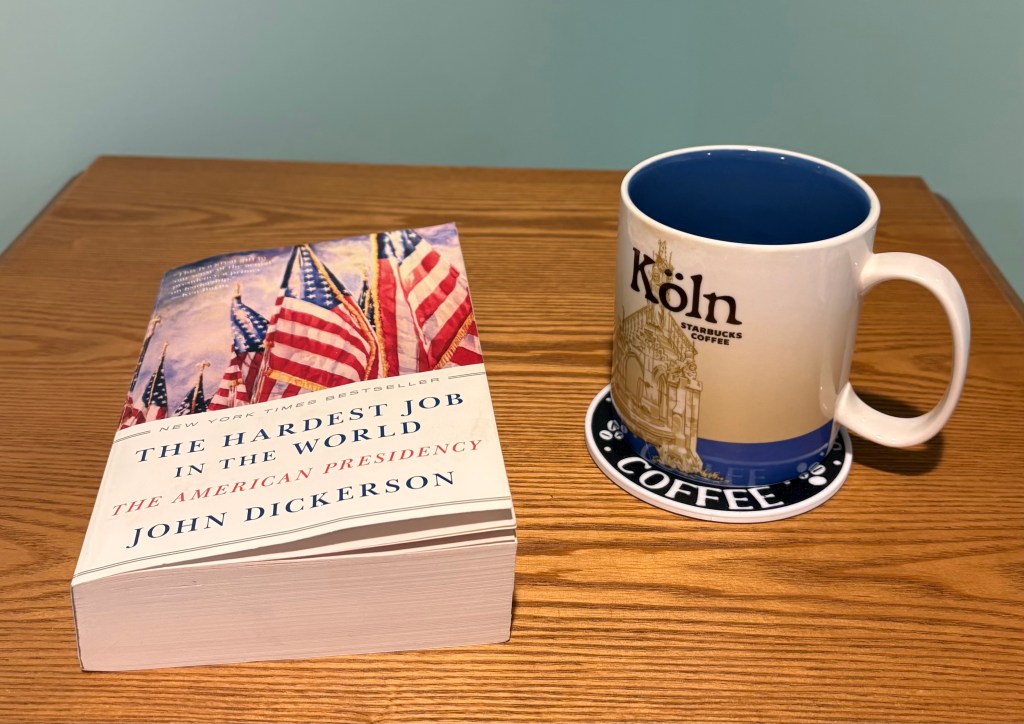
It’s interesting to learn how the office of the president of the United States came to be and how it has changed over time, mostly due to Congress’s neglect. I have been reading about the Founding Fathers and the important documents they produced that have guided this country. So when I saw an interview with John Dickerson about his book The Hardest Job in the World, it piqued my interest, and after watching the discussion, I decided to purchase the book. I’m glad I did.
The Hardest Job in the World: The American Presidency by John Dickerson was a fascinating book. The author is an American journalist, and his excellent writing and research skills were on full display. The book falls into the category of politics and government, but I would absolutely include history because of the amount of historical fact included as he describes the office of the presidency and the responsibilities associated with this high office.
The book contains about 629 pages, including a robust 21-page introduction, a 50-page bibliography, and a 75-page notes section. The main content is divided into three parts: The Office of the Presidency, Presidential Campaigns, and The Way We Live Now.
I think we Americans tend to know snippets of facts about different presidents throughout history and their contributions to the country, but this book gives readers an opportunity to put it all together and follow the transformation of the office from the first president, George Washington, onward.
The main theme throughout the book is how the office of the presidency has changed from what the Founding Fathers intended. We are definitely seeing the consequences of that departure now. I’m not sure whether this country will ever attempt a sort of reset to bring the presidency back to its original intent, but I hope we do for the sake of the country.
About the book, the author states the following:
“What you are about to read is an account of the office and how it has evolved over the years to become misshapen, and how our own expectations of it have become warped as well. This book is also an effort to change the way we think about the presidency…” (p. xxx)
This book spoke my “love language” (time management and organization) when I read the following in the introduction:
“Successful presidents live in Quadrants One and Two, farm out Quadrant Three to their teams, and brace themselves against incursions from Quadrant Four.” (p. xviii)
The reference is to the Eisenhower time-management matrix, which is divided into four quadrants:
Quadrant 1: Urgent/Important
Quadrant 2: Not Urgent/Important (leaders should spend most of their time here)
Quadrant 3: Urgent/Not Important
Quadrant 4: Not Urgent/Not Important
Quadrant 4 is where a leader wastes time changing the names of buildings, taking over golf courses, serving as master of ceremonies, and so on. For a leader with the hardest job in the world, lingering in Quadrant 4 is a sad commentary on his or her leadership abilities.
I found this part particularly insightful:
“We are in an age when our presidential candidates go through no apprenticeship process to test whether they have governing qualities. Previous experience in Washington is seen as a liability, but it should be considered an asset. When authenticity and campaign performance become the entire metric for judging whether a candidate should be elevated to such a high-stakes job, we’re not simply judging a book by its cover—we’re judging a bomb-defusing manual by its cover. We can’t afford to pick our central political player through such a defective system.” (p. xxvii)
With that said, here are some highlights from the book:
“Franklin Roosevelt initiated legislation, whereas before, presidents had only implemented policy that had been established by Congress.” (p. 7)
“‘More and more legislative authority is delegated to the executive branch every year,’ complained Republican Senator Ben Sasse of Nebraska in a floor speech in September 2018. ‘Both parties do it. The legislature is impotent. The legislature is weak.’ The decline of legislative activity has left America ‘increasingly governed by negotiation between the imperial presidency and whichever philosopher-king has the swing vote on the [Supreme Court],’ wrote New York Times columnist Ross Douthat. No one is happy with the outcome, but no one seems to know how to restore the balance.” (p. 14)
“It’s not just that a president faces new challenges, says General David Petraeus, he also captains a disordered ship. ‘In Washington, D.C. the center has been hollowed out of Congress because of party primaries, gerrymandering, vast amounts of money (some of it not accountable), the lack of civics education – all different sorts of issues that have led us to a point where the government shuts down and many of the budgets are not approved in time for the start of the fiscal year,’ he says. ‘If we’re going to do better around the world, we need to do better at home.’” (p. 32)
“The shift in the presidential first responder expectation started during Lyndon Johnson’s presidency. LBJ believed in a stronger connection between the people and their president…’I’m interested in the whole man,’ he said. ‘I am concerned about what the people, using their government as a tool, can do toward building the whole man, which will mean a better society and a better world.’ Johnson wasn’t just being empathetic. he used his public role and the comforting hand of government to build political power.” (p. 41)
“A president’s power to console comes from a ceremonial reverence Americans grant their presidents. To deserve the reverence, a president must act as steward of the dignity and stature of the office. In short, a president must be presidential. What does it meant to be presidential? Basically, to act in keeping with our highest expectations of the office.” (p. 65)
“Because power corrupts, society’s demands for moral authority and character increase as the importance of the position increases.” —John Adams (p. 66)
“As Jeffrey Tulis, the author of The Rhetorical Presidency, points out, the founders rejected ‘frequent popular appeals’ because a president who governed that way would undermined deliberation and lead to bad public policy. If a president whipped up the crowd, ‘the passions…not the reason, of the public would sit in judgment,’ wrote Madison in Federalist No. 49. ‘But it is the reason, alone, of the public, that ought to control and regulate the government. The passions ought to be controlled and regulated by the government.’” (p. 71)
“Members of Congress represent the diversity and breadth of America. Durable solutions to the toughest problems can come only through a system that passes laws informed by that diversity and in which the process makes everyone feel heard whether they win or lose. A president acting alone can’t replicate that diversity of representation. If they act unilaterally, they’re likely to galvanize their political rivals. Not does a president have Congress’s tools to address vital issues…When Congress does not address central questions on issues like healthcare, immigration, and economic policy, it lengthens the president’s to-do list.” (p. 117)
“The framers chose to allow Congress to override the president, but for much of the early republic, presidents deferred to that branch’s powers. When William Henry Harrison ran for president in 1840 he did not talk about policy, because, he said, to do so would encroach on Congress’s prerogative. Congress made the laws and the president simply executed them.” (p. 141)
“Each branch of government in the separation of powers system would be aligned so that while the executive, judicial, and legislative branches might grind against each other, the collective interlocking nature of the system would allow that those branches’ pushing against each other would keep the system running. “The great security against a gradual concentration of the several powers in the same department,’ wrote James Madison, ‘consists in giving to those who administer each department the necessary constitutional means and personal motives to resist encroachments of the others.’” (p. 147)
“To be successful, a president must do more than just disrupt the regular order of things. That may be what their voters are satisfied with, but greatness lies in replacing it with a better alternative.” (p. 220)
“As news outlets proliferated and technology provided twenty-four-hour coverage, White house staffers had to field more queries. At the same time standards of the journalism declined. Instead of asking the White House only about stories that had a possible basis in fact, some reporters started pushing lower-grade stuff…The change in the news cycle has had the greatest impact on discipline, or been the greatest invitation to a lack of discipline, in the presidency.” (p. 244)
“John Kennedy…when he made his pitch for the importance of the primary election system, he quoted Lord Bryce, a British academic and politician who wrote a three-volume history of American politics published in 1888…What Kennedy did not say is that Bryce argue that the process for electing presidents focused too much on political victory and not enough on what it took to do the job. As a result, mediocre men of average intelligence blundered into a post for which they were unprepared.” (pp. 271–272)
“The founders discussed the method for picking presidents at the Constitutional Convention, but they could do not better that to settle on the clumsy workaround of the Electoral College, cobbled together in a rush to overcome an impasse in discussions and to accommodate southern slave states. As William Grayson, who participated in the Virginia ratifying convention, put it, the Electoral College was ‘rather founded on accident, than any principle of government.’” (p. 272)
“As early as the election on 1800, electors gave up on the idea of being philosophers picking the best of their lot. They picked based on faction and made their choices based on political advantage, not reason.” (p. 273)
“‘Modern presidents have lost the balance required for good leadership,’ writes Elaine Kamarck in Why Presidents Fail; ‘they spend so much time talking that they mistake talking for doing.’ The time devoted to communications could be spent building alliances with Congress and with foreign and national leaders.” (p. 304)
“Epitome of what the framers wanted in a president. The Historian Richard McCormick defines that standard this way: ‘The ideal candidate in a republic was a man who, through his dedicated and disinterested public service, acquired a reputation for probity and integrity and accepted the call of his fellow citizen to successively higher office.’” (p. 316)
“Jefferson believed a well-informed electorate was necessary for the country’s survival. James Madison expressed a similar view…The two were talking about more than just public familiarity with candidates’ position papers. To be vigilant citizens, Jefferson argued, voters had to study history in order to understand the corrupting influence of human weakness.” (p. 327)
The conclusion of the book offers several insightful points:
“We must no longer confuse good campaigning skills with good governing skills…Governing requires ruthless prioritization based on the idea that everyone can’t have everything at the same time, including the president’s attention.” (p. 427)
“Campaigns push us to define presidential qualities in absolutes…Defining attributes by absolutes stops us from thinking more intelligently about the office and what it really requires. It also makes us the willing dupes of candidates and their handlers…Instead, we should think about presidential skills like honesty, political awareness, and decisiveness on a continuum.” (p. 428)
“National security challenges should occupy more of our time because they come in an area of the presidency where the chief executive has the most unchecked power and where the stakes are the highest.” (p. 434)
“We should be looking to others institutions – Congress, state and local government – and looking at the electoral process that picks those lawmakers. Those are the institutions where we can effectively address many of our national challenges.” (p. 443)
“Congress must reassert itself again, taking the lead in writing legislation to meet great national needs and at least weighing in on enormous questions like war and peace.” (p. 444)
“When the hardest job in the world slips off its standards, we should all hear that as a warning.” (p. 466)
The Hardest Job in the World was a great read, and I highly recommend it. It was illuminating to see how the presidency has changed over time and how we, the people, have lowered the standards of that office by failing to use reason when electing leaders. This did not happen overnight; it is the accumulation of poor decisions made by voters over the last three or four decades, culminating in what we see today.
There is always hope that we can correct the course. I believe—and I agree with the author—that it starts with taking a closer look at Congress and state governments, those institutions closer to the people, and making a conscious choice to elect the very best candidates. We need leaders with a holistic view, not ones constrained by party lenses. We need them to govern thoughtfully and for all people, not just those who agree with them.
This book provides much of what we need to start that conversation—but we must take our responsibility seriously. We must educate ourselves and use reason, not campaign slogans or talking points, when electing presidents if we want this country to survive.
About the Author:1
Award-winning journalist and author John Dickerson is co-anchor of the” CBS Evening News” and chief political analyst for CBS News. Dickerson leads the Network’s election coverage and political special reports. He received the Ford Prize for Distinguished Reporting on the Presidency and the David Broder Award for political reporting. A native Washingtonian, Dickerson graduated with distinction from the University of Virginia with a bachelor’s degree in English and a specialty in American studies.
 Thoughts about leadership, history, and more
Thank you for this informative review, Edward. Three words sum up a lot for me: disinterested public service; it seems to have gone missing in (self-servicing/ self-aggrandising) action.
LikeLiked by 1 person
You’re very welcome. Yes, that also caught my attention. You would think that sentiment is at the heart of everyone in public service, but it seems like it has been replaced with “how can I benefit from my position?”
LikeLiked by 1 person
The other word I would put in my brackets is partisan.
You note the dangers of “them v us” posturing in another review.
LikeLiked by 1 person
Yes, very dangerous. This political posturing is dividing democratic societies around the world. Thank you for adding that.
LikeLiked by 1 person
Totally agree. Ol Rupert thinks he makes the political decisions here, his papers have that much influence. Reminds me of that saying by Jim Morrison/ Chaomsky. Whoever controls the media controls the mind.
LikeLiked by 1 person
So true.
LikeLike
This resonated with me today- “As Jeffrey Tulis, , points out, the founders rejected ‘frequent popular appeals’ because a president who governed that way would undermined deliberation and lead to bad public policy. Our leader (Australia) is a kind man but although strong, has folded recently to public pressure and most likely fears a media backlash. I am disappointed. He needed to be strong at this point.
The last warning of the last quoted sentence in the book echoes loudly!
LikeLiked by 1 person
Thank you for letting me know what part of the book resonated with you. My opinion on why leaders are folding so quickly when facing media backlash is that they have tested the power their office brings and want to keep it for as long as they can. I think a leader should stick to his or her beliefs no matter what, and if they lose an election, then so be it. Of course, leaders can change if they were operating under false assumptions, but folding every time there is backlash is, in my view, wrong and actually dangerous. To me, that suggests they will do whatever they have to do to be right. We are seeing a lot of that happening in the United States.
LikeLiked by 1 person
It is not at the same level as the US, Edward, but the control over the media control is almost the same. The Murdoch press have a large influence on mainstream media in this country.
LikeLiked by 1 person
It’s incredible how much reach that company has. I did a quick search and had totally forgotten that he is Australian. I know freedom of the press is important, but giving these companies the freedom to interfere with government is unacceptable.
LikeLiked by 1 person
This is an excellent and deeply engaging review. I appreciate how you connect Dickerson’s historical analysis to the present moment, especially the idea that the presidency has drifted from its original design largely because Congress has failed to assert itself. Your discussion of the Eisenhower time-management matrix was particularly insightful—it’s a practical lens that makes the abstract idea of presidential leadership very concrete. I also found your emphasis on confusing campaign performance with governing ability especially timely. The way you wove in primary sources, Founders’ intent, and modern consequences mirrors the book’s strength and reinforces its central warning: the degradation of the office didn’t happen overnight, and neither will its repair. This review makes a strong case that restoring balance starts not just with the presidency, but with Congress, state governments, and a more informed and responsible electorate. Thought-provoking and well done. May America not only survive, but thrive!
LikeLiked by 1 person
Thank you very much. I’m hoping the same, that we can survive all this, so we can thrive and unite with our allies to improve society.
LikeLiked by 1 person
This! If only the die-hard party faithful on both sides realized we’re in the mess we’re in now because their parents and grandparents elected to Congress people who didn’t do their jobs. As for presidential hopefuls, they groom for years to be the “right” candidate by going to the right Ivy League schools, the right church (must be faithful), etc. I don’t want a candidate that looks the part. I want one that can do the job. It’s all so infuriating!
LikeLiked by 1 person
Great points. As an independent, I’m extremely frustrated with both parties in Congress and their inability to get anything done. Instead of solving problems, they are just fighting each other. Presidents nowadays are being manipulated by interest groups. I think you’re right, candidates are being groomed to do exactly what interest groups want them to do, and most of the time they are not doing what’s best for all citizens in the country. Thank you, for your comments.
LikeLiked by 1 person
Wow, another deep dive, over 600 pages. I can see that would be required for the subject matter! Glad someone is studying this important subject in depth. Thanks for your summary.
LikeLiked by 2 people
You’re welcome, my friend. I have never seen a book like this one that covers what the job of a president entails, so I’m glad I took a chance on it. I learned a lot from it.
LikeLiked by 1 person
Thanks, I may get it for Evan for his birthday. Sh, don’t tell. 😉
LikeLiked by 1 person
Awesome! We’ll keep it a secret. 👍🏼
LikeLiked by 1 person
I’ve often wondered why, with such a big population, that more don’t run for USA presidency. I’ve concluded that it’s very likely a pretty undesirable job unless all one is concerned about is the power and the glory. I’m guessing that this book answers my question.
LikeLiked by 2 people
Thank you, Terry. I think the job has changed, from candidates truly caring about the country and trying to lead the government virtuously to what we have in modern times, where it’s all about power and how one can benefit from being president. Politics and campaigning have become so horrible, full of personal attacks, that decent and intelligent people don’t want to run for office.
LikeLiked by 1 person
Your concluding paragraph “but we must take our responsibility seriously. “ made me think about how easy it is (here in the UK anyway!) to point our fingers at politicians, criticising, being verbally abusive, blaming, when many of us haven’t bothered to find out for ourselves about political organisation and procedure. Surely, it’s the duty of every responsible citizen to enquire into such information. Eligibility to vote is an important consideration but a contentious one.
For me this book sounds a heavy read but an important one. Thank you for the excellent summary.
LikeLiked by 2 people
Thank you very much. I like what you said in this line: “find out for ourselves about political organisation and procedure.” I think that is part of the issue, understanding each candidate’s platform. I would add that we also need to think about the long-term consequences of voting for a particular platform. Sometimes we vote one way and then end up regretting it. I know a lot of people in the U.S. fall into that category.
LikeLiked by 1 person
I have somehow not received your recent blogs. I will have to check my spam! You do a wonderful job of telling us what makes this book worthwhile. At the same time, Dickerson seems to be too sober about the condition of our government. The presidency has taken a bullet train to a destination far from that which was characteristic of the recent times, however flawed they were. The Supreme court is an enabler, apparently little mentioned by Dickerson, unless I missed it. Thanks again, Edward.
LikeLiked by 4 people
Thank you, Dr. Stein. Yes, I’m not completely sure what’s going on, but I somehow got unsubscribed from your blog. I corrected it immediately, though it took me two tries. Anyway, he mentioned the Supreme Court and the need to eliminate lifetime appointments. Something is extremely wrong with the administration this time around, and I would argue that the advisers in the inner circle are running the show, so to speak. That, in my view, is dangerous, and I hope Congress (since they are responsible for personnel authorization) will take action in the future to reduce the number of people in the Executive Branch.
LikeLiked by 1 person
You and several others were indeed, in my spam. I have removed you and them, I hope!
LikeLiked by 1 person
Thank you.
LikeLiked by 1 person
Looks good. One point that stands out is that campaigning skills have replaced governing skills as the basis of the presidency. Not to get too partisan, but the current resident of the White House is a picture perfect example of someone who has excellent self-marketing skills but puts us all in grave danger when it comes to his attempt a governing. Today’s mass media being what it is, I don’t see that changing. The best self-marketers will continue to win, with actual governing skills nearly irrelevant to the task of gaining the office.
LikeLiked by 2 people
Mass media is terrible, and they continue adding wood to the fire. Yesterday, I received a news alert about a college in our area that continues to provide “DEI” services (whatever that means) under a different name. I found myself thinking, “Knowing that this administration is against colleges that support diversity, why in the world is this news channel covering such an insignificant event on that campus?” Clearly, they are trying to create controversy to improve ratings, but I really don’t understand why we continue this cycle of self-inflicted pain. Greed is a powerful thing.
LikeLike
Yes, it’s a dark road ahead, with all the tech bros and their media machinery aligned with greed and power, in whatever form they find it.
LikeLiked by 1 person
Indeed!
LikeLiked by 1 person
A lot of this commentary applies to all countries and many of these failures are being experienced in many countries too. On the whole, democracy is in the process of failing.
LikeLiked by 2 people
Sadly, you are right about that. I can sense it while reading world news in The Economist, and the central theme is that governments are not addressing the problems raised by their citizens.
LikeLike
Yes, that is right
LikeLiked by 1 person
Thanks for the book recommendation
LikeLiked by 2 people
You’re very welcome.
LikeLike
Hi, Edward. I enjoyed your mindful review, particularly your remarks about the “Eisenhower time-management matrix.” Ha, my first thought at reading the title was that the book would be quite “dated” as of this year. So I’m glad you brought out the multiple aspects of the book. It sounds intriguing. Hugs.
LikeLiked by 1 person
Thank you, Teagan, and I’m glad you noticed my comments on the matrix part. It was a very good book. I hope you have a wonderful weekend, my friend.
LikeLiked by 1 person
Great post, keep hope alive, thanks for all you do to inform, educate, and start debate, we certainly need change, in our whole political system.
LikeLiked by 3 people
Thank you very much. We definitely need to keep community engagement going and try to connect with opposing views as much as we can. That’s the only way to get back on track.
LikeLike
It is only going to get harder….
LikeLiked by 1 person
You might be right, but I’m going to wait until the midterms to see if my assessment changes. If Congress doesn’t change and start putting the executive in check, then yes, it’s going to get harder and turn into a nightmare.
LikeLiked by 1 person
Two important takeaways: “We must no longer confuse good campaigning skills with good governing skills…” and “When the hardest job in the world slips off its standards, we should all hear that as a warning.” A great review of what would be for me a heavy read. And so, I am grateful to take your shortcut. No matter how off track things sometimes feel, I too think, “There is always hope that we can correct the course. I believe…” Resonating deeply with your last thoughts. Grateful for being here, always, my friend! With appreciation, sending you light and blessings!! ✨🙏🍀
LikeLiked by 3 people
Thank you, Susana. Yes, we need to keep our hope alive. Light will always win. Blessings to you, my friend, and I hope you have a wonderful weekend.
LikeLiked by 1 person
Link Edward and thanks!
Juan Ré
LikeLiked by 2 people
Thank you, Juan.
LikeLiked by 1 person
It’s been going downhill for a while… I hope it’ll get better soon.
LikeLiked by 1 person
I hope so too.
LikeLiked by 1 person
This sounds like an important book. Thank you for bringing it to our attention. The only way we can right the ship of state is if we study the history of how it came to founder so disastrously. As you say, the mess we’re in right now didn’t happen overnight.
LikeLiked by 2 people
You’re welcome, Liz. It’s going to take some time, but we can definitely correct our course.
LikeLiked by 1 person
I’m glad to hear to think that, Edward. You’re much better-versed in government and political science than I am.
LikeLiked by 1 person
Well, I’m hoping that things will change. I received a couple of news alerts about actions taken by Congress regarding the budget and health insurance, so the movement has already started.
LikeLiked by 1 person
I sure hope so.
LikeLiked by 1 person
I love this, and appreciate you bringing this to my attention, Edward. Not to put words in your mouth, but you allude to something that grinds my gears: if a person is dissatisfied with the “power” of the recent Presidents like something just magically happened, then I feel like the point is being altogether missed. The constantly expanding power of the Executive branch has been an ongoing process, arguably, since the moment the ink was dry on the Constitution, and Congress has aided and abetted it. We, as a population, reward it, in many ways.
I was not aware of this book, and will be making a point to check it out. Thanks for this tip!
LikeLiked by 3 people
Thank you, Scott. Yes, your comment about the Executive Branch expanding is interesting, and the book discusses that at length, even including a photo comparing FDR’s and Trump’s cabinets. We definitely have a problem when we vote for candidates based on the way they talk or behave. I try to hold my tongue most of the time because a lot of people complain about what is going on, but they forget that the majority voted for the current administration, and voter turnout was about 64%.
LikeLiked by 2 people
Amen to that, not to mention the 98.6% re-election rate in ’24. Thanks for bringing this to my attention!
LikeLiked by 1 person
Yes, I forgot about that. We can’t complain if we keep electing the same people. You’re very welcome.
LikeLiked by 1 person
This sounds like an awesome book, Edward and I appreciate your review. There’s a lot of meat and potatoes with some helpful ways to move back to that from what you share. It seems like things have changed from our Founding Fathers to Find Father/ leader PLEASE!!!! And Hurry Up Already!
Hugs xx
LikeLiked by 2 people
😂 I know… we’re not moving fast enough. Thank you, my friend.
LikeLiked by 1 person
Sheesh… you can say that again. Always .. you can count on my candid response and then some.. lol
LikeLiked by 1 person
Absolutely, and I appreciate that, my friend.
LikeLike
Thank you, Edward, for your insightful review of John Dickerson’s ‘The Hardest Job in the World: The American Presidency’. While I’m not a fan of Dickerson’s speaking style as a news anchor, you definitely sold me on his writing skills. You clearly show Dickerson’s research and writing abilities, and his capacity to relate presidential history to current challenges.
I’ve often seen Eisenhower’s time-management matrix but never realized where it originated.
Many of the passages you quoted are so helpful in understanding what the job is meant to be. It’s puzzling that more voters don’t seek to learn about the history of the presidency. Instead, voters tend to judge candidates more by campaign performance and hateful soundbites than by governing ability. Your review shows that presidential leadership requires more than riling up a political party base, it should demand higher morals and a dedication to the public good. Thank you for sharing this thought-provoking work.
LikeLiked by 2 people
You’re so welcome, Rose. I have to agree with you about his speaking style—it’s kind of boring, if you ask me. He is definitely better in written pieces than as an anchor. With our current fast pace and people glued to their smartphones and social media, we are definitely losing our ability to read and think deeply, and we are settling for sound bites from influencers. Thank you, my friend.
LikeLiked by 1 person
Well researched and done. We are living in a warped version at the present time. We need to get the money out of politics, repeal citizens united, restore checks and balances, enact term limits…
LikeLiked by 2 people
I completely agree. Brad also mentioned Citizens United. Congress has the power to change all that if we push them. Thank you, Beth.
LikeLiked by 1 person
Oh my goodness. You had my full attention when you shared Dickerson’s words…descriptions of the current state of affairs with the president/presidency, Edward. “Misshapen and warped”…right on. Without your encouragement this would probably not have been a book on my TBR but now I’m mighty intrigued. Thank you again for another fantastic review, invitation, summary – all in one. 😊❤️😊
LikeLiked by 2 people
You’re welcome, my friend. In my opinion, he offered a good analysis of how much the presidency has lost its standing. I think you are going to enjoy the discussions of key events throughout our history.
LikeLiked by 1 person
Appreciate your review and encouragement to read. Feels productive given all the insanity. Leaning into analysis and history helps me!
😉❤️😉
LikeLiked by 1 person
Absolutely! It helps me too, and it’s one of the reasons I read about the subject, because newspapers and the 24/7 crazy news cycle don’t explain things correctly.
LikeLiked by 1 person
Right on! Exactly how I feel…I’d rather read than be manipulated. ❤️😜❤️
LikeLiked by 1 person
Yes! 🙌🏼🫶🏼
LikeLiked by 1 person
❤️😉❤️
LikeLiked by 1 person
interesting. i will take a look at this book – thanks for bringing it to your blog Edward. Mike
LikeLiked by 2 people
You’re very welcome, Mike.
LikeLiked by 1 person
Interesting that the book reaches the conclusion that Congress has abdicated its responsibilities. That would also seem to be the reason the judicial branch exercises considerably more power than what the Founders intended.
LikeLiked by 2 people
Absolutely! I don’t think the founders were expecting justices to actually stay in their seats for life. They thought they would serve for a time and then move on to other jobs.
LikeLiked by 1 person
Doesn’t sound like a light read but certainly an important one.
LikeLiked by 2 people
t took me about a month because I always get sidetracked researching and reading some of the sources included in the books. I need to do a little better this year if I want to finish my list on time. I also think it is an important book because the notes highlight politicians’ remarks throughout our history, and it’s worth every penny just for that.
LikeLike
Hello you look so familiar how are you doing and where are you from ?
LikeLiked by 1 person
Doing great. Currently living in Illinois.
LikeLike
I will check this out! I have always been a fan of government itself. Not politics but the actual mechanics of government. It’s fascinating to me!
LikeLiked by 2 people
I agree, that part fascinates me as well. I would like to read more about how Congress used to be more deliberate when writing bills, with a lot of feedback from constituents, and how that process changed into what we have now. I’m really not sure how Congress handles that interaction today. I know that my senators and congressman don’t ask for my input much.
LikeLiked by 1 person
Without getting into the current climate, I literally just said yesterday (to myself) after reading an article – I wish I could have a senator from each party in front of me and ask them about certain kitchen table topics that affect my Joe Citizen bottom line and see how they’d try to assist me. That’s always how I thought it was run.
LikeLiked by 1 person
I hear you. In a sense, I think that’s how it was done at the beginning while drafting the Constitution. There was back-and-forth, with delegates returning to their states to debate and then bringing that input back to Congress. It might be difficult for the current Congress to do that, but they could more easily get input from their respective state senates and houses, even governors, which are probably more attuned to what’s going on in each state.
LikeLiked by 1 person
I could talk for hours about this!
LikeLiked by 1 person
Me too. 😀
LikeLiked by 1 person
Thanks for reading this book and sharing the insights Edward. It sounds very detailed and accurate in how we got here and possible ways to shift the power back to the people, states, and Congress. And I still believe that we can have little impact unless big money is removed, corporations are stripped of legal human status, and Citizens United is repealed. Did the book address those aspects?
LikeLiked by 2 people
You’re welcome, Brad. The book addressed big money and campaign spending, but not corporations or Citizens United. I guess it’s back to us to force change by electing the right people to Congress so they can write good laws.
LikeLiked by 1 person
Very interesting Edward. Hopefully someday a large number of people will choose to circle back to how it should be, or used to be…how it’s intended to be.
LikeLiked by 2 people
Thank you, my friend. Yes, let’s hope for that.
LikeLiked by 1 person