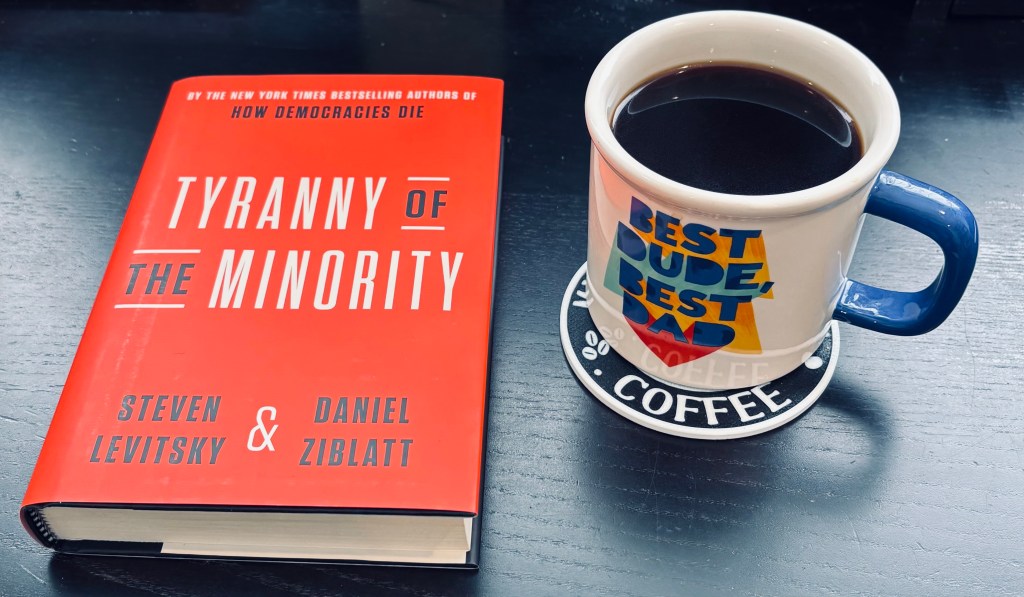
The Tyranny of the Minority: Why American Democracy Reached the Breaking Point by Steven Levitsky and Daniel Ziblatt was an interesting read. It is a close examination of what they perceive as structural flaws in the U.S. Constitution that have allowed minority rule to undermine, in their opinion, democratic norms.
Most of their focus is on four key issues: the need for an easier process to amend the U.S. Constitution, abolishing the Electoral College, abolishing the Senate filibuster rule, and establishing term limits for Supreme Court justices.
I felt the authors placed a heavy burden on government institutions, mostly on Congress and the Supreme Court, and I understand why they did that. However, I think the real problem is us, the citizens of this nation. We are failing in our civic duties, such as staying informed, discerning right from wrong, voting, respecting other people’s rights, and holding leaders accountable, just to name a few. So, just blaming institutions and changing them without doing the hard work of getting citizens to think again about the common good is not a real solution.
The book is well researched, with about 80 pages of notes where readers can check the sources they used. It is easy to read, though repetitive at times. What I really like about the book is that the authors provided a list of recommendations, 15 to be exact, which I appreciate. I don’t agree with all of them, but overall, most of their recommendations were sound.
The authors did an excellent job of getting my attention by proposing good questions right from the start:
“What are the forces that drive a mainstream political party to turn away from democracy? … We must also understand why America proved so exceptionally prone to backsliding… Why are the threats to American democracy emerging now, in the early twenty-first century? After all, the Constitution is centuries old.” (pp. 9–11)
In the book, the authors use the term “democrats” in an inclusive way, to describe people who support democracy, not party labels as we use them in this country.
They stated that loyal democrats should:
“(1) expel antidemocratic extremists from their own ranks, even at the cost of antagonizing the party base;
(2) sever all ties—public and private—with allied groups that engage in antidemocratic behavior;
(3) unambiguously condemn political violence and other antidemocratic behavior, even when it is committed by allies or ideologically proximate groups; and
(4) when necessary, join forces with rival pro-democratic parties to isolate and defeat antidemocratic extremists.” (pp. 42–44)
The authors walk readers through the journey of how the Constitution was written and how the institutions were created. They highlight the compromises made to reach consensus with smaller states in the Union and over the institution of slavery. States such as Delaware, which had existed as semi-independent entities since the Revolutionary War and had developed nation-like systems, wanted representation based on statehood rather than population—hence, two senators per state. Demands from the slaveholding southern states led to the congressional arrangements we have today. (pp. 151–156)
About the Electoral College, the book says,
“The Electoral College was not a product of constitutional theory or farsighted design. Rather, it was adopted by default, after all other alternatives had been rejected.” (p. 156)
Congress debated how to elect the president for 21 days and held 31 separate votes. They proposed a model similar to how monarchs and emperors were elected under the Roman Empire, where local princes and archbishops gathered in a council to elect the new emperor, and adapted it to elect the U.S. president. That’s how the Electoral College came about. (pp. 157–158)
Regarding the Supreme Court, the framers didn’t impose term limits or a mandatory retirement age because they weren’t concerned about long tenures due to shorter life expectancies in those days. Also, Supreme Court justices at the time were often interested in serving elsewhere—like Chief Justice John Jay, who left the Court to serve as governor of New York. Back then, justices served an average of 8.3 years; now they serve over 25 years. (p. 159)
Throughout the book, the authors provide many examples from other countries—such as Canada, France, and Norway—and how they amended their constitutions to correct deficiencies, which could serve as lessons for the United States.
The historical discussion about how the Democratic Party defended white supremacy in the late 1800s, using violence and voter fraud to stay in power in the South, and how that later shifted to the Republican Party was fascinating.
Since the book is titled Tyranny of the Minority, here’s an example the authors use to illustrate the concept through the Electoral Vote:
“Consider how the 2016 election played out in the states of Wisconsin (10 electoral votes), Michigan (16 electoral votes), Pennsylvania (20 electoral votes), and New York (29 electoral votes). Donald Trump won Wisconsin, Michigan, and Pennsylvania by narrow margins (23,000 votes, 11,000 votes, and 54,000 votes, respectively), which allowed him to capture all 46 of those states’ electoral votes. Hillary Clinton won New York by 1.7 million votes, carrying its 29 electoral votes. Summing up the votes in those four states, Clinton won the popular vote by 1.6 million votes, but Trump won the Electoral College vote among those states by 46 to 29. The loser won.” (p. 173)
For context, throughout U.S. history, only four presidents have been elected without winning the popular vote: Rutherford B. Hayes (1876), Benjamin Harrison (1888), George W. Bush (2000), and Donald Trump (2016). That’s not too bad when you consider that there have been 46 presidents since the country was founded.
I think the authors are somewhat biased against the Republican Party, especially Donald Trump. However, it’s important to remember that Trump won the popular vote in the 2024 election by over 2 million votes. Of course, the book was published before that election, so the authors couldn’t take it into account. I wonder if they would have reached a different conclusion.
I went back and checked the elections all the way back to 2000, and here’s what I found about the Electoral Vote vs. the Popular Vote:
- 2000: George W. Bush won the Electoral College; Al Gore won the popular vote by 543,895 votes.
- 2004: George W. Bush won both the Electoral College and the popular vote (by 3 million votes).
- 2008: Barack Obama won both the Electoral College and the popular vote (by 9.5 million votes).
- 2012: Barack Obama won both the Electoral College and the popular vote (by 4.9 million votes).
- 2016: Donald Trump won the Electoral College; Hillary Clinton won the popular vote by 2.8 million votes.
- 2020: Joe Biden won both the Electoral College and the popular vote (by 7 million votes).
- 2024: Donald Trump won both the Electoral College and the popular vote (by 2.2 million votes).
It seems to me that the Electoral Vote becomes a factor when the difference in the popular vote is less than about 3 million. Maybe the solution is simply to get more people to vote. Turnout in 2024 was 64%. Also, did you notice the difference in the popular vote between 2020 and 2024? I think that’s the real problem, not the Electoral Vote. Someone needs to analyze that gap and figure out how to get those voters back.
I want to finish this review with an interesting quote:
“John Roberts, later Chief Justice of the Supreme Court, recognized this when he championed judicial term limits in 1983, when he was working in the Office of White House Counsel under President Ronald Reagan: ‘The framers adopted life tenure at a time when people simply did not live as long as they do now. A judge insulated from the normal currents of life for twenty-five or thirty years was a rarity then, but it is commonplace today. Setting a term of, say, fifteen years would ensure that federal judges would not lose all touch with reality through decades of ivory tower existence.’” (pp. 240-241)
Chief Justice Roberts has been on the Supreme Court for over 20 years—five years past the limit he once recommended. Irony. You’d think he would heed his own advice and retire. He could then lobby Congress to set term limits, but I guess everything changes once you’re in the seat. Deeds, not words!
One more thing, to keep things fair: I loved Justice Ruth Bader Ginsburg. She was an outstanding person and judge, but I also remember this: “Despite two bouts with cancer and public pleas from liberal law scholars, she decided not to retire in 2013 or 2014, when President Barack Obama and a Democratic-controlled Senate could appoint and confirm her successor.”1 She died in September 2020, and President Trump selected Justice Amy Coney Barrett to replace her.
I think we can help institutions by doing the right thing when the time comes.
Overall, the book was really good. It’s full of historical facts and serves as a great tool for those wanting to understand the strengths and weaknesses of the constitution and the three branches of the U.S. government.
About the authors:
Steven Levitsky is an American political scientist and professor of government at Harvard University and a senior fellow for democracy at the Council on Foreign Relations. He is also a senior fellow at the Kettering Foundation, an American non-partisan research foundation.2
Daniel Ziblatt (born 1972) is an American political scientist who has been Eaton Professor of the Science of Government at Harvard University since 2018.3
 Thoughts about leadership, history, and more
This applies to my country too; “However, I think the real problem is us, the citizens of this nation. We are failing in our civic duties, such as staying informed, discerning right from wrong, voting, respecting other people’s rights, and holding leaders accountable, just to name a few. So, just blaming institutions and changing them without doing the hard work of getting citizens to think again about the common good is not a real solution.”
Thank you for sharing and God bless you.
LikeLiked by 3 people
You’re very welcome, and thank you for reading and commenting. God bless you and your family.
LikeLiked by 2 people
It is interesting to read a summary of how the US political system works and why. It’s never been very clear to me.
LikeLiked by 3 people
Thank you, Robbie. It was meant to be a simple construct, three separate and coequal branches of government (the President, Congress, and the Supreme Court), but our system is being challenged, and we’re entering a new era in the U.S. I know we’ll survive, but it’s going to be painful.
LikeLiked by 1 person
Yes, change is always hard. But necessary too.
LikeLiked by 1 person
That’s true.
LikeLiked by 1 person
Maybe including discretionary power?
LikeLiked by 2 people
Well, our Supreme Court ruled on a case not long ago that gave the president more powers. Because of that, some cases were dropped. So it’s now up to voters to punish bad behavior by voting the president out of office during the election cycle or Congress through impeachment proceedings.
LikeLiked by 1 person
Fair point. It seems Trump knows how to exploit the system, so fix it.
LikeLiked by 1 person
Yes!
LikeLiked by 1 person
Over the last year I’ve occasionally wondered about the US Constitution and checked for similarities or differences from the Australian constitution. Your review of this book was great. However it surprised me to see no mention of the discretionary powers of the President. From a scantily informed outsider POV this looked like a major issue.
Kind regards
DD
LikeLiked by 1 person
Great observation. They mentioned the President, but I think the authors were focusing on the Constitution, Congress, and the Supreme Court, because if you get those right, then the President can do his or her job without overextending presidential powers. Right now, it seems that Congress and the Supreme Court, which are supposed to have equal power to the President, are not doing their job to keep the balance.
LikeLiked by 1 person
An interesting and fascinating post Edward. I read all comments too but I don’t know enough about American politics to make a sensible comment. Except to say I’m left with the major issue regarding far too many people feeling alienated from politics and the problem is worldwide. Respect for politicians and anyone who holds a different opinion is at an all time low. I live in the UK and verbal abuse on social media is appalling. I see that some of the suggestions in the book would no doubt be useful, in order to get the electorate to be more interested. Those people who have been forgotten and neglected need more attention and help, for how can we expect them to be respectful and interested when many are treated in undignified ways.
Serving local and national politicians can too easily become blasé when in post for decades. We need representatives of all age groups.
I may buy the book for husband for Christmas as he is more informed about American politics than me and I think he would be interested.
Many thanks 🙏🏼
LikeLiked by 1 person
You’re very welcome, and thank you for reading and commenting. You highlighted a key issue in the U.S., the U.K., and many other countries, that is, people who have been forgotten and neglected. That’s a big problem, and it’s fueling the populist movement. Politicians who focus only on their political base while neglecting their opponents are doing a disservice to their country. Politicians need to listen to the issues of all citizens and work to address them as much as possible. That’s the only way to govern, in my view, but it seems like many politicians are too lazy to get their hands dirty. I also like what you said about the need for representation across all age groups, I agree with you 100%. I think your husband will enjoy the book. It has a good mix of history and politics, highlighting many examples from around the world as the authors describe how the U.S. could benefit from what has been done elsewhere.
LikeLiked by 1 person
An excellent review and a thoughtful commentary. Thank you, Edward. The founders did there best to create institutions that did not require noble leaders, but with the knowledge of human nature’s dark side.
Given that schooling is dependent on the states and municipalities, civic education cannot be counted on to create good citizens who want to participate in the Democratic Republic and serve more than their self interest..
We are witnesses to the ease with which some of the people are led astray. This is not the first time in world history. If liberal democracy around the world is to survive, there is much work to be done while remembering what the founders knew about human nature.
LikeLiked by 1 person
Thank you, Dr. Stein. You’re absolutely right. They did the best they could to reach consensus and get this country going. You’re probably right about civic education. Maybe we need to establish philosophical schools like in the old days, but they probably wouldn’t survive either, since some people don’t like to have an open exchange of ideas. I guess we’ll continue on this path until we reach a natural culmination, and hopefully, there’s an awakening at that point.
LikeLiked by 1 person
This would never be a book that I would read, but I am glad you are here to review it. Thank you for sharing it.
LikeLiked by 1 person
I wasn’t completely sure about the book, but I followed my gut, and I’m glad I read it. I learned a lot from it.
LikeLiked by 1 person
Calm insight illuminates subtly
LikeLiked by 1 person
Thank you.
LikeLike
This was a great review for a very interesting book. You have a lot of great comments as well. Many of us agree; something is wrong with the way things are in the political arenas of our country, it’s on us to do better, and we need term limits on the Supreme Court (and the Court needs to be nonpartisan).
LikeLiked by 1 person
Thank you, Rose. I absolutely agree on term limits, and I think judges should be selected based on their judicial experience, with rulings made under different administrations, so the Senate can evaluate and confirm nonpartisan judges.
LikeLiked by 1 person
Brilliant analysis, Edward. I agree: “However, I think the real problem is us, the citizens of this nation. We are failing in our civic duties…” A sad fact that may prove too difficult to overcome. I also agree with you about Justice Ginsberg.
LikeLiked by 1 person
I’m still hopeful that something will happen to finally make people wake up.
LikeLike
That’s quite a difference with the average length of service for Supreme Court justices. I’m in favor of putting term limits on the justices. Since, in a system of checks and balances, there doesn’t seem to be checks on the Supreme Court. Or that could be a limit to my knowledge of our government.
LikeLiked by 1 person
Absolutely! I don’t think there’s much willingness in Congress to do this, so it’s up to us to keep pushing our senators and congressional representatives to pass an amendment and impose term limits on the justices, and probably on themselves, since we have a few members of Congress who are well past retirement age. Thank you, Dave.
LikeLiked by 1 person
Thanks for the Cliff Notes, Edward. Looks like an extremely thought provoking book. I agree that more citizens must vote, but I’m not sure how to encourage it. The changes the writers suggest such as Supreme Court Term limits and elimination of the Electoral College are long overdue. However, the statements about “expel antidemocratic extremists from their own ranks” may be a bit idealistic, it might be helpful but I don’t think it needs to be a focus.
LikeLiked by 1 person
You’re welcome, my friend. I think voting should be mandatory. Too many people suffered and died for the right to vote, so we should honor their sacrifice by telling people they need to go out and vote. Their statement about expelling antidemocratic extremists was a bit over the top, but I took it as a reminder to address people with those behaviors as soon as they start bubbling up. Sometimes political leaders give too much space to those minority groups, and they tend to grow quickly.
LikeLiked by 2 people
A well-researched book with actionable recommendations? So good.
Thank you so much for your diligence, Edward. We all benefit from your work…much appreciated. 💝
LikeLiked by 1 person
Thank you, Vicki. It’s a pleasure to share with the community. I hope you have a great weekend, my friend.
LikeLiked by 1 person
You, too! You, too! 💝
LikeLiked by 1 person
Fascinating. Thanks for posting your review. I enjoyed reading your insights. Hugs.
LikeLiked by 1 person
Thank you, Teagan. Have a great weekend.
LikeLike
If we lived in a country where logic and common sense prevailed, I believe all of these key points would have already been addressed as a part of the natural progression of doing the next right thing- but with history as my witness- we do not.
LikeLiked by 2 people
Agreed. You would think that those in power would be more logical and guide citizens toward the common good, but the desire for power and control is stronger than doing what’s right. But as you said, history is a witness, and we keep seeing the same behavior again and again. The cycle never ends.
LikeLiked by 1 person
Beyond the structural flaws of society, you touched a pivotal point that seems to be lacking on a global level: “discerning right from wrong.” Discernment is such a powerful asset; it truly empowers individuals to build a better society. It helps us embrace the greatest good, individually and as a whole. And this is something that is very worn out on people these days. From lower consciousness to social media brainwashing, passing through lack of values, so many things compromised one of our most powerful gifts. Thank you, Edward, for this review and call for awareness of these basic and important aspects that we need to look at in order to move to a brighter future. Grateful for you, always, my friend. Light and blessings your way ✨🙏
LikeLiked by 2 people
Thank you, Susana. You mentioned social media, and I believe that’s one of the main factors affecting democratic societies. People don’t realize that there are “actors” spreading propaganda and using algorithms to influence our behavior. Many are spending too much time on TikTok, Facebook, X, and other platforms, to their own peril. We should get back to finding ourselves and connecting with our inner light, cultivating virtues so we can become more discerning. Your blog helps in that respect, and that’s why I enjoy it so much. Blessings, my friend, and I hope you have a wonderful weekend.
LikeLiked by 1 person
Touched by your kind words and resonating deeply with your thoughts about social media. Getting back to our essence definitely helps us foster discernment and other forgotten values that ultimately are part of who we truly are and are meant to be expressed. It’s truly a joy and a blessing to be here and connecting with you, my friend ✨🙏
LikeLiked by 1 person
You’re so welcome, my friend. 🙏🏼
LikeLiked by 1 person
I love the research you do when reading a book, Edward. You are our WP fact checker. Sounds like a great book. Getting more people to vote is key as it seems they are trying to make it harder for people to vote in general which is the challenge.💗
LikeLiked by 3 people
Thank you so much, my friend. I think it’s time for citizens to mobilize, vote, and push state legislators and congressional representatives to do the right thing. We need to get Congress back to being a separate branch and start challenging the executive.
LikeLiked by 1 person
Amen to this, Edward! You sure you don’t want to run?! I’d vote for you!
🙏❤️💕
LikeLiked by 2 people
Thank you, my friend, for your vote of confidence. Who knows, maybe one of these days I’ll run for something. For now, I’m joining forces with the community and pushing our state legislature to get things moving. We just convinced the state to finally approve funding for a passenger rail connecting our metropolitan area to Chicago. Apparently, our legislators received quite a few emails from us, and they finally passed the bill to provide funds after decades of empty promises.
LikeLike
“However, I think the real problem is us, the citizens of this nation. We are failing in our civic duties, such as staying informed, discerning right from wrong, voting, respecting other people’s rights, and holding leaders accountable, just to name a few.”
I concur my good man! Although to be fair we are far from a Jeffersonian democracy of farmers as when The Constitution was written. It is amazing it has stood the test of time, but I think it does need some structural reforms, especially related to campaign finance and redistributing issues, as well as lower thresholds for impeachment given the partisan nature of our politics.
LikeLiked by 1 person
Thank you. I agree with you that the Constitution needs changes to keep up with the times. Campaign finance reform and term limits for Congress and the Supreme Court are at the top of my list. There was a time when I thought older, more experienced senators were needed to keep things running, but they’re making things worse. They need to retire and let others come in with new ideas and energy to make some changes.
LikeLiked by 2 people
The incumbents have too much momentem. They pretty much always win. I agree
LikeLiked by 1 person
I agree about the scotus reforms that are needed, it’s clear, as illustrated by what we are currently experiencing. I also am all for reforming the electoral college. part of our civic duty as citizens is to stay informed and be active in the democratic process including voting, and far too many people are currently not involved. also important to keep a strong separation of church and state.
LikeLiked by 2 people
Thank you, Beth. About 40% of the population not voting is problematic. I agree with you about scotus and the separation of church and state, we need to keep them far apart.
LikeLiked by 1 person
Very interesting Edward! I don’t quite understand American politics and elections but I’m going to Google and see if I can figure it out. Seems more complicated than in Canada but maybe that’s just my ignorance.
LikeLiked by 1 person
Thank you, CJ. It’s definitely more complicated than it should be.
LikeLiked by 1 person
Thanks for the review, we are at a point where some of our leaders do not obey the constitution anyway, unless it benefits them, so i do not know how much changing the constitution would help, but more people voting and term limits for SCOTUS would help. Great post.
LikeLiked by 2 people
Thank you, and I agree. I think people changing their attitudes is more beneficial than changing the Constitution at this point.
LikeLiked by 1 person
I like what you’ve shared about this book and have reserved it at our library.
LikeLiked by 1 person
Cool! I think you’re going to enjoy it. Thank you, Brad.
LikeLiked by 1 person
I’m sure I will.
LikeLiked by 1 person
I think the mess the country is in is as much of a job for the sociologists and the social psychologists as it is for the political scientists. Something has gone horribly wrong with our society that a significant portion of it holds such hatred and intolerance towards other people.
LikeLiked by 3 people
You know, Liz, you make a good point. I wonder if any psychologists are researching or writing about it. I might need to look into it. I’m sure sociologists are all over the subject. Well, you just gave me some homework. Thank you.
LikeLiked by 1 person
You’re welcome, Edward. (You can take a teacher out of the classroom . . . )
LikeLiked by 1 person
…but you can’t take the classroom out of the teacher.) Yes, 🙌🏼.
LikeLiked by 1 person
🙌🏻
LikeLiked by 1 person
Agree entirely with views on SCOTUS. Disagree equally with views on.Electoral college. The Constitution never would have been ratified without the safeguard for smaller states. The large states would just run all over the small states. But it might be interesting to allocate electoral votes in each state proportionally leading to a more multiparty system.
LikeLiked by 1 person
Thank you, Phil. You’re absolutely right about the ratification process. After reading the Biography of John Adams and other documents about how much back-and-forth occurred during that process, I realize we wouldn’t really have a Constitution, or a country, without those safeguards and other compromises. Regarding your last comment, are you referring to a system like the ones in Maine and Nebraska?
LikeLiked by 1 person
You know I will have to check them out. I would set up if you get 51% of the popular vote in that state you get 51% of the Electoral vote. I definitely want that in the House especially now with the radical gerrymandering. I think it might be worth a look with the Electoral College. Is that how those states do it?
LikeLiked by 1 person
I think they give one electoral vote to the winner of each congressional district, and the state winner receives two additional votes for the two senators.
LikeLiked by 1 person
Yes thanks Edward. I would love to know what the folks in these states think. Nowadays with winner take all they only campaign in a few states which is very different than when I was growing g up.
LikeLiked by 1 person
This country is lapsing into a cultural war which, in my opinion, the GOP uses to its advantage. Currently they support a man who has no desire to honor any Constitution! Any set of judges! Let alone the Bible. So change is moot I think. But a very thorough review! Thanks!
LikeLiked by 2 people
Thank you very much, JT. Yes, we are living through a very confusing time. We’ll see what happens after next year’s midterm.
LikeLiked by 1 person
“We are failing in our civic duties, such as staying informed, discerning right from wrong, voting, respecting other people’s rights, and holding leaders accountable, just to name a few”
Yes Sir! You hit the nail on the head!🔨
LikeLiked by 1 person
Thank you very much.
LikeLike
the real problem is us, the citizens of this nation. We are failing in our civic duties, such as staying informed, discerning right from wrong, voting, respecting other people’s rights, and holding leaders accountable
This is exactly the problem with almost every government in the world
I write a conditional letter of acceptance to every candidate that I will vote for them if they will support and defend Christian values in our schools, hospitals, courts and government.
The only one that will accept is the Christian Heritage Party
As well we need independent candidates that vote for their ridings desires not the parties
We need a referendum before any lay or statute is made ( but most people are too lazy to vote they just say that is what I voted you for)
LikeLiked by 2 people
I hear you, and the document I shared on Tuesday discussed the need for citizens to get involved in the lawmaking process. Regarding Christian values, you need to remember that there are millions of non-Christian people in the United States, and even many so-called Christian politicians are not demonstrating Christlike behavior. The Christian faith is an individual relationship with God and should not be a requirement for running a government. Christianity doesn’t have a good record when it comes to governing.
LikeLiked by 2 people