“A good judge must not be a young person but an old one, who has learned late in life what injustice is like and who has become aware of it not as something at home in his own soul, but as something alien and present in others, someone who, after a long time, has recognized that injustice is bad by nature, not from his own experience of it, but through knowledge.”1
I read the above quote yesterday while reading Plato’s Republic, and my mind immediately connected it to a chapter I had recently read in Tyranny of the Minority and an article from The Economist. With everything going on in this country, and the cases decided or soon to be decided by the U.S. Supreme Court, I wasn’t surprised to make that connection. Still, the coincidence of reading about judges in three different sources was interesting, and it led me to write about it.
Let me start with a brief history of the U.S. Supreme Court.
“Under Article Three of the United States Constitution, the composition and procedures of the Supreme Court were originally established by the 1st Congress through the Judiciary Act of 1789. As it has since 1869, the Court consists of nine justices—the Chief Justice of the United States and eight Associate Justices—who meet at the Supreme Court Building in Washington, D.C. Justices have lifetime tenure, meaning they remain on the Court until they die, retire, resign, or are impeached and removed from office.”2
Interestingly, the Constitution sets no qualifications to serve as a Supreme Court justice—no requirements for age, citizenship, residence, or prior judicial experience.3 You would think that a justice on our Supreme Court would have years of judicial experience, but that’s not always the case in this country. A little short of Plato’s ideal? Maybe.
In Tyranny of the Minority, the authors discuss “counter-majoritarian” institutions and mention the Supreme Court as one of them (the other two being the Electoral College and the Senate filibuster). About the Supreme Court, they write:
“The framers’ decision not to impose term limits or a mandatory retirement age should not be surprising. They were not concerned about long tenures on the Court. Life expectancy was shorter at the time of the founding, and importantly, the position of Supreme Court justice lacked the status and appeal that it has today… As a result, there was little expectation that justices would stay in their positions. The first Chief Justice, John Jay, left his position after 5.5 years to serve as governor of New York. Indeed, the six justices of the first Supreme Court appointed by President George Washington served an average of only 8.3 years, compared with an average of 25.3 years for justices who have left the bench since 1970.”4
I wonder why our Supreme Court justices want to stay on the bench for a lifetime. Maybe it’s just job security.
Then, in The Economist this week, I read a great article titled “The King and Aye: The President’s Agenda Looks Safe at the Supreme Court—with a Few Exceptions.” The Economist website now features a handy AI tool that summarizes articles, and here’s the summary of that piece:
“The Supreme Court’s emergency docket has provided victories for Donald Trump, allowing significant policy changes without full judicial scrutiny. This expedited process has raised concerns about the adequacy of judicial review for critical issues of presidential authority. Upcoming Supreme Court cases will test Mr. Trump’s trade policies and presidential powers, with predictions favoring his success. The Court’s conservative majority appears inclined to support expansive interpretations of executive authority. The Court’s term may also address contentious issues like voting rights, with potential implications for future elections.”
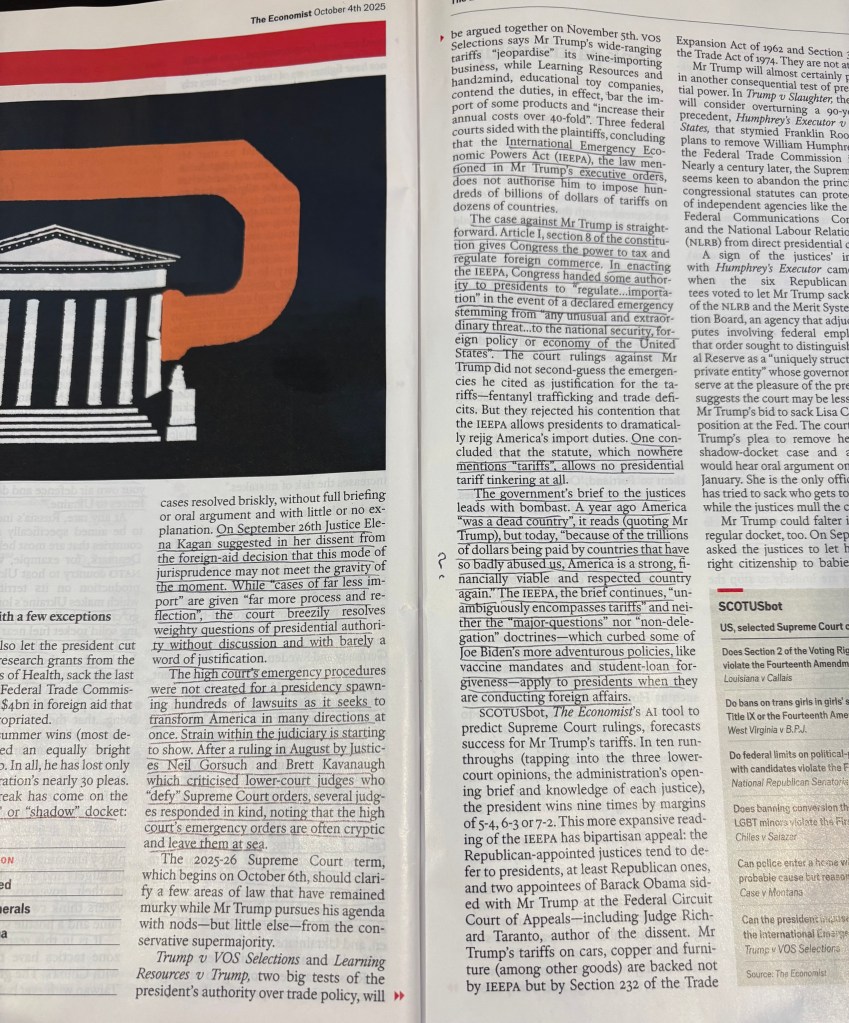
With that background, I dug a little deeper and decided to check how many years of judicial experience our nine Supreme Court justices had prior to their appointments. Here’s what I found:
| Justice | Prior Judicial Experience | Court(s) | Time on Supreme Court (approx.) |
|---|---|---|---|
| Chief Justice John Roberts | 2 years, 3 months5 | U.S. Court of Appeals for the D.C. Circuit | 20+ years |
| Justice Clarence Thomas | 1 year, 7 months6 | U.S. Court of Appeals for the D.C. Circuit | 34 years |
| Justice Samuel Alito | 15 years, 6 months7 | U.S. Court of Appeals for the Third Circuit | 20 years |
| Justice Sonia Sotomayor | 6 months (U.S. District Court, S.D.N.Y.) + 10 years, 10 months (U.S. Court of Appeals, Second Circuit)8 | District & Appeals Courts | 16+ years |
| Justice Elena Kagan | None9 | — | 15+ years |
| Justice Neil Gorsuch | 10 years, 8 months10 | U.S. Court of Appeals for the Tenth Circuit | 8+ years |
| Justice Brett Kavanaugh | 12 years, 5 months11 | U.S. Court of Appeals for the D.C. Circuit | 7 years |
| Justice Amy Coney Barrett | 2 years, 11 months12 | U.S. Court of Appeals for the Seventh Circuit | 4 years |
| Justice Ketanji Brown Jackson | 8 years, 4 months (U.S. District Court, D.D.C.) + 1 year (U.S. Court of Appeals, D.C. Circuit)13 | District & Appeals Courts | 3 years |
All the justices were appointed between the ages of 43 and 55. I’m not a lawyer or a judicial expert, and of course, age is probably not the issue. But it would be nice if presidents selected nominees with 10 or more years of judicial experience before appointing them to the Supreme Court. You know, someone with experience. But since these appointments are political, I probably shouldn’t expect too much from the process.
With the lack of prior judicial experience among some justices, combined with lifetime appointments to such an important and independent branch of government, should the Constitution be amended to add some experience requirements, or perhaps term limits? After all, they are making important decisions that impact our daily lives.
Interestingly enough, Tyranny of the Minority also mentions that Norway, one of the most democratic countries in the world, scored a perfect 100 in Freedom House’s Global Freedom Index (I actually checked today, and Norway’s score is 99; Finland has a perfect score. Sadly, the U.S. scored 8414). Norway’s constitution was adopted in 1814 and was amended 316 times between then and 2014.15
So maybe it’s time to make some amendments, and see if we can improve our score a bit.
References:
- Grube, G.M.A. Plato Republic. (p. 85). Indianapolis: Hackett Publishing Company, Inc., 1992 ↩︎
- https://en.wikipedia.org/wiki/Supreme_Court_of_the_United_States#Composition ↩︎
- https://en.wikipedia.org/wiki/Supreme_Court_of_the_United_States#Nomination,_confirmation,_and_appointment ↩︎
- Levitsky, Steven and Ziblatt, Daniel. Tyranny of the Minority. (p. 159). New York: Crown Publishing Group, 2023 ↩︎
- https://en.wikipedia.org/wiki/John_Roberts ↩︎
- https://en.wikipedia.org/wiki/Clarence_Thomas ↩︎
- https://en.wikipedia.org/wiki/Samuel_Alito ↩︎
- https://en.wikipedia.org/wiki/Sonia_Sotomayor ↩︎
- https://en.wikipedia.org/wiki/Elena_Kagan ↩︎
- https://en.wikipedia.org/wiki/Neil_Gorsuch ↩︎
- https://en.wikipedia.org/wiki/Brett_Kavanaugh ↩︎
- https://en.wikipedia.org/wiki/Amy_Coney_Barrett ↩︎
- https://en.wikipedia.org/wiki/Ketanji_Brown_Jackson ↩︎
- https://freedomhouse.org/country/scores ↩︎
- Levitsky, Steven and Ziblatt, Daniel. Tyranny of the Minority. (p. 202). New York: Crown Publishing Group, 2023 ↩︎
Note: Freedom House rates people’s access to political rights and civil liberties in 208 countries and territories through its annual Freedom in the World report.
 Thoughts about leadership, history, and more
what does it say about our society that we often prioritize youth over experience in judges? 🤔
LikeLiked by 1 person
Great question. They just want judges who can stay on the bench for a long time and support the agenda of the president who appointed them.
LikeLike
Excellent article, as usual, Edward. Who’d have thought I’d be wishing for the “good ol’ days” of short lifespans. In select cases. Some much shorter than others.
LikeLiked by 1 person
Right? Thank you so much, Natalie.
LikeLike
Great blog
LikeLiked by 1 person
Thank you.
LikeLike
Even in the happiness index, the Norwegians scored highest in the world and my wife was surprised that USA was not top of the list.
Thank you Edward for sharing and God bless you abundantly.
LikeLiked by 1 person
They are happier, indeed. You’re welcome, and God bless you.
LikeLiked by 1 person
Great post. As a foreigner, I can only watch what is happening in the US with dismay. I particularly wonder how a handful of individuals can willingly destroy the balance of power in America. I call that accessory during the fact…
Thanks Edward.
LikeLiked by 1 person
You’re very welcome, and thank you for your comment. The problem I have is that millions of people voted for that disruption to occur. That’s my main concern: the people who think that what’s going on in this country is right. Scary!
LikeLiked by 1 person
I understand your point perfectly. Not only millions of people have voted for that, but still millions believe that the “right thing” is being done… They don’t see that they’re next “in line”. As many others, I have posted about today’s version of Pastor Niemöller’s “First they came”.
I am afraid it is hard to fight “stupidity” with plain “Reason”. Still, one has to keep fighting…
LikeLiked by 1 person
You are absolutely right about that. We must keep trying until the end.
LikeLiked by 1 person
📎📎📎📎📎
LikeLiked by 1 person
It broke my heart when our government changed to the way it is now, the one in charge, the senate, the house and the supreme court. None of it is right nor just. Great article Edward.
LikeLiked by 1 person
Thank you very much, Melissa. We are definitely going through a tough time, but I’m sure that things will get better. We have been through worse.
LikeLiked by 1 person
I don’t know a lot about the US Supreme Court but change is always good and life appointments are generally not good.
LikeLiked by 1 person
Indeed. Thank you, Robbie.
LikeLiked by 1 person
Edward, thanks for this interesting and informative post.
LikeLiked by 1 person
You’re very welcome, Rosaliene. Thank you for reading.
LikeLiked by 1 person
Wow, Edward. I had no idea about the experience (or lack thereof) of our justices. And the change in number of average number of years on the Supreme Court bench. You’re right – we need to make some changes. Thank you for such a thought-provoking and informative post, my friend!
LikeLiked by 1 person
You’re welcome, my friend. One of them has been there for almost 34 years, that’s insane and, in my opinion, creates bias. I hope people will see that at some point and demand that Congress change it.
LikeLiked by 1 person
Artfully conveyed
LikeLiked by 1 person
Thank you.
LikeLike
Thanks for your excellent chart and analysis. I agree that 10 years of judging experience and age limits should be amendments to the constitution. That would benefit all of the people in the US.
LikeLiked by 2 people
Hopefully, we get it done one day, that, and term limits for Congress. Some people in Congress are out of touch. Thank you, my friend.
LikeLiked by 1 person
Very good post on our Supreme Court justices, Edward. Count me in with you and everyone else who wants better requirements, term limits, and to create amendments that improve our system.
LikeLiked by 2 people
Thank you, Rose, and I’m sure there are millions of people who want the same.
LikeLiked by 1 person
Are our lives now reduced to a political agenda and that’s it? Just asking.
LikeLiked by 1 person
It seems like, and it’s crazy if you ask me. I know we can do better as society.
LikeLike
This is interesting to say the least, Ed. My thoughts are that many of the justices appointed are for Trump’s future benefit, and ten years of judicial experience should be required, and there should be term limits. Thank you for sharing this information.
On Tue, Oct 14, 2025 at 1:41 PM Thoughts about leadership, history, and
LikeLiked by 2 people
Thank you, Sandra. I’m sure there are plenty of strong, independent judges out there doing great work who are more qualified than some on the current court, but sadly, it’s all about politics.
LikeLiked by 1 person
Thanks for you like of my post, “Isaiah Chapters 46;” you are very kind.
LikeLiked by 1 person
You’re welcome. 🙏🏼
LikeLiked by 1 person
Thank you
LikeLiked by 1 person
👍🏻
LikeLiked by 1 person
Experience is definitely an essential aspect allowing a better performance. This is true for any activity and should be paramount in delicate areas such as justice. A very in-depth post, touching the fragilities of the system, Edward! I always appreciate your clear vision on the structural aspects of our society. Well done, my friend! Lots of light and blessings your way 🙏✨
LikeLiked by 2 people
Absolutely! It’s incredible that political fanaticism gets in the way of selecting the best candidates based on experience rather than political preferences, especially for those in charge of guarding our constitutional rights. Thank you for reading and commenting. Blessings, my friend. 🙏🏼
LikeLiked by 1 person
FYI, Canada has a mandatory retirement age of 75 for its Supreme Court justices, as it does for its Senators (the body of which is quite different from the U.S. Senate).
LikeLiked by 2 people
Thank you, Jane. I wish we had that here in the U.S.
LikeLiked by 1 person
As long as Trump is president, the only thing that will happen is whatever he wants. As he said today, Republican programs will stay and Democratic will be eliminated.
LikeLiked by 2 people
Yeah… what I’m afraid of is that there’s so much hate building up that, in the future, the tables are going to turn, and Democratic politicians will be persecuting Republicans, and the cycle will continue. I just hope this craziness ends at some point and we can get back to a more balanced approach.
LikeLiked by 1 person
Excellent post and research!
LikeLiked by 2 people
Thank you. I learned a few things in the process, which is always a good thing.
LikeLiked by 1 person
You did well to make your case. The only issue I might quibble with is the absence of injustice in some wise souls. I have met many very good people and doubt that anyone on the planet can say such a thing about himself with certainty. If you find such a one, call me!
Your point on term limits and the need for more amendments to the constitution are very well taken. Thank you.
LikeLiked by 2 people
Injustice was part of the dialogue regarding judges in Plato’s Republic. I’m in the middle of that dialogue, and it’s very interesting so far. It’s probably impossible to find a perfect judge, but our Justices can do better. I’ll definitely call you when I find one, but I’m afraid they’re all in heaven now. 😀
LikeLike
The pandering of the current Supreme Court to Trump—beginning with giving him immunity from prosecution for criminal acts committed in carrying out of his presidential duties—feels like a personal betrayal.
LikeLiked by 1 person
Their bias is on full display, and they are probably a little scared about getting impeached. Some of them are borderline with the gifts they are receiving. So the majority there is trying to keep the administration happy instead of doing the right thing. Thank you, Liz.
LikeLiked by 1 person
You’re welcome, Edward. The MAGA 6 certainly deserve being impeached.
LikeLiked by 1 person
That’s the first time I’ve heard that term used about the Justices. Interesting!
LikeLiked by 1 person
I got “Maga Six” from Ron Popok’s Legal AF commentary on Substack.
LikeLiked by 1 person
I might need to check that out.
LikeLiked by 1 person
What I particularly like about his Substack site is that he posts supporting evidence.
LikeLiked by 1 person
That’s a very good thing, especially with all the misinformation out there.
LikeLiked by 1 person
Nice post! The Supreme Court was never meant to be as powerful.as it is. And yes there needs to be mandatory retirement ages for Justices.
LikeLiked by 2 people
Thank you. I was doing some additional reading, and you are right, they never were meant to be that powerful. The news article discusses the emergency docket, how Justices are ruling with little to no explanation, and why lower courts are sometimes challenging them. It’s ridiculous, and a lifetime appointment makes no sense.
LikeLike
Well researched Edward. Like you, I’d like to see experience requirements and term limits, but unfortunately appointments have become very political and seemingly biased. And we need term limits for the Senate and Congress too, and most importantly, to get the big money out of politics.
LikeLiked by 3 people
I agree with you, and since Congress is not going to set term limits for themselves or the Supreme Court, it’s up to us to keep pushing our politicians to get it done. I’m sure the majority of Americans want to put term limits in place, but big money, as you said, is making it impossible.
LikeLiked by 2 people
Exactly!
LikeLiked by 1 person