As I was preparing this post, I considered writing it in two parts: a book review and my commentaries. However, since this is a blog and I appreciate the flexibility it provides, I decided to write a single post that includes some commentary, personal reflections, and concludes with the book review. In my head, it made sense and felt logical, so I hope you find both the post and the book review helpful.
When I began my Army career, I was taught that to be a successful officer and lead soldiers in combat, I needed to read military history and learn everything I could about past wars and battles. This was essential to becoming a well-rounded leader. So, I spent over 24 years doing just that—learning from the great leaders of the past.
As many of you know, I grew up without a father or any strong male role models until I joined the Army. This great U.S. military institution shaped me into the person I am today. Because I didn’t have a father in my life, I made a commitment that when the time came for me to become a father, I would give it my all.
Sixteen years ago, I was blessed with the incredible gift of fatherhood, and just as the Army had taught me, I knew I needed to learn everything I could about being a father. Fatherhood is a tremendous responsibility—one that should never be taken lightly.
I read many books about what to expect in those first months and years. I read What to Expect When Your Wife Is Expanding—I know, a silly title, but it was actually a pretty good book—and What to Expect When You’re Expecting, just to understand the experience from a mother’s perspective. But I didn’t stop there. I read many other books and articles to prepare myself for the future, covering topics such as finances, education, emotional intelligence, counseling, and guiding a son through different developmental stages. I even read about having the “sex talk” and the rite of passage marking the transition from boyhood to manhood—something I believe is extremely important for both boys and girls.
I have also read about family trauma, both to work through my own experiences and to learn how to avoid it as I started my own family. The list of books I’ve read over the years is long, so I won’t mention them all here. However, the one I just read and want to discuss is Surviving Sue by Dr. Victoria (Vicki) Atkinson.
I believe this book should be required reading for all new parents. It’s a book to read slowly, highlighting passages, taking notes, and reflecting on the life experiences Vicki shares—both from her childhood and her adult years. There is much to learn from her grandparents, parents, siblings, and extended family.
As you read her story, you may find yourself transported to your own past experiences, recognizing similarities and reflecting on them. At least, that was my experience, and I believe many readers will have a similar response if they allow themselves to. Some of Vicki’s stories took me back 20, 30, even 40 years, reminding me of my own life and the things I witnessed—and continue to witness—within my own family.
I wanted to read Vicki’s book not only to understand her journey but also to learn how she cared for her mother, who suffered from Alzheimer’s. I once mentioned to her that my own mother has Parkinson’s. Though these are different diseases, there is still much I can learn from Vicki’s experiences regarding accommodations and caregiving when an illness begins to take away daily functions and full-time care becomes necessary.
Of course, I learned much more than that, and I’m grateful I followed my gut and read the book. That said, you must be open to letting the book teach you these lessons.
Now, let’s turn to the actual book review.
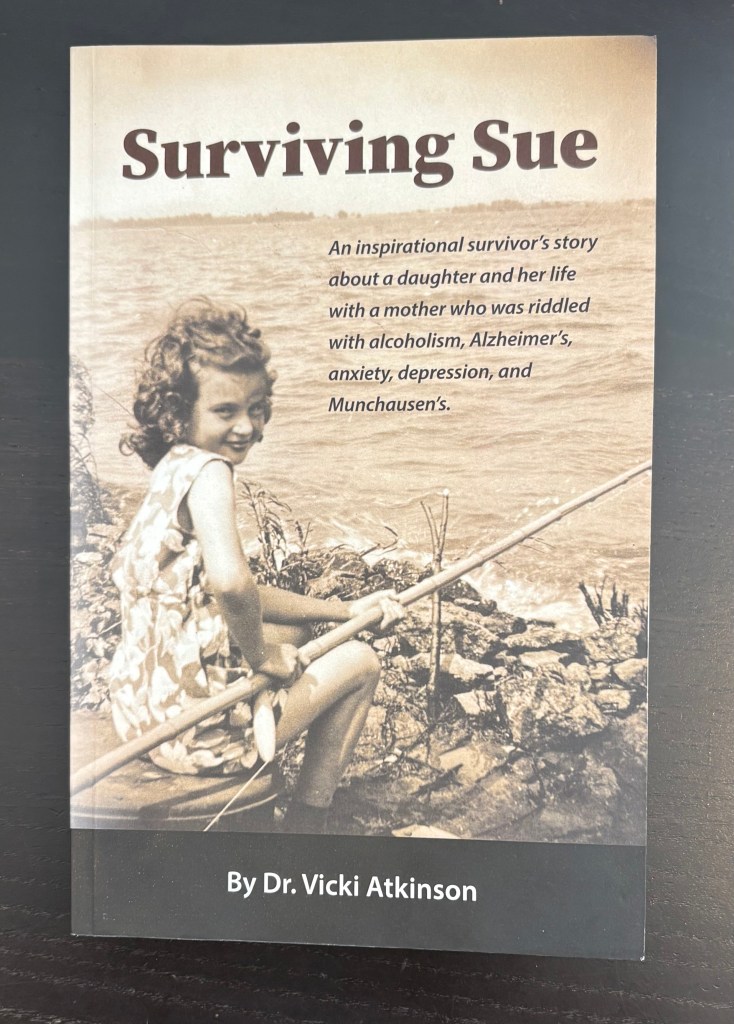
The book is a memoir, and its front cover effectively describes its content: “An inspirational survivor’s story about a daughter and her life with a mother who was riddled with alcoholism, Alzheimer’s, anxiety, depression, and Munchausen’s.”
The book is divided into five parts, covering Sue’s family background, Vicki’s formative years, her marriage to Paul, the birth of her daughter, her support for Lisa and Sue, and Sue’s final days. Vicki beautifully captures the ups and downs of her life in an engaging and educational way.
Vicki’s book is not just a narration of her life, the challenges she faced, and how she overcame them—it is also highly educational. Readers will not only learn how she endured years of emotional hardship and supported both Lisa and Sue but also how family and external influences shape our lives. A careful and reflective reading of Vicki’s book can teach us how to break the cycle of intergenerational abuse. It offers insight into what to do—and what not to do—as a grandmother, mother, daughter, sister, aunt, or uncle—lessons you won’t necessarily learn in a classroom or even from your own family.
The book contains some heartbreaking stories—many of which moved me to tears. But through these painful stories, a thoughtful reader can also find opportunities for self-improvement: how to speak to children in a supportive way, how to celebrate their small victories, how to confront personal addictions before they take control and harm others, and what knowledge is needed to support a mother, sibling, aunt, uncle, or child on a path of self-destruction.
These are difficult topics, and many people prefer to avoid thinking about them. Most of us hope for a perfect life, free from the hardships Vicki describes. But I believe we must be proactive, learning how to navigate these challenges to avoid—or at least minimize—the pain that Vicki, myself, and many others have endured while growing up in dysfunctional families.
I’m going to highlight parts of the book that caught my attention and led me to deep reflection. While I have left out many emotionally heavy passages that I highlighted and took notes on, I have included a few that I chose to paraphrase.
Part I (1938–1984: My Mom, Sue) This section covers the early years of Arnola Sue, a name chosen by her father out of disappointment that she was not born a boy, turning Arnold into Arnola. Sue adopted her middle name and lived as Sue. This section also introduces her siblings: Louisa, Carolyn, and Keith.
When Sue’s father died, ten-year-old Sue had to take on a significant role because her grieving mother, “Nanny,” was unable to function fully as a single parent. The church provided support but also imposed severe expectations, which Sue described as “Bible-beating.”
Sue married young, divorced, and later married Vicki’s father, Sonny, but continued to struggle with pain and suffering that ultimately affected Lisa and Vicki.
Highlights from Part I:
- “When her father passed, Sue became the responsible family member because my grandmother embraced the role of ‘grieving widow.’ She did little but grieve and lament her circumstances.” (p. 4)
- “Sue learned to make the most of donated food from neighbors and the congregation, but Nanny’s incapacitating grief was never-ending and she retreated from the world, including her children.” (p. 5)
- “For Sue, the most shameful bits were the rumors about her drinking and drug use…” (p. 6)
Vicki describes the cruelty behind Sue’s decision to have Vicki on her birthday (pp. 13–14), an incident of physical abuse (pp. 15–16), and Sue’s reaction to Vicki’s IQ testing (p. 20). However, she also acknowledges Sue’s positive impact, such as advocating for disabled children (p. 25).
Throughout the book, Vicki balances humor with pain, as seen in her reaction to Sue’s cooking: “What’s the Campbell’s soup slogan? Mmm Mmm Good? Mmm Mmm Nope!” (p. 41).
Another grateful comment by Vicki toward Sue: “Despite the hardships with Sue, I admired her strengths. Her capacity for empathy and her powerful social justice heart were highly interwoven with her madness.” (p. 47)
The family dynamics between Sue and her sisters were complex and often volatile. “Laughter…crying…anger…shit flying. The four stages. Sometimes we’d see a fifth stage – the disowning with quick departures, swearing, and months of cooling off afterward until someone apologized.” (p. 60)
Vicki details the life and tragedy of Michael, Lisa’s workshop friend, on pages 83 through 87. Due to Michael’s mental disabilities, he was subjected to illegal human testing. Vicki unfolds a series of heartbreaking details about Michael before quoting him: “My mom gave me up because I was broken and not like the others, but I’m okay now. When I was little, the testing was painful, but I don’t remember all of it. I just have the scars.” (p. 85) This was a deeply emotional and gut-wrenching revelation.
Part II (1984–1997: Let’s Go to California) covers the time Sue, Sonny, and Lisa spent in California while Vicki, already married, remained in Chicago. It describes Sue and Sonny’s volunteer work with the Special Olympics, Sue’s continued struggles with alcohol and mental instability, including a hospital stay, and the birth of Vicki’s daughter, Delaney.
Highlights from Part II:
- “She was an alcoholic. It was the first time and only time Sonny used the word to describe Sue.” (p. 98)
- A tense interaction between Sue and Vicki following Sue’s hospital release, culminating in Vicki’s breaking point: “In some ways, it was the end. Sue made it clear how she felt about me, and whether it was her detox talking or the pile-up of decades of frustration, I’d had enough, too.” (p. 102)
- “To Louisa, Sue was a beer-drinking, dirty joke-telling fraud… Carolyn saw it, too, but was willing to ignore ‘bad Sue’ for the greater good of keeping the peace.” (p. 107)
- “Sue – predictably – hated my choice of professions, and the more education I earned, the more intimidated she was.” (p. 111)
- “As I moved closer to completing my degree, I was convinced Sue was suffering from a combination platter of alcoholism, anxiety, depression, and Munchausen’s. She self-medicated her way through pain – throughout her life – and her chief coping mechanisms in the face of daily confrontations drove her to redraft her own identity with Miller Lite leading the way.” (pp. 112-113)
Part III (1997–2012: The Beginning of the End) covers the death of Vicki’s father and the return of Sue and Lisa to Chicago.
Highlights from Part III:
- After Sonny’s funeral, Vicki recounts a touching yet chaotic moment between Sue and Delaney: “Sue had a gift for connecting with children – or anyone in need – in a fun-loving, gregarious manner… While that may be a trait common to loving grandparents worldwide, Sue’s unique brand of crazy often left Delaney stunned and amazed.” (p. 138)
- Vicki uses short vignettes modeled after I Love Lucy episodes to illustrate Sue’s erratic behavior. These episodes include Sue falling in front of Vicki’s house on Easter, an incident at a bank, and an unforgettable moment when Sue won an Escalade while waiting at the dealership for her car, which was in the shop. On live TV, she declared, “Get the f*ck out of my face. Why would I want a goddamn tank? I don’t want that house on wheels. I just want to get my car and go.” These humorous yet telling anecdotes foreshadow Sue’s dementia diagnosis. (p. 153-169)
Part IV (2012–2014: The Slide) details Sue’s decline due to Alzheimer’s and Lisa’s transition to a community home and supported independent living.
Highlights from Part IV:
- Vicki discovers Sue’s attempt to reverse co-guardianship of Lisa, which is swiftly shut down by Deanna, Sue’s legal counsel. (p. 185)
- A violent verbal and physical altercation between Sue, Vicki, and Delaney while Vicki is driving. (p. 197)
- A discussion between Sue and her psychiatrist: “Yes, Sue, you are experiencing the early onset of dementia, and you’re on the road to an Alzheimer’s diagnosis. We may be able to slow the progression with some new medications, but Sue, you can’t manage your medications any longer. It’s too risky. We’ll discuss options. A visiting nurse is a great idea; maybe Vicki can assist with weekly refills and sorting…And while we’re on the topic, Lisa’s medications are a concern…I’m also worried about the other challenges you face, including anxiety and alcoholism…I’m aware that your preoccupation with Lisa’s health points to a condition we once called ‘Munchausen’s by Proxy,’ but now it’s referred to as FDIA (Factitious Disorder Imposed on Another)—basically, it’s about being overly involved with someone else’s health.” (pp. 206-207)
- A discussion with Lisa while preparing her move to a new home: “Lisa motioned me toward the bathroom and closed the door. ‘I already know what I want. I hate all those flower tops and fussy sweaters Mom makes me wear. Can I just take my stretchy jeans and my sweatshirts? You know, my Cubs and Reds t-shirts and sweatshirts? They remind me of Dad and make me happy.'” (p. 217)
Part V (2014–2015: Solo Moves for Sue) captures Sue’s transition to assisted living and her final days.
Highlights from Part V:
- A shocking moment of memory loss: “A lady in a white Cadillac stopped by the station to ask how to get to Crestview Drive in your community… Sue misjudged the landscaping and rolled over a decorative boulder, right in front of the gate house. Stu was the guard on duty and he watched as Sue tried to continue forward – at first – and then put the car in reverse to maneuver the big car off the rock. Stu explained to me, ‘I didn’t believe what I was seeing, Vicki. And then, Sue pulled up to the gatehouse and said, ‘Oh, hey Stu,’ like nothing happened. I asked if she was okay and she said, ‘Sure, how are you?’ and with that, she proceeded through the gate.’” (p. 224-225)
- Sue’s volatile behavior leads to hospitalization in a geriatric psychiatric unit for five weeks. “Her rage was unrelenting as the doctors continued to evaluate her condition and address the violent outbursts.” (p. 273)
- “Thankfully, after almost two months in the hospital, Sue was on the road again—this time to her new home at Goldenrod. As Charlotte walked Sue in, a paramedic followed behind. I knew it was Sue but wondered if she recognized me. She had a massive smile on her face when she saw Paul, exclaiming, ‘Oh, hi, I’m so glad you’re here!’ When she looked at me, she paused, and I waited for her to call me Carolyn, but instead, she just began to cry and said, ‘Oh, Vicki, too. I’ve missed you so much. Where is Lisa?’ The mix of pain and hopefulness in her eyes levels me. Sue was there, but part of her was gone.” (p. 280)
- The final days, including hospice care and a profoundly moving farewell from Lisa. (p. 282-289)
Reading Surviving Sue was an emotional journey that left a deep impact on me. Vicki’s memoir is wonderful, and it showcases her tremendous character, resilience, and love. I wholeheartedly recommend this book.
I recently read in The Economist that a great memoir should be “intimate, genuine, and revelatory.” Dr. Vicki Atkinson has achieved exactly that with Surviving Sue.
 Thoughts about leadership, history, and more
Loved how you pointed out the emotional depth of the story. Makes me want to read it even more!”
LikeLiked by 1 person
Thank you so much. I think you will enjoy her powerful story.
LikeLike
I love how you write such a detailed review! I have a long list of books to read (always), but I do get through them eventually, I will add yours to my list!
LikeLiked by 2 people
Thank you, Melissa. Mine is pretty long too, and I just added four more yesterday. There are so many good books and so little time.
LikeLiked by 1 person
A great review and excellent book. Thought your synopsis was spot-on!
LikeLiked by 2 people
Thank you very much, Brian.
LikeLiked by 2 people
Thank you so much, Brian. 🥰
LikeLiked by 1 person
What a beautiful and detailed review of Vicki’s incredible book, Edward. I felt her love, compassion, and patience in each page, even though it was a difficult book for her to write. It’s wonderful to see these well-deserved reviews coming in for her. Thank you for sharing!
LikeLiked by 2 people
You’re very welcome, Lauren, and thank you for reading and for your comments. I agree, it must have been very difficult to write. It takes time to get “stuff” out of our hearts, into our private journals, and then into the public. There is definitely a healing element in that.
LikeLiked by 2 people
Love this exchange between you and Lauren, Edward! Love and compassion and yes – it takes time to find the words, but healing is possible. Thank you both so much. 🥰
LikeLiked by 1 person
You’re very welcome, my friend. 🫶🏼
LikeLiked by 1 person
A thorough review of Vicki’s book and a moving post. I was also deeply affected by Vicki’s book — by her resilience and by her ability to look back at difficult times in her life and talk about them with heart and humor.
LikeLiked by 2 people
Thank you very much, Dave. After reading her story and learning how she dealt with difficulties, I had to rethink my own ways because it takes a special person to do what she did, and I’m not sure I’m there yet.
LikeLiked by 2 people
How perfectly put – that was my goal! Addressing the pain points but leaning into heart and humor. Thank you for that, Dave. 💕
LikeLiked by 2 people
Such a thoughtful and inspiring review of Vicki’s book. Sharing your personal insights was moving and deeply poignant. Thank you for sharing!
I have read Vicki’s incredible story of survival and triumph. Truly a powerful story.
LikeLiked by 2 people
Thank you so much for reading and commenting; her story is very powerful, indeed.
LikeLiked by 1 person
So grateful to you, Alegria, for all of the support and enthusiasm for “Surviving Sue”. You inspire…and I’m glad to know you! 💕
LikeLiked by 2 people
I feel the same about you my friend. 💕
LikeLiked by 2 people
You did an exemplary job on Vickis book and breaking it down into bit size pieces that brought life to what she went through, Surviving Sue. Thank you so much for sharing how much it touched you and the sense you made of it. What an intense story and incredible book, sharing her vulnerabilities and survival. Wonderful review and book that I applaud Vicki for writing and you for sharing, Edward! 💓
LikeLiked by 2 people
Thank you so much, Cindy. I was chatting with Liz Gauffreau about how courageous Vicki was in sharing her story. I learned a lot from it, and I’m sure many others will benefit as well.
LikeLiked by 2 people
You’re so welcome and that is where wonderful, honest compelling books come from. It’s obvious how much it touched you! 💗
LikeLiked by 1 person
Thank you for the thorough and engaging presentation of Vicki’s book and for sharing more of your personal experience in your post’s introduction. Well done, Edward. Seems a helpful resource and insightful story, wherever someone might be in their life journey. Will add to my list.
Your mention of What to Expect When You’re Expecting brought back memories for me. I wore that book out! The first edition when I bought it. 😊
LikeLiked by 2 people
You’re welcome, and thank you so much for your comments, Michele. Yes, we did the same, and we gave the books to a young couple that was expecting. I’m sure they wore out the books too.
LikeLiked by 1 person
Just did a quick search… there are so many different titles of that book now! My “original” might be a collector’s item. 😃 It served me well and taught me a lot. You’re welcome!
LikeLiked by 1 person
Oh, wow, yeah. I just checked, and they have a 2024 edition. Yours is definitely a collector’s edition. With 4.8 stars and over 29,000 ratings, yes, it’s an outstanding book. I also saw this title: “You Will Rock as a Dad!: The Expert Guide to First-Time Pregnancy and Everything New Fathers Need to Know.” I bet is a good book.
LikeLiked by 1 person
Examining generational trauma to heal and grow. Congratulations on this frank and helpful memoir, Vicki! Thanks for the review, Edward.
LikeLiked by 2 people
You’re very welcome, my friend.
LikeLiked by 1 person
Thank you so much, Rebecca! And cheers to Edward. Yes! 🥰
LikeLiked by 2 people
Thank you for this in-depth discussion of what looks to be an important book. Congratulations to Vicki for having the courage to write it.
LikeLiked by 2 people
You’re very welcome, Liz. I completely agree. She’s a very courageous woman. Thank you for reading and commenting.
LikeLiked by 2 people
You’re welcome, Edward.
LikeLiked by 1 person
Cool
LikeLiked by 1 person
Thank you.
LikeLike
An in-depth book review and amazing post, Edward! So interesting to see how one’s unpleasant and traumatic experiences may help frame life and even foster personal growth. It was your case in what concerned fatherhood, and it was the case of Vicki with Sue. Suffering is never desired but often is the main driver to become a better and wiser person. Your post offers a lot to reflect on… and I can only be grateful for being here and having access to such good and profound content. Thank you, my friend! Wishing you a beautiful day and sending you lots of light and blessings*
LikeLiked by 3 people
Thank you so much for your comments, Susana. You are so right—it’s kind of bittersweet in a sense. It’s important to take those traumatic events and the suffering that accompanied them and use them as a motivator, not only to get out of the situation but also to improve ourselves. Blessings, my friend, and thank you for your words of wisdom, which are always so welcome.
LikeLiked by 2 people
What a beautifully detailed review, Edward. I’m glad you described your background first, because that made your take on Surviving Sue, all the more touching and impactful.
LikeLiked by 2 people
Thank you so much, Sheila. 🙏🏼
LikeLiked by 1 person
Edward, terrific review and insights. I liked the segue into the review that drew on your own experiences, and the breakdown and discussion of the various periods. I’m so intrigued I’ve added this to my TBR list. Great post 😎👏
LikeLiked by 2 people
Thank you very much, Darryl. I always try to share how a book personally connects with me. I’m happy to hear that you enjoyed the post and the review.
LikeLiked by 1 person
Wow, this is deep review and very eloquently written, Edward. It sounds this book was extremely impactful on you and transporting you back to your own memories even, very inspiring. I will have to take a close look at this one. Thank you for sharing this detailed review 🙏 it sounds like an amazing read! 😊 ☕️ ☕️
LikeLiked by 2 people
Thank you, Laura, and it really was an amazing read. Books like this one are very helpful when you are going through a similar situation or about to.
LikeLiked by 1 person
To care for children, new parents and grandparents should read books. I am now a grandfather. My wife and I are both learning new things about how to take care of our grandchildren.
LikeLiked by 1 person
Absolutely! Taking care of family is a lifelong learning experience. Society is continually changing, and we need to keep learning and adapting for the good of our loved ones. Thank you for reading and commenting. 🙏🏼
LikeLiked by 1 person
You may have convinced me to read Vicki’s book, Edward. I was considering it because Vicki seems like an absolutely amazing person, but I was concerned that reading another difficult life story may be more than I’m prepared for. Since you’ve included that “it is also highly educational”, I may give it a try. It’s critical to have educational information when dealing with these types of situations. People who go through difficult times need understanding and more importantly, solutions.
In 2001, I attended an event with speaker Dave Pelzer, author of “A Child Called “It””. He gave an inspirational speech about how he survived one of the most horrific cases of child abuse. In a 2001 news article, Orion UK Publishing’s Trevor Dolby said, “We get 10 letters a day from people saying the first book mirrors their own childhood, which is very depressing.”
Family dysfunction happens at a much higher rate than society will ever comprehend. Speaking from my own experiences, and later in life at my job as a School Crisis Interventionist working with 1600 students and staff in several schools in critical crisis situations. It was infuriating when the community couldn’t see how many children were suffering, and because of privacy, I couldn’t just tell them how dire things were. Yet leaders often complained about “that family” and “those people”, while refusing to lend a hand to help them.
Thank you so much for sharing your story, and Vicki’s story. I feel so grateful and blessed to be in contact with both of you amazing people!
LikeLiked by 3 people
Thank you so much, Rose. I think Vicki’s professional background helped frame the book. Also, the inclusion of other professionals who assisted Vicki in working through the issues with Sue and supporting Lisa was very illuminating. For me, looking at the whole story and recognizing when family members and friends should have helped Sue’s family was incredibly insightful. Sometimes we see things in our own families but don’t feel equipped to step in and help. The book helped me recognize those moments, and in my mind, I was formulating a dialogue about how I could help if I were to witness similar situations.
I know that I was able to help my mom escape an abusive situation almost 25 years ago when I confronted her ex-husband. But it took me some time to process everything and prepare myself mentally to go all in if he decided to push back and ignore my warning. Some things are not easy to do, but you have to do them anyway.
LikeLiked by 1 person
Kudos for wanting to learn, grow, and break the cycles Edward. The book sounds very helpful and intense. I read many personal growth books in my 30s and 40s, but have decided to focus more on acceptance at this point in my life.
LikeLiked by 2 people
Thank you, Brad. I think I’m getting to that point as well, but I’m reading Bittersweet: How Sorrow and Longing Make Us Whole by Susan Cain, and the “longing” aspect is very interesting. It’s something I want to explore because I’m definitely longing for something, and I hope I can find it soon so I can bring more balance to my life.
LikeLiked by 1 person
Best wishes with satisfying that longing. I never found it.
LikeLiked by 1 person
Thank you! I’ll keep pursuing since I still have a little time left on this earth. 🤞🏼 You’re still young, so maybe you should keep searching, my friend.
LikeLiked by 1 person
I don’t know if 66 is young, but thanks for the encouragement Edward.
LikeLiked by 1 person
Well, remember that we had—and still have—80-year-old guys trying to run this country. So, 66 sounds pretty young to me, and you still have plenty of time to run for president. 😆
LikeLiked by 1 person
LOL
LikeLiked by 1 person
Edward, I didn’t write a comment right away after reading your excellent review because I needed time to absorb everything you mentioned. I have read Vicki’s book and can attest to everything you say. But I didn’t know any of what you shared about your own upbringing, or at least only a very small amount. I think of both you and Vicki, and how kind and considered you both are, how responsible you both are about how others are treated and also how you both challenge yourselves to be well-informed, to keep learning and growing as individuals. Now I think about how you both had diffcult upbringings (and for Vicki at least that is putting it mildly), and I marvel at how neither of you have let your difficult upbringings keep you from somehow taking positive lessons from those experiences and becoming exemplars for how to be good, kind, productive people with meaningful lives. I had no such challenges, only love and support from my parents; I stand in awe of you both. Bravo, Edward.
LikeLiked by 3 people
Thank you so much for your wonderful comments, Jane. You have touched on something that I have been struggling to understand for a couple of decades now: How can intergenerational trauma be disrupted? Maybe we were lucky to have received a chance to see the world and our circumstances differently, and we took on the responsibility to change our family tree just a little. I know in my family, one of my cousins received that gift, and his life is following a wonderful path. Not knowing Vicki’s daughter except for what Vicki has shared about her over time, it seems to me that Vicki changed her family tree as well, and Delaney has an opportunity to continue the beautiful work that her mom started decades ago.
LikeLiked by 1 person
You are a shining example that with resolve, belief in goodness in the world, and perseverance, the negative cycle can be broken. So sad that it has to be that way. When you speak of intergenerational trauma, that is precisely what has affected countless Indigenous families in Canada as a result of the egregious residential schools. It takes a long, long time to overcome having little sense of self-identity or self-worth , or to know how to parent well when you haven’t experienced it yourself.
LikeLiked by 1 person
That’s a tough one, Jane. What the Indigenous families are experiencing in Canada and the U.S. is extremely difficult. It definitely takes a long time to work through.
LikeLiked by 1 person
This is an outstanding review, Edward. You bring us into the world of Sue and give a powerful endorsement of Vicki’s book.
LikeLiked by 2 people
Thank you, Mary. It’s a very engaging story, and I was sucked in from the beginning.
LikeLiked by 1 person
Hi Edward, this is a fascinating post with a lot of insights into how you operated and overcame your background and other obstacles on your life’s path. The review was interesting and both Sue and Vicki had very difficult times. It seems like Vicki did better overcoming her issues than Sue did. Lots of food for thought.
LikeLiked by 2 people
Thank you very much, Robbie. You are absolutely right about the overcoming piece—that was a huge learning point for me. Breaking intergenerational issues is very important, and Vicki’s book shines a light on how that is possible.
LikeLiked by 2 people
🙏🦋🩵
LikeLiked by 1 person
What a great and thoughtful review of an incredible book, Edward. I love how you ended with that quote from the Economist about memoirs needing to be “intimate, genuine, and revelatory.” Yes, yes, yes. And I agree about Surviving Sue and Vicki’s character, resilience and love. Great review!
LikeLiked by 2 people
Thank you so much, Wynne. Wow, did I learn a lot from Vicki’s book. It was excellent.
LikeLiked by 1 person
Your post is deeply moving and full of personal insights that are sure to resonate with many readers. The way you’ve shared your reflections on fatherhood and the challenges of caregiving, along with the heart-wrenching and educational lessons from Dr. Atkinson’s book, is incredibly powerful. Your willingness to delve into such vulnerable and emotional experiences is not only brave but serves as an inspiration to others who may be facing similar challenges. Keep sharing your journey with honesty and grace—it’s evident that your words can make a profound impact. Keep going!
LikeLiked by 2 people
Thank you very much, John, for your kind words. I’m glad the post and review were impactful to you. Your comment motivates me to keep growing as a blogger.
LikeLiked by 1 person
🤝👏🌷
LikeLiked by 1 person
Very insightful review. Thank you for making this book sound so inviting.
LikeLiked by 3 people
Thank you so much, Violet. I learned a lot from reading the book, and I wanted to express how impactful it was to me. I’m glad you enjoyed the review.
LikeLiked by 1 person
Thanks for sharing, Edward 🙏. Much appreciated.
LikeLiked by 2 people
Thank you for reading and commenting, Michael.
LikeLiked by 1 person
You’re welcome, Edward.
LikeLiked by 1 person
Edward…Edward…Edward. You honor me with your incredibly kind words and thoughtful, detailed review. I don’t think I have the capacity to express my gratitude in full. Truly. Thank you for reading and for sharing YOUR expansive heart in the process. My hoped-for outcome in writing was the goal of inspiring resilience. Thank you for the generous feedback. So much. 💕
LikeLiked by 5 people
Oh, my friend, you inspired me greatly. As I read your stories and saw how you demonstrated resiliency throughout, I started to think that there is no way I could have managed those situations the way you did. I learned a lot, and you inspired me to be a better son now that I’m going to face some of the challenges you faced with Sue. I’m immensely grateful for the lessons you taught me through your wonderful book, Vicki.
LikeLiked by 3 people
My goodness. You are so very welcome. Sticking together – learning, sharing. Sending hugs your way! 🥰
LikeLiked by 2 people
Hugs received, and I’m sending a big one your way. Thank you, my friend. 🫶🏼
LikeLiked by 2 people
🥰❤️🥰
LikeLiked by 1 person