History is one of those subjects in high school where most students don’t care much about; I, for one, was one of those students. My favorite subjects were math and science, which was one of the reasons why I studied Chemistry in college. However, my perspective on history took a dramatic turn back in 1999 when I became a young second lieutenant in the Army.
Reading lists were (and still are) a crucial part of military officer education, with the Army expecting us to read books from those lists and learn leadership lessons from the great battles of the past. Books like “Once an Eagle” by Anton Myrer, a war novel covering the period from World War I through the Vietnam War, “Company Commander” by Charles B. MacDonald, a memoir of a Captain during World War II, and “We Were Soldiers Once … and Young” by LTG Harold Moore and Joseph Galloway, narrating the creation of the Air Cavalry and the battle of Ia Drang during the Vietnam War, were on that list. We read them carefully, taking copious notes as if our lives depended on it.
Many years later, my passion for history continues to grow. It is a fascinating subject that captivates me. Recently, while reading articles about the history of Puerto Rico, the subject of El Morro caught my attention. You can’t discuss the history of our island without highlighting the importance of this fortification as part of the Spanish colonial defenses.
Although I’ve always known this fort as the Castillo San Felipe del Morro, I sometimes forget that this significant place in Puerto Rico is also known as Fort Brooke.
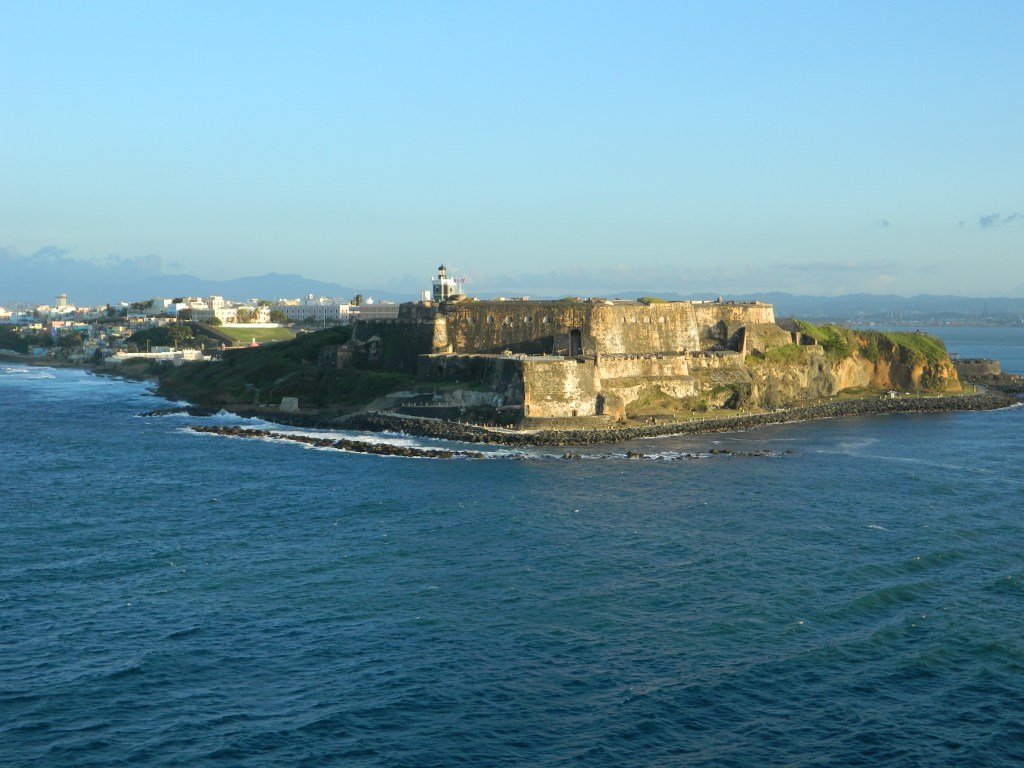
Here’s a brief history of El Morro:
- Construction began around 15391 and was completed on or about 17712. It was used for coastal defense by Spain until 1898.
- The site was acquired by the United States as part of the Treaty of Paris on December 10, 1898, as a result of the Spanish-American War.3
- El Morro and adjacent sites were named Fort Brooke and were used by the U.S. Army from 1903 to 1945 as a coastal artillery location, base, and small arms range. The small arms range was located near the Santa Barbara Battery during WW II.4
- Between World War II and 1978, the land was turned over to the National Park Service.5
- In 1983, it was designated as a World Heritage landmark by the United Nations Educational, Scientific, and Cultural Organization (UNESCO).6
El Morro is now a national park and a key tourist destination visited by thousands. Director Steven Spielberg used El Morro during the filming of “Amistad” in 1997.78
I recognize that this beautiful place is part of Fort Brooke, but it will always be known as the Castillo San Felipe del Morro or El Morro, as we affectionately call it on the island.
- https://en.wikipedia.org/wiki/Castillo_San_Felipe_del_Morro ↩︎
- R.A. Van Middeldyk, The History of Puerto Rico. (P. 109). Philadelphia, 1903 ↩︎
- https://usace.contentdm.oclc.org/utils/getfile/collection/p16021coll7/id/21445 ↩︎
- https://usace.contentdm.oclc.org/utils/getfile/collection/p16021coll7/id/24132 ↩︎
- https://www.saj.usace.army.mil/FortBrooke/ ↩︎
- https://whc.unesco.org/en/list/266 ↩︎
- https://theculturetrip.com/caribbean/puerto-rico/articles/10-great-movies-filmed-in-puerto-rico ↩︎
- https://youtu.be/Ew-YU2EqIts?feature=shared ↩︎
 Thoughts about leadership, history, and more
That fort looks like Fort Jesus in Kenya’s coastal city of Mombasa. It was a Portuguese colonial fort built around 1333.
It’s now a tourist attraction under the Museums of Kenya.
LikeLiked by 2 people
Thank you for reading and commenting. Wow, built in 1333, that’s pretty cool. I searched and looked at some of pictures and I can definitely see the similarities.
LikeLiked by 1 person
Thanks for the history lesson. My husband and I visited El Morro during our honeymoon in Puerto Rico!
LikeLiked by 1 person
Wow, that’s awesome. There is another one not too far from el Morro, Castillo San Cristóbal, but el Morro is much better.
LikeLiked by 1 person
I think we missed el Castillo. We saw El Yunque and Arecibo however! If you’d like you can read my post from a few years ago about it using the key word Arecibo on my site’s search.
LikeLiked by 1 person
Cool. I’ll do that.
LikeLiked by 1 person
Chemistry was the bane of my existence, Edward History a close second but I love it now.
Love your great post and wonderful sharing of El Morrow!
Thanks and have a fantabulous weekend❤️
LikeLiked by 1 person
Thank you, Cindy, and I’m glad you liked the post. Have a fantabulous weekend.
LikeLiked by 1 person
You’re so welcome! I sure did.. I will and I’ll see you tomorrow on Fun Fri-Yayyy❣️
LikeLiked by 1 person
Thank you for sharing the history and photos of El Morro. I learned something.
LikeLiked by 1 person
Thank you for reading and glad that you liked the post.
LikeLike
Nice 🩵❤️💓
Blessed and happy day 🌞
Greetings from 🇪🇸
Pk 🌎
LikeLiked by 1 person
Thank you.
LikeLike
What interesting history, Edward. Thank you!
LikeLiked by 1 person
Thank you Wynne.
LikeLiked by 1 person
Like you, I never enjoyed history in school, but have loved it ever since. I enjoyed learning a little about Puerto Rican history in this post. I’d love to learn more. Re this historic site, I’d definitely stick with calling it El Morro!!
LikeLiked by 3 people
El Morro is definitely better. Glad that you like the post and learned a little bit of history.
LikeLiked by 2 people
Edward, I’ve never heard of Fort Brooke — or if I had, not realized it’s importance. Thank you for this post. It was very educational. Isn’t it interesting that we have places close to us with so much history? I used to envy Europeans with their Castles. But we have just as many fascinating places.
LikeLiked by 1 person
Absolutely right. We have a lot of beautiful forts and other structures like El Morro and Fort Monroe in Virginia with a lot of history.
LikeLiked by 1 person
Thanks for this idea. Anita
LikeLiked by 2 people
Thank you Anita. 🙏
LikeLiked by 1 person
That’s quite a fort. Have you read “The Things They Carried” by Tim O’Brien? It’s about soldiers during the Vietnam War – not too historically important but interesting view of war from the soldier’s perspective.
LikeLiked by 2 people
I have not read it but I’m going to check it out. Thank you for the recommendation and for reading the post.
LikeLike
It’s an extraordinary place. Thanks for the history and photo. Hugs.
LikeLiked by 2 people
Thank you for reading and commenting. Glad you like the post.
LikeLiked by 1 person
i love your blog its amazing . please think about visiting mine
I will follow and give a like! My Blog is about Lake Garda in Italy Check it here http://www.lakegardatourist.com
LikeLiked by 1 person
I read a couple of your posts and they are pretty cool. Thank you for reading.
LikeLike