We are about 18 days away from the new year, and I know many of you are preparing or at least thinking about New Year’s resolutions. I’m not a big fan of New Year’s resolutions; instead, I spend time reviewing and adjusting my short and long-range plans. I started this process back in the ’90s when I was in college, and since I’m an introvert who is in my head all the time, I can’t help it.
I want to recommend that instead of making New Year’s resolutions, use that time to think long and big. Look at your short-term goals (1-5 years) and meditate on those, then write down some plans or steps on paper to achieve them. Do the same for everything beyond 5 years and write down a long-term plan for those. It might seem complicated, but it isn’t; just grab a piece of paper and a pen and start writing. The important thing is to spend time thinking about those goals and to codify them in a way that you can review over time.
The key to achieving short and long-range goals is, of course, time management. You need to decide what is important in your life and use your time wisely. I use what I learned in books, “The 7 Habits of Highly Effective People” and “First Things First” by Stephen Covey, specifically the Time Management Matrix, to pursue my goals.
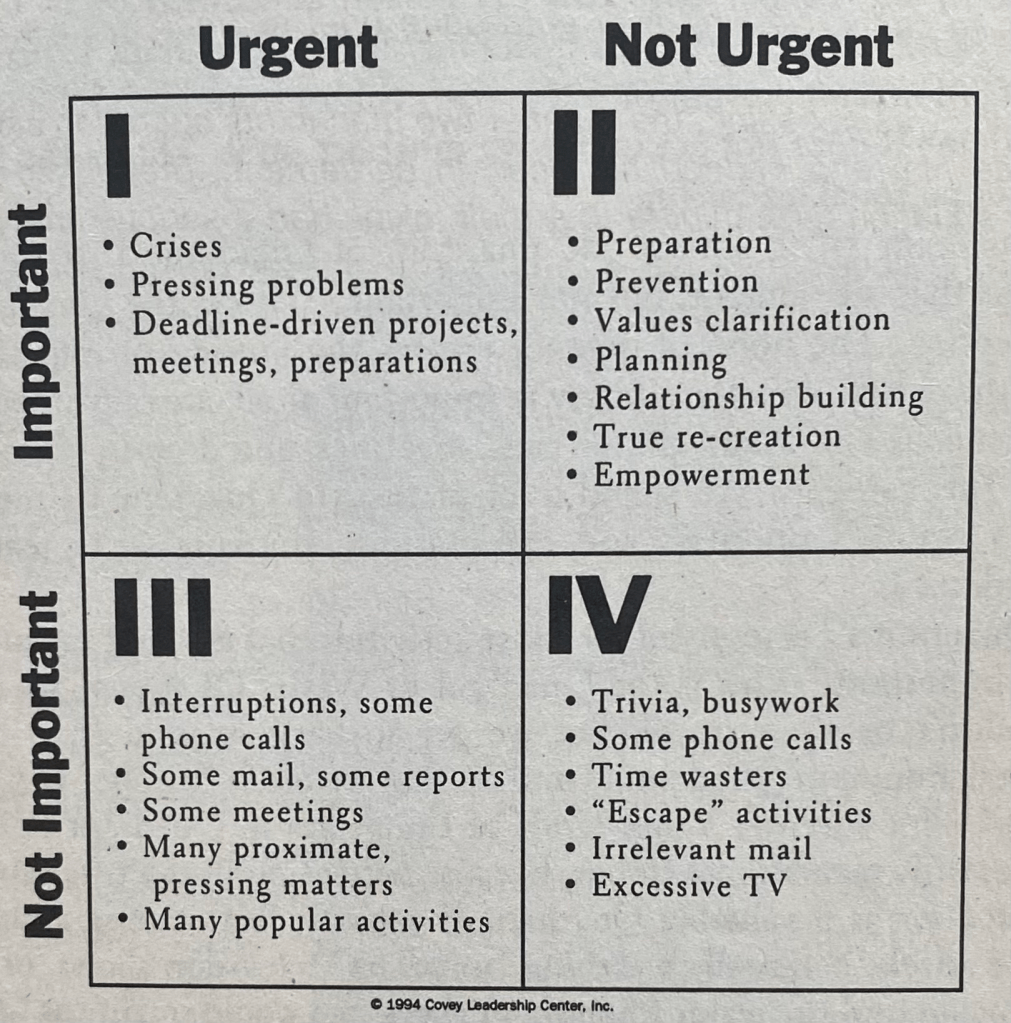
Below is the Time Management Matrix description taken from the book “First Things First,” pages 37-38.
Quadrant I represents things that are both “urgent” and “important.” Here’s where we handle an irate client, meet a deadline, repair a broken-down machine, undergo heart surgery, or help a crying child who has been hurt. We need to spend time in Quadrant I. This is where we manage, where we produce, where we bring our experience and judgement to bear in responding to many needs and challenges. If we ignore it, we become buried alive. But we also need to realize that many important activities become urgent through procrastination, or because we don’t do enough prevention and planning.
Quadrant II includes activities that are “important, but not urgent.” This is the Quadrant of Quality. Here’s where we do our long-range planning, anticipate and prevent problems, empower others, broaden our minds and increase our skills through reading and continuous professional development, envision how we’re going to help a struggling son or daughter, prepare for important meetings and presentations, or invest in relationships through deep, honest listening. Increasing time spent in this quadrant increases our ability to do. Ignoring this quadrant feeds and enlarges Quadrant I, creating stress, burnout, and deeper crises for the person consumed by it. On the other hand, investing in this quadrant shrinks Quadrant I. Planning, preparation, and prevention keep many things from becoming urgent. Quadrant II does not act on us; we must act on it. This is the Quadrant of personal leadership.
Quadrant III is almost the phantom of Quadrant I. It includes things that are “urgent, but not important.” This is the Quadrant of Deception. The noise of urgency creates the illusion of importance. But the actual activities, if they’re important at all, are only important to someone else. Many phone calls, meetings, and drop-in visitors fall into this category. We spend a lot of time in Quadrant III meeting other people’s priorities and expectations, thinking we’re really in Quadrant I.
Quadrant IV is reserved for those activities that are “not urgent and not important.” This is the Quadrant of Waste. Of course, we really shouldn’t be there at all. But we get so battle-scarred from being tossed around in Quadrants I and III that we often “escape” to Quadrant IV for survival. What kinds of things are in Quadrant IV? Not necessarily recreational things, because recreation in the true sense of re-creation is a valuable Quadrant II activity. But reading addictive light novels, habitually watching “mindless” television shows, or gossiping around the water fountain at the office would qualify as Quadrant IV time wasters. Quadrant IV is not survival; it’s deterioration.
Where do I get the time to spend in Quadrant II? If you’re looking for time to spend in Quadrant II, Quadrant III is the primary place to get it. Time spent in Quadrant I is both urgent and important – we already know we need to be there. And we know we shouldn’t be in Quadrant IV. But Quadrant III can fool us. The key is learning to see all of our activities in terms of their importance. Then we’re able to reclaim time lost to the deception of urgency, and spend it in Quadrant II.1
The value of the matrix is that it helps us to see how importance and urgency affect the choices we make about how to spend our time.2
Staying in Quadrant II as much as possible will increase your chances of meeting your goals and certainly improve your life.
 Thoughts about leadership, history, and more
This is a very timely post! It is a critical key for personal development.
LikeLiked by 2 people
Absolutely! Thank you for your comment.
LikeLike
The time management matrix – such a good reminder. Really great post about how to plan! Thank you, Edward
LikeLiked by 3 people
Glad that you found it helpful.
LikeLiked by 1 person
Thank you for the timely information, Edward. Made me think of S.M.A.R.T. goal setting.
LikeLiked by 2 people
SMART is a pretty powerful goal setting and coaching tool. I used it extensively with my team to set their job performance goals and provide feedback during counseling and annual appraisal reports. Thank you for the feedback.
LikeLiked by 2 people
That is fantastic! I am sure they appreciated your leadership. You are welcome.
LikeLiked by 1 person
The majority appreciated the system and the feedback they received as it helped with their career development. However, some individuals merely aimed to fulfill the minimum requirements for a salary and showed no interest in any form of feedback, which was sad. Some people simply don’t wish to grow.
LikeLiked by 1 person
True, not everyone is interested or up for the challenge.
LikeLiked by 1 person
Important vs not important is the tricky part. What some may think is not important, ends up being important.
I do the same thing on resolutions for the new year.
LikeLiked by 2 people
Absolutely and it is definitely a balancing act.
LikeLiked by 2 people
Oh, yes! I also follow the time management quadrant/matrix. It truly helps me on my priority list. Thanks for sharing, Edward.
LikeLiked by 4 people
Awesome! Thank you for your comments. It’s definitely a great tool.
LikeLiked by 1 person
interesting was to prioritize, Edward.
❣️
LikeLiked by 3 people
It all comes down to prioritization so that we have the time to do the things that are truly important.
LikeLiked by 3 people
good idea always.. I still like to do the things i want first.. 😎😎
LikeLiked by 1 person
Of course, like a good extrovert.
LikeLiked by 1 person
You got it-:)
💕
LikeLiked by 1 person