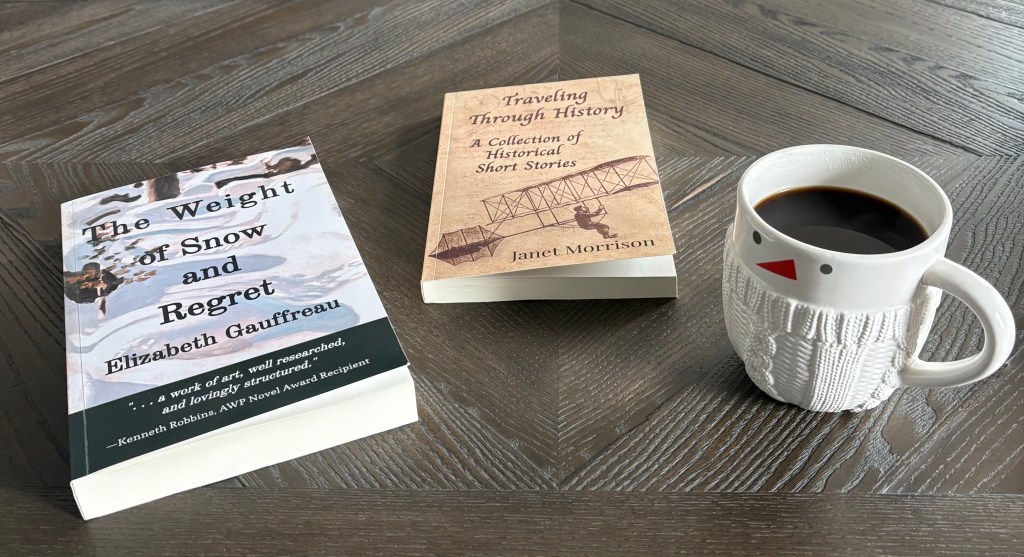
I’ve mentioned in other posts that I don’t usually read much fiction, but I’m gradually adding more to my reading list. I’m discovering that biographical and historical fiction can be especially captivating. Following my instincts, I chose two wonderful works of historical fiction by authors and bloggers in my WordPress community—and I thoroughly enjoyed both.
The first is The Weight of Snow and Regret by Elizabeth (Liz) Gauffreau.
Before reading this novel, I knew nothing about poorhouses1. These institutions provided basic housing, food, and care for people with disabilities, orphans, and the elderly in the United States and Britain. In the U.S., most began to close after the Welfare Act of 1967.
This novel brings one of them to life: the Sheldon Poor Farm in Vermont, which closed its doors on October 1, 1968.
Liz vividly depicts the circumstances that brought people to the Sheldon Poor Farm, making their struggles tangible and compelling.
The story centers on two characters: Claire Lapierre, a fleeting presence, in my view, whose story sets the stage for the main narrative, and Hazel Morgan, whose life is full of twists and turns that will capture your heart. Hazel’s journey takes her from a traumatic childhood experience that lands her in the poorhouse temporarily, through adulthood, and eventually full circle as she returns—this time as a caregiver, dedicating herself to helping those in need.
Liz did an excellent job researching the history of these poorhouses and writing a fictional story that feels remarkably real. Some of the social conditions forming the backdrop of the novel are still relevant today.
The second is Traveling Through History by Janet Morrison.
Traveling Through History is a collection of short stories inspired by various sources, as Janet states in the introduction. The stories inspired by her ancestors, who migrated from Scotland to America, were particularly fascinating.
Traveling Through History includes 13 short stories. My favorites were The Tailor’s Shears, From Scotland to America, and A Letter from Sharpsburg.
The Tailor’s Shears is a moving story about the conflict between the Anglican Church and the Presbyterians in the 17th century. It narrates the stories of the Covenanters2, members of a Scottish religious and political movement who supported the Presbyterian Church of Scotland. The story centers on Alexander Montgomery, a Presbyterian tailor, who gets in trouble with the local government and is sent to Barbados as forced labor in the sugarcane business, and Sir Ian Douglas, Alexander’s client and a well-known man in town who helps Mrs. Montgomery and their children through this difficult time.
From Scotland to America tells the story of five people who migrated in the 1700s: John, his wife Mary; John’s brother James, and his wife Jennet; and John’s youngest brother Robert. They embarked on a journey from Campbeltown, Scotland, to Pennsylvania, then to North Carolina, where they finally bought land and settled.
Finally, A Letter from Sharpsburg tells the story of a Confederate soldier named John, who fought in the Battle of Sharpsburg (or the Battle of Antietam) and wrote a letter to his parents during the American Civil War. As a former soldier, I could relate to the sentiments expressed in the letter and to the ugliness of war.
I had a great time reading both novels and researching the history and facts behind the stories.
I like to read local history and then see the connections to broader history. In Liz’s novel, this meant gaining a close view of social conditions in the United States in the 19th and early 20th centuries, and seeing how locally-run poorhouses filled gaps before the current welfare system. There is a critical article on the History website titled “Poorhouses Were Designed to Punish People for Their Poverty” that discusses the dark side of some of these institutions.
Janet’s stories provide a personal touch about the political and religious conditions in Scotland that motivated migration to America. Her stories place readers in historical settings we usually read about but cannot fully immerse ourselves in, helping us imagine what life was like in those days.
If you enjoy historical fiction based on local history, these two novels will be a great addition to your collection.
About the Authors:
Elizabeth Gauffreau writes fiction and poetry with a strong connection to family and place. Her work has been widely published in literary magazines, as well as several themed anthologies. Her short story “Henrietta’s Saving Grace” was awarded the 2022 Ben Nyberg prize for fiction by Choeofpleirn Press.
Janet Morrison is a North Carolina author. Writing nonfiction and historical fiction let her combine two of her favorite things — writing and doing historical research. Her work has won various awards from the North Carolina Society of Historians. She has a Bachelor of Arts degree in political science with a minor in history and a Master of Public Administration degree.
 Thoughts about leadership, history, and more
Both these books tell stories from history that I don’t know much about (yet). Thanks for your great reviews.
LikeLiked by 1 person
You’re welcome. I definitely learned a lot from reading both books.
LikeLiked by 1 person
Hi Edward, I have also read and enjoyed Liz’s book. A fascinating, albeit tragic, insight into life in a poor house at that point in history. The elderly lady who lost her home due to flooding was especially tragic for me. The other book, Traveling Through History, sounds right up my street. Thanks for the recommendation.
LikeLiked by 2 people
You’re welcome, Robbie. When the baby died in the car accident, that hit me the most.
LikeLike
Yes, that was incredibly sad 😢
LikeLiked by 1 person
I know, and I even told my wife about it.
LikeLike
💜
LikeLiked by 1 person
Tus propuestas siempre interesantes y el humor genial con esa taza que intenta mantenerse
con una cálida temperatura. Gracias por compartir Edward.
Lindo día.
LikeLiked by 1 person
Gracias por leerlas y por tu comentario. Sí, la taza es genial y perfecta para esta temporada tan fría. El café la mantiene caliente y a mí también.
LikeLike
Ive been enjoying Liz’s book. And she abnounce recently that the audio version is now available..so imma get that. I love having good fiction to listen to on my morning walks sometimes.
LikeLiked by 1 person
The story is very neat because it presents life in those poorhouses in a lively way, for lack of a better word, instead of just reading a dry version in history books or on the internet. The pace gets very interesting and fast toward the end. Yeah, I read her post about the audio version, pretty cool.
LikeLiked by 1 person
You do quite a job of keeping us informed about what is worth reading, Edward. There is a German word that captures your help. It is “dienen.” It means, “to serve.” Thank you.
LikeLiked by 1 person
You’re welcome, and I truly appreciate your kind words. They mean a lot to me.
LikeLiked by 1 person
Liz’s book is very good. I loved it.
LikeLiked by 1 person
It really was. The story, especially toward the end, got me hooked.
LikeLiked by 1 person
I’m so glad you enjoyed Liz’s book! Great reviews, Edward.
LikeLiked by 1 person
Thank you so much, Dawn. I really enjoyed the story, and Hazel touched my heart.
LikeLike
What a wonderful post! 📚 I loved learning about these stories that transform history into fiction and make us feel like we were in the past. 🙂🙏🏻✨
LikeLiked by 1 person
Thank you very much.
LikeLiked by 1 person
Hi, Edward. It’s exciting to see these reviews for our little community. Yes, indeed, Liz is a marvelous researcher, which to me is a fundamental part of fiction. I’m not familiar with Janet’s work, but it’s getting good press. Thanks for posting your reviews and supporting indie authors. Hugs all around.
LikeLiked by 1 person
You’re very welcome, Teagan, and thank you for your comment. Both were great reads.
LikeLiked by 1 person
Such a great review of Liz’s book Edward which you covered so well. I’m sure she was over the moon. The history and labor of love is truly magnificent. Also, Janet’s stories look really fascinating as well! Thanks for sharing both of these wonderful books and authors. xx
LikeLiked by 1 person
Thank you so much, my friend. I really enjoyed both books.
LikeLike
Edward, thanks for the reviews and bringing these novels to our attention.
LikeLiked by 1 person
You’re very welcome, Rosaliene.
LikeLiked by 1 person
Love your reviews, Edward…thank you for these! And cheers to your adorable mug/companion. I meant to comment about “him” the other day and forgot. Dressed for the weather, yes indeed! 💝😊💝
LikeLiked by 1 person
Thank you so much, Vicki. I just finished my afternoon cup of joe, and the mug says hi! 🥶➕☕️🟰😊
LikeLiked by 1 person
Hi back! My very non-descipt clear glass mug of green tea…is green…with envy. Wishing “she” had a warm sweater. Haha! 😜💝😜
LikeLiked by 1 person
Well, my friend, it’s time for a makeover and to jazz up your lady mug. Take advantage of the winter discounts. 😀🫶🏼
LikeLike
Too funny! Yes…I can do better. My trusty mug serves me well and she’s been entirely neglected! Thanks for the giggles, Edward! 😜💝😜
LikeLiked by 1 person
You’re so welcome, my friend. Happy Friday, and have a wonderful weekend!
LikeLike
Best string of emojis EVER! 😜❤️😜
LikeLiked by 1 person
Yes! 🙌🏼 Thank you. 🙏🏼
LikeLiked by 1 person
Thanks for sharing these reviews, Edward. I do enjoy historical fiction.
I’d never heard of poorhouses, even though I recall my parents saying, “At this rate, we’ll end up in the poorhouse before long.” when I was growing up.
LikeLiked by 1 person
You’re very welcome, Michelle. It was interesting to read more about the poorhouses. I was thinking yesterday about some of the movies I watched in the past that portrayed “poorhouses,” and I didn’t make any connections until now.
LikeLiked by 1 person
These stories sound excellent, Edward. Thank you for the detailed summaries and the author bios. I enjoy well-researched historical fiction. More interesting to learn about history that way. 👍🏻I’ve been moving through my reading stack, some digital, since the holidays. 📚 🤓
LikeLiked by 1 person
Thank you so much, Michele. You’re so right about making learning more interesting. I was just commenting with Violet about the value of historical fiction. I need to add more to my list.
Awesome progress on your end. I’m surprised that I’ve already finished four books. I usually read one book a month, but I guess practice makes perfect, and I’m getting better at reading, which is good because I want to read more every year. 🤓
LikeLiked by 1 person
You’re very welcome. Finding the balance between writing and reading takes intentional effort, on my part. Though not categorized as historical fiction, Michael Moorcock’s book, Gloriana comes to mind. I enjoyed learning about Elizabethan England in that book. I love his work! Just one of many authors…
LikeLiked by 1 person
Intentionality—yes. That’s the only way to work through all the projects and everything we have going on. I was trying to follow a list of the 100 books to read before we die, but I almost died last year reading Pride and Prejudice. 😂 OMG, it was boring.
LikeLiked by 1 person
haha Well, at least you gave it a go!
LikeLiked by 1 person
Yes, I did. 😔 Thank you, my friend.
LikeLiked by 1 person
Historical fiction can open your eyes to the lived realities of history like no other genre. It is my favorite- and I am so glad you are enjoying it! It can really open the door to so much research- I just cannot give it enough praise.
LikeLiked by 1 person
Thank you, Violet. You are spot on, and I’m starting to see that now. My interest, I think, started when I read the Army of the Potomac trilogy by Bruce Catton. The way he wrote about the history of the Civil War was fantastic, it felt like a novel. So I’m definitely going to read more of them. I think it’s easier to picture how people experienced events in the past.
LikeLiked by 1 person
The two books you review sound very interesting. Thanks for sharing the links so we can get more information.
I’ve heard of the Poor Houses but didn’t really know anything about them.
I also had ancestors that sailed to Canada and America from the Isle of Arran Scotland, so I’d be interested in reading Janet’s book.
I’m not much of a fiction reader, but historical fiction certainly adds depth to the stories that have shaped our world. One book that had me more interested in reading historical fiction is ‘The Paris Library’. This story is based on the true World War II story of the heroic librarians at the American Library in Paris, and tells of when the Nazis arrive in Paris and how Jewish people were taken. Library workers risked their lives to save people and books. That story has stuck with me.
LikeLiked by 1 person
Thank you for the recommendation, Rose. I might check that book out. I wasn’t much of a fan of fiction, and the only author I really follow is Isabel Allende. Her books are all based on real experiences surrounding family, social issues, and politics. That has always attracted me. So historical fiction is a good addition, and I’m looking forward to reading more of it.
LikeLiked by 1 person
Wonderful reviews of two interesting and remarkable books. Reading about historical aspects certainly enriches our perspective and also helps us value what we are living now, which is an extension of all those events. Sharing life with a historian always helps me better situate current times. Thank you, Edward, for sharing about these two gems. Sending you light and blessings and wishing you a peaceful and warm day 🙏✨
LikeLiked by 1 person
You’re very welcome, my friend. Reading about historical events is fascinating, and like you said, it enriches our perspectives. Thank you, and I hope you have a wonderful weekend. 🙏🏼
LikeLiked by 1 person
Thanks for sharing your book review — such an interesting read. Who knows, I might pick up one of your recommendations. I love historical fiction, especially stories like this.
LikeLiked by 1 person
You’re very welcome, and thank you for reading.
LikeLiked by 1 person
They sound interesting!
LikeLiked by 1 person
Thank you, Kimberly. I really enjoyed reading them.
LikeLiked by 1 person
🙂
LikeLiked by 1 person
Thought provoking as always – thank you! (love the photo! teacups and mugs are becoming your thing!) Linda xx
LikeLiked by 1 person
You’re welcome. Yes, I have so many that I need an excuse to use all of them. Thank you, my friend. ☕️☕️
LikeLiked by 1 person
🙂 🌟
LikeLiked by 1 person
What a delightful review of two interesting books. Thanks, Edward!
LikeLiked by 1 person
You’re very welcome, my friend.
LikeLike
I’ve come across these books but I have not read them. They sound like great books and you wrote very helpful reviews.
LikeLiked by 1 person
Thank you very much. Yes, the stories in both novels were really good. I enjoyed them and learned a lot from both.
LikeLiked by 1 person
Thank you so much for the wonderful review, Edward! I’m so glad you enjoyed the book. Congratulations to Janet! I enjoyed Traveling Through History as well.
LikeLiked by 2 people
You’re very welcome, Liz. It was a great, emotional story, and I learned a lot from it.
LikeLiked by 1 person
i hope poorhouses don’t make a come back :T
LikeLiked by 1 person
I’m with you. Definitely not the best place to be.
LikeLiked by 1 person
Those sound like great books, Edward. I’ve learned about so many interesting things by reading fiction. And how wonderful you are supporting your WordPress Community! You don’t strike me as the kind of person who enjoys romance novels, but if you ever get a hankering to try one, I’d be happy to set you up (LOL)
LikeLiked by 2 people
Thank you, and that’s true about reading fiction, especially historical fiction. We learn a lot from the stories. I’m not into romantic novels yet, but we’ll see what the future holds. 😂
LikeLiked by 2 people
I very much enjoy historical novels and will search these out, so thanks for your reviews, Edward. One of my faves in this genre was “The Tide Between Us” by Olive Collins.
LikeLiked by 2 people
Thank you for the recommendation, Terry. I did a quick read on Amazon, and it looks interesting. I’m adding it to my reading list. Reading that it’s based on 2,000 Irish children deported to Jamaica piqued my interest.
LikeLiked by 2 people
I’ve found well researched historical fiction the very best source for poetic inspiration.
LikeLiked by 2 people
I can definitely see that. Thank you, Ana.
LikeLiked by 2 people
These books sound like ones I’d enjoy. Thank you for the recommendations, Edward. I just started watching Death by Lightning on Netflix. It’s about President Garfield, and so far, it’s interesting.
LikeLiked by 4 people
You’re very welcome, Mary. I watched it, and it was good.
LikeLiked by 1 person
great reviews Edward and nice photo! hopefully, there’s no power issues for the week coming up so we can all focus on the temps being above freezing Mike
LikeLiked by 2 people
Thank you, Mike. Yeah, it looks like we’re going to be in the low to mid-30s next week. It’s been rough for the past two weeks or so.
LikeLiked by 1 person