Last week, I shared my thoughts on The Anxious Generation by Jonathan Haidt, which examines the impact of social media and smartphones on children and teens.
Building on that, today I want to explore two troubling trends tied to the uncontrolled use of social media: the way low-quality content quietly consumes vast amounts of our time, and how these platforms are used to exploit and manipulate others.
Low-quality content on social media seems endless. You can go to any platform and see short videos of people getting dressed for work, morning routines, people jumping off cliffs, twenty-year-olds explaining how they’re making millions from home—and I even saw a video on LinkedIn of a product, some kind of foot scrubber that makes your feet nice and soft, posted by the Leadership Think Tank. I’m not sure what a foot scrubber has to do with leadership—maybe nice, soft feet will help you in your next company meeting or something.
While doing some research, I found that SixDegrees1 was one of the first social media platforms. Then came Friendster, which focused on real-life social connections, followed by MySpace and many others. All were created to build social networks and improve human connections.
Today, social media has become a vast universe where people share all kinds of content—good and bad—and it’s no longer just about creating meaningful social connections.
For anyone with a social media account, how can you separate the good from the bad and focus on what really matters?
One way to manage social media effectively is through critical ignoring—the ability to decide what to ignore and where to focus our limited attention.2 Developed by Dr. Sam Wineburg and a team at the Stanford History Education Group3, the concept helps us take control of our digital lives instead of letting endless content dictate our focus.
By practicing critical ignoring, we can reduce time wasted on distractions and engage only with what truly matters. This means resisting the urge to click on rage-bait headlines, scrolling past trolls instead of arguing, muting or unfollowing accounts that thrive on outrage, verifying content before sharing it, and letting some “debates” go because they are designed to provoke, not inform.
This diagram, part of the article Critical Ignoring as a Core Competence for Digital Citizens4, includes practical and very useful recommendations.
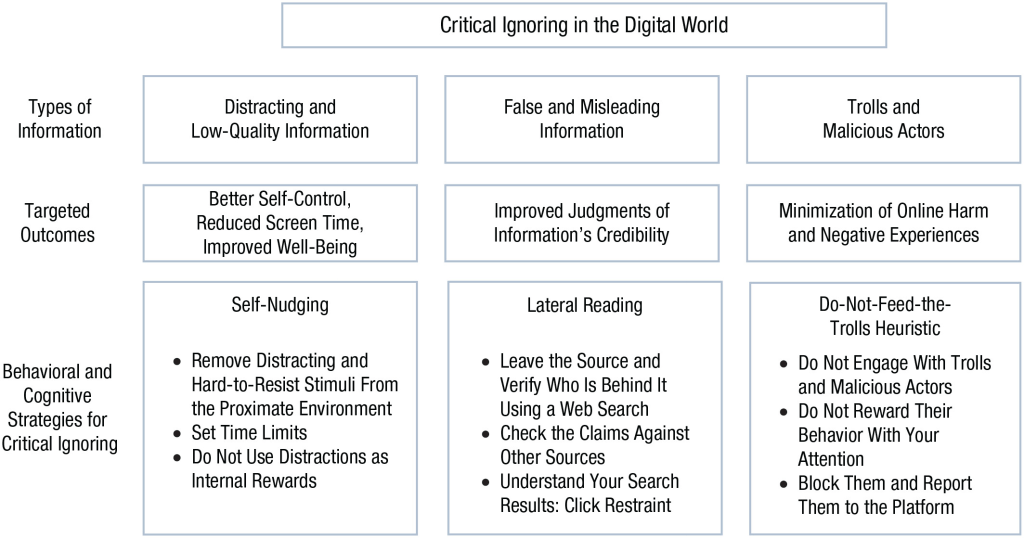
The diagram identifies the types of distracting information that trigger curiosity, outrage, or anger, and suggests actions we can take to avoid them and improve our experience. I particularly like the recommendation on how to deal with trolls and malicious actors.
The second, and more problematic, issue with social media is its ability to attract people into certain crowds or groups. We see this every day in politics, with hundreds of groups catering to conservatives and liberals. But there are also people using these platforms to target the vulnerable, including children, and to recruit members into cults.
One such platform is Roblox, an online gaming platform. Roblox offers users more than just a gaming experience; it also serves as a medium for communication and connection6. There have been multiple reports of predators using it to lure children.789 I included a number of links in the sources section for those who want to read these reports. It is also interesting to note how some of these predators use Roblox in conjunction with Discord, an instant messaging and VoIP platform that allows communication through voice calls, video calls, text messaging, and media sharing10, to pursue their purposes.
Then there is the case of a “pastor” who created a TikTok presence to help social media stars and dancers in Los Angeles. Robert Shinn, pastor of the Shekinah Church, was accused of sex trafficking and money laundering.11 He is reportedly a cult leader who used TikTok to target his victims. There is even a Netflix documentary, Dancing for the Devil: The 7M TikTok Cult12.
Social media has many benefits when used with purpose and moderation, but it also comes with serious risks. As The Anxious Generation by Jonathan Haidt shows, children and teens are especially vulnerable to its effects. Practicing critical ignoring, deciding what to focus on and what to ignore, can help all of us reclaim our attention and protect our time from low-quality content. At the same time, parents can use books like Haidt’s, along with other resources,13 to guide their children in navigating online spaces safely, avoiding pitfalls such as predatory behavior on platforms like Roblox.
What started as a way to strengthen human connections is now a tool that can either enrich our lives or consume them. How we engage with it makes all the difference.
- https://en.wikipedia.org/wiki/SixDegrees.com ↩︎
- https://spsp.org/news/character-and-context-blog/kozyreva-wineburg-lewandowsky-hertwig-critical-ignoring ↩︎
- https://theconversation.com/to-navigate-the-dangers-of-the-web-you-need-critical-thinking-but-also-critical-ignoring-158617 ↩︎
- Kozyreva, A., Wineburg, S., Lewandowsky, S., & Hertwig, R. (2022). Critical Ignoring as a Core Competence for Digital Citizens. Current Directions in Psychological Science, 32(1), 81-88. https://doi.org/10.1177/09637214221121570(Original work published 2023) ↩︎
- https://journals.sagepub.com/cms/10.1177/09637214221121570/asset/fce36b54-e750-4e14-8360-53d8489a23b3/assets/images/large/10.1177_09637214221121570-fig1.jpg ↩︎
- https://about.roblox.com/newsroom/2023/10/reimagining-bringing-people-together-communication-connection-expression#:~:text=Roblox is a platform for communication and connection. ↩︎
- https://www.businessinsider.com/roblox-online-gaming-giant-child-predator-allegations-lawsuits-2025-8 ↩︎
- https://www.montanarightnow.com/great-falls/roblox-safety-concerns-grow-after-disturbing-crimes/article_6db58a56-f489-11ef-9659-77bd5b263695.html ↩︎
- https://www.nbcnews.com/news/us-news/roblox-discord-sued-15-year-old-boy-was-allegedly-groomed-online-died-rcna231049 ↩︎
- https://en.wikipedia.org/wiki/Discord ↩︎
- https://www.latimes.com/california/story/2025-07-25/feds-raid-tujunga-home-of-alleged-tiktok-cult-pastor-in-sex-trafficking-investigation ↩︎
- https://en.wikipedia.org/wiki/Dancing_for_the_Devil ↩︎
- https://www.aap.org/en/patient-care/media-and-children/center-of-excellence-on-social-media-and-youth-mental-health/?srsltid=AfmBOoqqcA0oIEIG8Kk6fg3hFPFztZ1T65W1k_AOrUDEiA9o7IiI1Jrn ↩︎
 Thoughts about leadership, history, and more

Thank you for this important information. I’m going to share it with my son and granddaughter. Sometimes I have to remind myself about clickbait and how precious my time is.
LikeLiked by 1 person
You’re welcome. A trial has just started in California against Instagram and YouTube, where they are accused of causing addiction through the way they use their algorithms to keep children scrolling.
LikeLiked by 1 person
I believe it. I have occasionally found myself caught in the youtube web late at night and need to be careful with that.
LikeLiked by 1 person
Me too. It’s super dangerous once you start scrolling—it’s so easy to get lost there for an hour or two.
LikeLike
Thanks for admitting that, Edward. There’s always something for us humans to work on.
LikeLiked by 1 person
You’re welcome, and absolutely. We are a work in progress.
LikeLiked by 1 person
Thanks for sharing this concept of critical ignoring. I think it names a practice I tend to use with social media. Open eyed use of connection tools is very important. Garbage in garbage out. We must be cautious.
LikeLiked by 1 person
You’re welcome, my friend. Garbage in, garbage out, that’s a good way to put it.
LikeLiked by 1 person
As more and more schools across the globe are helping kids by restricting or banning the use of mobile phones during lessons there is also a current “OFF movement” underway. The OFF movement calls for creatively and collectively reviving the Off button. “It’s not about switching everything off, but about regaining control over technology and ensuring that its development is aligned with human interests.”
Check it out and join us in promoting “OFF February 2026”
LikeLiked by 1 person
Very interesting initiative. We definitely need to reduce the time spent with technology and spend more time making real connections. Thank you for reading and for the information.
LikeLike
Social media is so carefully designed to keep one hooked. And their are gonna be many bad actors there, just as in real life. I applaud the efforts of some governments to ban minors from social media. Parents cannot police such a vast world.
Critical ignoring as adults really means we are aware that the rabbit hole is bottomless. Many of us are hooked before we realise it.
Another, good post, Sir.
LikeLiked by 1 person
Thank you, Nigel. Those algorithms are evil. I just finished the book The Attack from Within, and I agree with the author. The government needs to regulate how companies use them. That’s how they’re getting people addicted to their platforms.
LikeLiked by 1 person
Oh.. that sounds like a great book. Gonna go download it now. Cheers, Edward.
LikeLiked by 1 person
It is. Thank you.
LikeLiked by 1 person
Really interesting I have chat turned off on roblox they only play with each other, as for social media I ignore the mindless rubbish
LikeLiked by 1 person
That’s a good thing, what you are doing with Roblox. I didn’t know about all the dangers until I read the reports. Very scary stuff. Social media, there is some good content, but the majority is rubbish, like you said.
LikeLiked by 1 person
I dropped off FB (unless for work) a very long time ago. Same with the platform formerly known as Twitter and I never even bothered signing up for the rest. Lately my social media weakness is actually Substack. I only follow 3 individuals. But it’s set up to where when you visit the page, it defaults to the home page feed rather than the feed showing the only 3 people I follow. So really, there is two feeds going on and the main feed is anyone and everyone in the free world. Kind of like what I remember of Facebook. There’s much political commentary and videos from common people and I need to limit my exposure to this which I am working on today. I honestly can’t determine if I am starting to become radicalized, or if the rest of my fellow Americans are asleep and I am one of the people who is awake. It does seem like America is under siege and get over here on WordPress I’m the only one I see talking about it amongst all those I follow. So I’m like, “hmm, am I becoming radicalized?” Whether I am or not, it’s definitely a good move for me to back off substack some.
LikeLiked by 1 person
You’re not radicalized, my friend; it’s the algorithms and the freaking news that are pushing us to the limit. I’m cutting a lot of stuff, including newspaper articles that ramble on without really informing. I’m finding more of that in The Economist and The Wall Street Journal, which I’m reading in print. The only good thing is that I can read the papers faster. 😂
I’ve noticed the same thing on Substack when I do my once-a-week check-in, and I’m not liking what I’m seeing there. LinkedIn is about the same now. Companies are making money off current controversies, and they don’t care about the division they’re causing. It’s better to navigate our online interactions very carefully.
LikeLiked by 1 person
Hi Edward, the ability of like minded people to gather on social media and spread false news and extreme views is well known. I never share anything with a political bend. I also don’t engage in discussions about politics ever. My book, Through the Nethergate actually covers this aspect.
LikeLiked by 1 person
I hear you. I was always irritated with Facebook for that reason. I only have LinkedIn, and every time I check the app, there’s something false or an extreme view. I only have it for my professional contacts, but I’m thinking about closing that one too.
LikeLiked by 2 people
I have WP, Facebook for family and friends, instagram and Bluesky. The only one I spend real time on is WP which is different to other social media.
LikeLiked by 1 person
You’re right about WP. There’s a lot of good content here, and the engagement is much better than anything else out there, in my opinion.
LikeLiked by 1 person
I agree. It’s positive engagement, generally
LikeLiked by 1 person
So true, Edward. Social media can either steal our time or serve us, choosing what to focus on makes all the difference.
LikeLiked by 1 person
Yes, and in my case, it was stealing my time, so I had to let it go. Thank you, Willie. 🙏🏼
LikeLiked by 1 person
this is 100. i like to use mine to connect with others, get viral recipes, find new restaurants, and ways to save money hacks lol or better use of my credit cards
LikeLiked by 1 person
Cool! This is my first time hearing about using SM for tips on saving money and credit cards.
LikeLiked by 1 person
You’re right, Edward, it makes all the difference. I love your critical ignoring information. What a great way to create a framework. Here’s to keeping our focus on what matters and our kids safe. Thank you for presenting ways to engage thoughtfully – it really helps, my friend!
LikeLiked by 1 person
Right? That group of researchers did a great job framing it in an easy-to-follow format. Their website has a lot of valuable information as well. This is an important subject, so I’m happy to share what I find to help keep our kids safe. Thank you so much, my friend.
LikeLiked by 1 person
Such an important subject. It makes me even more appreciative that I get to read you resources, thoughts and approaches!
LikeLiked by 1 person
Wow, Edward, thank you for this comprehensive post, and I love the idea of critical ignoring. So many important takeaways. This year, I’m pulling back from sm more than ever. Maybe I’m showing my age, but there’s just so much junk out there. It’s hard to tell what’s real nowadays. I’m glad my kids are adults because I worry about the younger generations scrolling and believing what they read. Anyway, thank you for your wisdom!
LikeLiked by 1 person
Thank you, Lauren. I personally don’t find any use for it, and I found it depressing to see what some of the people I know were doing on Facebook when I had an account. I think that as we grow older and our priorities change, we realize we don’t have much time on earth, so we want to engage in meaningful things, and social media isn’t one of them.
LikeLiked by 1 person
That’s how I’m feeling, Edward, so I deactivated my FB account but my Instagram is still active. I’m just not on it that much. And as much as I love blogging after almost 15 years, I’ve decided to blog less to have more time for other things. It’s hard to find a balance sometimes. 🙂
LikeLiked by 1 person
I hear you. I’ve been blogging for a little over two years now, but I can see myself in the future posting once a week, or every other week, once my wife retires and we travel more and do other things.
LikeLiked by 1 person
Your conclusion, “What started as a way to strengthen human connections is now a tool that can either enrich our lives or consume them. How we engage with it makes all the difference”, is about a perfect a sum up as can be. Kudos on your characterization of it being a tool, and neither inherently good nor bad in itself. I think that gets missed nowadays, when everything has to be “good” or “bad”!
LikeLiked by 1 person
Thank you, Scott. Even though I don’t use it, there is definitely value in it, as I know many people use it to promote their work and stay connected with family. I think the danger comes when low-quality content is pushed out just to keep people glued to their phones, scrolling endlessly, especially teens, who are more vulnerable.
LikeLiked by 1 person
Exactly, Edward. You are a critical thinker, so you look at everything more carefully and sort out the trash. When we look at the source, we typically know what to expect and whether or not it is trustworthy.
LikeLiked by 2 people
Thank you, Mary. One thing I appreciate about AI (ChatGPT and the one that comes with Google Search) is that when I have doubts about something I’ve read, I can ask AI to check the information and provide sources, and it does so very quickly. It’s a great tool for research.
LikeLiked by 2 people
Edward – In Google, type in how accurate is Google ai assist
LikeLiked by 1 person
I just did, and it’s awesome: “69% to 80% accuracy. However, these tools are not fully reliable and may provide incorrect information.” 😂 I probably forgot to mention that I ask AI to provide the source and then go check it myself, but this is hilarious. Thank you, Terry.
LikeLiked by 1 person
And it gave both of us a different answer.
This is the one I get every time I pose that question:
Use as a starting point: Treat AI overviews as a summary or a guide, not the final word, especially for important topics.
Verify important information: Always cross-reference critical information (especially for medical, legal, or financial advice) by clicking through to the source links provided and consulting authoritative, trustworthy websites.
Exercise skepticism: Be aware that the AI can and will make mistakes and “hallucinate” (fabricate details or sources).
LikeLiked by 1 person
🤣 It’s hallucinating for sure.
LikeLiked by 2 people
It’s crazy, I know. I’ve done lots of research and recently read that when I enter my search topic, if I put a space at the end and then type in -ai, then the first few answers are usually from reliable sources. As soon as you go further down in the answers and select a different version of your question, ai takes over again.
LikeLiked by 1 person
Interesting. I use the “Deep Research” option in ChatGPT, and in Google AI Mode, I use the “Thinking 3Pro” option. So far, they have been providing pretty accurate sources.
LikeLiked by 2 people
Thanks for those tips, Edward!
LikeLiked by 1 person
You’re welcome.
LikeLiked by 2 people
Thank you for this well researched and well written post, Edward. I don’t much care for trolls either, but I find it easy to ignore them and avoid interactions with them. The one I dislike the most is the misleading and false information, and the fact that people read it, believe it, and share it, and then their friends do the same, and so on until our feeds are flooded with this garbage. I can’t begin to imagine how damaging this is to people of all ages, and especially to young, developing minds. These days, almost every reel and every outrageous photo on Facebook is ai created, and the sad part is the number of people who buy into this stuff, propagate it, and spread it as if it’s the gospel truth. I don’t know if other social media platforms are the same. I would imagine they are.
LikeLiked by 2 people
You’re welcome, Terry. I don’t have a Facebook account, but my wife does, and you’re right—the amount of AI content with misinformation is incredible. I know LinkedIn is full of AI images and fake videos. Very damaging for those who don’t check sources.
LikeLiked by 2 people
I love this new (to me) concept: “critical ignoring.” I guess I’ve been doing some of it intuitively (such as not interacting with trolls/bots), but I certainly have surrendered once or twice to a stream of seemingly endless videos (of horses, for example) on YouTube. I appreciate this blog post very much, Edward, and I also enjoyed reading everyone’s comments. WordPress does seem to have remained a relatively respectful and sane space for communication with other human beings — for which I am very grateful. I used to camp for two weeks every summer on Cape Cod and write songs. It always gave me a nice “re-set” to be away from the internet for 14 days. And I even wrote a song that touches directly upon this topic called “Can We Slow It Down?” You can click here for a link to it on various streaming platforms if you are curious…
LikeLiked by 1 person
I agree with you, this space is pretty safe, and in the few interactions I’ve had where opinions differed, the discussions were respectful. I tried Reddit about three years ago, and it was really bad. People are quick to insult without remorse. Thank you, Will, for adding the link to the song; it was a nice one and definitely related to the subject.
LikeLiked by 1 person
Foot scrubbers and leadership. Gah! And yep! Where’s the connection…when we only see disconnection??? Oh my goodness, Edward. This post was the perfect afternoon pick-me-up. So much better than media scrolling, LOL. Your thoughts here — about low quality content…”quietly consumes vast amounts of our time” feels so spot-on. I’m lifting my teacup to you, friend. A trip into WP to read compelling blog posts like yours? So much better! 💝😊💝
LikeLiked by 2 people
I know. I’m thinking about sending a note to the person hosting that group to see if they can block that content. If not, then I guess I’ll say adios to that group. I don’t spend much time there, but I don’t need to see a foot scrubber video as soon as I open the app.
I love our WP community and the great content we share. It definitely beats any social media out there. Thank you, my friend. 🫶🏼
LikeLiked by 2 people
Thank you…I mean it. Good to be connected with you and thoughtful, like-minded souls here. A bright spot, indeed. 💝😊💝
LikeLiked by 1 person
Thank you, my friend. I truly appreciate that, and I feel the same way. Grateful for the connection and this community.
LikeLiked by 1 person
Sending Tuesday hugs to you! 💝😊💝
LikeLiked by 1 person
Here’s my dilemma, I need to cut down on my time. I need to raise my critical ignorance bar so-to-speak. But right when I’m ready to turn my phone back into … well just a phone — I come across a great article or tool or post like yours that reminds that there is good in the world. Ha, ha, the challenges of modern life. I guess in the end it all comes back to an old idea: “everything in moderation.” Thanks Edward!
LikeLiked by 2 people
Hey, at least I don’t have videos showing my morning beauty routine. 😂 I hear you. Blogging is my only online presence, and I have a plan to keep it under control. The Reader, the part that shows the latest posts from everybody, is kind of dangerous, so I don’t use it. Otherwise, I’d just be scrolling like people do on X, Facebook, etc. I visit individual pages instead, and that helps.
LikeLiked by 2 people
Thank you for the helpful information and for including the diagram, which effectively organizes the concept of Critical Ignoring. 👍🏻
LikeLiked by 3 people
You’re welcome, my friend. They did an excellent job on that diagram.
LikeLiked by 1 person
Great reminder that our attention is valuable. “Critical ignoring” is such a useful concept for staying safe and intentional online.
LikeLiked by 3 people
Absolutely! Thank you, John.
LikeLiked by 2 people
🙌🎉🎉
LikeLiked by 1 person
You resume it all well in this sentence: “Social media has many benefits when used with purpose and moderation, but it also comes with serious risks.” I would say that the risks are greater than the benefits, especially if there’s no clear intention, sharp awareness, and good calibration of the social platform used. If it’s just scrolling and blindly consuming all that is presented, then self-poisoning is assured. I use it with moderation and discernment, in awareness, but now and then I realize I am already off the track… dormant in a way! I use it mostly to share my posts, and only on Instagram did I find a cohesive and supportive spiritual community, though the engagement is still far from the WP experience (my fav!!). This is truly an important and timely post, Edward! Loved the “critical ignoring” strategy you shared, which can help us navigate the muddy waters of social media. How it is changing the world and people’s realities is what amazes me the most! Thank you for this invaluable share! Light and blessings your way, always, my friend! ✨🙏
LikeLiked by 3 people
Thank you so much, Susana. Blogging in WordPress has been by far the best experience I’ve had in a virtual environment. There is a lot of good engagement and content in our community. The critical ignoring chart created by those researchers is pretty awesome.
LikeLiked by 3 people
Appreciated
LikeLiked by 1 person
Thank you for reading.
LikeLiked by 1 person
I love this critical ignoring Edward! Please add that to my settings!!!
oh, this is too funny…..
“some kind of foot scrubber that makes your feet nice and soft, posted by the Leadership Think Tank. I’m not sure what a foot scrubber has to do with leadership—maybe nice, soft feet will help you in your next company meeting or something.”
While my feet aren’t fine but are good enough for leadership, I have fallen prey to the click bite skin products that guarantee wrinkles be gone and I even know better. It’s almost comical. Duhhhhh ..
What really concerns me is the kids and predators luring the children. Thanks for the great information, my friend! xx
LikeLiked by 3 people
Yes, I saw the ad and wanted to click on it and buy it, but I resisted the temptation. 😂
Yes, the reporting about kids and teens is alarming. We need to keep an eye on our little ones.
LikeLike
Great info here Edward! Luckily i’m great at ignoring lol and otherwise i use time limits! Works like a charm 🍀
LikeLiked by 2 people
Thank you. Time limits/screen time on the phone?
LikeLiked by 1 person
On my phone yep, it times me out and shuts down the app. I’ve also just timed myself too like said okay you have one minute on FB! That works great!
LikeLiked by 2 people
I use the “focus” option a lot, but I might need to check on the time limits. Thank you.
LikeLiked by 1 person
Gee… I do critical ignoring and didn’t even know I did it! LOL. Ok, so my first computer was a Trash 80 and not long after that I was in Chat Rooms. This was before “Social Media” or any of the concepts of online communication. I loved being able to converse with people anywhere, anytime and be able to simply walk away from someone who was rude.
Little did we know in the early 80s what this connection would turn into. Yes, it’s a monster of information — most of the data out there is trash. Even “trusted” celebrities can pander false, misleading information. Now more than ever, we need to educate not only our kids, but also the adults who missed “critical thinking” in school.
Good analysis of the information. Keep up the research!
LikeLiked by 3 people
I know, me too, but it’s good that there is a name for that, thanks to the Stanford team. Those chat rooms and bulletin boards back then were great, excellent collaboration with minimal distractions. One thing I hated in the Department of Defense was when they transitioned to Microsoft Teams. That green dot next to your name was deadly. I used to block my calendar to avoid people chatting and calling me all the time, even at home, because it was installed on the government-issued smartphones. Luckily, it was toward the end of my career, so I didn’t have to deal with that for too long.
LikeLike
I’m making social media less and less of a priority. I was without a computer for two weeks a little while back and it really opened my eyes to how much time I had been wasting on some of the sites. It can be a lovely way to interact with friends who are far away, but so much of it seems to be ads for things that don’t interest me and people bickering over politics. Who has time for that?
LikeLiked by 3 people
I agree. You can easily waste an entire weekend scrolling through videos and checking out friends’ photos if you’re not careful. I’d rather read a book or watch a movie with the family.
LikeLiked by 2 people
I love that concept of critical ignoring. I’m particular about who I follow but these platforms are really good at serving up content whether you follow someone or not I have learned to be very disciplined about who and what I engage with. Just ignore the clickbait and keep on scrolling is my motto!
LikeLiked by 2 people
I agree. LinkedIn is getting really bad, there’s a lot of garbage being circulated, including misinformation. Not even professional networks are safe anymore.
LikeLiked by 1 person
Good advice. Thanks Edward.
LikeLiked by 2 people
You’re very welcome, Brad.
LikeLiked by 1 person
This is a strong reminder that attention is a resource that needs governance, not just willpower. The idea of critical ignoring connects closely to systems thinking because it shifts the focus from reacting to every input to designing an environment where only what truly matters gets through. That kind of intentional filtering is what allows digital habits to support real priorities instead of constantly competing with them.
LikeLiked by 3 people
Indeed. I like what you said about intentionality, that’s key when engaging with social media and other online resources. Our engagements need to have a purpose, not just be mind-numbing when we are tired. Thank you for reading and commenting.
LikeLiked by 1 person
You have done a fine job of dealing with Haidt’s work and beginning to deal with the adverse impact of social media.
I don’t think it will be simple for some adults to extricate themselves, however. The “draw” of human contact, keeping up with the Joneses, and wanting to be in the know about life, will not be easily defeated.
I would add the kind of critical intelligence and judgement needed to pull away is not easily achieved. Alone or with few friends, life “lives” in the internet and not outside, except perhaps in one’s job, if one has friends there.
The lure of social media has had time to develop. The victims are behind the curve. Does the Stanford team have a plan to reach and train the folks who would benefit from their recommendations? I hope so.
LikeLiked by 2 people
Thank you, Dr. Stein. While reading about the Stanford group, I found that they are a robust initiative and have a Digital Inquiry Group that is developing solutions and collaborating with schools, offering training among other things. Even their research has been incorporated into a California law. So there is a lot happening behind the scenes. I wish more of that were brought to our attention.
I agree with you that disengaging from the pull of social media is a difficult task for most people. The attraction is too strong, and the companies, with their algorithms, are doing an excellent job of making the need for social media seem indispensable (I would call it an addiction, but I’m not an expert in that area).
LikeLiked by 2 people
I never engage with trolls or malicious actors, so I’m okay there. (I witnessed so many emails feuds/wars in my professional career that the “Don’t engage” mantra is automatic.) I’m working on controlling my intake of political content. I’m doing better than I was, but I’m not there yet.
LikeLiked by 4 people
I’m with you on the political content. I was really bad back when I was watching cable news. My goodness, I spent way too many hours watching news and political commentary. I’m glad I cut that out of my life—I feel much better now.
As for emails at work, I agree, I avoided them when I was angry. I did face-to-face if the person was in the building; if not, I would call them. It’s dangerous to get into that back-and-forth via email.
LikeLiked by 3 people